
My daughter married a Korean man when she was twenty-one.She has not come home in twelve years.But every year, without fail, she sends me $80,000.This Christmas, I decided to go to her without telling anyone.And when I opened the door to her house…I froze.My name is Theresa Whitmore, and I am sixty-three years old. I live in a small town in Ohio, in the same house where I raised my only daughter, Mary Lou.…More article below 👇
I became a widow when Mary Lou was only eight. Her father died suddenly from a heart attack, leaving behind hospital bills, a half-paid mortgage, and a little girl who still asked every night when Daddy was coming home.So I became mother and father both.
I worked two jobs. I cleaned offices at dawn and waited tables at a diner until my feet burned. Every dollar I earned went to Mary Lou’s school supplies, her winter coats, her piano lessons, and later, her college applications.She was my whole world.
Mary Lou was the kind of daughter people noticed. She was beautiful, yes, but more than that, she was gentle. She helped old neighbors carry groceries. She remembered birthdays. She never went to bed without kissing my cheek.
Then, when she was twenty-one, she met Kang Jun.
He was Korean, almost twenty years older than her, polished, quiet, and rich in a way I had only seen in magazines. He owned businesses, wore expensive suits, and spoke softly, like a man who never needed to raise his voice to get what he wanted.
I did not dislike him because he was Korean. I disliked the distance in his eyes.
I disliked the way he looked at my daughter like she was something he had already decided to own.
“Mary Lou,” I told her one night, “you are too young. You barely know this man.”
She looked at me with tears in her eyes and said, “Mom, I know what I’m doing.”
Those were the words young people say when they are already too far gone to hear warning.
They married quickly.
The wedding was small, almost rushed. I remember standing beside her in the airport a month later as she prepared to leave for South Korea. She hugged me so tightly I could hardly breathe.
“I’ll come back soon,” she whispered.
But she cried like she already knew she was lying.
One year passed.
Then two.
Then five.
At first, she called often. Then the calls became shorter. Then rare. After a while, there were only messages.
Every year, exactly $80,000 arrived in my account.
With it came the same short line.
“Mom, always take care of yourself. I’m doing well.”
Everyone in town thought I was blessed.
“Your daughter married well,” they said.
“You are lucky.”
“She must love you very much.”
I smiled and nodded because it was easier than explaining that money can fill a bank account, but it cannot sit across from you at Christmas dinner.
It cannot laugh in the kitchen.
It cannot call you Mom in the doorway.
Every Christmas, I still cooked Mary Lou’s favorite beef stew. I placed a bowl for her at the table. I laid out a spoon, a napkin, even a glass of water.
Then I ate alone.
Twelve Christmases came and went.
By the twelfth, my hands had more wrinkles, my knees hurt in the cold, and my hair had gone almost completely gray.
That year, after another $80,000 arrived and another message said she was “doing well,” something inside me finally broke.
I bought a plane ticket to Seoul.
I did not tell Mary Lou.
I did not tell the neighbors.
I packed one suitcase, my passport, her old address written on paper, and a small framed photo of us from before everything changed.
It was my first time leaving the country.
The flight was long and terrifying. I gripped the armrests every time the plane shook. I prayed silently, not for safety, but for courage.
When I landed, the airport swallowed me in noise, lights, and a language I could not understand.
Somehow, I found a taxi.
I showed the driver the address.
The house was in a quiet neighborhood, two stories tall, clean, and elegant. The garden was trimmed perfectly, but there were no Christmas decorations, no wreath, no lights, no sign of warmth.
I rang the bell.
No one answered.
The gate was unlocked.
My heart pounded as I walked inside the yard and reached the front door. My hand trembled as I touched the handle.
It opened.
“Mary?” I called softly.
No answer.
The living room was beautiful, but lifeless. Everything was too clean. No shoes by the door. No coat on a chair. No coffee cup on the table.
The flowers in the vase were plastic.
The kitchen looked unused. The refrigerator held only bottled water and a few pieces of withered fruit.
A terrible feeling crawled up my spine.
I went upstairs.
The first bedroom had one bed. One pillow. One side of the closet filled with women’s clothes. No men’s jackets. No ties. No shoes.
The second room was an office, but it looked like a room arranged for appearance, not use.
No family photos.
No papers.
No trace of Kang Jun.
Then I opened the third door.
My knees almost gave out.
The room was full of boxes.
Some were sealed.
Some were open.
Inside them were stacks of cash.
Dollars.
Hundreds and hundreds of bills packed tightly in bundles.
I touched one stack with shaking fingers.
If Mary Lou had been sending me $80,000 every year, why was all this money hidden here?
Where had it come from?
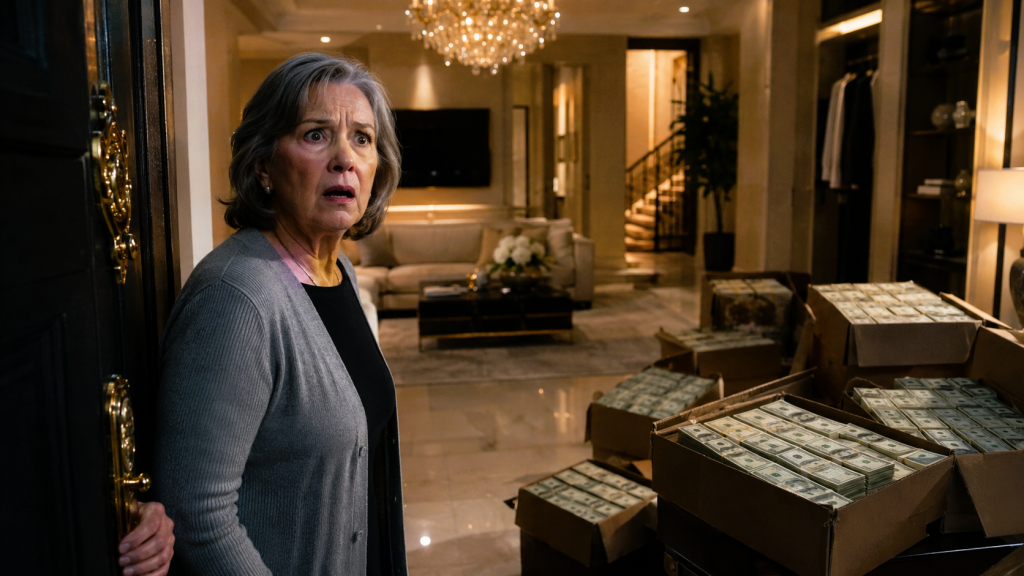
And why did the room feel less like storage…
And more like a secret?
That was when I heard the front door open downstairs.
A slow step.
Then another.
I could barely breathe.
“Mary?” I called.
Silence.
Then a woman’s voice answered in English.
“Mom?”
I ran down the stairs.
And there she was.
My Mary Lou.
Twelve years older, thinner, paler, but still my daughter. Her hair was tied back. Her coat hung loosely from her shoulders. A grocery bag had fallen at her feet, apples rolling across the floor.
For one second, neither of us moved.
Then she covered her mouth and began to cry.
“Mom,” she whispered. “Why are you here?”
I wanted to run into her arms, but the look in her eyes stopped me.
It was not joy.
It was fear.
“What is upstairs?” I asked.
Her face went white.
She grabbed my wrist and pulled me away from the staircase.
“You shouldn’t have come.”
Those four words cut deeper than twelve years of silence.
“I am your mother,” I said, my voice breaking. “I crossed the world because I needed to know if my daughter was alive or just pretending to be.”
Mary Lou locked the front door.
Then she closed every curtain in the living room.
Only after that did she sit down, as if her legs could no longer hold her.
“Kang Jun died nine years ago,” she said.
The room tilted.
“What?”
“He died nine years ago, Mom.”
I stared at her, unable to understand. For years, I had imagined him keeping her busy, keeping her away, controlling everything. But he had been dead almost the whole time.
“Why didn’t you tell me?” I whispered.
Mary Lou wiped her face with trembling hands.
“Because his death didn’t free me. It trapped me.”
Then she told me everything.
Kang Jun had not been the wealthy, honorable businessman he appeared to be. His companies were drowning in debt. Some debts were legal. Others were not.
After he died suddenly from a stroke, men came to the house. Calm men in dark coats. Men who smiled without warmth.
They told Mary Lou that her husband had signed her name onto documents.
Loans.
Guarantees.
Contracts she had never understood.
“They said if I ran,” Mary Lou whispered, “they would find you.”
My chest went cold.
“Me?”
She nodded.
“They had your address. Your phone number. Photos of your house. They knew where you shopped. They knew the name of your church.”
I covered my mouth.
“All these years,” she said, “I stayed because I thought staying here kept you safe.”
I looked toward the ceiling, toward the room full of money.
“And the cash?”
Her voice dropped lower.
“I started helping one of Kang Jun’s old business partners move money. At first, I thought it was just accounting. Then I realized it was worse. By then, they owned me. Every year, I sent you money because I wanted you to have something good from my suffering.”
I could not stop crying.
I had spent twelve years feeling abandoned.
But my daughter had been alone in a foreign country, trying to protect me.
I reached for her hand.
“Mary Lou, we are leaving.”
She shook her head quickly.
“No. You don’t understand. We can’t just leave.”
Before I could answer, someone knocked on the front door.
Three slow knocks.
Mary Lou froze.
A man’s voice called from outside.
“Mary Lou. We know your mother is here.”
Her fingers dug into my hand.
“Go upstairs,” she whispered. “Hide.”
But I was tired of hiding from the truth.
I stood up.
“No.”
“Mom, please.”
“No,” I said again, stronger this time. “I did not cross an ocean to lose you in your own house.”
The knock came again.
Mary Lou was shaking.
I walked to the door before she could stop me.
When I opened it, two men stood outside. One was older, broad-shouldered, wearing a black coat. The other was younger, with sharp eyes and a phone in his hand.
The older man looked past me at Mary Lou.
“You brought trouble,” he said.
I stepped in front of my daughter.
“No. I brought her mother.”
He smiled faintly.
“You should go home, old woman.”
Something inside me burned.
For twelve years, I had been quiet. I had accepted money instead of answers. I had smiled while my heart broke.
Not anymore.
“My daughter is coming with me,” I said.
The younger man laughed.
“She owes more than you can imagine.”
Mary Lou began to cry behind me.
“I don’t owe you my life,” she said suddenly.
The men looked at her.
For the first time, I heard strength in her voice.
“I kept records,” she continued. “Every transfer. Every name. Every threat. Every document Kang Jun forged. Everything.”
The older man’s smile disappeared.
Mary Lou reached behind a shelf and pulled out a small black drive.
“I was afraid to use it,” she said. “But I’m more afraid of staying.”
The younger man stepped forward.
I lifted my phone, my hand shaking but steady enough.
“I called the police before I opened the door,” I lied.
The men stopped.
Maybe they believed me.
Maybe they didn’t.
But then, from down the street, came the sound of a siren.
Mary Lou had not called the police.
But a neighbor had.
The men looked at each other, cursed under their breath, and walked away quickly.
Mary Lou collapsed into my arms.
This time, I did not let fear stop me.
I held my daughter for the first time in twelve years.
We stayed that way until the police arrived.
The next days were a blur of statements, translators, embassy calls, and tears. Mary Lou handed over the drive. She told everything. Some people were arrested. Others disappeared.
It was not simple.
It was not over in one night.
But for the first time in years, my daughter slept without locking every door twice.
A week later, on Christmas morning, Mary Lou and I sat together in a small hotel room near the airport.
There was no fancy tree.
No perfect table.
No beef stew.
Just instant coffee, two paper cups, and my daughter’s head resting on my shoulder.
“I’m sorry, Mom,” she whispered.
I stroked her hair like I did when she was little.
“I spent twelve years thinking money was the only proof you still loved me,” I said. “But now I know the truth.”
She looked up at me.
“You were trying to keep me alive.”
Mary Lou cried then, not with fear, but with release.
When we finally flew home together, I held her hand the entire way.
Back in Ohio, the neighbors came running when they saw her step out of the car.
Some cried.
Some stared.
Some whispered.
But I did not care.
That Christmas night, I cooked beef stew again.
For the first time in twelve years, the chair across from me was not empty.
Mary Lou sat there, wrapped in one of my old sweaters, eating slowly, smiling through tears.
The money was still there.
The years were still gone.
The pain could not be erased.
But my daughter was home.
And when she reached across the table and held my hand, I finally understood something.
Sometimes a child’s silence is not abandonment.
Sometimes it is sacrifice.
And sometimes, a mother must cross the world to hear the truth her heart already knew.
THE END! THANKS FOR READING!