
On my way to my son’s house in suburban Ohio, I stopped for gas at a small station off Route 42.It was late afternoon, the kind of gray November day when the sky looked bruised and the wind carried the smell of rain, wet leaves, and cold pavement. I remember that clearly because everything after that felt like it happened underwater.I was supposed to be at Daniel’s house by five.His wife, Marissa, had invited me for dinner. She said she was making roast chicken, Daniel’s favorite, but Daniel had sounded strange when he called me that morning. His voice was tight, almost breathless.“Mom,” he had said, “just come by tonight. Please.”“What’s going on?”A long silence followed.Then he said, “We need to talk.”That was all.I tried calling him twice after lunch, but he did not answer. I told myself he was busy. Daniel had always been the quiet type, the kind of man who carried problems in his chest until they nearly broke him. Ever since his father died twelve years earlier, he had changed. We both had.
My husband, Charles Whitaker, had died in a car accident on a rainy night just outside town. The police said he lost control on a bend in the road. They said it was quick. They said there was nothing suspicious.I believed them because grief makes you accept whatever explanation lets you survive the next morning.
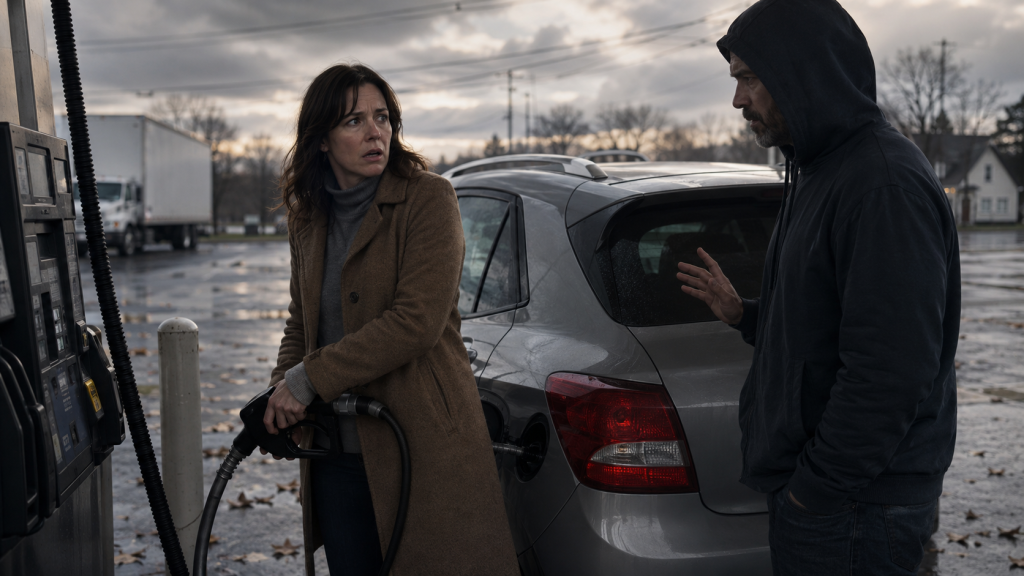
At the gas station, I stood beside pump six and watched the numbers climb. My hands were cold, even inside my gloves. Across the lot, a delivery truck idled near the air pump. A few cars came and went. Nothing felt unusual until the man appeared.He came from the side of the building, wearing a dark hoodie pulled low over his forehead. He looked about forty, maybe older, with a tired face and nervous eyes. He moved like someone who had not slept in days.
I tightened my grip on my purse.
“Don’t go,” he said.
I stared at him. “Excuse me?”
His eyes flicked toward my car, then back to my face.
“Don’t go to your son’s house. You’ll regret it.”
My stomach dropped so suddenly I forgot the gas nozzle was still in my hand.
“What the hell are you talking about?”
The man did not flinch. He looked at me with pity, and somehow that frightened me more than anger would have.
“Twenty minutes,” he said. “You’ll understand.”
Then he turned and walked away fast, cutting behind the delivery truck and disappearing around the corner of the building.
For a moment, I could not move.
The pump clicked off. I stood there listening to the wind drag dead leaves across the pavement. My first thought was to call Daniel. My second was that the man must have overheard me on the phone. Maybe he was unstable. Maybe he was trying to scare me.
I got into my car and locked the doors.
I should have stayed.
I should have called the police.
Instead, I drove.
The road to Daniel’s neighborhood wound through bare trees and quiet streets lined with tidy houses. My thoughts jumped from Daniel to the stranger to Charles, then back again. By the time I reached Daniel’s street, my hands were shaking so badly I almost missed the turn.
Then I saw the police lights.
At first, my mind refused to connect them to Daniel’s house. Red and blue flashed against the wet pavement, against the windows, against the white siding of the houses. Two patrol cars blocked the street. An ambulance sat crooked in the driveway.
I slowed down, my breath catching in my throat.
Then I saw Marissa sitting on the curb in her cream sweater.
Her hands were covered in blood.
A police officer stepped in front of my car and shouted for me to stop.
“That’s my son’s house,” I said, stumbling out before the car door had fully opened.
“Ma’am, stay back.”
“Where is Daniel?”
The officer’s silence was too long.
I pushed past him, but another officer caught me by the arm. I saw Daniel’s front door hanging open. I saw broken glass scattered across the porch. I saw two paramedics rushing inside with a stretcher.
“Daniel!” I screamed.
Marissa looked up.
Her face was pale. Her hair had fallen loose around her shoulders. She looked terrified, but for one second, when her eyes met mine, I saw something underneath the fear.
Not grief.
Not shock.
Guilt.
A voice came from the driveway.
“Mrs. Whitaker?”
I turned.
The man from the gas station stood beside an unmarked police car. His hoodie was gone. Underneath it, he wore a dress shirt, a holstered weapon, and a detective’s badge clipped to his belt.
“My name is Detective Aaron Miles,” he said quietly.
I stared at him, unable to speak.
“I tried to stop you because we believed the situation was about to turn violent.”
“What situation?” I whispered.
Before he could answer, the paramedics came out of the house.
Daniel was on the stretcher.
His face was white, his shirt soaked dark near his ribs, an oxygen mask pressed over his mouth. His eyes were closed.
My knees nearly gave out.
“He’s alive,” Detective Miles said quickly. “But he’s badly injured.”
I tried to run to my son, but the officer held me back.
“Let them work,” Miles said. “Please.”
The paramedics loaded Daniel into the ambulance. Marissa stood suddenly, but an officer stepped in front of her.
“Ma’am, you need to sit back down.”
“My husband is hurt!” she cried.
Detective Miles looked at her, then at me.
“Your son called us this morning,” he said. “He said he had evidence about a death from twelve years ago.”
My skin went cold.
“Twelve years ago?”
Miles nodded.
“Your husband’s death.”
The world seemed to tilt.
“No,” I said. “Charles died in an accident.”
“That is what everyone believed.”
I looked toward the ambulance, where Daniel lay fighting for breath.
Miles lowered his voice.
“Daniel said someone in this family lied. Tonight, he was going to name them.”
At the hospital, I sat under fluorescent lights that made everyone look already dead.
No one told me anything for nearly an hour. Nurses moved in and out. Officers stood near the doors. Marissa was brought in separately, wrapped in a blanket, still playing the part of the broken wife. Every few minutes, she sobbed into her hands.
I watched her.
I thought about the look in her eyes.
Detective Miles finally returned just after six thirty. His sleeves were rolled up, and there was a deep crease between his brows.
“Daniel is in surgery,” he said. “The knife missed his heart, but he lost a lot of blood.”
I closed my eyes.
“Who did it?”
“We’re still confirming.”
“You know.”
He did not answer.
I stood. “Detective, my son may die. Do not protect me from the truth.”
Miles glanced toward the hallway where Marissa sat with an officer beside her.
“Daniel told us he found something last week while cleaning out your old storage unit.”
My mind raced. “What storage unit?”
“The one that held your husband’s things.”
I had forgotten about it. After Charles died, I boxed up anything I could not bear to look at: his coats, his tools, his old paperwork, his watch collection. Daniel had offered to clear it out months ago. I thought it was his way of helping me move on.
“What did he find?” I asked.
“A small recorder hidden inside one of Charles’s old desk clocks.”
I remembered the clock immediately. Brass frame. Cracked face. Charles had kept it in his office for years.
Miles continued.
“The recording was made the night your husband died.”
My hand went to my mouth.
“What was on it?”
“A conversation. Your husband and another man. Charles was accusing him of stealing company money and using delivery trucks for illegal shipments. He said he had documents. He said he was going to the police.”
I shook my head slowly. “Charles worked in accounting. He never told me any of this.”
“He may have been trying to protect you.”
“Who was the other man?”
Miles’s expression hardened.
“Gordon Hale.”
The name meant nothing to me at first.
Then my eyes moved across the waiting room.
Marissa.
Her maiden name was Hale.
I whispered, “Her father?”
Miles nodded.
“Gordon Hale owned a regional trucking company. Your husband’s firm handled their books. Hale died two years ago, but we believe Charles discovered something that could have put him in prison.”
My stomach turned.
“Are you saying Marissa knew?”
“We believe Daniel confronted her this afternoon. He told her he had already called us and that he planned to tell you everything over dinner.”
I looked at Marissa through the glass wall of the waiting area. She was no longer crying. She sat very still, staring at the floor.
“She stabbed him,” I said.
“We believe so.”
The words did not feel real.
Marissa had spent three Christmases at my table. She had hugged me after Charles’s funeral anniversary. She had called me Mom once, quietly, when Daniel was not listening.
“How could she marry my son?”
Miles sighed.
“We do not think she married him because of this. But we think she discovered the recording before Daniel contacted us. Her father built her entire life on money that came from those crimes. If the truth came out, the lawsuits alone could destroy everything she inherited.”
I wanted to hate her immediately, completely, but what I felt first was horror. Horror that evil could sit across from you at Thanksgiving and pass the salt.
A nurse came out just before nine.
Daniel had survived surgery.
I cried so hard I could not stand.
They let me see him after midnight. He looked small under the hospital blankets, his face bruised with exhaustion, tubes in his arms, machines breathing softly beside him.
I took his hand.
“Daniel,” I whispered. “It’s Mom.”
His eyelids fluttered.
For a second, I thought he was still unconscious. Then his fingers tightened weakly around mine.
“Clock,” he breathed.
“I know,” I said, leaning close. “Detective Miles told me.”
His eyes opened just enough to shine with pain.
“No,” he whispered. “Not clock.”
I froze.
Daniel swallowed, fighting for strength.
“Garage.”
Then he slipped back into sleep.
I found Detective Miles in the hallway and repeated the word.
Within an hour, police searched Daniel’s garage.
Behind a loose panel near the workbench, they found a flash drive sealed in a plastic bag. Daniel had hidden it there before Marissa attacked him.
The flash drive contained scanned documents, bank records, shipping schedules, and one video file.
The video was from an old dashboard camera recovered from Charles’s car.
For twelve years, it had been missing from the official evidence file.
The footage showed Charles driving in the rain. His breathing was shaky. Headlights appeared behind him, too close. A truck rammed his bumper once, then again. Charles shouted a name.
“Hale!”
The truck hit him a third time.
The screen spun.
Then blackness.
I watched the video once.
Only once.
Marissa was arrested the next morning.
She did not scream. She did not deny it. She only looked at me as the officers guided her hands behind her back.
“I didn’t mean for Daniel to die,” she said.
I stared at her. “But you meant to silence him.”
Her mouth trembled.
“My father is dead. Daniel was going to ruin a dead man’s name.”
“No,” I said. “Your father ruined his own name.”
She looked away.
“And you nearly killed my son to protect it.”
For the first time, her face broke. Not from guilt, I think, but from the realization that the story she had protected all her life was finally over.
Daniel spent three weeks in the hospital.
Recovery was slow. Painful. Some days, he barely spoke. Other days, he apologized to me again and again for reopening the past.
But he had not reopened it.
He had freed us from it.
At Charles’s grave, a month later, Daniel stood beside me with one hand pressed against his healing side. The sky was cold and clear. No rain. No bruised clouds. Just pale winter sunlight across the cemetery grass.
“I thought knowing would make it worse,” Daniel said.
I slipped my arm through his.
“Not knowing was worse.”
He nodded.
Detective Miles called that afternoon to tell us Gordon Hale’s old case was officially being reopened. There would be hearings. News stories. Lawyers. Questions. The kind of truth that does not arrive gently.
But it was still truth.
That night, I drove past the gas station off Route 42.
Pump six was empty. The delivery truck was gone. The pavement was dry.
I parked for a moment under the fluorescent lights and thought about the stranger who had warned me.
Twenty minutes.
That was all it took for my life to split into before and after.
For years, I believed the worst thing that ever happened to my family was my husband’s death.
I was wrong.
The worst thing was the lie that followed.
And the only thing more terrifying than the truth was how close I came to never hearing it at all.
THE END! THANKS FOR READING!