
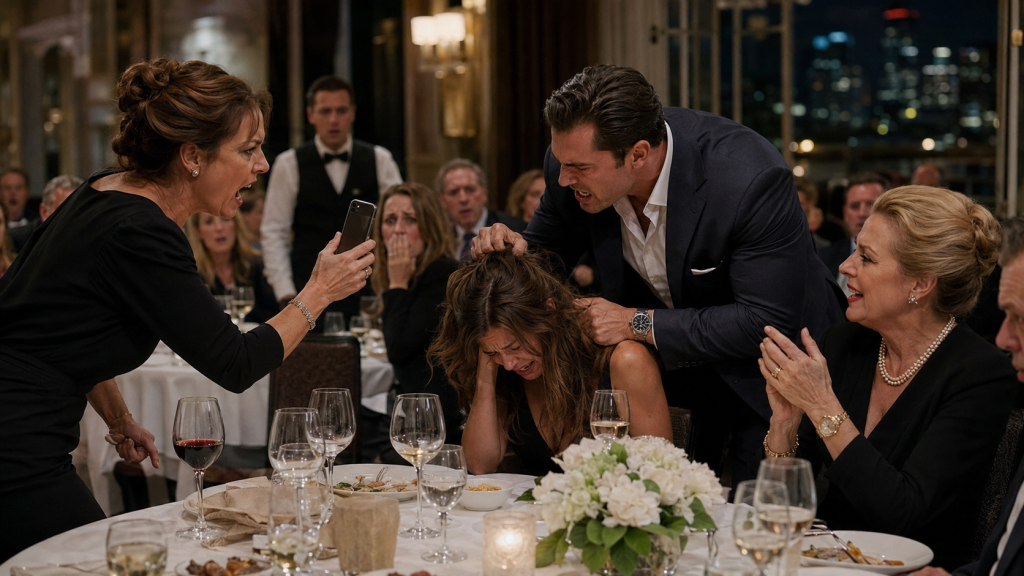
At a crowded restaurant, my son-in-law grabbed my daughter by the hair and humiliated her in front of everyone.Then his mother smiled and cheered, “That’s how it’s done! She needs to learn her place.”My daughter broke down in tears, and I stood up shaking with rage.The restaurant was called Marigold & Ash, the kind of place in Boston where the lights were soft, the wineglasses thin, and everyone spoke as if manners were printed on the menu.
My daughter, Emily Whitaker, sat across from me with her hands folded around a glass of untouched water. She was twenty-eight, pretty in a tired way, with brown hair falling over one shoulder and a smile she had been forcing all night.Beside her sat her husband, Brent Callahan, a broad-shouldered man with an expensive watch and a cruel little smirk that appeared whenever someone else spoke too long.
His mother, Diane Callahan, occupied the seat next to him like a queen on a throne. Pearls at her throat, red lipstick sharp as a blade, eyes always measuring my daughter.I had come to dinner because Emily asked me to.
“Please, Mom,” she had whispered over the phone that afternoon. “Just be calm tonight. Brent wants both families to try again.”
Try again.That phrase tasted bitter as I watched Brent interrupt her for the sixth time.
“She forgets things,” he told the table, laughing. “Bills, appointments, basic instructions. I swear, living with Emily is like managing a teenager.”
Emily’s face burned.
“That’s not true,” she said softly.
Brent turned his head slowly.
“Excuse me?”
The silence at the table tightened.
Emily swallowed.
“I said that’s not true. I handle the rent, the groceries, your dry cleaning, the insurance—”
Before she could finish, Brent’s hand shot out.
He grabbed a fistful of her hair near the back of her head and yanked.
Emily cried out, sharp and broken. Her chair scraped the floor. Several people turned. A waiter froze beside a nearby table with a tray of plates balanced in both hands.
Brent leaned close to her ear, still holding her hair.
“Don’t embarrass me in public.”
For one second, the world became perfectly still.
Then Diane clapped.
She actually clapped.
“That’s how it’s done!” she said, smiling proudly. “She needs to learn her place.”
Emily’s eyes filled with tears. She looked at me, not like a grown woman asking for help, but like the little girl who used to run into my arms after nightmares.
Something inside me went cold.
I stood up slowly.
Brent looked at me with lazy amusement.
“Sit down, Linda.”
I reached into my purse, took out my phone, and placed it on the table.
Then I said, loud enough for every person in that restaurant to hear, “Let go of my daughter, or the next voice you hear will be the police dispatcher listening to me report an assault in progress.”
Brent laughed.
“You wouldn’t dare.”
I tapped the screen.
“911, what is your emergency?”
The color drained from his face.
I looked him dead in the eye and said, “My son-in-law has just assaulted my daughter in a public restaurant. He is still touching her. We need police at Marigold & Ash on Hanover Street.”
Brent’s fingers loosened at once.
Emily pulled away from him so quickly her chair nearly tipped backward. Her hands flew to her head, and she bent forward, shaking.
Diane stood up.
“This is outrageous,” she hissed. “You are destroying this family over a misunderstanding.”
I kept my eyes on Brent.
“There are witnesses,” I told the dispatcher. “And the restaurant has security cameras.”
A waiter stepped forward then, pale but steady.
“Yes, ma’am,” he said. “The camera is right above this table.”
Diane’s mouth snapped shut.
Brent looked up at the ceiling.
For the first time all night, he looked afraid.
Emily was sobbing into her hands. I moved around the table, took my coat from the back of my chair, and wrapped it over her shoulders.
“You are coming home with me tonight,” I said.
Brent slammed his palm on the table.
“She’s my wife.”
“No,” I said. “She is my daughter.”
Diane pointed one shaking finger at Emily.
“She belongs to my son.”
And that was when the police walked in.
Two officers entered through the front of the restaurant, their dark uniforms cutting through the warm golden lighting like a storm through candlelight.
The manager rushed toward them, whispering quickly and pointing to our table.
The entire restaurant had stopped pretending not to watch.
Brent stood and forced a smile.
“Officers, this is a private family disagreement,” he said.
One officer, a woman with calm eyes and a firm voice, looked past him and directly at Emily.
“Ma’am, are you hurt?”
Emily opened her mouth, but no sound came out.
I put my hand on her shoulder.
“She is scared,” I said. “And he grabbed her by the hair in front of everyone.”
Brent laughed too loudly.
“That’s insane. I barely touched her.”
The waiter spoke from behind me.
“No, sir. You pulled her head back.”
A woman at the next table raised her hand.
“I saw it too.”
Then a man near the bar said, “So did I.”
Another voice followed.
“And his mother clapped.”
Diane’s face twisted.
“You people have no idea what that girl puts my son through.”
The female officer turned to Diane.
“Ma’am, sit down.”
Diane froze as if nobody had ever spoken to her that way in her life.
Brent reached toward Emily again.
“Baby, tell them this is nothing.”
Emily flinched so hard the officer noticed.
That tiny movement changed everything.
The officer stepped between them.
“Sir, keep your hands where I can see them.”
Brent’s expression changed from charming to furious in half a second.
“You don’t understand who I am.”
The second officer, taller and older, gave him a flat look.
“I understand enough.”
They separated us.
Emily and I were guided toward the front waiting area, away from the table. The female officer crouched slightly so she could speak to Emily at eye level.
“Has he done this before?”
Emily stared at the floor.
I wanted to answer for her. I wanted to say yes, because of the bruises I had noticed and the excuses I had swallowed. The long sleeves in July. The sudden headaches before family gatherings. The way she never answered phone calls unless Brent was out of the room.
But I knew this answer had to come from her.
Emily pressed her lips together.
Then she nodded.
One small nod.
It broke my heart.
The officer’s face softened.
“Okay. You’re safe right now.”
Across the restaurant, Brent was talking fast. His hands moved wildly. Diane kept interrupting, insisting Emily was dramatic, unstable, ungrateful.
Then the manager appeared holding a tablet.
“We have the footage,” he said.
Brent stopped talking.
Diane stopped breathing.
The officers watched the video near the hostess stand. I did not need to see it again. I had already burned the image into my mind forever.
My daughter’s head jerking back.
Her face twisting in pain.
His mouth at her ear.
His mother smiling.
When the officer returned, her voice was different.
“Mr. Callahan, turn around.”
Brent blinked.
“What?”
“You’re being placed under arrest.”
Diane screamed.
People gasped.
Brent looked at Emily as if she had personally betrayed him by bleeding where people could see it.
“Emily,” he snapped. “Tell them no.”
Emily trembled under my coat.
For a moment, I thought fear would win.
Then she lifted her face.
Her eyes were red. Her voice shook.
But the words came out.
“No.”
Brent stared.
Emily took a breath.
“No more.”
The officers put his hands behind his back.
Diane lunged toward Emily, but the older officer blocked her.
“This is your fault!” Diane shrieked. “You weak little nothing! You ruined my son!”
Emily stepped backward.
I stepped forward.
“No,” I said. “Your son ruined himself. You just applauded.”
Diane looked as if I had slapped her.
Maybe I should have said more. Maybe I should have shouted every word I had held in for three years.
But the truth was, my daughter needed peace more than Diane deserved my rage.
So I turned away.
The restaurant manager offered us a private office until the report was finished. Emily sat on a small leather chair beneath a framed wine certificate, her hands clasped so tightly her knuckles were white.
“I’m sorry,” she whispered.
I knelt in front of her.
“Do not apologize.”
“I told you to be calm.”
“I was calm,” I said. “That was me calm.”
A broken laugh escaped her, then turned into another sob.
I held her the way I had when she was six and feverish, when she was twelve and heartbroken, when she was sixteen and thought the world had ended because a boy did not call.
But this was different.
This was my grown daughter collapsing under the weight of a marriage that had trained her to call cruelty love.
“I thought I could fix it,” she whispered.
“I know.”
“He said I made him angry. He said if I acted better, he would be better.”
“That is what men like him say.”
She looked at me with wet eyes.
“Why didn’t I leave sooner?”
I brushed her hair away from her face, gently, carefully, the opposite of how he had touched her.
“Because leaving is not one moment. It is a thousand moments of trying to believe you deserve to survive.”
Her face crumpled again.
“I’m so tired, Mom.”
“I know, baby.”
The officer came back twenty minutes later. She gave Emily information about a protective order, victim services, and what would happen next. She spoke gently but clearly.
Emily listened like someone trying to learn a new language.
A language where she mattered.
A language where fear was not normal.
When we finally left Marigold & Ash, the cold Boston air hit us like a slap.
Snow had started falling, soft and thin beneath the streetlights.
My car was parked half a block away. Emily walked beside me, wrapped in my coat, her hair loose around her face.
Behind us, Diane’s voice echoed from the restaurant entrance.
“Emily!”
We stopped.
Diane stood there alone now, no pearls of confidence left in her posture. Her lipstick looked smeared at one corner.
“You need to fix this,” she called. “A wife does not send her husband to jail.”
Emily’s hand found mine.
For a second, I felt her fingers squeeze the same way they had when she was little, crossing busy streets.
Then she turned around.
Her voice was quiet, but it carried.
“A husband does not hurt his wife.”
Diane’s face hardened.
“You’ll regret this.”
Emily shook her head.
“No. I regret not doing it sooner.”
Then she turned back to me.
We walked to the car without another word.
That night, I made tea in my kitchen while Emily sat at the table in my old sweatshirt, staring at nothing. Her phone kept lighting up.
Brent’s friends.
Diane’s sisters.
Unknown numbers.
Messages poured in faster than she could read them.
You’re overreacting.
You destroyed your marriage.
He was embarrassed.
You should have handled it privately.
I took the phone from her hand and powered it off.
“Tonight, the world can wait.”
She nodded.
I made the guest room with fresh sheets. She stood in the doorway looking lost, as if she needed permission to sleep somewhere safe.
“This room is yours as long as you need it,” I told her.
“What if he gets out tomorrow?”
“Then we deal with tomorrow tomorrow.”
She looked down.
“What if I get scared and want to go back?”
The honesty in that question nearly brought me to my knees.
I took both her hands.
“Then you tell me. And I will remind you what happened tonight until you remember you are worth protecting.”
She cried again, but this time the tears were different.
Not just fear.
Release.
The next morning, Emily woke before sunrise. I found her in the kitchen, wrapped in a blanket, looking out at the snow-covered street.
“I want to file the order,” she said.
I nodded.
“Okay.”
“And I want to get my things.”
“We will ask for a police escort.”
“And I want a divorce.”
The word sat between us, terrifying and beautiful.
Divorce.
Freedom.
Beginning.
I poured coffee into two mugs.
“You do not have to do everything today.”
She looked at me.
“If I wait, I’ll start hearing his voice in my head again.”
So we did not wait.
By noon, we were at the courthouse.
By three, the temporary protective order was granted.
By five, two officers met us outside the apartment she had shared with Brent.
Emily’s hands shook as she unlocked the door.
Inside, everything looked perfect.
White sofa.
Glass coffee table.
Wedding photo on the wall.
In the picture, Brent was smiling like a man who owned the sun. Emily was smiling too, but now I could see what I had missed before.
Her smile never reached her eyes.
She packed quickly.
Clothes.
Documents.
Medication.
A small jewelry box that had belonged to my mother.
Then she stopped in the bedroom doorway.
There was a dent in the wall beside the closet.
I stared at it.
Emily whispered, “That was from the night I burned dinner.”
My stomach turned.
She picked up a framed wedding photo from the dresser and looked at it for a long moment.
Then she placed it face down.
“I’m ready,” she said.
The months after that were not easy.
People like Brent do not lose control quietly.
He called from blocked numbers until the order stopped him. Diane posted vague comments online about “false accusations” and “destroyed sons.” Some relatives said Emily should have kept family business private.
But something had changed in my daughter.
At first, it was small.
She cut her hair shorter because Brent had always liked it long.
She bought a yellow coat because Diane had once told her bright colors made her look childish.
She laughed at breakfast one morning and then covered her mouth, surprised by the sound.
Therapy helped.
Distance helped.
Safety helped.
But the biggest change came six months later, on a warm Saturday in June, when Emily and I returned to the North End for lunch.
Not at Marigold & Ash.
Never there again.
We chose a small café with red umbrellas and loud music and waiters who smiled with their whole faces.
Emily ordered pasta and ate every bite.
Halfway through the meal, she looked across the table at me.
“I thought that night was the worst night of my life,” she said.
I reached for my water.
“And now?”
She watched people pass on the sidewalk. A little girl ran ahead of her mother, laughing, hair flying behind her.
Emily smiled softly.
“Now I think it was the night my life started coming back.”
I felt tears sting my eyes.
She reached across the table and took my hand.
“I was so ashamed,” she said. “When he grabbed me, I thought everyone was looking at me because I was weak.”
“They were looking because he was cruel.”
“I know that now.”
The words settled between us like sunlight.
Across the street, church bells began to ring.
Emily tilted her face toward the sound.
For the first time in years, my daughter looked peaceful.
Not fixed.
Not finished.
But free.
And sometimes freedom does not arrive with fireworks.
Sometimes it arrives in a crowded restaurant, after years of silence, when a mother stands up, dials three numbers, and finally makes the whole room see what her daughter had been surviving all along.
THE END! THANKS FOR READING!