
Chapter 1: The First Saturday
My name is Hannah Miller. I was twenty-eight years old, a senior accountant at a mid-sized auditing firm in Topeka, and my life had always been built around order—numbers, tax files, strong coffee, and late nights at the office.
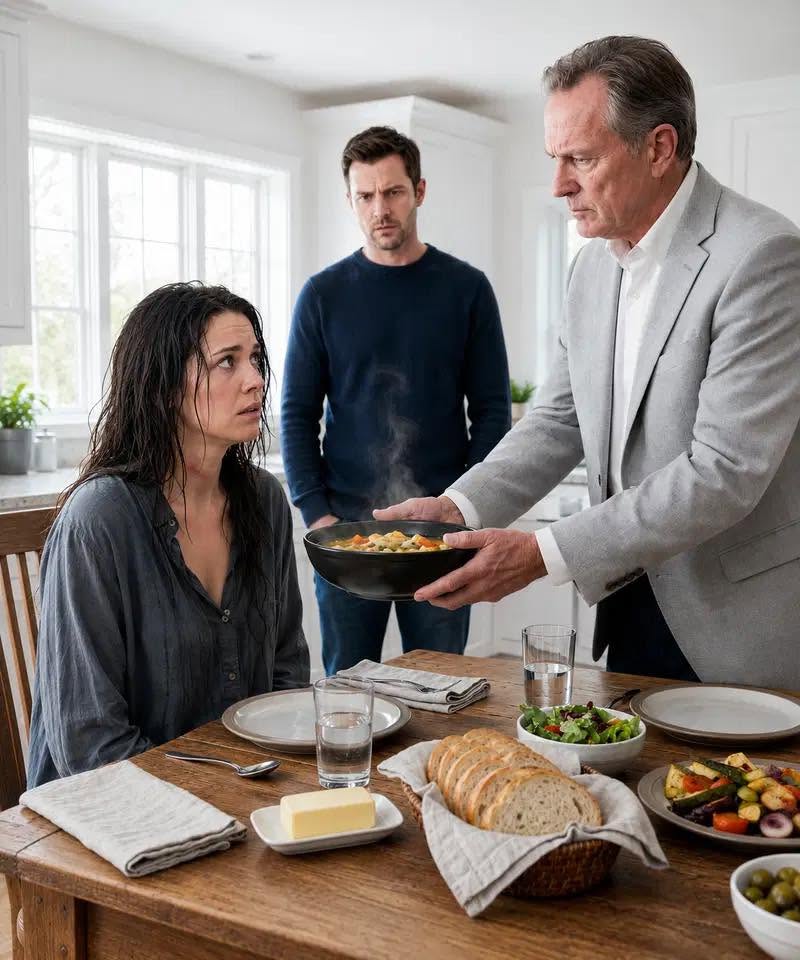
So when I began feeling weak and strangely disoriented after dinners at my in-laws’ house, everyone blamed stress.
My husband, Brian Peterson, and I had been married for three years. He worked as a civil engineer, but everyone knew his real security came from his father, Frank Peterson, the powerful director of Public Works in our town. Frank was strict, controlling, and used to being obeyed. His wife, Martha, was quiet, polished, and always preparing huge family meals as if she were feeding an army.
From the beginning of our marriage, one rule was clear: the first Saturday of every month belonged to the Peterson family dinner.
“Family is not optional,” Frank always said.
The first incident happened in April.
Martha served beef broth, vegetables, rice, and iced hibiscus tea. Frank personally placed a deep bowl in front of me.
“You look pale, my dear,” he said. “Eat. You need your strength.”
Ten minutes later, the room began to blur. Voices sounded far away. My body felt heavy, as if I were sinking underwater.
“Hannah, you look terrible,” Brian said.
But he didn’t help me.
When I tried to stand, my legs failed. Brian dragged me to the guest room. I woke up three hours later with a dry mouth, messy hair, and my blouse buttoned wrong.
“Your blood pressure dropped,” Brian said calmly. “You probably didn’t eat enough breakfast.”
I wanted to believe him.
But the next month, it happened again after Frank handed me a glass of fruit punch.
This time, I woke with smeared lipstick and the horrible feeling that someone had been too close while I was unconscious.
“Why are my buttons wrong?” I asked.
Brian barely looked up. “You probably moved around in your sleep.”
But I knew myself.
And I knew something was wrong.
In June, I prepared.
Before dinner, I photographed myself in the mirror—clean white blouse, straight buttons, watch in place. I also marked a tiny dot beneath my camisole strap to see if anyone touched me.
At lunch, I only pretended to drink the broth. I barely wet my lips. Beneath the rich smell, I caught something bitter and metallic.
I faked nausea.
Brian brought me to the guest room as usual. I lay still, eyes closed, pretending to be unconscious.
Then I heard his phone.
Click.
A photo.
Click.
Another.
Then Frank’s voice came from the doorway.
“Now it looks convincing enough for the documents.”
My heart pounded, but I did not move.
Later, in my car, I checked a recording accidentally captured by my phone. Seven seconds in, a man’s voice said clearly:
“This time, add more sedative. She’s starting to suspect something.”
That night, I did not sleep.
The next Saturday, I hid a pen recorder in my bag and placed a tiny camera inside a fake wall charger.
When I arrived, two unfamiliar pairs of men’s shoes sat near the door.
“We have guests tonight,” Martha said, refusing to meet my eyes.
Frank introduced Roger and Victor. Victor looked at me in a way that made my skin crawl.
During dinner, Frank raised his glass.
“To family,” he said, “and to agreements that benefit everyone.”
I pretended to drink.
Pretended to become dizzy.
Pretended to collapse.
Brian carried me to the guest room. This time, I heard the door lock from outside.
Then footsteps approached.
Victor laughed softly.
“Is she out?”
Frank replied coldly, “She won’t wake easily today. We have work to do.”
And I realized something terrible was about to happen.
Chapter 2: The Truth Comes Out
The door opened slowly.
I stayed motionless beneath the blanket, eyes shut, hands clenched tightly. I recognized Brian’s cologne, Frank’s cigar smoke, and Victor’s uneven breathing.
“Did you turn off her phone?” Frank asked.
“Yes,” Brian answered. “It’s in her bag.”
Victor scoffed. “Your wife is smarter than the others. She’s been asking questions.”
The others.
That word chilled me.
Frank snapped, “Enough. We need her signature on those land transfer papers before Monday.”
Then I understood.
Months earlier, my parents had inherited two valuable plots of land near the city outskirts. Frank wanted them for almost nothing. I had warned my parents not to sign anything without checking the deeds, appraisals, and zoning permits.
From that moment, Frank had treated me like an obstacle.
And now he wanted to remove that obstacle.
A rough hand reached toward my neck, checking whether I was truly unconscious.
I opened my eyes and kicked hard.
Victor crashed backward into a chair.
“She was awake!” he shouted.
I ran for the door, but Brian grabbed my arm.
“Hannah, calm down,” he begged.
“Don’t touch me!” I screamed.
Frank’s face went pale. Martha appeared in the hallway, trembling.
“Martha,” I said, “did you know?”
She lowered her eyes.
That silence answered everything.
Frank quickly recovered.
“Don’t make a scene,” he said. “Nothing happened yet. We only need your signature.”
“You drugged me for a signature?”
He waved his hand dismissively. “We were going to compensate you. Two million dollars. Forget today ever happened.”
I looked at Brian.
“Were you going to buy my silence too?”
He said nothing.
Frank stepped closer.
“No one will believe a hysterical woman over a respected public official,” he warned.
Then a faint beep sounded from the corner.
My hidden camera was uploading to the cloud.
Frank heard it. He found the fake charger, smashed it on the floor, and shouted, “What did you record?”
I didn’t answer.
Because I had already set a backup plan.
If I didn’t reply to my friend Kelly within ten minutes, she was instructed to send my location and the live footage to the police.
A thunderous knock hit the front door.
“Police! Open up!”
The house froze.
Victor tried to flee. Brian stood paralyzed. Martha began sobbing.
Frank opened the door, pretending to be offended.
“This is private property,” he said.
An officer showed a warrant.
“Frank Peterson, you are under investigation for threats, extortion, and illegal use of sedatives.”
The police searched the house. In Frank’s study, they found laptops, USB drives, and folders filled with stolen land records.
As officers led me out, Brian whispered, “Please don’t destroy everything.”
I stopped and looked at him.
“You destroyed everything the moment you locked that door.”
That night, I gave my statement until almost morning.
At 1:42 a.m., an encrypted message arrived from an unknown number.
“Do not trust Martha. She has more evidence, but she is more afraid than you know.”
The next day, the news exploded.
Local official under investigation for real estate extortion ring.
My parents cried. Neighbors whispered. My name spread everywhere.
Brian called that afternoon.
“My dad will take the blame,” he said. “He’ll tell them I knew nothing.”
“And did you?” I asked.
Silence.
“I never meant to hurt you,” he said.
“You locked me in that room with them.”
“I thought they would only scare you into signing.”
“That makes you worse,” I said. “You knew I was terrified, and you still let them in.”
Then I hung up.
Later, another anonymous video arrived. It showed Brian arguing with Victor near a warehouse.
Victor laughed and said, “Don’t act innocent. When did you get paid for every piece of land we stole?”
The video ended with one sentence:
“Hannah was not the first.”
And I knew the nightmare was bigger than me.
Chapter 3: The Cost of Silence
The words stayed with me.
Hannah was not the first.
The next day, the prosecutor’s office called me in. Agent Henderson placed a thick folder on the table.
“We found three more women connected to this case,” he said.
“Three?” I whispered.
“For now.”
Frank had not only wanted my parents’ land. For years, he had used his power to pressure families with valuable property. First came low offers. Then threats. Then fake scandals, forced signatures, and fear.
“Was Brian involved?” I asked.
Henderson hesitated.
“He appears in multiple files. Not always leading, but always present.”
Present.
That word hurt most.
Brian had always been present.
Present when they took me to the room.
Present when they turned off my phone.
Present when they treated me like a problem to be handled.
That night, Martha asked to meet me at a quiet café near the river. Undercover agents stayed nearby.
She looked nothing like the polished woman I remembered. Her hands trembled. Her face was gray with fear.
“I sent you the anonymous videos,” she said.
I waited.
“After the first time you passed out, I knew something was wrong. I checked Frank’s laptop and found terrible things.”
“And you still let me go back?”
Tears filled her eyes.
“I was afraid of him.”
“So was I,” I said.
She placed a USB drive on the table.
“This has names, dates, and evidence. I should have given it sooner.”
“Yes,” I said. “You should have.”
She looked down.
“I am not asking you to forgive Brian,” she whispered. “I’m asking you not to.”
I took the USB and left.
The case grew rapidly after that. Frank was arrested. Roger was taken into custody. Victor disappeared for a short time, then resurfaced demanding money.
Brian called from an unknown number.
“Victor has another hard drive,” he said. “More videos. More victims.”
Agent Henderson listened as I put the call on speaker.
“Where are you?” Henderson asked.
Brian hesitated.
“At an old warehouse near the industrial park.”
Then the line cut off after a loud crash.
Police moved immediately. I insisted on going. Henderson refused at first, but I ended up in the back of a patrol car.
At the warehouse, rain poured down. A gunshot echoed inside.
Officers entered. I stayed behind a truck, shaking.
There was shouting. Another shot. Then someone yelled that a man was down.
When they let me closer, I saw Brian on the concrete, blood on his shirt. Victor was handcuffed nearby, shouting that everyone had betrayed him.
Brian looked at me.
“Are you okay?” he whispered.
That question broke something in me.
The man who had helped trap me was now lying there, asking about my safety.
“Don’t talk,” I said, holding his hand.
“I’m sorry,” he murmured.
“You don’t get to fix it like this.”
“I don’t know how else to fix it.”
He survived, but his future was gone.
The hard drive was recovered. It revealed many more victims.
One week later, I filed for divorce.
Brian signed the papers from his hospital bed.
“Did you ever love me?” he asked.
“Yes,” I said honestly.
His eyes filled with tears.
“Then not everything was a lie.”
“No,” I said. “But love does not erase consequences.”
Before I left, he whispered, “I thought if I didn’t touch you myself, I wasn’t like them.”
I stopped at the door.
“That was your mistake. You thought watching silently didn’t count.”
I never visited him again.
Months later, the trial began. Some people called me brave. Others said I should have kept it private.
It is strange how quickly people defend powerful men and blame the women who expose them.
Frank stood in court still acting untouchable.
“This is a family vendetta,” he claimed.
I asked to speak.
“You did not lose your power because of me,” I told him. “You lost it when you thought fear could be bought. I did not destroy your family. You turned it into a criminal operation.”
For the first time, Frank had nothing to say.
Victor, Roger, and Frank received long sentences. Brian was convicted too. His sentence was lighter than his father’s, but it followed him forever.
Later, I received one final letter from him.
He wrote that his worst crime was convincing himself his silence was neutral.
“It wasn’t,” he wrote. “My silence was a closed door that allowed evil to enter.”
I kept the letter in a box, not because I still loved him, but because scars deserve to be remembered without being allowed to bleed again.
I sold our apartment. I left Topeka. I moved to a quiet house with flowers at the entrance and slowly learned how to sleep without fear.
At first, I pushed a chair against my bedroom door.
Then I only left a lamp on.
Months later, I slept seven full hours and woke up crying with relief.
Two years have passed.
I now work as an independent consultant and support women facing violence, intimidation, and corruption.
I do not tell my story for pity.
I tell it because danger does not always arrive loudly.
Sometimes, it sits at your dinner table, serves you soup, calls you “dear,” and says family comes first.
I learned that a large house is not always a home.
I learned that a respected name does not mean a decent heart.
And I learned that love without courage can become complicity.
So if something inside you says something is wrong, listen.
Even if people call you dramatic.
Even if they say you are tired, sensitive, or imagining things.
Sometimes, your intuition is the only part of you that has not been deceived yet.
**THE END**