
My son removed me from the family group chat, and when I asked him why, he replied, “Mom, it was for working adults. You don’t understand anything we talk about.” A week later, all twelve of them arrived at my farm with suitcases, meat, and coolers, convinced that I would leave the key under the flowerpot one more time.
But that night, by the closed gate, a sign and a notebook were waiting for them. A notebook they never should have despised. It wasn’t the moment Charlie removed me from the family group that hurt the most. It was the phrase that came after.
“Mom, it was for working adults. You don’t understand anything we talk about.”
I stared at that message for a long time.
My thumb hovered over the screen, but I didn’t know what to say.
I am seventy-six years old.
I have buried a husband, raised three children, survived droughts, debt, hospital bills, and winters so cold the pipes froze beneath the kitchen.
But somehow, in my son’s eyes, I was no longer an adult.
I was just old.
Just slow.
Just someone to visit when they needed fresh sheets, a stocked fridge, and a free place to stay.
The farm had been mine and Joe’s dream.
We bought it when the roof leaked, the barn leaned to one side, and the fields were more weeds than soil.
People laughed at us.
Joe only smiled and said, “Give us ten years.”
It took fifteen.
Fifteen years of farmer’s markets, broken tractors, late payments, and savings hidden in glass jars behind flour bags.
But we made it beautiful.
Apple trees along the fence.
Lemon trees near the kitchen window.
A pond where the grandchildren used to catch frogs.
A porch wide enough for rocking chairs and Sunday coffee.
After Joe died, the farm became the place everyone came back to.
At first, I loved it.
I cooked big meals.
I made beds.
I filled jars with jam and pickles.
I left the key under the big blue flowerpot by the side door because family should never feel locked out.
But slowly, they stopped calling first.
Then they stopped asking.
Then they stopped helping.
They arrived with coolers, children, dogs, laundry, empty gas tanks, and big smiles.
They left with leftovers, muddy floors, stained towels, and promises to visit “properly next time.”
Next time never came.
So when my daughter-in-law Lauren texted me one week after I was removed from the group chat, I already knew something inside me had changed.
“Barbara, leave the key in the usual spot. We’re coming Friday with the kids.”
No please.
No thank you.
No how are you, Mom?
Twelve people were coming to my home.
And apparently, I was the last person to know.
I drove to the farm on Thursday morning.
John, the caretaker, was repairing a fence near the barn when I arrived.
He had worked for Joe and me for more than twenty years.
He knew the farm almost as well as I did.
When he saw my face, he took off his hat.
“Mrs. Barbara,” he said softly, “something happen?”
I shook my head.
“Not yet.”
Inside the house, everything looked the same.
Joe’s chair still sat beside the fireplace.
The clock still ticked above the kitchen door.
And on the dining table sat the old brown leather notebook.
Joe had sewn the cover himself.
Inside, we had written everything.
The cost of the well.
The year we planted each tree.
The price of roof repairs.
The names of neighbors who helped us during storms.
The money we owed.
The money we paid back.
The dreams we had.
That notebook was not valuable to anyone else.
But to me, it was proof that this farm had not appeared by magic.
It had been earned.
I was still sitting there when Charlie arrived Friday afternoon.
He walked in without knocking.
He did not hug me.
He did not ask why I was there early.
He only frowned.
“Mom? What are you doing here?”
I looked at him carefully.
“I live here, Charlie.”
He sighed like I had made things difficult.
“You know what I mean. We planned a weekend.”
“No,” I said. “You planned a weekend.”
He crossed his arms.
“Mom, don’t start.”
“Why was I removed from the family group?”
His expression tightened.
“It wasn’t personal.”
“It felt personal.”
“It was just easier. We talk about schedules, work, adult things.”
There it was again.
Adult things.
I looked at my son, my first baby, the boy I once carried through fever nights.
“Charlie, I am your mother.”
He gave a small laugh.
“That’s not what I meant. You just don’t understand half of what we talk about anymore.”
Then his eyes landed on the notebook.
He picked it up and flipped through the pages.
“What is this old thing still doing here?”
“That is your father’s notebook.”
Charlie barely looked at it.
“Mom, these things just gather dust.”
Then he tossed it into the trash.
Not placed.
Not set aside.
Tossed.
Like garbage.
I felt something inside me go completely still.
He pointed toward the hallway.
“You should tidy up a bit before the others get here.”
I did not answer.
Because if I had spoken in that moment, I might have said words a mother can never take back.
So I waited.
I watched them arrive one by one.
Lauren came in carrying shopping bags and complaining about traffic.
My daughter Melissa arrived with her husband and two teenagers, both staring at phones.
My youngest, David, walked in with his wife, three children, and a cooler full of meat.
No one asked if I needed help.
No one asked if I wanted them there.
They filled the house with noise.
They opened cabinets.
They moved furniture.
They told the children not to bother Grandma because Grandma got tired easily.
But they had no problem letting Grandma cook.
That evening, I stood at the kitchen sink while they laughed outside by the grill.
Charlie told a story about me mixing up an app on my phone.
Everyone laughed.
Lauren said, “Honestly, Barbara is sweet, but she’s from another century.”
Another century.
I looked down at my hands.
Old hands, yes.
Wrinkled hands.
But these hands had fed them.
Paid for school shoes.
Changed bandages.
Held dying parents.
Buried a husband.
Signed checks when they were short on rent.
And opened this farm again and again.
That night, after everyone went to bed, I took the notebook from the trash.
I wiped coffee grounds from the cover.
Then I carried it to my bedroom.
Under the loose floorboard beneath my bed was a metal box Joe had made years before.
Inside were the deed, insurance papers, land maps, and a sealed envelope.
Joe had written on the envelope:
“When they forget what this place cost, remind them.”
My hands trembled as I opened it.
Inside was a letter.
Joe had written it before he died.
He had known more than he said.
He wrote that the farm should never pass to anyone who treated it like a prize.
He wrote that land remembers love.
He wrote that children who only come to take must be taught the price of taking.
And then, at the bottom, he had written one line that made me cry quietly for the first time that day.
“Barbara, this farm is yours before it is anyone else’s.”
The next morning, I woke before sunrise.
I called John.
Together, we packed every cooler, suitcase, speaker, and bag they had brought.
We placed them neatly outside the gate.
Then I removed the key from under the flowerpot.
For the first time in eleven years, there was nothing beneath it.
By eight o’clock, I had locked every door.
By nine, I had called my lawyer.
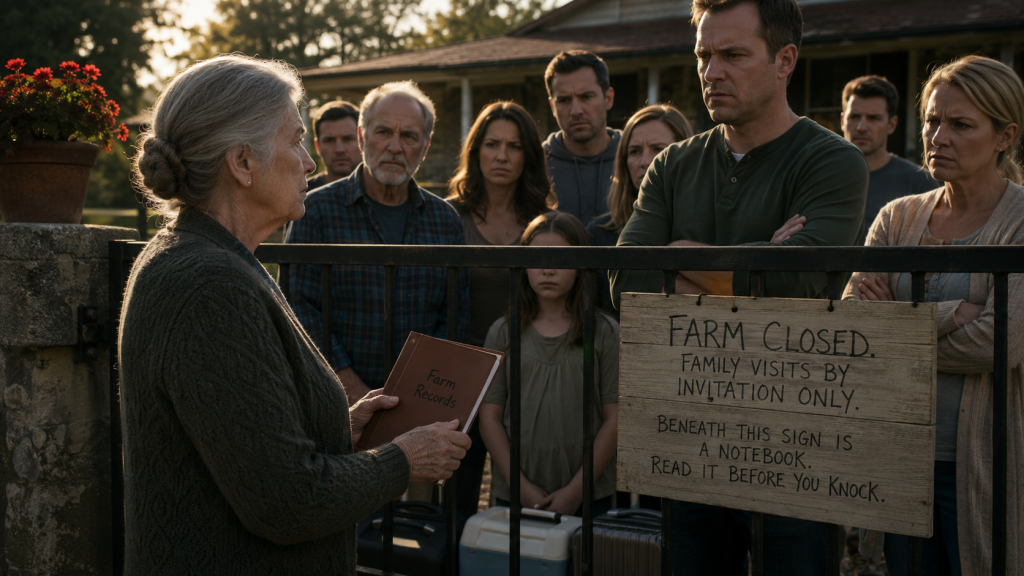
By ten, I had nailed a sign to the front gate.
It said:
FARM CLOSED. FAMILY VISITS BY INVITATION ONLY.
BENEATH THIS SIGN IS A NOTEBOOK.
READ IT BEFORE YOU KNOCK.
At noon, the first car pulled up.
Then the second.
Then the third.
They had gone into town for more drinks, ice, and groceries.
Now they were back, laughing, until they saw the locked gate.
Charlie got out first.
“Mom?” he shouted.
I stood on the porch, far enough that they could see me but not reach me.
Lauren rattled the gate.
“Barbara, this is ridiculous!”
The children started whining.
Melissa looked embarrassed.
David looked angry.
Charlie pointed at the sign.
“What is this supposed to mean?”
John walked to the gate and handed him the notebook through the bars.
Charlie frowned.
“What is this?”
“The thing you threw away,” I called.
He opened it.
At first, he looked annoyed.
Then his face changed.
Page after page showed the truth.
The first loan Joe and I took.
The year we almost lost the farm.
The hospital bill we paid for Charlie’s daughter when she broke her arm.
The money we gave Melissa for her divorce attorney.
The months David lived here rent-free after losing his job.
Every “small favor.”
Every “temporary help.”
Every time I said, “Don’t worry about paying me back.”
They had forgotten.
The notebook had not.
Lauren’s face went pale when Charlie turned to a page with her name on it.
“Wedding catering deposit — paid by Mom and Joe.”
Melissa took the notebook from him and flipped faster.
“College fund shortage — covered.”
“Truck repair — covered.”
“Mortgage payment — covered.”
“Summer camp — covered.”
Line after line.
Year after year.
Love written in numbers.
Sacrifice written in ink.
David swallowed hard.
“Mom, why would you write all this down?”
I walked slowly to the gate.
“Because your father believed memory fades when people are comfortable.”
Charlie lowered the notebook.
“Mom, we didn’t know.”
I laughed once, but there was no joy in it.
“You didn’t ask.”
Lauren crossed her arms.
“This is dramatic. We’re family.”
“Yes,” I said. “That is what I thought too.”
Charlie rubbed his forehead.
“Open the gate. We can talk inside.”
“No.”
Everyone went quiet.
I had never said no like that before.
Not to them.
Not with my whole heart behind it.
Melissa’s eyes filled with tears.
“Mom, please. The kids are tired.”
“The children are welcome another day,” I said. “When their parents learn how to ask.”
Charlie’s jaw tightened.
“So what? You’re kicking us out?”
“I am closing my home to people who treat it like a hotel.”
David stepped forward.
“We brought food. We planned this weekend.”
“You planned it without me.”
Lauren snapped, “Because you make everything emotional.”
I looked at her through the gate.
“No, Lauren. I made everything easy. That was my mistake.”
Then I held up the metal box.
Charlie’s eyes narrowed.
“What’s that?”
“The deed. The land documents. And my new will.”
No one moved.
I watched the words hit them harder than any shout.
“My lawyer is changing everything,” I said. “This farm will not automatically go to people who remove me from conversations and still expect my key under the flowerpot.”
“Mom,” Charlie whispered, “you can’t mean that.”
“I have never meant anything more.”
Melissa began crying.
David looked at the ground.
Lauren opened her mouth, but Charlie raised a hand to stop her.
For once, he looked at me like he saw a person.
Not an old woman.
Not a convenience.
His mother.
“Mom,” he said quietly, “I’m sorry.”
I wanted to believe him.
I really did.
But sorry spoken at a locked gate is different from sorry spoken before consequences arrive.
So I nodded.
“Then prove it slowly.”
They left that afternoon.
Not with shouting.
Not with apologies grand enough to fix everything.
Just silence.
One by one, they loaded their suitcases and coolers back into their cars.
Before Charlie drove away, he placed the notebook carefully on the stone pillar beside the gate.
Not thrown.
Not dismissed.
Placed.
That was something.
Not enough.
But something.
For three weeks, I heard almost nothing.
Then letters began arriving.
Not texts.
Letters.
Melissa wrote first.
She apologized for laughing when Lauren made jokes about me.
She admitted she had let convenience make her selfish.
David wrote next.
He said he had told his children the truth about the farm.
That Grandma’s house was not free.
That love was not permission.
Charlie’s letter came last.
It was six pages.
He wrote about being ashamed.
He wrote that removing me from the group had been cruel.
He wrote that he had mistaken my silence for weakness.
At the end, he asked if he could visit.
Alone.
I let him come on a Saturday.
He knocked.
For the first time in years, my son knocked on my door.
When I opened it, he was holding flowers in one hand and the old notebook in the other.
“I repaired the cover,” he said.
I looked down.
The stitching was uneven, but careful.
His eyes were red.
“I’m sorry, Mom.”
This time, I believed him a little more.
I let him in.
But I did not put the key back under the flowerpot.
Some lessons should remain visible.
Months passed.
The farm became quieter, but it did not feel lonely.
My children began calling before visiting.
They brought groceries instead of expecting mine.
They washed dishes.
They changed sheets.
They asked about the trees.
They listened when I told stories about Joe.
Not perfectly.
People do not become thoughtful overnight.
But they tried.
And trying, when it is honest, has weight.
One Sunday, all twelve came again.
This time, they arrived with no coolers, no speakers, no demands.
Charlie stood at the gate and called me.
“Mom, we’re here. Is it still a good time?”
I looked at the flowerpot by the side door.
Empty underneath.
Then I looked at Joe’s chair on the porch.
For the first time in a long while, I smiled.
“Yes,” I said. “Come in.”
That afternoon, we ate under the apple trees.
The grandchildren helped John carry chairs.
Lauren apologized to me quietly while we sliced tomatoes in the kitchen.
It was awkward.
It was late.
But it was real.
After dinner, Charlie asked if I would show everyone the notebook.
So I brought it out.
Not as a weapon.
As a reminder.
We sat together while I read the first page aloud.
Joe’s handwriting was faded, but still clear.
“This farm will survive only if love and respect live here together.”
No one laughed.
No one rolled their eyes.
Even the teenagers looked up from their phones.
When I finished, Charlie reached across the table and held my hand.
“I understand now,” he said.
Maybe he did.
Maybe he only understood the beginning.
But sometimes the beginning is enough.
I still have the metal box.
I still have the new will.
And the key?
The key is no longer under the flowerpot.
It hangs around my neck on a thin silver chain.
Not because I want to keep my family out forever.
But because I finally remembered something they had forgotten.
A mother’s love can open many doors.
But it should never be mistaken for a door left unlocked.
THE END! THANK YOU FOR READING!