
My stepdaughter arrived at the emergency room unconscious, and my husband calmly looked at the doctor and said, “She’s always been careless. She fell down the stairs again.”
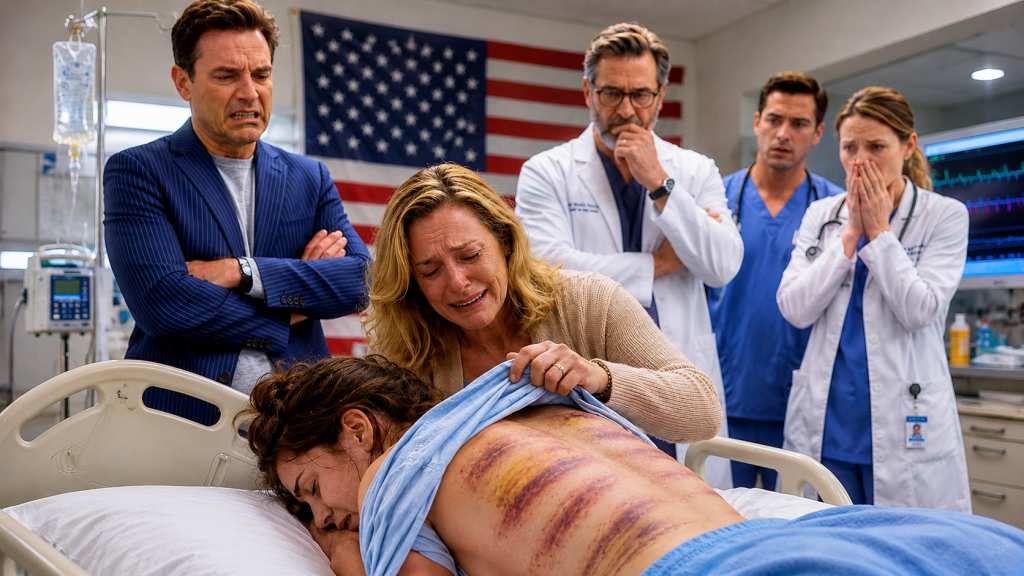
I pulled back her sleeve and froze when I saw bruises shaped exactly like his belt buckle. He leaned closer and whispered, “She isn’t even your biological child, so this isn’t your concern.”
I turned toward the security camera and replied, “The day I adopted her was the day she became my daughter, and you just confessed inside my hospital.”
The first thing I noticed was the dark stain spreading through Sophie’s sock. The second was the unsettling calm on Daniel’s face.
He stood beside the trauma bed with his hands in his coat pockets, speaking to the emergency doctor like he was explaining a broken vase instead of his unconscious thirteen-year-old daughter.
“She’s always been accident-prone,” Daniel said. “She fell down the stairs again.”
Again.
That word landed in the room like a stone.
Sophie lay completely still beneath the bright trauma lights.
Her brown hair was tangled around her pale face.
Her lips were cracked.
Her fingers twitched once, then went still again.
I was the Chief Medical Officer at St. Catherine’s Hospital.
I had spent years learning how to keep my voice calm during panic, how to look at bloodwork and scans instead of fear, how to make decisions while families sobbed beside me.
But in that moment, none of my training mattered.
None of my titles mattered.
I was not Dr. Mara Whitmore.
I was only the woman who packed Sophie’s lunches, braided her hair before school, waited in the parking lot after theater practice, and legally became her mother two years earlier.
Dr. Patel looked at me from the foot of the bed.
“Mara?”
His voice carried a warning.
He knew me well enough to know I was seconds from breaking.
I swallowed hard.
“Start a complete trauma assessment,” I said. “Full imaging. Toxicology. Labs. Photograph and document every injury.”
Daniel’s head snapped toward me.
“That’s unnecessary.”
I did not look at him.
“And notify child protection services immediately.”
The room went quiet.
The nurse beside Sophie froze with a blood pressure cuff in her hand.
Dr. Patel’s eyes shifted from me to Daniel.
Daniel gave a short, humorless laugh.
“Child protection? Mara, don’t be ridiculous. She fell.”
“She is unconscious,” I said.
“She hit her head.”
“She has injuries in different stages of healing.”
His face tightened.
“You don’t know that.”
I stepped closer to Sophie and gently lifted her sleeve.
The sight beneath it made my stomach drop.
Deep purple marks covered her upper arm.
Some were fading yellow at the edges.
Some were newer.
Then I saw the one that made everything inside me freeze.
A square-shaped bruise with a small broken corner.
Perfectly matching the buckle on Daniel’s black leather belt.
The belt he was wearing.
The belt I had seen hanging from his hand the night before when he told Sophie to go upstairs and “think about respect.”
My fingers trembled, but I kept my voice steady.
“Photograph this.”
The nurse nodded quickly.
Daniel stepped closer.
“Mara.”
I looked up.
His mouth barely moved when he whispered, “She’s not your real daughter. Stay out of this.”
For one second, the whole room disappeared.
I saw Sophie at eleven years old, standing in the hallway outside family court, clutching the stuffed rabbit I had given her.
She had looked up at me with terrified hope and asked, “After the adoption, can I call you Mom even when Dad is around?”
I had knelt in front of her and said, “You can call me Mom anywhere.”
She had cried so hard she got hiccups.
Now Daniel was standing in my emergency room, trying to erase that with one sentence.
My eyes shifted toward the black camera mounted above the trauma bay.
After a violent incident in the emergency department the previous year, every camera had been upgraded to record video and audio.
The warning notices were posted clearly at each entrance.
Daniel knew that.
Or he should have.
“She became my daughter the moment I adopted her,” I said quietly. “And you just confessed inside my hospital.”
For the first time, fear appeared on Daniel’s face.
But it disappeared quickly.
He had always been good at hiding.
“You honestly think a bruise proves anything?” he said. “I’m her biological father. People will believe me before they believe an angry ex-wife.”
That was his first mistake.
He thought I was angry.
He did not understand that I had moved beyond anger months ago.
Anger was hot.
Anger shouted.
Anger made mistakes.
What I felt now was colder.
Clearer.
I had spent eighteen months fighting our divorce for one reason only.
Sophie’s safety.
When I married Daniel, Sophie was nine.
Small for her age.
Quiet.
Always watching adults before speaking.
Her biological mother had died when she was six, and Daniel had built his identity around being the grieving widower who sacrificed everything for his daughter.
People believed him.
I believed him.
At first.
He was charming in public.
Generous with strangers.
The kind of man who remembered nurses’ names and tipped waitresses too much.
He cried when he talked about Sophie’s mother.
He told me he wanted Sophie to have a woman in her life again.
I loved that little girl before I admitted I was afraid of her father.
The signs came slowly.
A slammed cabinet.
A sharp correction.
A punishment that felt too harsh.
The way Sophie apologized before anyone accused her.
The way she flinched when keys hit the counter.
The first time I asked Daniel if he was too hard on her, he smiled sadly and said, “You don’t understand trauma parenting yet.”
I believed him because I wanted to.
Then Sophie started hiding food in her school backpack.
She wore long sleeves in summer.
She began sleeping with her desk chair under her bedroom door handle.
When I asked why, she said, “It makes me feel safer.”
That night I did not sleep.
I began documenting quietly.
Not because I wanted to destroy my husband.
Because I was terrified that if I moved too soon, I would lose access to Sophie completely.
Daniel controlled the story everywhere.
At school, he was the devoted father.
At church, he was the widower who found love again.
At court, he was the biological parent.
I was the stepmother.
The second wife.
The outsider.
Even after the adoption, he reminded me constantly that blood mattered.
But Sophie did not need blood.
She needed someone who would stay.
During mediation, Sophie finally told me the truth in fragments.
Not all at once.
Never directly at first.
She said Dad got scary when bills came.
She said Dad hated when she cried.
She said Dad told her no one would believe a dramatic little girl.
She said if I told anyone, he would make sure she never saw me again.
So I found a family attorney.
I found a child psychologist.
I spoke quietly with the hospital’s child protection team.
I created a plan.
Daniel thought my silence meant surrender.
It meant evidence.
Then, on a rainy Thursday night, he brought Sophie into my emergency room and lied in front of everyone.
A nurse entered holding a plastic evidence bag.
Inside was Sophie’s damaged phone.
“We found this hidden inside her boot,” she said.
Daniel’s face changed instantly.
It was brief, but I saw it.
Dr. Patel saw it too.
The nurse handed me the bag.
“The screen still turns on.”
I pressed the button.
Thirty-seven voice recordings were waiting.
My breath stopped.
Sophie had been recording him.
Daniel lunged forward.
“Give me that.”
Hospital security caught him before he reached the bed.
Two guards pinned his arms gently but firmly.
“Sir, step back.”
“That is my daughter’s property!”
“It is potential evidence,” I said.
His eyes burned into mine.
“You planned this.”
“No,” I said. “Sophie survived this.”
The monitor beside the bed suddenly screamed.
Every head turned.
Sophie’s heart rhythm changed on the screen.
Dr. Patel moved instantly.
“Pressure dropping. I need fluids wide open. Call neuro. Get respiratory in here.”
The room transformed into controlled chaos.
Nurses moved around me.
I backed away because I was her mother, not her doctor now.
That was the hardest thing I had ever done.
To stand there.
To let others fight for her.
Daniel looked at me while security held him.
“If she dies, this is your fault.”
The words were clear.
Cold.
Captured by the recording system above us.
I stared at him.
“No,” I said. “Whatever happens next belongs to you.”
Behind me, Sophie’s heartbeat fought beneath the machines.
She was still here.
And she was still fighting.
For three terrifying minutes, the room belonged to alarms, commands, and prayer.
Then the rhythm steadied.
Dr. Patel looked at the monitor.
His shoulders lowered just slightly.
“She’s stabilizing.”
My knees almost gave out.
A nurse touched my back.
“Dr. Whitmore, sit down.”
“I can’t.”
“You need to.”
“I said I can’t.”
Because if I sat down, I would fall apart.
And Sophie needed to open her eyes to someone standing.
Daniel was taken into the hallway, shouting that he was being framed.
His voice faded behind the sliding doors.
For the first time since Sophie arrived, the room felt safer.
Not safe.
But safer.
Dr. Patel approached me.
“Mara, she has a concussion, dehydration, and signs of repeated trauma. We’re still waiting on imaging. But she is stable for now.”
I nodded, though the words came through water.
“Can she hear me?”
“Maybe.”
I moved to the side of her bed.
Her face looked impossibly young.
Thirteen was old enough to carry secrets.
Too young to carry this.
I took her hand carefully.
“Sophie, it’s Mom. I’m here.”
Her eyelids fluttered.
For one second, I thought I imagined it.
Then her fingers moved inside mine.
A broken whisper came from her lips.
“Mom?”
One word.
That was all.
One word broke me.
I bent over her hand and cried silently.
“I’m here, baby. You’re safe now.”
Her eyes opened just enough to find mine.
“Don’t let him take me.”
“I won’t.”
“He said you would leave.”
“Never.”
“He said I wasn’t yours.”
I pressed my forehead to her hand.
“He lied.”
A tear slipped down her cheek.
“I recorded him.”
“I know.”
“I hid it in my boot because he checks my pockets.”
“You were so brave.”
“I was scared.”
“Brave people are scared too.”
Her eyes closed again, but her hand stayed curled around mine.
Child protection arrived within the hour.
So did police.
So did the hospital legal team.
The emergency department became a place of whispers and controlled movement.
A detective named Elaine Morris took my statement in a quiet consultation room.
She was gray-haired, sharp-eyed, and calm in a way that made me trust her.
She placed a recorder on the table and said, “Tell me everything from the beginning.”
So I did.
I told her about the adoption.
The long sleeves.
The fear.
The private disclosures.
The custody fight.
The phone recordings.
The belt buckle bruise.
The threat Daniel whispered.
The threat he shouted.
When I finished, Detective Morris looked through the glass wall toward Sophie’s room.
“You built a case before tonight.”
“Yes.”
“Why not report earlier?”
The question was not accusing.
It was careful.
“Because every time Sophie tried to speak, Daniel got ahead of the story. I was afraid a weak report would leave her alone with him.”
The detective nodded slowly.
“That happens more than people think.”
I looked down at my hands.
“I should have saved her sooner.”
“No,” Detective Morris said firmly. “He should not have hurt her.”
I closed my eyes.
I needed to hear that.
Even if I did not believe it yet.
By sunrise, a judge signed an emergency protective order.
Daniel was barred from contacting Sophie.
Barred from entering the hospital.
Barred from coming near me.
When the security director handed me a copy, I stared at the paper until the words blurred.
A piece of paper could not undo years.
But it could stand between my daughter and the next danger.
That mattered.
Sophie woke fully the next afternoon.
Her room was quiet, soft with morning light through half-closed blinds.
A nurse had braided her hair loosely to keep it off her face.
There were flowers from the pediatric unit on the windowsill and a stuffed bear from Dr. Patel, who pretended it was “standard neurological equipment.”
Sophie stared at the ceiling for a long time before speaking.
“Is he mad?”
I sat beside her bed.
“He can be mad somewhere else.”
“Is he coming?”
“No.”
“Did I get you in trouble?”
My heart cracked.
“No, sweetheart.”
“He said if I told, you’d lose your job.”
I took her hand.
“My job is fine.”
“He said he’d tell everyone you wanted his money.”
I almost laughed, but there was no humor in it.
“I have my own money.”
“He said the court would believe him.”
“The court has evidence.”
She swallowed.
“Are the recordings enough?”
“They help.”
“What if I sound stupid in them?”
I leaned closer.
“You sound like a child trying to survive.”
Her face twisted.
“I hate him.”
Then immediately, she panicked.
“I don’t mean that. I mean—I do, but he’s my dad, and I’m not supposed to—”
“Sophie,” I said gently. “You are allowed to feel everything.”
She stared at me.
“Even if it’s ugly?”
“Especially then.”
Tears filled her eyes.
“I wanted him to love me.”
“I know.”
“Why didn’t he?”
There are questions no mother can answer without lying.
I refused to lie to her again.
“Because something in him is broken in a way you could never fix.”
She cried then.
Not loudly.
Not dramatically.
Just a quiet, exhausted cry that seemed to come from somewhere deeper than her body.
I climbed carefully onto the edge of the bed and held her as much as the wires allowed.
She whispered into my sweater, “Am I really staying with you?”
“Yes.”
“What if the judge changes his mind?”
“Then I will fight again.”
“What if it takes years?”
“Then I’ll fight for years.”
“What if you get tired?”
“I won’t get tired of you.”
Her small fingers clutched my sleeve.
“Promise?”
I kissed her forehead.
“Promise.”
Daniel’s arrest made the local news two days later.
Not because of Sophie’s name, which was protected.
Because Daniel had spent years building himself into a respected businessman, charity donor, and grieving father.
The headline called him a “prominent local figure.”
I hated that phrase.
It made him sound important.
It did not mention how Sophie used to count footsteps in the hallway.
It did not mention the chair under her door.
It did not mention the little girl who apologized to nurses for needing water.
But the news brought phone calls.
Some supportive.
Some curious.
Some cruel.
People from church left messages saying Daniel must be misunderstood.
One woman said, “A father wouldn’t do that without a reason.”
I deleted that one before Sophie could hear it.
My mother-in-law, Daniel’s mother, called twelve times.
I finally answered on the thirteenth.
“Where is my son?” she demanded.
“In custody.”
“What have you done?”
I looked through the window at Sophie sleeping.
“I protected my daughter.”
“She is his daughter.”
“She is mine too.”
“You poisoned her against him.”
“No. His own voice did that.”
Silence.
Then she said, “You’ll regret this.”
“No,” I said. “I regret waiting.”
I hung up.
That night, Sophie had a nightmare.
I woke in the recliner beside her bed to the sound of her gasping.
“No, please, I’m sorry, I’m sorry—”
I was on my feet instantly.
“Sophie. Wake up. You’re safe.”
She thrashed once, then opened her eyes.
For a moment, she did not know where she was.
Then she saw me.
Her face crumpled.
“I thought I was home.”
I brushed hair from her forehead.
“You’re not there anymore.”
“I don’t want to go back.”
“You won’t.”
She looked around the hospital room.
“Can we make our house different?”
The question surprised me.
“Our house?”
“When I come home with you.”
I swallowed.
“Yes. We can make it any way you want.”
“No belts on chairs.”
“Done.”
“No yelling upstairs.”
“Done.”
“Can I have a lock?”
That one hurt.
Not because she asked.
Because she had lived in a world where a lock felt like love.
“Yes,” I said. “You can have a lock.”
“And a lamp that stays on?”
“As many lamps as you want.”
“And maybe yellow curtains?”
I smiled through tears.
“Yellow curtains.”
She nodded, exhausted.
“Okay.”
When Sophie was discharged five days later, every nurse on the unit found a reason to come say goodbye.
Dr. Patel signed her discharge papers himself.
He crouched beside her wheelchair and said, “You did excellent work as a patient.”
Sophie gave him a suspicious look.
“I mostly slept.”
“Exactly. Very professional.”
She smiled a little.
It was the first real smile I had seen since the emergency room.
Detective Morris met us at the back exit so we could avoid reporters.
She handed me a card.
“Call anytime. And Sophie?”
Sophie looked up.
The detective’s voice softened.
“What happened to you was not your fault.”
Sophie’s lip trembled.
She nodded once.
At home, I had done everything she asked.
Yellow curtains.
Soft lamps.
A new comforter with tiny stars.
A lock on the door, installed by the hospital maintenance chief himself after he heard the story and said, “No kid should have to ask twice.”
Sophie stood in the doorway for a long time.
“This is mine?”
“All yours.”
She stepped inside carefully, like the room might disappear.
On the bed was the old stuffed rabbit from adoption day.
She picked it up.
“You kept her?”
“Of course.”
Sophie hugged the rabbit to her chest.
Then she turned around and looked at me.
“Can I close the door?”
“Yes.”
“Will you be mad?”
“No.”
She closed the door.
I heard the lock click.
Then silence.
I sat down in the hallway outside her room and cried with my hand over my mouth.
Not because she locked me out.
Because she finally could.
The weeks that followed were not easy.
People think safety fixes everything.
It does not.
Safety is only the first clean breath after drowning.
Healing is what comes after.
Sophie jumped at loud noises.
She hoarded snacks under her pillow.
She asked permission to shower.
She apologized when she spilled water.
She woke up from nightmares and then apologized for waking me.
Every time, I told her the same thing.
“You are not in trouble.”
At first she did not believe me.
Then she believed me for five minutes.
Then ten.
Then a whole afternoon.
Progress looked small from the outside.
To me, it looked like miracles.
The first time she left her bedroom door open while doing homework, I had to go into the kitchen and pretend to wash dishes so she would not see me cry.
The first time she laughed at a movie without covering her mouth, I saved the memory like a photograph.
The first time she said, “Mom, can we order pizza?” without flinching, I said yes so fast she laughed again.
Meanwhile, Daniel’s legal case moved forward.
His attorney tried everything.
He claimed I was bitter about the divorce.
He claimed Sophie was confused.
He claimed the recordings were manipulated.
He claimed the hospital had conspired against him because I was an executive there.
But evidence has a weight that lies cannot always lift.
The camera footage captured his whisper.
The emergency room audio captured his threat.
The medical documentation showed patterns.
The recordings on Sophie’s phone showed his own words over and over.
Cold.
Controlled.
Cruel.
At the custody hearing, Sophie did not have to sit in the same room as him.
That was one mercy.
She testified through a child advocate.
I sat in the hallway with her while she waited.
She wore a yellow sweater and held the stuffed rabbit in her lap.
“What if I forget something?” she asked.
“Then you forget something.”
“What if I cry?”
“Then you cry.”
“What if he hates me forever?”
I took her hand.
“Sophie, love that depends on silence is not love.”
She looked at me for a long time.
Then she whispered, “Was he ever good?”
I thought carefully.
“Yes,” I said. “Sometimes he did good things.”
“That makes it confusing.”
“I know.”
“Can someone be good sometimes and still dangerous?”
“Yes.”
She nodded slowly.
“I think that’s the part that hurts.”
“Me too.”
When the judge granted me full custody and suspended Daniel’s parental rights pending the criminal case, Sophie did not react at first.
She sat very still.
Then she turned to me.
“So I don’t have to visit?”
“No.”
“Not even holidays?”
“Not even holidays.”
“Not even if he says sorry?”
“Not unless you want contact someday, and professionals agree it is safe. You are not being forced.”
Her shoulders began to shake.
I thought she was crying.
Then I realized she was laughing.
Not because it was funny.
Because relief sometimes escapes the body strangely.
She laughed and cried at the same time, and I held her in the courthouse hallway while people walked around us pretending not to stare.
That evening, we went for pancakes.
Sophie ordered chocolate chip pancakes, fries, and a strawberry milkshake.
“Is that dinner?” I asked.
She looked nervous.
“Is it too much?”
I handed the menu back to the waitress.
“It is a celebration.”
Sophie smiled into her milkshake.
“I’ve never had celebration fries.”
“Then we’re starting a tradition.”
Months passed.
The bruises faded.
The nightmares became less frequent.
Sophie started therapy twice a week.
Then once a week.
She joined theater again.
At first she only helped with props.
Then one day she came home and said, “I auditioned.”
I kept my voice casual.
“Oh?”
“I got a small part.”
“That’s wonderful.”
“It’s only three lines.”
“Three lines can change a whole scene.”
She rolled her eyes.
“You’re being Mom dramatic.”
Mom dramatic.
I loved that phrase more than any award I had ever received.
On opening night, she stood under the stage lights in a blue dress and said her three lines clearly.
Her voice shook, but it did not break.
After the show, I gave her yellow roses.
She looked embarrassed and pleased.
“You didn’t have to do that.”
“Yes, I did.”
She hugged me in the lobby.
In public.
Without fear.
That was another miracle.
Daniel eventually took a plea.
I did not attend the sentencing.
Sophie did not either.
Our attorney read the outcome to me over the phone while Sophie was at school.
Prison time.
Mandatory counseling.
Permanent restrictions.
A restitution order.
Consequences.
Not enough to erase anything.
But enough to name what happened.
When Sophie came home, I told her only what she needed to know.
“He admitted enough that there won’t be a trial.”
She set her backpack down slowly.
“So I don’t have to tell strangers everything?”
“No.”
She sat at the kitchen table.
“Is he going away?”
“Yes.”
“For a while?”
“Yes.”
She looked at her hands.
“I feel bad.”
I sat across from her.
“That’s allowed.”
“I also feel happy.”
“That’s allowed too.”
“What if that makes me a bad person?”
“It makes you a person who is safe.”
She cried then.
I made tea.
We sat together until the sky turned dark.
A year after the emergency room night, Sophie asked to visit the hospital.
Not as a patient.
Just to see it.
I hesitated, but her therapist said it might help if Sophie felt in control.
So on a quiet Sunday afternoon, I brought her through the staff entrance.
The trauma room had been repainted.
The camera was still there.
Sophie stood under it and looked up.
“That’s the one?”
“Yes.”
She stared for a long time.
“I used to think cameras were scary.”
“What do you think now?”
She glanced at me.
“That one helped.”
We walked past the nurses’ station.
One of the nurses recognized her and smiled.
“Hi, Sophie.”
Sophie smiled back.
Not hiding.
Not shrinking.
Just Sophie.
Before we left, she paused near the exit.
“Mom?”
“Yes?”
“Can we get celebration fries?”
I laughed.
“Always.”
Years later, people would ask me when Sophie became my daughter.
They expected me to say the adoption day.
The courthouse.
The signed papers.
The judge smiling while Sophie held my hand.
And yes, that was one answer.
But there were others.
She became my daughter when she asked if she could call me Mom.
She became my daughter when I learned how she liked her sandwiches cut.
She became my daughter when I stayed up all night sewing a costume for her school play.
She became my daughter when she trusted me with the truth.
She became my daughter when I stood in that emergency room and chose her over my marriage, my reputation, my fear, and every person who believed blood mattered more than love.
Daniel was wrong.
Biology is not the only claim a parent can have.
Sometimes motherhood is paperwork.
Sometimes it is packed lunches.
Sometimes it is sitting outside a locked bedroom door, grateful your child finally feels safe enough to close it.
Sometimes it is standing beneath a hospital camera and refusing to be silent.
Sophie is sixteen now.
She is taller than me.
She paints stars on her shoes.
She still loves theater.
She still keeps the stuffed rabbit on a shelf, though she pretends it is only “vintage decor.”
Sometimes she has hard days.
Sometimes a slammed door still makes her go quiet.
Healing is not a straight road.
But she laughs more than she apologizes now.
That is how I measure time.
Not in court dates.
Not in medical reports.
Not in scars.
In laughter.
Last week, she came home from rehearsal, dropped her backpack by the door, and called, “Mom, I’m starving!”
Such a normal sentence.
Such an ordinary teenage complaint.
I stood in the kitchen with tears in my eyes.
She saw me and groaned.
“Are you crying because I asked for pasta?”
“Maybe.”
“You’re so dramatic.”
“Yes,” I said, smiling. “Mom dramatic.”
She rolled her eyes and hugged me anyway.
That night, after she went upstairs, I found a note on the counter.
It was written in purple marker.
Mom,
I know you think you saved me.
You did.
But you also taught me that I was worth saving.
Love, Sophie.
I read it three times.
Then I placed it in the small wooden box where I keep the most important things.
Her adoption certificate.
The yellow rose ribbon from opening night.
The first drawing she ever gave me.
And now the note.
Proof of a life rebuilt.
Proof that love can be chosen and still be real.
Proof that a girl who once whispered, “Don’t let him take me,” could one day shout from the kitchen that she wanted pasta.
That is what survival looks like sometimes.
Not grand.
Not perfect.
Not painless.
Just a daughter coming home hungry.
A mother boiling water.
A house with yellow curtains glowing in the evening light.
And a locked door upstairs that no longer means fear.
It means safety.
It means choice.
It means she is finally home.
THE END! THANKS FOR READING!