
The smile was not arrogance. It was not forgiveness either. It was the smile of a woman who had survived long enough to stop asking cruel people for permission to exist. My father’s eyes narrowed. He had expected shame.
He had expected me to flinch. He had expected the same nineteen-year-old girl he had left in the rain with two broken suitcases and a heart he thought he owned. But I was not nineteen anymore.
And Alden Rowe was not God. He leaned closer, his voice lowering. “Do you think standing there quietly makes you dignified?” “No,” I said. “It makes me uninterested.” Griffin laughed, but it came out too sharp.
“Uninterested?” he repeated. “In what? The family you begged to be part of?” “I never begged,” I said. My father’s jaw tightened. A few people nearby had stopped pretending not to listen.
The string quartet continued playing in the corner, but the melody suddenly sounded thin beneath the silence around us.
Griffin turned his body slightly, performing for the small audience.
“You know,” he said, “Calder invited her because he has a soft spot for lost causes. Always has. Since he was a kid, he tried to save injured birds, stray dogs, and sad women with no place to go.” I looked past him toward Calder.
My nephew was watching from across the room, his face tense.
His bride stood beside him, one hand resting lightly on his arm.
She was beautiful in a quiet, commanding way.
Not fragile.
Not decorative.
Her posture was too straight for that.
Her eyes moved over the room like she was reading a battlefield.
I had only met her once before, three months earlier, at a small café near the water. Calder had called me unexpectedly and asked if I would meet the woman he was going to marry.
“I need her to know the truth about my family,” he had said.
When I arrived, she stood to greet me before Calder even finished saying my name.
“Commander Elise Vance,” she said, extending her hand.
“Retired?” I asked, noticing the careful bearing she carried.
“Not yet,” she replied.
Then she looked at me with a recognition that startled me.
“It’s an honor, ma’am.”
I had not heard anyone say that in a civilian place in years.
Not like that.
Not with meaning.
That afternoon, Calder told me he had invited me to the wedding despite knowing my father would object.
“I don’t want to start my marriage by being a coward,” he said.
I had almost refused.
Not because I feared my father.
Because I did not want to bring old poison into the happiest day of my nephew’s life.
But Elise had folded her hands around her coffee cup and said, “With respect, ma’am, men like Alden Rowe only keep power when everyone agrees to whisper around them.”
I liked her immediately.
Now, in the ballroom, she watched my father insult me with the stillness of someone waiting for the correct moment to strike.
My father followed my gaze and gave a dismissive huff.
“Don’t look to Calder for rescue,” he said. “That boy is emotional. Always has been. His mother made him soft.”
Griffin’s smile twitched.
Calder’s mother, my sister-in-law Annelise, had died when Calder was twelve.
She had been gentle, yes.
But not weak.
Weak people did not survive fifteen years married to Griffin Rowe.
I set my glass down.
“Careful,” I said.
My father blinked.
“Excuse me?”
“Speak about me however you like,” I said. “But don’t use a dead woman to make yourself feel tall.”
The quiet around us deepened.
Griffin’s face darkened.
“You don’t get to mention my wife.”
“I just defended her.”
“You abandoned this family,” he snapped.
“No,” I said. “This family abandoned me.”
My father laughed softly.
It was a terrible sound because it carried no humor.
“You were given every advantage,” he said. “Education. Refinement. A name people respected. And you threw it away because you were too selfish to understand duty.”
There it was.
Duty.
The word he had used like a chain.
For him, duty had meant obedience.
For me, eventually, it meant something else.
Something harder.
Something cleaner.
A memory rose before I could stop it.
The bus station at midnight.
My dress soaked from the rain.
My hands shaking around a paper cup of coffee because I had nowhere to sleep and only eighty-three dollars in my purse.
A Navy recruitment poster on the wall.
A woman in uniform standing beneath it, waiting for her younger brother.
She had seen me crying even though I was trying not to.
“You all right?” she asked.
“I don’t know,” I answered.
She had studied me for a moment.
Then she pointed at the poster.
“Sometimes the place you run to is not the place that saves you,” she said. “Sometimes it’s the place that teaches you how to save yourself.”
Three weeks later, I enlisted.
Not because I was brave.
Because I had nothing left to lose.
My father’s voice pulled me back.
“You became nothing,” he said.
I looked at him.
A strange calm moved through me.
He truly believed it.
All these years, he had imagined me somewhere small.
Poor.
Broken.
Maybe working behind counters.
Maybe married badly.
Maybe punishing myself for disobeying him.
He had never tried to find out.
That was the funny thing about people who think they own your destiny.
When you leave their reach, they prefer the version of you that failed.
It comforts them.
Before I could answer, Calder crossed the room.
“Aunt Maren,” he said, his voice tight. “Are you okay?”
Griffin turned sharply.
“This is your wedding, Calder. Don’t embarrass yourself.”
Calder ignored him.
He looked only at me.
“I’m sorry,” he said.
I touched his arm.
“You have nothing to apologize for.”
My father straightened, rearranging his face into the mask he wore in public.
“A small family misunderstanding,” he said to the people nearby. “Weddings stir old emotions.”
“No,” Calder said.
The room shifted again.
Alden Rowe was not accustomed to being contradicted by his grandson.
Calder’s face was pale, but he stood firm.
“This is not a misunderstanding,” he said. “You insulted my guest.”
“Your guest?” Griffin said. “She is here because I allowed it.”
Calder looked at his father.
“You didn’t allow anything. Elise and I made the guest list.”
Griffin’s nostrils flared.
“Watch your tone.”
Calder smiled sadly.
“I have watched my tone my entire life. I’m done.”
A murmur rippled outward.
My father’s eyes flashed.
“This is neither the time nor place.”
“You made it the place,” Calder said.
Then Elise appeared beside him.
The bride’s gown was ivory silk, simple and breathtaking, with no excessive lace or glitter. Her dark hair was pinned at the nape of her neck. She wore no veil now, only small pearl earrings and an expression so controlled it made the older men around her look nervous.
“Is everything all right?” she asked.
My father’s face transformed.
He smiled warmly, the way powerful men smiled at women they underestimated.
“Elise,” he said. “You look radiant. Forgive this little disturbance. Family history can be tedious.”
Elise glanced at me.
Then back at him.
“I don’t find history tedious, Mr. Rowe.”
Something in her tone was almost gentle.
That made it worse.
Griffin stepped in.
“My sister has always enjoyed making things uncomfortable.”
“Your sister,” Elise said, “has been standing quietly while three men insult her.”
Griffin’s mouth opened.
No words came.
My father’s smile thinned.
“Careful, my dear.”
Calder stiffened.
Elise did not.
“My dear?” she repeated.
The temperature in the room seemed to drop.
My father realized too late that he had chosen the wrong tone with the wrong woman.
Elise lifted one hand slightly.
A staff member near the stage noticed and nodded.
The string quartet faded out.
A soft microphone crackle filled the ballroom.
Guests turned toward the head table, confused.
Elise looked at Calder.
He gave her a small nod.
Then she took his hand and led him toward the stage.
My father muttered something under his breath.
Griffin leaned toward me.
“I don’t know what you think you’re doing,” he hissed, “but if you ruin my son’s wedding—”
“I’m standing here,” I said. “Your son is doing the rest.”
His face went red.
At the stage, Elise accepted the microphone from the bandleader.
She stood beneath the floral arch, her wedding gown glowing under warm chandelier light.
Calder stood beside her, shoulders squared.
“Good evening, everyone,” Elise said.
The room quieted immediately.
She smiled.
“Thank you all for being here to celebrate our marriage. Calder and I are grateful for every person who came to witness the beginning of our life together.”
Polite applause moved through the ballroom.
Elise waited.
“But before dinner continues, there is someone in this room I need to acknowledge.”
My father’s hand tightened around his glass.
Griffin looked suddenly uneasy.
Elise turned her head.
Her eyes found mine across the ballroom.
I felt every guest turn with her.
“For most of you,” she said, “this woman may seem like a distant relative seated near the back of the room.”
A few people glanced at Table 42.
“But to my husband, she is the aunt who never stopped answering his letters, even when his own family told him not to write to her.”
Calder lowered his gaze.
My throat tightened.
I remembered those letters.
The first had arrived when he was thirteen.
A simple envelope with uneven handwriting.
Dear Aunt Maren, Dad says I should not contact you. Grandpa says you made bad choices. But Mom once told me you were the bravest woman she knew. Is that true?
I had read it three times before answering.
Dear Calder, brave people are often just scared people who refuse to become cruel.
After that, the letters came secretly for years.
He told me about school.
About missing his mother.
About wanting to study engineering.
About hating the way his father spoke to waiters.
I wrote back from wherever I was stationed.
Italy.
Bahrain.
San Diego.
Norfolk.
The Pacific.
Sometimes months passed before I could respond, but I always did.
I never told him what to think about his family.
I only told him to become someone he could respect.
Elise continued.
“She was exiled from her family at nineteen because she refused to marry a man chosen for her as part of a business arrangement.”
A loud whisper crossed the ballroom.
My father’s face went rigid.
“She was told she would become nothing without the Rowe name,” Elise said. “So she left with two suitcases and built a life of service, discipline, and honor.”
My pulse slowed.
I knew what was coming now.
I had asked Calder not to do this.
He had promised he would keep it tasteful.
Apparently, his bride had a different definition of tasteful.
Elise’s voice strengthened.
“She served thirty-one years in the United States Navy.”
The room changed.
Not loudly.
But fully.
Heads lifted.
Conversations died.
My father stopped breathing.
“She commanded destroyers. She led humanitarian rescue operations after typhoons. She oversaw evacuation corridors under hostile conditions. She mentored officers who now serve all over the world. She received decorations she never speaks about, because true service rarely needs applause.”
My father looked at me as if seeing a stranger wearing my face.
Griffin’s mouth hung slightly open.
Elise’s eyes shone.
“And six months ago, she retired from active service with a rank very few ever earn.”
She set the microphone down briefly.
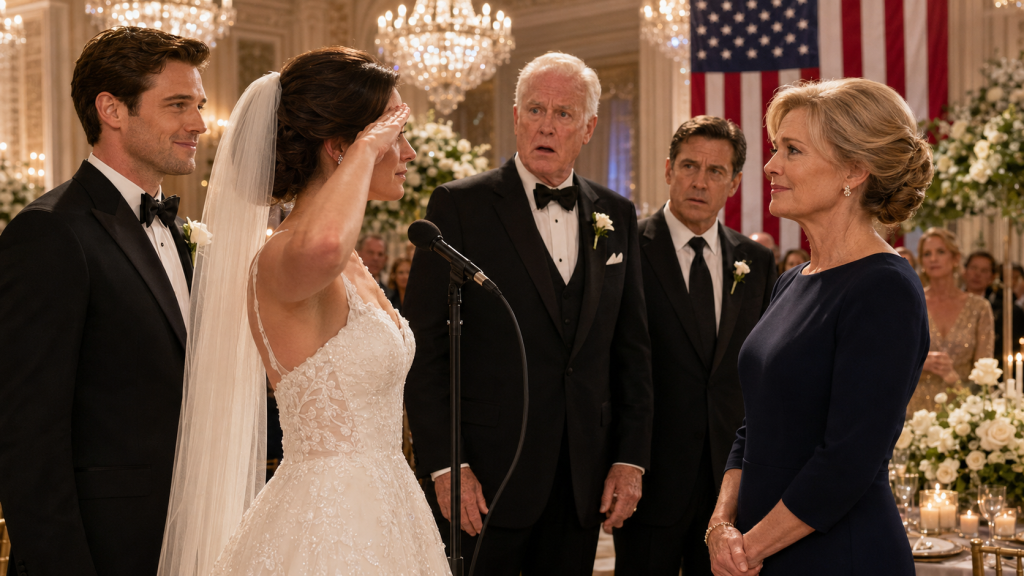
Then, in front of the entire ballroom, Elise Vance turned toward me, lifted her right hand, and saluted sharply.
Calder did the same.
My heart clenched.
Then Elise picked up the microphone again.
“Everyone,” she said, her voice clear as glass, “please raise your glasses for a toast to Admiral Maren Rowe.”
For one second, nothing happened.
The silence was enormous.
Then a chair scraped.
An older man near the center of the room stood.
I recognized him instantly.
Senator Whitcomb.
He had been on the Armed Services Committee years ago.
He raised his champagne flute.
“To Admiral Rowe,” he said.
Another guest stood.
Then another.
Then half the room.
Then all of it.
Glasses lifted under the chandeliers like stars.
“To Admiral Rowe,” the crowd repeated.
My father’s face had gone white.
Griffin looked as though someone had pulled the floor from beneath him.
I did not move.
I could not.
I had stood before crews during storms.
I had spoken in rooms full of generals, diplomats, and grieving families.
I had faced emergencies where hesitation could cost lives.
But nothing prepared me for hearing my name restored in the very room where my father wanted me small.
Elise lowered her salute.
Calder’s eyes were wet.
I lifted my glass slowly.
Not to my father.
Not to Griffin.
To Calder.
To the boy who had written letters because he wanted the truth.
To the man who refused to begin his marriage inside a lie.
The room drank.
Applause began quietly, then grew.
It filled the ballroom.
Not wild applause.
Respectful.
Heavy.
Real.
I wanted to disappear.
I wanted to laugh.
I wanted to cry.
Instead, I stood still and accepted it because I had learned, over many years, that refusing honor does not make you humble.
Sometimes it only insults the people offering it.
When the applause finally softened, Elise smiled.
“Dinner will be served shortly,” she said, as if she had not just detonated two decades of family mythology.
The quartet resumed playing.
But the ballroom was no longer the same.
People who had ignored me now looked embarrassed.
Guests near my table shifted aside as if I suddenly required more space.
A woman in emerald silk approached first.
“Admiral Rowe,” she said. “My husband served in the Navy. Thank you for your service.”
“Thank you,” I said.
A gray-haired man followed.
Then another couple.
Then Senator Whitcomb himself.
“Maren,” he said warmly. “It has been too long.”
My father heard that.
I saw it hit him.
Not only had I become someone.
I had become someone known in rooms he wanted access to.
He had spent twenty-one years telling himself I was nothing, while men he respected had learned to stand when I entered.
The irony was almost cruel.
Almost.
After the guests moved away, my father approached.
Slowly.
Not with apology.
Not yet.
Alden Rowe did not bend easily.
Griffin followed behind him, looking furious and humiliated.
My father stopped in front of me.
For the first time that evening, he did not look down at my dress, my shoes, or my empty neckline.
He looked at my face.
“Why did you never tell us?” he asked.
I almost smiled.
“Tell you what?”
His throat moved.
“That you had… done all this.”
“All this?” I repeated. “You mean my life?”
His eyes flickered.
Griffin snapped, “You let us believe—”
“I let you?” I turned to him. “You were adults. Telephones existed. So did search engines.”
His face reddened.
My father said quietly, “You changed your records.”
“I changed nothing. I stopped using Rowe socially for many years. Professionally, my name was always available. You never looked.”
That truth landed harder than any insult.
My father stared at me.
I knew what he was remembering.
Every charity gala where he boasted about family legacy.
Every dinner where he described Griffin as his only successful child.
Every time someone mentioned the military and he dismissed it as a fine place for people without options.
His daughter had been rising through the ranks while he was busy pretending she had fallen.
Griffin recovered first.
“So what?” he said. “You wore a uniform. Congratulations. That does not erase how you turned your back on us.”
Calder appeared beside me before I could speak.
“No,” he said. “You don’t get to rewrite this.”
Griffin glared at his son.
“Stay out of it.”
“It’s my wedding.”
“And I paid for half of it.”
Calder smiled faintly.
“No, Dad. You pledged to pay half. Then you threatened to pull the money unless Elise removed Aunt Maren from the guest list.”
Griffin’s face tightened.
The nearby guests began listening again.
Calder continued.
“So Elise and I paid for the wedding ourselves.”
Griffin looked around, suddenly aware of the audience.
My father looked at Calder.
“You should have come to me.”
“I did,” Calder said. “You said, and I quote, ‘Your aunt made her bed in poverty. Let her sleep in it.’”
The words struck the air like stones.
I had not known that.
For one moment, the old wound stirred.
Not because my father had said it.
Because Calder had heard it.
My nephew looked at me.
“I’m sorry,” he said.
I shook my head.
“No. Don’t carry his shame for him.”
Elise joined us then.
Her face was calm, but her eyes were sharp.
“Gentlemen,” she said, “I would prefer the rest of my wedding not become a trial. But if either of you insults Admiral Rowe again tonight, I will not be as polite as I was during the toast.”
Griffin stared.
“You’re threatening me at your own wedding?”
“No,” Elise said. “I’m establishing boundaries at my own wedding.”
I had to lower my eyes to hide a smile.
Calder looked at her as if he had married lightning.
My father took a slow breath.
“Calder,” he said, “perhaps we should speak privately.”
“No,” Calder said. “Not tonight.”
“Family matters should not be handled publicly.”
“You taught us the opposite,” Calder replied. “You humiliated Aunt Maren publicly. You insulted Mom publicly. Dad insulted waiters, staff, and anyone he thought beneath him publicly. You only want privacy when consequences arrive.”
For the first time, Griffin looked genuinely wounded.
Not sorry.
Wounded.
Men like my brother often mistake exposure for injustice.
My father’s hand trembled around his glass.
He looked older suddenly.
Not frail.
Just diminished.
“Maren,” he said.
I waited.
The old part of me wanted something.
An apology.
A confession.
A sentence that could travel backward twenty-one years and cover the girl in the rain with warmth.
But time does not work that way.
Alden Rowe could apologize now, and the rain would still have fallen.
The suitcases would still have split open.
The first winter in barracks would still have been lonely.
The letters from home would still have never come.
He swallowed.
“I may have misjudged certain things.”
Griffin looked at him sharply.
I stared at my father.
“That is not an apology.”
His face hardened by reflex.
Then he looked around.
Too many people were watching.
Too many people now knew enough.
He lowered his voice.
“I was harsh.”
“You were cruel.”
His jaw worked.
“I believed I was protecting the family.”
“You were protecting control.”
He flinched.
I did not enjoy it as much as I expected.
That surprised me.
For years, I had imagined confronting him.
In some versions, I shouted.
In others, he wept.
In the most childish versions, he begged me to return, and I walked away while he collapsed beneath the weight of his regret.
But reality was quieter.
There stood my father, a man who had lost the power to define me, and what I felt was not victory.
It was distance.
A vast, clean distance.
He said, “What do you want from me?”
The question stunned me.
Because for once, I knew the answer.
“Nothing.”
His eyes flickered.
“I’m serious, Maren.”
“So am I.”
“You must want something. An apology. Recognition. Some admission.”
I looked at him carefully.
“At nineteen, I wanted you to open the door.”
The room seemed to fade around us.
“I wanted you to say you were angry but I was still your daughter. I wanted Mother to run after me. I wanted Griffin to stop laughing. I wanted one person in that house to choose me.”
Griffin looked away.
My father’s face tightened.
“But now?” I continued. “Now I don’t want a door from you. I built my own.”
His eyes shone for the briefest second.
He blinked it away.
“And your mother?” he asked.
The question came like a knife slipped between ribs.
My mother had died eight years after I left.
She never called.
Not once.
But a box arrived after her death from an attorney I did not know.
Inside were my childhood drawings, my baby bracelet, and one short note.
I was not strong enough. Forgive me if you can.
I never knew whether I forgave her.
Some days yes.
Some days no.
I looked at my father.
“She made her choice.”
He nodded slowly.
For the first time, shame crossed his face without being immediately replaced by pride.
Then Griffin ruined it.
“Well, this is touching,” he said bitterly. “But let’s not pretend she came here for love. She came here to show us up.”
Calder turned on him.
“She came because I invited her.”
“She came because she wanted this moment.”
“No,” I said.
My voice was quiet, but everyone heard it.
“I came because your son asked me to witness his happiness.”
Griffin’s expression faltered.
“And despite everything,” I added, “I wanted to see him happy.”
Calder’s eyes filled again.
Griffin looked between us.
Something ugly and jealous moved over his face.
He had a son who had trusted me with his heart more than he had trusted his own father.
And even now, Griffin could not understand that love is not inherited by title.
It is earned by tenderness.
Elise touched Calder’s hand.
“Come,” she said softly. “We have guests waiting.”
Calder nodded.
But before he returned to the stage, he hugged me.
Not quickly.
Not formally.
He wrapped both arms around me like the thirteen-year-old boy who had once written, Is it wrong that I miss someone I barely know?
I held him tightly.
“You did good,” I whispered.
He laughed softly against my shoulder.
“You sound like my commanding officer.”
“I outranked most of them.”
He pulled back, smiling through tears.
Then he and Elise returned to their wedding.
Dinner resumed.
But the energy in the ballroom had changed completely.
Guests came to speak with me between courses.
Some asked about my service.
Some remembered operations I had hoped history would forget.
Some simply introduced themselves with new respect.
I answered politely.
I kept my stories short.
Not because I was ashamed, but because some things belonged to the men and women who lived them with me, not to ballroom curiosity.
At one point, a young woman in a black serving uniform approached my table while pouring water.
Her hands trembled slightly.
“Admiral,” she whispered, “my sister just joined the Navy.”
I looked up.
Her cheeks flushed.
“She’s scared,” the girl said. “Our parents think she’s making a mistake.”
I smiled gently.
“Tell her fear is allowed. Quitting on herself is not.”
The girl swallowed and nodded.
“Thank you.”
As she walked away, I felt my father watching me from the head table.
Not angrily now.
Studying.
As if trying to reconcile the daughter he had discarded with the woman strangers trusted.
After dessert, the dancing began.
Calder and Elise danced first.
They moved together beautifully, not perfectly, but honestly.
He laughed when she stepped on his shoe.
She kissed his cheek in apology.
It was the kind of small tenderness my family had always considered unsophisticated.
I thought it was magnificent.
Later, Calder came to my table.
“Aunt Maren,” he said, offering his hand. “Dance with me?”
I raised an eyebrow.
“You know I have two left feet.”
“You commanded ships.”
“Ships don’t require rhythm.”
He grinned.
“Please?”
So I danced with my nephew beneath crystal chandeliers while half the room pretended not to watch.
He held my hand carefully.
Like I was precious.
Like I had always belonged somewhere.
“I hope tonight wasn’t too much,” he said.
“It was definitely too much.”
He winced.
“But,” I added, “your wife is remarkable.”
His face softened.
“I know.”
“She will terrify your father.”
“I know that too.”
We turned slowly.
Then Calder’s smile faded.
“I spent years believing Grandpa about you,” he said. “When I was little.”
“You were a child.”
“I still feel guilty.”
“Don’t.”
“He said you were selfish.”
“I was nineteen.”
“He said you abandoned the family.”
“I survived it.”
Calder swallowed.
“Mom told me the truth before she died. Not all of it. Just enough. She said you were the only Rowe who ever chose freedom over appearance.”
My chest tightened.
Annelise.
Gentle, watchful Annelise.
I had not known she defended me.
“She was kind,” I said.
“She was lonely,” Calder replied.
I looked at Griffin across the room.
He was drinking too fast.
“Yes,” I said. “I think she was.”
The song ended.
Calder kissed my cheek.
“I’m glad you came.”
“So am I.”
Later that night, I stepped out onto the hotel terrace for air.
The city spread below in gold and silver lights.
Cold wind moved gently against my face.
For the first time all evening, I let my shoulders drop.
Inside, music and laughter continued.
Outside, I was alone with the stars.
Or so I thought.
The terrace door opened behind me.
I did not turn.
My father’s voice came quietly.
“You always liked the cold.”
“No,” I said. “I just learned not to complain about it.”
He came to stand beside me, leaving several feet between us.
For a while, neither of us spoke.
Below, cars moved like streams of light.
Finally, he said, “Your mother kept a file.”
I turned slightly.
“What?”
“After she died, I found a file in her desk. Newspaper clippings. Articles. Mentions of you.” His voice roughened. “She followed your career.”
I stared at him.
“She knew?”
“Yes.”
The wind felt suddenly sharper.
“And you?”
“I did not open it for years.”
“Why?”
His mouth twisted.
“Pride.”
At least it was honest.
“When I finally did,” he continued, “I convinced myself it could not be you. Or that the articles exaggerated. Or that rank did not mean character.”
I almost laughed.
“You really worked hard not to be proud of me.”
His face crumpled briefly.
“Yes.”
The simplicity of it hurt more than any excuse.
He gripped the stone railing.
“I was wrong.”
I said nothing.
“I was wrong about Easton Bell. He was later indicted for fraud. Did you know?”
“Yes.”
Of course I knew.
I had seen his face in the news fifteen years earlier.
My father exhaled.
“I would have handed you to him.”
“Yes.”
His hand trembled.
“I told myself marriage was strategy. That affection could come later. That women in our family had always understood sacrifice.”
“No,” I said. “Women in our family were trained not to scream.”
He closed his eyes.
For a moment, he looked every one of his seventy-six years.
“I don’t know how to repair this,” he said.
“You may not be able to.”
He nodded slowly.
The answer did not surprise him, but it wounded him anyway.
“I am sorry,” he said.
The words came quietly.
No audience.
No performance.
No witnesses except the city and the cold.
I had waited twenty-one years for those three words.
And when they finally came, they did not unlock the past.
They simply stood between us, small and late.
“Thank you,” I said.
He looked at me with something like desperation.
“That’s all?”
“That’s all I can give tonight.”
His eyes lowered.
“I deserved that.”
“You earned it.”
A small sad sound left him.
Not quite a laugh.
Not quite a sob.
We stood together in silence again.
Then I asked the question I had never allowed myself to ask.
“When I left, did you think I would come back?”
He did not answer immediately.
“Yes,” he said at last. “Within a week. Maybe two.”
“And when I didn’t?”
His voice became barely audible.
“I became angrier.”
“Because I survived?”
“Because you proved I was not necessary.”
The truth settled between us.
There it was.
Not duty.
Not family honor.
Not protection.
Control.
He had not only punished me for leaving.
He had hated me for living well without him.
I looked back at the city.
“I needed a father,” I said. “Not a king.”
He pressed his lips together.
“I know that now.”
“Good.”
Inside, the music shifted to something slower.
Through the glass, I saw Calder and Elise dancing again.
My father saw them too.
“He’s a good man,” he said.
“He chose to be.”
My father nodded.
“I don’t think Griffin knows how to love him.”
“No,” I said. “But Calder knows how to love anyway.”
That seemed to strike him deeply.
He turned toward me.
“Maren, may I write to you?”
The question was so unexpected that I looked at him fully.
Alden Rowe, who once threw my bags into rain, now looked like a man asking permission to knock on a door he had burned down.
“You may write,” I said.
Hope moved across his face.
“But I may not answer.”
The hope dimmed, but he accepted it.
“That is fair.”
“It isn’t about fairness,” I said. “It’s about peace.”
He nodded.
“I understand.”
I was not sure he did.
But perhaps understanding, like forgiveness, sometimes begins as discipline before it becomes truth.
When I returned to the ballroom, Griffin was waiting near the hallway.
His tie was loosened.
His eyes were bloodshot.
For a moment, I considered walking past him.
Then he stepped into my path.
“Are you satisfied?” he asked.
“No.”
That seemed to confuse him.
“You got your little tribute. You made Dad apologize, I assume. Calder thinks you’re some hero. What else do you want?”
“From you?” I asked. “Less than nothing.”
His face twisted.
“You always thought you were better than me.”
“No,” I said. “I hoped you would become better than you were.”
He flinched.
Then anger returned.
“Don’t talk to me like I’m a child.”
“Then stop acting like the boy who laughed while his sister was thrown out.”
He stared at me.
For one second, the old Griffin appeared.
Not the arrogant man.
The brother who used to sneak cookies into my room when I had nightmares.
The boy who once cried when our father hit his dog with a riding crop for tracking mud onto the porch.
That boy had existed.
But he had buried himself early to survive Alden Rowe’s house.
“I was twenty-three,” he said quietly.
“You were old enough.”
“I was scared of him too.”
The confession surprised me.
But not enough.
“So you stood beside him.”
His eyes filled with resentment.
“What was I supposed to do?”
“Something.”
He looked away.
“Easy for you to say. You left.”
“Yes,” I said. “I left. And you stayed. We both paid for our choices.”
He swallowed hard.
For a moment, I thought he might apologize too.
But Griffin was not ready to live without armor.
Instead, he said, “Calder will regret humiliating me.”
A coldness entered my voice.
“No, Griffin. He will regret it if you make him choose between loving you and respecting himself.”
His face hardened.
I stepped closer.
“Do not punish your son for telling the truth at his wedding.”
He scoffed.
“Is that an order, Admiral?”
“No,” I said. “It’s a warning from someone who knows what happens when a parent chooses pride over a child.”
He looked past me toward Calder.
His expression shifted.
Fear.
Not of me.
Of becoming our father.
For once, he said nothing.
I walked away.
The evening ended close to midnight.
Guests lined the front steps of the hotel with sparklers, laughing as Calder and Elise ran through them toward a waiting vintage car.
Elise saw me and broke away from the crowd.
She hugged me tightly.
“Thank you for coming,” she said.
“Thank you for the ambush.”
She pulled back, smiling.
“You’re welcome.”
“I did not agree to the toast.”
“No,” she said. “But you needed it.”
“I needed a quiet dinner and cake.”
“You needed witnesses.”
I studied her.
She was right.
That irritated me.
She grinned as if she knew.
Calder hugged me next.
“I’ll call after the honeymoon,” he said.
“Don’t,” I replied. “Enjoy your wife. Call when you’re home.”
He nodded.
Then he leaned closer.
“Grandpa cried on the terrace, didn’t he?”
I looked at him.
“Go to your car.”
He laughed and kissed my cheek.
I watched them leave beneath sparks and cheers.
The car rolled away into the city night, carrying two people brave enough to begin honestly.
When the crowd dispersed, I stepped back into the hotel lobby to collect my coat.
My father stood near the entrance.
Alone.
For once, no circle of admirers surrounded him.
He saw me and inclined his head.
Not commandingly.
Not proudly.
Almost humbly.
I nodded back.
That was all.
It was enough for tonight.
Outside, the air smelled like rain.
Not the heavy rain of twenty-one years ago.
A cleaner rain.
The kind that washed the streets without flooding them.
I walked toward the taxi stand with my coat over my arm.
My heels ached.
My clearance-rack dress moved softly around my knees.
In the hotel windows, I caught my reflection.
For a second, I saw the nineteen-year-old girl again.
Wet hair.
Shaking hands.
Suitcases at her feet.
Become nothing, my father had said.
I wished I could reach through time and take her face in my hands.
I wished I could tell her that one day she would stand in a ballroom full of chandeliers while people raised their glasses to her name.
I wished I could tell her she would command ships, cross oceans, survive storms, and become the kind of woman cruel men could no longer define.
But maybe she had known.
Maybe some small part of her, standing in the rain, had already understood that being unwanted by the wrong people can be the beginning of belonging to yourself.
My taxi arrived.
As I opened the door, my phone buzzed.
A message from an unknown number.
For a moment, I thought it might be my father.
It was not.
It was Griffin.
I stared at the screen.
Thank you for coming tonight. Calder was happy. Annelise would have been happy too.
I read it twice.
No apology.
Not yet.
But not cruelty either.
Sometimes change begins as a sentence that does not bite.
I typed back:
She would have been proud of him.
Then I got into the taxi.
As the hotel disappeared behind me, its chandeliers glowing through tall windows like trapped stars, I leaned back and let the city pass in silence.
Twenty-one years earlier, I had left my father’s house with nothing but rain, shame, and two suitcases.
That night, I left his world again.
But this time, I carried my name openly.
Not the Rowe name he thought he had given me.
My name.
Maren.
Admiral.
Aunt.
Survivor.
And for the first time in a long time, none of those titles felt heavy.
They felt like home.
💬THE END! THANK YOU FOR READING!