
My husband hit me for asking where he had been all night. The next morning, I made his favorite Southern breakfast and served it with a smile. He called me a “proper wife.” Then the kitchen door swung open, and every bit of color left his face. Everything changed because of one simple question.
“Where did you spend last night?” That was all I said. Not shouted. Not accused. Not thrown like a weapon. Just asked. My husband, Ethan Blackwood, replied with the back of his hand. The blow pushed my lip into my teeth, and in an instant, I tasted blood.
For a few seconds, the kitchen went still except for the rain tapping the windows and the soft crackle of grease cooling on the stove. Ethan stood above me, completely calm. His white dress shirt remained flawless.
His cufflinks caught the kitchen light. His wedding ring shone as if it meant something sacred. “Do not question me in my own home,” he said. His voice was cold. Not loud.
That was what frightened people about Ethan if they ever saw past the charm.
He did not need to shout to be cruel.
He knew how to make cruelty sound like instruction.
I touched my mouth and stared at the red on my fingers.
Then I looked up at him.
For one tiny second, something like uncertainty flickered in his eyes.
Maybe he thought I would scream.
Maybe he thought I would threaten him.
Maybe he thought I would finally become the hysterical woman he had been calling me behind closed doors for months.
But I did not move.
I did not speak.
I simply looked at him.
A smile slowly came back to his face when he understood I would not fight back.
That had always been the part he enjoyed most.
The quiet.
He confused it with fear.
With obedience.
With weakness.
In Ethan’s mind, I was only Charlotte Blackwood, the polished Southern wife who knew which fork belonged with salad, which charity board expected handwritten notes, and how to pour sweet tea while pretending not to notice lies.
He loved introducing me that way.
“My wife keeps our home running like a dream,” he would say at dinners, placing one hand on the small of my back as though I were both prize and property.
People smiled.
They loved us.
Ethan Blackwood, handsome real estate developer, heir to one of Charleston’s oldest families.
Charlotte Blackwood, daughter of Judge William Hart, elegant, gracious, always composed.
A perfect couple.
A perfect house.
A perfect lie.
What Ethan forgot was that I had been raised in the home of a respected judge.
Not just a father with a title.
A man who believed documents mattered.
A man who taught me that truth did not have to be loud if it had evidence.
What Ethan never valued was that I had spent years examining financial wrongdoing long before I became Mrs. Blackwood.
Before marriage, I worked in forensic accounting.
I followed hidden payments, shell companies, false invoices, and bank transfers that people thought were buried deep enough to stay invisible.
I knew how liars moved money.
And what Ethan did not know was that every suspicious conversation, every missing dollar, every false signature, every late-night call, and every lie he had told during the past six months had been carefully recorded.
Saved.
Copied.
Protected.
That night, he straightened his cufflinks as if nothing at all had happened.
“My mother is coming by in the morning,” he said. “Make breakfast. And try not to shame me.”
I pressed a napkin to my bleeding lip.
“Of course.”
That response pleased him.
His shoulders relaxed.
He thought the subject was finished.
He thought one strike and one command had restored the world to its proper order.
Then he left the kitchen.
I waited until I heard his study door close.
Only then did I let my hand tremble.
Not for long.
Fear is useful only if you let it sharpen you.
I walked to the pantry, opened the old flour tin on the highest shelf, and removed the second phone Ethan never knew existed.
It was not registered in my name.
My father had given it to me three months earlier after I finally told him, not everything, but enough.
At the time, he had listened in silence while I described missing business funds, strange phone calls, Ethan’s temper, and the way his mother, Margaret, made little comments about obedience every time Ethan embarrassed me in public.
My father did not interrupt.
He simply reached into his desk, removed the phone, and said, “Document everything. And if he ever puts his hands on you, call me before you talk yourself out of leaving.”
I had almost laughed then.
Not because it was funny.
Because I still wanted to believe Ethan would never cross that line.
People ask why women wait for the obvious.
They do not understand that the obvious arrives slowly.
First he corrects your tone.
Then your clothes.
Then your friends.
Then your spending.
Then your memory.
Then one day he lifts his hand, and a part of you whispers, But he was kind once.
That whisper is dangerous.
That night, I silenced it.
I took a photo of my lip.
Then another from a different angle.
I recorded a short video saying the date, time, and what had happened.
My voice sounded too calm.
I sent everything to my father.
Then I sent the backup files to Nora Pierce, my former colleague from the financial crimes division.
Nora had been waiting for the final piece.
For months, she and I had been quietly building a file on Ethan Blackwood.
At first, I thought he was only cheating.
The late nights.
The expensive cologne.
The hotel receipts he claimed were for client meetings.
The whispered calls from the porch.
Then I found the transfers.
Small at first.
Nine thousand here.
Twelve thousand there.
Payments labeled as consulting fees sent to companies with names like Harbor Growth Solutions and Palmetto Asset Management.
They sounded legitimate if you did not look too closely.
I looked closely.
Both companies traced back to a registered agent in Delaware.
Then to a holding company.
Then to a woman named Cassandra Vale.
Cassandra was a luxury interior designer Ethan had once dismissed as “a demanding client.”
She was also the woman photographed with him outside a Savannah hotel three weeks earlier.
But the affair was only the surface.
Ethan had been moving money from investor accounts into shell companies, inflating construction invoices, forging approvals, and using his mother’s social connections to silence questions.
Margaret Blackwood was not just proud of her son.
She was useful to him.
She had introduced him to wealthy widows, retired judges, old-money church donors, and family friends who trusted the Blackwood name more than contracts.
Then Ethan used their money.
And when questions came, Margaret smiled over tea and said, “My son is building something beautiful for Charleston.”
Beautiful.
That word covered a lot of theft.
By midnight, my father called the second phone.
His voice was controlled, which meant he was furious.
“Charlotte.”
“I’m okay.”
“No, you are not.”
“I know.”
A pause.
“Do you want me to come tonight?”
I looked toward the study door.
Light glowed under it.
Ethan was likely pouring bourbon, texting Cassandra, or congratulating himself for reminding his wife of her place.
“No,” I said.
“Charlotte—”
“Tomorrow morning. He told me to make breakfast. His mother is coming.”
My father understood me too well.
Another pause.
Then he said, “Are you certain?”
“Yes.”
“Nora has already contacted federal authorities. They were waiting for probable cause beyond the financial file. Domestic assault changes urgency.”
I closed my eyes.
The word assault sounded like it belonged to another woman.
Not me in my kitchen with a napkin pressed to my mouth.
“Will you come?” I asked.
“I will be there.”
“Bring them through the kitchen door.”
“Why?”
I looked around the room.
At the copper pans Ethan liked polished.
The long farm table Margaret had chosen.
The framed watercolor of the Blackwood estate hanging above the sideboard.
Because that room had witnessed too much silence.
“Because he thinks it belongs to him,” I said.
My father’s voice softened.
“Then tomorrow he learns otherwise.”
After we hung up, I did not sleep.
I changed the sheets in the guest room and slept there with a chair under the door handle.
Not because a chair could stop Ethan if he truly wanted to enter.
Because sometimes a symbol helps you survive the night.
At dawn, I rose.
My lip had swollen slightly, but makeup could not hide all of it.
I did not try too hard.
Let Margaret see.
Let her respond.
Some evidence is not paper.
Sometimes it is a person’s cruelty when they think cruelty is safe.
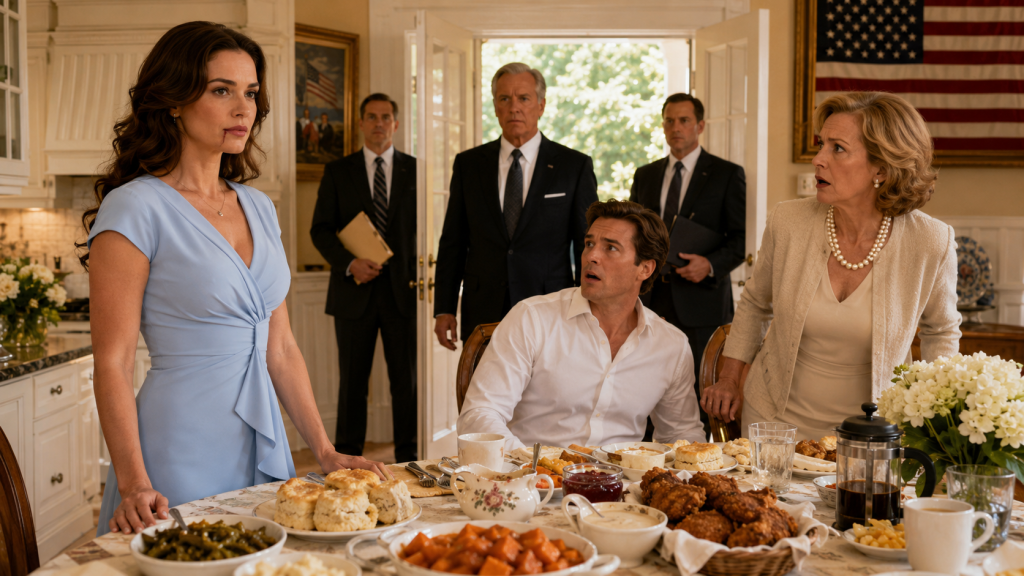
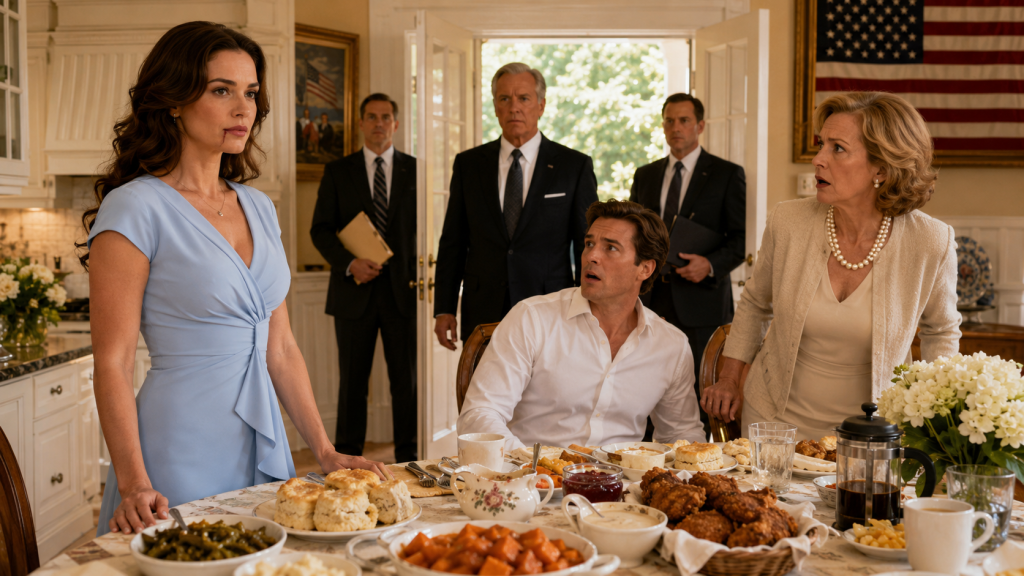
I put on a pale blue dress and tied my hair back with a ribbon.
Then I cooked.
Biscuits from scratch.
Peppered gravy.
Fried chicken.
Candied yams.
Buttered vegetables.
Sweet preserves.
Fresh coffee.
I made Ethan’s favorite Southern breakfast exactly as he liked it.
I wanted the house to smell like comfort.
Like tradition.
Like every lie he had used to trap me.
I shined the family silver.
Placed crystal glasses.
Set fresh magnolias in the middle of the table.
Everything appeared perfect.
Exactly how Ethan preferred it.
He came downstairs at 8:17, wearing a clean shirt and the casual confidence of a man who believed yesterday’s violence had already been absorbed into marriage.
His eyes went to my mouth.
Then away.
“Makeup would have helped,” he said.
I poured coffee.
“I tried.”
He seemed pleased by the answer.
“Mother hates mess.”
“I know.”
He sat at the head of the table and unfolded his napkin.
Not once did he apologize.
Not once did he ask if I was in pain.
Instead, he took a biscuit, split it open, and said, “See? Peace is easy when everyone remembers their role.”
I smiled.
Margaret Blackwood arrived fifteen minutes later.
She wore pearls, a cream suit, and judgment like perfume.
Her gaze landed on my injured lip immediately.
She paused in the doorway.
For half a second, I watched her decide what kind of woman she would be.
Then she gave a smug little smile.
“A wife ought to know when to stop speaking.”
There it was.
Clean.
Undeniable.
Ethan laughed.
I only poured her coffee.
“Good morning, Margaret.”
She handed me her gloves without looking at me.
“I hope breakfast is ready. I have a committee meeting at eleven.”
“Of course.”
Before long, they sat at the dining table like honored guests.
Admiring the food.
Praising the arrangement.
Fully certain they were still in control.
Margaret cut into a biscuit.
“At least you still know how to keep a table.”
Ethan leaned back in his chair.
“That’s what I told her. Charlotte just needs reminding sometimes.”
I set down the gravy boat.
My fingers did not shake.
Margaret smiled at him.
“You always were too patient.”
I almost laughed.
Patient.
That was one word for it.
Ethan reached for the silver dish of fried chicken.
“What a good wife,” he said proudly.
Then he looked at me with amusement.
“A proper wife.”
I stood beside the table, hands folded in front of me.
“Yes,” I said. “A proper wife keeps records.”
Ethan’s fork paused.
Margaret looked up sharply.
“What does that mean?”
I picked up one last covered dish from the sideboard and set it directly in front of Ethan.
It was heavy silver, engraved with the Blackwood crest.
His grandmother’s serving dish, Margaret once told me, reserved for important meals.
I stepped backward.
At that exact second, the kitchen door opened.
The entire room went silent.
Ethan turned toward the doorway.
The certainty disappeared from his face.
The coffee cup shifted slightly in his hand.
And for the first time that morning, he looked frightened.
Because the person stepping through that door was not anyone he ever thought would appear.
My father, Judge William Hart, entered first.
He was tall, silver-haired, and calm in the way only truly powerful men can afford to be.
Behind him came two federal agents in dark suits.
And beside them was Nora Pierce, my old colleague from the financial crimes division, carrying a thick evidence folder.
Ethan’s face went gray.
“Charlotte,” he whispered. “What is this?”
I lifted the silver lid from the covered dish.
Inside was not food.
It was a stack of printed bank transfers, offshore account records, shell company documents, photographs of him with Cassandra Vale, copies of forged signatures, and screenshots of messages he believed he had deleted.
Margaret stood so quickly her chair scraped the floor.
“How dare you bring outsiders into my son’s home?”
My father looked at my swollen lip.
Something dangerous moved behind his calm eyes.
“This is my daughter’s home too.”
One agent stepped forward.
“Ethan Blackwood, we have a warrant related to wire fraud, embezzlement, witness intimidation, and domestic assault.”
Ethan backed away from the table.
“Charlotte, tell them this is a misunderstanding.”
I smiled the same quiet smile I had worn while making his breakfast.
“A proper wife keeps records, Ethan.”
His mother gasped when agents moved toward his briefcase near the sideboard.
Ethan stepped in front of it.
“You can’t touch that.”
The agent held up the warrant.
“We can.”
They opened the briefcase.
Inside was the burner phone I knew he carried but had never been able to photograph, three envelopes of cash, a passport, a false driver’s license under another name, and a stack of investor checks marked for deposit.
Margaret pressed both hands to her mouth.
“Ethan?”
He snapped, “Mother, be quiet.”
That command struck her harder than any evidence.
For once, she was not his queen mother.
She was another obstacle.
Nora placed her folder on the table beside the biscuits.
“Mr. Blackwood, we have records connecting Harbor Growth Solutions and Palmetto Asset Management to your personal expenditures, including payments to Cassandra Vale, hotel stays in Savannah and Atlanta, luxury vehicles, and private gambling debts.”
Margaret’s eyes widened.
“Cassandra?”
I turned to her.
“The demanding client.”
Her gaze darted to Ethan.
“Is that true?”
Ethan ignored her and looked at my father.
“Judge Hart, surely this can be handled privately.”
My father’s expression did not change.
“You struck my daughter.”
Ethan swallowed.
“That was a marital disagreement.”
The room went cold.
My father stepped closer.
“No. That was a crime.”
Ethan’s mask cracked.
“You think you can come into my house and embarrass me?”
I looked around.
“My house.”
He turned toward me.
“What?”
“The deed is in my name. The down payment came from my inheritance. The mortgage is paid from my separate account. You signed the acknowledgment before the wedding.”
Margaret looked stunned.
“But Ethan said—”
“Ethan lied.”
Nora opened another document.
“He lied often.”
Ethan’s face twisted.
“You think you’re clever?”
“No,” I said. “I think I waited too long.”
He moved toward me so quickly one agent stepped between us.
“Careful,” the agent said.
Ethan stopped.
His hands curled at his sides.
For the first time, I saw him without charm.
No polished speech.
No Southern manners.
No gentleman developer.
Just a frightened man watching control slip away.
“You planned this?” he hissed.
I touched my split lip gently.
“No. You did. I only served it warm.”
Nora almost smiled.
Margaret sank back into her chair.
The pearls around her neck trembled with each breath.
“This will ruin us,” she whispered.
I looked at her.
“You said a wife ought to know when to stop speaking.”
Her eyes filled with tears.
“I didn’t mean—”
“Yes, you did.”
She flinched.
“Charlotte, please.”
“There it is,” I said softly. “Please. Not when he hurt me. Not when you saw my face. Only now that consequences arrived.”
My father put one hand lightly on my shoulder.
I had not realized I was shaking until then.
The agents began moving through the house.
One went to Ethan’s study.
Another secured his phone.
Nora asked for access to the office safe.
Ethan refused.
Then the agent showed him the search warrant again.
The safe contained more.
Forgery stamps.
Investor files.
A ledger with initials instead of names.
And a velvet jewelry pouch containing diamond earrings I had never seen.
Those earrings matched a photo Cassandra Vale had posted three days earlier before quickly deleting it.
Margaret stared at them.
Her face collapsed in slow motion.
“He bought her jewelry?”
I almost felt sorry for her.
Almost.
Because Margaret Blackwood could excuse cruelty.
She could excuse theft if it protected the family name.
She could excuse her son humiliating his wife.
But another woman receiving diamonds purchased with stolen money?
That reached her pride.
Not her conscience.
Pride.
Ethan was escorted to the foyer.
He was not handcuffed at first.
Then he tried to pull away.
The agent turned him, secured his wrists, and read him his rights.
Margaret made a strangled sound.
I stood very still.
There was no triumph in watching your husband taken from your home.
Only a strange emptiness.
Even when the man deserves it.
Even when you planned for it.
Even when your lip still throbs from his hand.
Marriage makes witnesses of objects.
The hallway table where he once left roses.
The stairs where he carried me laughing after our wedding reception.
The doorway where he now stood in handcuffs.
All of it existed together.
That was the cruel part.
Abusers are not monsters every second.
If they were, leaving would be easy.
Sometimes they bring flowers.
Sometimes they dance with you in kitchens.
Sometimes they remember exactly how you take your coffee.
Then one day they hit you and say it is their home.
Both versions are real.
Only one is safe to believe.
As Ethan passed me, he stopped.
His eyes were bright with fury.
“You’ll regret this.”
My father moved instantly, but I lifted a hand.
I wanted to answer for myself.
“No,” I said. “I regret yesterday. I regret every time before yesterday. Today is the first thing I do not regret.”
The agent led him out.
Rain had stopped.
Morning sunlight cut across the porch as Ethan Blackwood, golden son of Charleston society, stepped into a federal vehicle in front of the magnolia trees his mother had planted for our wedding.
Margaret stood at the open door watching.
Her face was ruined with shock.
“This will kill his father,” she whispered.
“His father died four years ago,” I said.
She turned, confused.
I continued.
“You mean this will kill the story you tell about him.”
She looked away.
I walked back into the dining room.
The breakfast was still warm.
Biscuits split open.
Coffee cooling in crystal cups.
Gravy thickening in its porcelain bowl.
It looked like a magazine spread interrupted by justice.
Nora joined me at the table.
“You okay?”
I laughed once.
It sounded brittle.
“No.”
“Good answer.”
She placed a sealed evidence bag on the table.
“I’ll need your full statement again at the field office. But not this minute.”
I nodded.
My father stood near the window, looking older than he had when he arrived.
Not weak.
Just heartbroken.
“I should have come last night,” he said.
“I asked you not to.”
“I am your father. I should have ignored you.”
“You taught me to build a case.”
His mouth tightened.
“I did not teach you to endure harm for evidence.”
“No,” I said. “Ethan taught me that.”
He closed his eyes.
“I’m sorry.”
I went to him then.
For the first time since the kitchen door opened, I let myself be a daughter.
Not a wife.
Not a witness.
Not a woman holding herself together by sheer force.
Just a daughter.
My father wrapped his arms around me, careful not to touch my face, and I cried against his jacket.
Margaret remained in the foyer.
No one comforted her.
Eventually, she turned toward us.
“Charlotte,” she said.
I stepped away from my father.
“What?”
“I didn’t know about the money.”
“I believe that.”
Her face softened with relief.
“But you knew about him.”
The relief vanished.
“You knew what kind of man he was when he was angry. You saw my lip this morning. You smiled. You said I should have stopped speaking.”
Her mouth trembled.
“I was raised differently.”
“So was I,” I said. “But I learned.”
She looked down.
For once, Margaret Blackwood had no perfect reply.
“Am I allowed to leave?” she asked quietly.
Nora answered before I could.
“Agents may need to speak with you regarding financial introductions you made on Ethan’s behalf. For now, do not destroy documents or contact potential witnesses.”
Margaret looked offended.
“I would never—”
Nora raised one eyebrow.
Margaret stopped.
She took her handbag and left through the front door without saying goodbye.
The house felt larger after everyone left.
The agents remained for hours.
They photographed Ethan’s study, removed boxes of documents, cloned hard drives, and labeled evidence.
I sat at the kitchen table with cold coffee and answered questions.
When did I suspect financial misconduct?
How did I obtain the records?
Where were recordings stored?
Did Ethan know?
Had he threatened me before?
Had he physically harmed me before?
That question made the room blur.
Because the answer was complicated.
Not like yesterday.
Not so clean.
There had been the night he gripped my wrist hard enough to bruise because I tried to leave a dinner early.
The time he threw a glass against the fireplace near my feet.
The time he blocked the bedroom door and said no wife of his walked away mid-conversation.
The time he drove too fast down a dark road while telling me I made him crazy.
Were those harm?
Yes.
Had I called them that?
No.
I answered truthfully.
Nora wrote carefully.
My father sat beside me without interrupting.
By evening, the house was quiet.
The kitchen smelled faintly of grease, magnolias, and coffee gone stale.
I stood alone at the sink and washed blood from a napkin.
Then I stopped.
Why was I washing evidence?
Old habits.
Clean the mess.
Smooth the tablecloth.
Protect the name.
I dropped the napkin into a paper bag and labeled it, as Nora had instructed.
The next days moved like a storm system.
Headlines appeared faster than I expected.
Prominent Charleston Developer Under Federal Investigation.
Blackwood Project Funds Questioned.
Sources Allege Investor Fraud.
Ethan’s attorney released a statement calling the investigation “a politically motivated domestic dispute.”
My father’s name appeared in online comments within hours.
People accused him of using influence.
Others said Ethan had always been arrogant.
Women I barely knew sent private messages saying, I’m sorry, and then stories of their own.
Cassandra Vale disappeared from social media.
Margaret stopped attending committee meetings.
The Blackwood family house closed its gates.
And I filed for divorce.
Not quietly.
Not politely.
Not with language about irreconcilable differences.
My petition included financial misconduct, abuse, dissipation of assets, and criminal investigation disclosures.
Ethan called from jail twice.
I did not accept.
Then he sent messages through his attorney.
He wanted to retrieve personal items.
He wanted access to the house.
He wanted to speak privately.
My attorney replied no.
That one word felt like medicine.
No.
A complete sentence.
A locked door.
A life raft.
Two weeks after Ethan’s arrest, I returned to the financial crimes division office to give additional statements.
Walking back into that building after years away felt strange.
People remembered me.
Some hugged me.
Some looked at my healing lip and did not know where to place their eyes.
Nora walked me into a conference room and spread documents across the table.
“He was deeper in than we thought,” she said.
“How deep?”
“Fourteen investors confirmed so far. At least three shell entities. Possible interstate wire fraud. We also found evidence he planned to move money overseas within the next month.”
My stomach turned.
“He was going to leave?”
Nora hesitated.
“With Cassandra.”
I looked at the documents.
A property inquiry in Belize.
A private flight quote.
Passport copies.
Transfers scheduled but not completed.
The night I asked where he had been, Ethan had not merely been cheating.
He had been preparing to run.
“Was I part of the plan?” I asked.
Nora’s silence answered first.
Then she said, “There was a life insurance policy increase request.”
The room tilted.
My father, who had come with me, stood so suddenly his chair scraped the floor.
“Nora.”
“We are investigating. There is no evidence of an imminent physical plan against Charlotte. But the financial motive exists.”
I pressed one hand against the table.
For months, I had thought I was uncovering theft.
Then betrayal.
Then violence.
Now I understood something darker.
Ethan had not seen me as a wife for a long time.
I was an obstacle with a signature.
A house.
A policy.
A name he could still use until he no longer needed me.
That night, I did not return home.
My father insisted I stay with him.
For once, I did not argue.
My childhood bedroom had been converted into a reading room years earlier, but he had the guest suite prepared with fresh sheets and a vase of garden roses.
I slept twelve hours.
When I woke, my father was in the kitchen making coffee badly.
My mother had died when I was sixteen, and he had never mastered breakfast beyond toast and overcooked eggs.
“You’re burning it,” I said from the doorway.
He looked at the pan.
“Yes.”
I laughed.
It startled both of us.
Then I cried again.
Healing, I learned, is rude.
It does not arrive gracefully.
It comes while coffee burns.
While your phone buzzes with attorney updates.
While you find a bruise fading and feel angry that your skin is moving on before your mind is ready.
The divorce took ten months.
The criminal case took longer.
Ethan tried every defense.
I was unstable.
I was vindictive.
My father influenced law enforcement.
Nora had a personal grudge.
The documents were misunderstood.
The transfers were temporary.
Cassandra was only a consultant.
His hand had “accidentally” struck me during an emotional argument.
That last lie made me leave the deposition room.
Not because I could not answer.
Because if I stayed, I might have broken the calm everyone expected from me.
My attorney followed me into the hallway.
“You don’t have to be composed every second,” she said.
“I know.”
“Do you?”
I looked at the courthouse floor.
Not really.
Composure had been my armor so long I sometimes mistook it for skin.
Eventually, Ethan accepted a plea agreement on several financial charges after two investors agreed to testify and Cassandra turned over communications in exchange for limited immunity.
The domestic assault charge remained part of the record.
Not as much punishment as some people wanted.
Not enough for my father.
But enough to end Ethan Blackwood’s public mythology.
He was sentenced to prison.
Ordered to pay restitution.
Stripped of licenses connected to his development work.
His company collapsed.
The Blackwood name, once spoken with reverence at country clubs and charity teas, became shorthand for scandal.
Margaret sold the family estate eighteen months later.
I heard she moved to a smaller home near her sister in Virginia.
She wrote me one letter.
Only one.
I almost threw it away.
Instead, I opened it standing over the kitchen trash can.
Charlotte,
I failed you as a woman and as an elder. I taught my son pride and called it dignity. I saw your injury and protected him with cruelty. I do not ask forgiveness. I only acknowledge what I did.
Margaret
No apology could restore what she helped protect.
But acknowledgement matters.
I folded the letter and placed it in a file labeled Past.
Not evidence.
Past.
Two years have passed now.
I still live in the house.
People asked why I stayed.
They said the kitchen must hold terrible memories.
It does.
But it also holds the morning I stopped being afraid.
It holds the door my father walked through.
The table where lies met paper.
The silver dish that served evidence instead of food.
I replaced the dining table.
Repainted the study.
Turned Ethan’s office into a music room, though I barely play piano.
I donated the Blackwood silver except for the covered dish.
That I kept.
Not because it was beautiful.
Because it reminds me that presentation can be deceiving.
People see polished silver and expect comfort.
Sometimes the truth waits underneath.
I returned to forensic accounting work part-time, then fully.
Now I consult for women leaving complicated marriages involving hidden assets.
I know how to find shell companies.
I know how to read false invoices.
I know the sound of a woman apologizing before asking for help because someone taught her needs were burdens.
I never tell them they should have left sooner.
That sentence helps no one.
Instead, I say, “You are here now. Let’s protect what remains and recover what we can.”
Sometimes they cry.
Sometimes they bring folders.
Sometimes they bring nothing but fear.
We start there.
Fear is still information.
Last month, I made biscuits for the first time since that morning.
For a long while, I could not bear the smell.
Peppered gravy made my stomach turn.
Fried chicken reminded me of Ethan leaning back in his chair, calling me a proper wife.
But my father came for Sunday lunch, and I wanted to take the memory back.
So I woke early.
Mixed flour and butter.
Rolled dough.
Cut circles with the rim of a glass.
The house filled with warmth.
Not performance.
Not obedience.
Just food.
My father arrived through the front door this time, carrying peach preserves and a newspaper tucked under his arm.
He paused in the kitchen.
“Are you all right?”
I looked at the biscuits cooling on the counter.
“Yes,” I said.
And I meant it.
Not perfectly.
Not forever.
But in that moment.
We ate at the new table near the windows.
No crystal.
No polished silver.
No Margaret judging the place settings.
Just chipped blue plates, fresh coffee, and sunlight across the floor.
My father took one bite and smiled.
“Your mother would have approved.”
I smiled back.
“She would have told you not to burn the coffee.”
He laughed.
So did I.
The sound filled the kitchen differently than Ethan’s laughter ever had.
Soft.
Safe.
Mine.
People sometimes ask what I felt when Ethan turned pale that morning.
Satisfaction?
Yes, for a second.
Relief?
Absolutely.
But mostly I felt clarity.
The kind that arrives when you finally stop trying to make a dangerous person understand your pain.
Ethan did not need to understand.
He needed to stop.
And since he would not stop himself, I opened the door to people who could stop him.
He thought breakfast meant I had surrendered.
He thought my smile meant obedience.
He thought my silence meant the house still belonged to him.
But while biscuits warmed in the oven and coffee brewed beside the stove, his world was already ending in folders, warrants, bank records, and saved recordings.
The kitchen door did not swing open by accident.
It opened because I asked for help.
That was the bravest thing I did.
Not gathering evidence.
Not making breakfast with a split lip.
Not standing still while federal agents entered my home.
The bravest thing was admitting I could not survive by being proper anymore.
I had to be protected.
I had to be believed.
I had to leave the role Ethan loved and become the woman he feared.
My husband hit me for asking where he had been all night.
The next morning, I made his favorite Southern breakfast.
He sat at my table, called me a proper wife, and smiled like a king.
Then the kitchen door opened.
My father walked in.
The agents followed.
Nora placed the evidence on the table.
And Ethan Blackwood finally learned that a quiet woman is not always helpless.
Sometimes she is listening.
Sometimes she is documenting.
Sometimes she is waiting until every lie is warm, plated, and ready to serve.
That morning, Ethan wanted breakfast.
So I gave him exactly what he deserved.
THE END! THANKS FOR READING!