
Last night, my son hit me, and I didn’t cry. This morning, I made pancakes and bacon, laid out the good tablecloth, and poured fresh coffee like it was a special occasion.
It wasn’t a celebration. It was the final breakfast of a mother who used to forgive everything. And when Dylan came downstairs smiling, he found the one man at my table he never thought he’d have to face again.
“If you ever tell me no again, I swear you’re going to regret giving birth to me.” That was what my son told me at half-past eleven last night, in the kitchen of my house in Evanston, Illinois.
My son. The boy who used to sleep with a little red toy car under his pillow.
The same boy who, as a toddler, would hug my legs and say, “Mom, when I grow up, I’m never going to let anyone make you cry.”
Last night, he was the one who raised his hand. My name is Eleanor. I am forty-nine years old.
I work at a school library, and for years, I confused being a mother with enduring everything.
I endured his yelling.
His slammed doors.
His lies.
His late nights coming home smelling of stale beer.
His jobs that never lasted.
His promises of “I’ll change tomorrow.”
His “you’re overreacting.”
His “you always try to make me look like the bad guy.”
Dylan is twenty-three years old.
He has broad shoulders, a loud voice, and a rage that does not feel like pain anymore.
It feels like a habit.
As a child, he was sweet.
Restless.
Affectionate.
He used to leave “pretty” rocks on the kitchen table because he said they were treasures.
Then came the divorce.
His father, Richard, moved to Milwaukee.
Dylan filled up with a bitterness that first made me pity him and later made me fear him.
I defended him far too much.
When he dropped out of college, I said he was confused.
When he lost his first job, I said they did not appreciate him.
When he lost his second, I said he was depressed.
When he started asking me for money to go out, I said he just needed a distraction.
When he stopped asking and started demanding, I said it was only a bad phase.
Mothers are experts at putting pretty names on the things that are destroying us.
Yesterday, I got home late from the library.
My feet were swollen.
My back was aching.
I was carrying a grocery bag with bread, eggs, and cheap coffee.
I had spent the whole afternoon helping seventh graders find books for a history project, smiling at children who still believed adults knew how to keep the world steady.
I unlocked my front door, stepped inside, and heard the television blaring from the living room.
Dylan was on the sofa with his shoes on the coffee table.
An empty beer bottle stood on the floor beside him.
There were crumbs on the rug.
A greasy plate balanced on the armrest.
He did not look up when I entered.
I set the grocery bag on the counter and began putting things away.
Bread in the box.
Eggs in the fridge.
Coffee in the cabinet.
Normal things.
Small things.
The kind of things a woman does when she is trying to pretend her home is still a home.
Then Dylan walked into the kitchen.
He did not say hello.
He did not ask if I had eaten dinner.
He just held out his hand.
“I need cash.”
I looked at him.
“I don’t have any.”
His face tightened.
“I didn’t ask if you had any. I said I need it.”
I felt my fingers tremble, but this time, I did not reach for my purse.
“It’s over, Dylan.”
He frowned.
“What?”
“I’m not giving you any more money for your drinking, your partying, or your lies. If you want to go out, get a job.”
His smile came slowly.
Ugly.
Humorless.
“And who do you think you are now?”
I took a deep breath.
“I think I’m the person who pays for this house.”
That was when I lost him.
Or maybe that was when I truly saw him for the first time.
His jaw tightened.
His eyes went empty.
He took a step toward me, and I felt, right before it happened, that a line was about to be crossed with no return.
“Don’t talk to me like that.”
“I am talking to you the way I should have a long time ago.”
He let out a short laugh.
“Then learn your place.”
I did not see the hand coming.
I just felt the blow.
Dry.
Hard.
My face whipped to the side.
I grabbed the edge of the counter to keep from falling.
The refrigerator buzzed.
The wall clock ticked entirely too loud.
The kitchen smelled of coffee, bread, and shame.
Dylan looked at me for a second.
I waited for him to get scared.
To say sorry.
To cry.
To realize what he had done.
Nothing.
He shrugged.
“Just so you understand.”
Then he went upstairs to his room and slammed the door.
I was left alone with my cheek burning and a heavy truth lodged in my chest.
I was no longer safe in my own home.
I did not cry.
That was what scared me the most.
Not because it did not hurt.
But because something inside me had finally stopped begging.
For years, I had begged in silent ways.
Begged him to see me.
Begged him to remember he loved me.
Begged him to return to the boy who placed rocks on my table like diamonds.
Begged God, the universe, my dead mother, anyone listening, to give me my son back.
Last night, after his bedroom door slammed, I realized I could love the boy he had been without surrendering to the man he had become.
At 1:20 in the morning, I picked up my cell phone.
I stared at Richard’s name for almost a full minute.
My pride said no.
My shame said no.
The mother who still wanted to protect Dylan said no too.
But the woman who had just been struck by her own son pressed call.
Richard answered with a sleep-heavy voice.
“Eleanor?”
I hesitated for two seconds.
Then I said the sentence I never thought I would say.
“Dylan hit me.”
On the other end of the line, there was silence.
Not empty silence.
Heavy silence.
As if everything Richard and I had done wrong as parents had just crashed down between us.
Then he spoke.
Firm.
Firmer than I had heard him sound in years.
“I’m on my way.”
“Richard…”
“Don’t ask me to stay out of it. Not this time.”
He hung up.
I did not sleep.
At four in the morning, I turned on the stove.
I made pancakes, scrambled eggs, hash browns, and bacon.
I brewed fresh coffee.
I brought out the good plates, the ones I only used on Thanksgiving.
I ironed the embroidered tablecloth my mother left me before she died.
It was not a party.
It was a funeral.
The funeral of the mother who justified everything.
As the pancakes browned in the pan, memories rose like steam.
Dylan at five, sitting on the counter, stealing chocolate chips.
Dylan at nine, crying because a stray cat would not let him pet it.
Dylan at thirteen, furious after the divorce, refusing to speak to Richard for months.
Dylan at seventeen, punching a hole through his bedroom wall and telling me it was my fault because I would not leave him alone.
That should have been the first sign.
No.
That was not true.
There had been signs before that.
A slammed door.
A cruel joke.
A demand.
A look in his eyes that made me lower my voice in my own kitchen.
I had simply trained myself not to count them.
Shortly before six, Richard knocked on the door.
When I opened it, he stood on the porch with grayer hair, a dark coat, and a brown manila folder under his arm.
He looked older than I remembered.
Not weak.
Just weathered.
He did not ask stupid questions.
He looked at my cheek.
He looked at my hands.
He looked at the table.
He understood everything.
“Is he upstairs?”
“Sleeping.”
His jaw clenched.
“Since when has this been happening?”
I could not answer quickly.
That, in itself, was an answer.
Richard closed his eyes.
“Eleanor…”
“I didn’t call you here to talk about old guilt.”
“But it’s there.”
“Yes,” I said. “And today, it ends.”
He set the folder down on a chair.
“I need to ask you something. And I need you not to answer as a mother. Answer as a woman.”
I looked at him.
“Ask.”
“Is he leaving this house today?”
It hurt like a knife twisting slowly.
I thought of Dylan as a little boy with scraped knees.
I thought of Dylan as a teenager, screaming that everyone always abandoned him.
I thought of Dylan last night, striking me and walking upstairs as if I were just another piece of furniture.
“Yes,” I said.
The word came out broken.
But it came out.
Richard lowered his head.
He did not celebrate.
He did not smile.
He simply exhaled like someone who was also burying something.
“Then you need to brace yourself when he comes down.”
“I know.”
“He is going to insult you.”
“I know.”
“He is going to blame you.”
“He already does.”
Richard opened the brown folder.
Inside were documents, copies, a lawyer’s phone number, and a prepared police report that did not have my signature yet.
I stared at the blank space.
My name waited there.
Eleanor Miller.
Mother.
Victim.
Woman.
For years, those three words had not managed to fit together in my head.
“I don’t want to destroy him,” I whispered.
Richard looked at me with deep sorrow.
“Eleanor, letting him continue isn’t saving him.”
That sentence hit me harder than Dylan had.
Because it was true.
At 7:17 in the morning, we heard footsteps upstairs.
Heavy.
Slow.
Walking with the confidence of someone who believes everyone in the house is terrified of him.
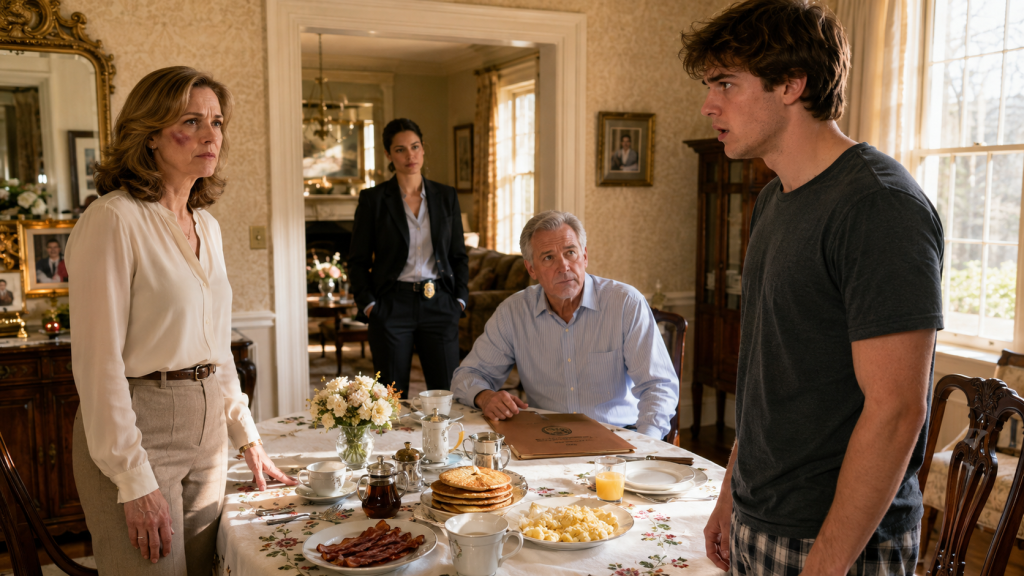
Dylan came downstairs with messy hair, wearing the same T-shirt from last night, a lazy smirk on his mouth.
He smelled the food.
He saw the tablecloth.
He saw the plated breakfasts.
His chest puffed out with pride.
“So you finally learned,” he said.
I did not answer.
He walked toward the table as if nothing had happened.
As if my cheek was not bruised yellow and purple.
As if his hand had not crossed a boundary with no way back.
Then he looked at the head of the table.
He saw Richard sitting there.
He saw the brown folder in front of him.
And he saw, standing by the front window, a woman in a dark suit with a detective’s badge hanging around her neck.
His smile vanished.
“What is this?”
Richard did not raise his voice.
“Sit down, Dylan.”
Dylan looked at the detective.
Then at me.
“What did you do, Mom?”
For the first time in a very long time, I did not look down.
I placed my hand on top of the folder.
I felt the paper beneath my fingers.
I felt my face burning.
I felt everything I had kept quiet for years stand up right alongside me.
And I said, “What I should have done the very first day you made me afraid.”
Dylan stared at me like he did not recognize my voice.
Then he laughed.
It was not real laughter.
It was a weapon.
“You called the police on your own son?”
Detective Harris stepped forward.
“Mr. Miller, I’m here because your mother reported an assault.”
His eyes snapped toward her.
“Assault? She’s being dramatic.”
Richard’s chair scraped softly against the floor as he stood.
“Careful.”
Dylan turned on him.
“Oh, now you want to play father?”
Richard’s expression did not change.
“I failed you in ways I’ll answer for. But not today. Today, you answer for what you did to your mother.”
Dylan’s nostrils flared.
He looked at me again.
“You really brought him here? After everything?”
“I brought him here because you are his son too,” I said. “And because I am done being alone with your anger.”
His face twisted.
“You’re unbelievable.”
Detective Harris spoke calmly.
“Dylan, I need you to remain calm and listen.”
He threw his hands up.
“For what? For her lies?”
“She has a visible injury,” the detective said. “She has given a statement. Your father is here as a witness to this conversation, and we are going to handle this safely.”
Dylan pointed at me.
“You see? This is what she does. She plays the victim. She knows exactly how to make people feel sorry for her.”
For a second, my old instinct rose.
Explain.
Soften.
Protect.
Tell everyone he was tired.
Tell everyone he was hurt.
Tell everyone he had a good heart underneath it all.
But then I remembered the sound of the slap.
I remembered the shrug.
Just so you understand.
My voice came out quiet.
“I am not playing anything, Dylan. I am done performing motherhood for a son who thinks love means obedience.”
His eyes flashed.
“I never asked to be born.”
“No,” I said. “You didn’t. But you are grown now. And being born did not give you the right to destroy me.”
Richard looked at the pancakes on the table.
Then at Dylan.
“Eat if you want. Then pack a bag.”
Dylan blinked.
“What?”
“You’re leaving today,” Richard said.
Dylan laughed again, but this time there was panic inside it.
“Leaving where?”
“You can come with me to Milwaukee for one week under strict conditions,” Richard said. “No drinking. No threats. No taking money from your mother. You look for work. You meet with the counselor I found. Or you can refuse and figure out where to go after the police finish here.”
Dylan looked at me.
“You’re kicking me out?”
My throat tightened.
“Yes.”
The word was small, but it stood.
He shook his head slowly.
“You’re my mother.”
“I know.”
“You’re supposed to help me.”
“I did. I helped you avoid consequences until consequences became the only thing that might save you.”
His face reddened.
“So that’s it? You’re choosing him over me?”
“No,” I said. “I am choosing safety over fear.”
The kitchen went still.
The clock ticked.
The coffee cooled.
The pancakes sat untouched on good plates, soft and golden, as if this were a normal morning in some other family’s life.
Detective Harris asked Dylan questions.
He denied everything at first.
Then he said I had “gotten in his face.”
Then he said I had “provoked him.”
Then he said he had “barely touched” me.
Each sentence was a small confession wearing a disguise.
Richard listened with one hand pressed against the back of a chair.
I watched his knuckles turn white.
Finally, the detective asked Dylan to step outside with her.
He looked at me one last time before following.
There was hatred in his eyes.
But beneath it, something else.
Fear.
Not of me.
Of losing control.
When the door closed behind them, I sank into a chair.
Richard sat across from me.
For a moment, we were not divorced.
We were not ex-husband and ex-wife.
We were just two parents sitting among the wreckage of what our child had become.
Richard rubbed his face.
“I should have been here more.”
I looked at him.
“Yes.”
He nodded.
No defense.
No excuses.
“I thought giving him space would make him come around,” he said. “Then I thought sending money was enough. Then I thought you had it handled.”
“I didn’t.”
“I know that now.”
I looked toward the front door.
“I kept thinking if I loved him harder, he would get better.”
Richard’s eyes filled.
“And I kept thinking if I stayed away, he would hate me less.”
We sat with that.
Some truths are too large to fix in one morning.
But naming them is still a beginning.
Detective Harris came back inside.
Dylan did not.
“He’s outside,” she said. “He’s upset, but calmer.”
I stood.
“What happens now?”
“That depends on what you want to do,” she said. “You can proceed with the report. You can request an emergency protective order. He can be removed from the home today.”
I looked at Richard.
Then at the table.
Then at the staircase.
I saw every version of my son there.
Little Dylan running down in pajamas on Christmas morning.
Teenage Dylan stomping upward after calling me names.
Adult Dylan coming down smirking because he believed breakfast meant surrender.
I picked up the pen.
My hand shook.
But I signed.
Eleanor Miller.
The letters looked strange.
Like they belonged to a braver woman.
Then I realized they belonged to me.
Dylan was not arrested in front of me.
I was grateful for that.
Not because I wanted to protect him from shame, but because my heart could only survive so much in one morning.
Detective Harris explained the next steps.
Richard went upstairs with another officer while Dylan packed.
I stayed in the kitchen.
I heard drawers open.
A closet door slam.
One muffled curse.
Then footsteps.
When Dylan came down, he carried a duffel bag over one shoulder.
His face was hard.
His eyes were wet.
That nearly broke me.
Not because tears erased what he had done.
They did not.
But because mothers are made with cruel memory.
We see the man and the child at the same time.
He stopped in front of me.
For one wild second, I thought he might apologize.
Instead, he said, “You’ll regret this.”
I looked at him.
“No, Dylan. I already regret waiting this long.”
His mouth trembled.
He turned away.
Richard opened the door.
Dylan stepped outside.
The cold morning air rushed in, sharp and clean.
Before Richard followed, he looked back at me.
“I’ll call you when we get there.”
I nodded.
Then the door closed.
And my house fell silent.
This time, the silence was different.
It did not feel like fear.
It felt like shock.
I walked to the table and looked at the untouched breakfast.
I had imagined this meal as a final scene.
A dramatic ending.
But real endings are not dramatic.
They are messy.
Half-eaten grief.
Cold coffee.
Pancakes nobody touches.
A chair pulled back too far.
A mother standing in a kitchen, wondering how saving herself could feel so much like losing a child.
I picked up one plate.
Then another.
Then I stopped.
I sat down and finally cried.
I cried for the little boy with the red toy car.
I cried for the young man who had let anger become his language.
I cried for the mother I had been.
The one who thought love meant absorbing every blow life handed her through her child.
I cried until the coffee went cold.
Then I washed the dishes.
That afternoon, I changed the locks.
The locksmith was a kind older man named Calvin.
He did not ask questions.
Maybe the bruise on my cheek answered them.
When he finished, he handed me the new keys.
“They’ll feel strange for a few days,” he said.
I closed my fingers around them.
“Good.”
That evening, Marsha from next door came over with soup.
She had seen the police car.
Neighbors always see more than they say.
She did not ask for details.
She just placed the pot on my stove and hugged me carefully.
“I’m here,” she whispered.
For years, I had believed shame demanded privacy.
But shame loves silence.
Healing does not.
Over the next week, the house revealed itself to me in new ways.
The hallway no longer made my stomach tighten.
The sound of a car passing outside no longer made me check the clock.
I stopped listening for heavy footsteps.
I stopped hiding my purse in the laundry room.
I stopped sleeping with my bedroom door locked and a chair against it.
That was when I understood how much fear had become part of my daily routine.
Richard called every night.
Not to report every detail, but to tell me Dylan was alive.
Angry.
Sullen.
Mostly silent.
But alive.
On the third day, Richard said, “He asked if you called.”
I closed my eyes.
“What did you say?”
“I told him you need peace more than he needs reassurance.”
A week later, Dylan left Richard’s apartment after an argument.
For twelve hours, no one knew where he was.
I almost broke.
The old Eleanor reached for her keys.
The new Eleanor called Richard, then the counselor, then the emergency contact number Detective Harris had given me.
At midnight, Dylan texted.
“Guess you’re happy now.”
I stared at the words until they blurred.
Then I typed back.
“I love you. I will not let you abuse me. Get help.”
He did not answer.
The next month was brutal.
There were legal appointments.
Counseling sessions.
Victim support meetings.
Phone calls I let go to voicemail.
Messages from Dylan that swung between rage and desperation.
“You ruined my life.”
“I need money.”
“You don’t care if I’m homeless.”
“I’m sorry.”
“You made me do this.”
“I miss home.”
Every message pulled at a different thread inside me.
Some nights, I sat with my phone in my lap, shaking from the effort not to rescue him from the consequences he had earned.
At my first support meeting, I almost walked out.
The room smelled like coffee and old carpet.
Women sat in a circle, all ages, all backgrounds.
I looked at their faces and thought, I do not belong here.
Then a woman named Teresa said, “The first time my daughter shoved me, I apologized to her.”
Something inside me cracked open.
After the meeting, Teresa touched my arm.
“Your child?”
I nodded.
“My son.”
She sighed.
“That one hurts different.”
“Yes,” I whispered.
She squeezed my hand.
“Different doesn’t mean you deserve it.”
I carried that sentence home like a candle.
Two months after the breakfast, Dylan agreed to attend a court-ordered counseling program.
Richard drove him.
Dylan refused to look at me when we passed each other outside the building.
He had lost weight.
His hair was longer.
His face looked younger somehow without the smirk.
For one second, my feet moved toward him.
Then I stopped.
Love could stand still.
Love did not always need to chase.
After the hearing, Richard walked me to my car.
“He’s starting to understand,” he said.
“Is he?”
“A little.”
I looked toward the building.
“I don’t know what I want anymore.”
Richard nodded.
“You want your son back.”
“Yes.”
“And you want to never be afraid of him again.”
My eyes filled.
“Yes.”
“Both can be true.”
I went home to my quiet house.
That night, I made soup and ate at the kitchen table alone.
The empty chair across from me no longer felt like punishment.
It felt like space.
Six months passed.
Spring came slowly to Evanston.
Snow melted from the edges of sidewalks.
The maple tree in my front yard began to bud.
At the library, students prepared for summer reading.
A little boy asked me for books about race cars, and I had to turn away for a moment because of the red toy car memory.
Healing is not a straight road.
It loops.
It tricks you.
One minute you are fine.
The next, a child asks for a book, and you are standing in the ruins again.
Then one Saturday morning, a letter arrived.
No return address.
I knew Dylan’s handwriting immediately.
I made tea before opening it.
My hands shook less than I expected.
The letter was four pages long.
The first page was defensive.
He wrote that I had embarrassed him.
That Richard had treated him like a criminal.
That the detective had looked at him like he was a monster.
The second page changed.
He wrote that he remembered the sound my head made when I hit the cabinet.
I had not remembered that part.
He had.
He wrote that he kept waiting for me to scream, but I didn’t.
He wrote that my silence scared him.
The third page was the hardest.
He wrote, “I think I hated you because you kept loving me when I knew I didn’t deserve it. It made me feel weak. So I tried to make you weak instead.”
I put the letter down and sobbed.
Not because it fixed everything.
It did not.
But because, for the first time, he had looked inward instead of pointing at me.
The final page held one sentence I read ten times.
“I am sorry I became someone you had to survive.”
I pressed the paper to my chest.
Then I folded it carefully and placed it in the drawer beside my mother’s tablecloth.
I did not invite him home.
Not then.
Forgiveness is not a key.
It does not automatically unlock the door.
I wrote back the next day.
“Dylan, I read your letter. I believe your apology is a beginning. I love you. I am proud you are facing yourself. I am not ready to see you at the house. We can meet with the counselor present when she believes it is time.”
He replied two days later.
“Okay.”
Just that.
Okay.
It was the most respectful word he had sent me in years.
Three weeks later, we met in a counseling office with beige walls and a box of tissues on every table.
Dylan sat across from me.
Richard sat beside him.
The counselor, Dr. Levine, explained the rules.
No shouting.
No blaming.
No interrupting.
Dylan kept his eyes on the floor.
When he finally looked up, he looked younger than twenty-three.
“I’m sorry,” he said.
His voice broke on the second word.
“I know saying it doesn’t make it okay.”
“No,” I said softly. “It doesn’t.”
He nodded fast, swallowing hard.
“I scared you.”
“Yes.”
“I hurt you.”
“Yes.”
“I thought because you were my mom, you’d never stop taking it.”
The room went quiet.
I looked at him.
“That is what almost destroyed us both.”
He cried then.
Not loudly.
Not dramatically.
Just tears slipping down his face while he tried to breathe through the shame.
I wanted to hold him.
Every cell in my body wanted it.
But Dr. Levine had warned me before the meeting.
Do not rush to comfort him out of accountability.
So I stayed seated.
I let him feel it.
That was one of the hardest acts of love I had ever performed.
Months turned into a year.
Dylan did not move back home.
He stayed first with Richard, then in a small room he rented from a man in his recovery group.
He got a job stocking shelves at a hardware store.
Not glamorous.
Not impressive.
But steady.
He started paying his own phone bill.
Then his own car insurance.
He sent me twenty dollars one Friday with a note.
“For the coffee I used to steal from your cabinet.”
I laughed and cried at the same time.
We had dinner in public places at first.
Diners.
Small restaurants.
A park bench with sandwiches.
He never came to my house without permission.
The first time I invited him over was almost eighteen months after the breakfast.
I told him he could come for Sunday lunch.
Richard came too.
Not because I was afraid, exactly.
But because trust rebuilds better with witnesses.
Dylan arrived holding flowers.
Not expensive ones.
Grocery store daisies.
He stood on the porch and waited.
He did not try the doorknob.
He did not use the old key he no longer had.
He waited until I opened the door.
That small act nearly undid me.
“Hi, Mom,” he said.
“Hi, Dylan.”
His eyes moved to my face, then away.
The bruise was long gone.
But we both saw it anyway.
Lunch was simple.
Chicken salad.
Bread.
Lemonade.
No good tablecloth.
Not yet.
We talked about work.
About Richard’s bad knee.
About a student at the library who had tried to return a book with peanut butter inside it.
For a while, we sounded almost normal.
Before he left, Dylan stood in the entryway.
“Mom?”
“Yes?”
“Thank you for not giving up on me.”
I held his gaze.
“I did give up on the version of you that hurt me.”
He nodded slowly.
“Good.”
Then he said, “I’m trying to give up on him too.”
Two years after the morning with the pancakes, I brought out the embroidered tablecloth again.
Not for a funeral this time.
For Thanksgiving.
Richard came.
Dylan came.
Marsha from next door came.
Teresa from the support group came too, because family is sometimes built from the people who help you tell the truth.
Dylan arrived early to help.
He peeled potatoes in the kitchen, standing where he had once raised his hand.
I noticed.
He noticed too.
After a while, he set the peeler down.
“I think about it every time I stand here,” he said.
I looked at him.
“So do I.”
His eyes filled.
“I’m sorry.”
“I know.”
“I hate that I made this room scary.”
I wiped my hands on a towel.
“Then help me make it safe again.”
He nodded.
And he did.
He cooked.
He cleaned.
He asked before opening cabinets.
He thanked me for dinner.
He laughed softly with Richard.
He listened more than he spoke.
At the table, before we ate, Richard raised his glass.
“To Eleanor.”
I shook my head.
“Don’t.”
“Yes,” he said gently. “To Eleanor. For surviving what she should never have had to survive. And for loving with boundaries instead of fear.”
No one clapped.
It was not that kind of moment.
But everyone lifted a glass.
Dylan’s hand shook as he lifted his.
I looked around the table.
The good plates were out.
The embroidered cloth lay smooth beneath our hands.
Coffee waited in the kitchen.
The house was warm.
The locks were new.
And I was no longer the mother who forgave everything.
I was the woman who learned that forgiveness without safety is not mercy.
It is surrender.
After dinner, Dylan helped wash dishes.
When he reached for a plate, I saw a small red toy car tattooed on the inside of his wrist.
I stared.
He noticed and lowered his sleeve slightly.
“I got it six months ago,” he said.
“Why?”
His voice was quiet.
“To remember who I was before I got angry. And who I’m trying to find again.”
I touched the edge of the sink.
For a moment, I saw him at three years old, sleeping with that toy under his pillow.
Then I saw him at twenty-three, standing in my kitchen with shame in his eyes and soap on his hands.
Both were my son.
But only one was welcome in my home.
I reached for a towel.
“Then keep looking,” I said.
“I will.”
That night, after everyone left, I folded the tablecloth carefully.
I did not cry.
Not because I was numb this time.
Because I was peaceful.
There is a difference.
I walked through the house, turning off lights.
The hallway.
The living room.
The kitchen.
At the front door, I paused and touched the lock.
For years, I had believed motherhood meant an open door no matter what came through it.
Now I know better.
A home without boundaries is not love.
It is a place where fear learns your schedule.
A mother can love her child and still call the police.
A mother can remember tiny hands and still protect her own face.
A mother can pray for her son and still change the locks.
A mother can serve breakfast and still make it the last meal before everything changes.
My name is Eleanor.
I am fifty-one now.
I still work at the school library.
Children still ask me for books about dragons, race cars, planets, and lost dogs.
Sometimes, when a mother comes in with tired eyes and a son who speaks to her too sharply, I want to pull her aside and tell her everything.
I want to say, Do not wait until love becomes fear.
I want to say, A boundary is not betrayal.
I want to say, Saving him cannot mean disappearing yourself.
But most days, I simply smile, stamp the books, and hope she learns sooner than I did.
As for Dylan, he is still healing.
So am I.
We are not the same family we were before that morning.
We never will be.
But sometimes, on Sundays, he comes for lunch.
He knocks.
He waits.
I open the door.
And every time he steps inside gently, respectfully, carefully, I remember the morning he came downstairs smiling and found his father, a detective, and the end of my silence waiting at the table.
That was the morning I lost the illusion that love could fix everything.
But it was also the morning I found something stronger.
My voice.
My safety.
Myself.
And this time, I am keeping all three.
💬THE END! THANK YOU FOR READING!