
My ten-year-old grandson was left alone at the airport by my daughter-in-law while she boarded a flight with my son and her own children for a two-week vacation.
Then she sent me a text saying she had decided he was grounded and should stay behind. I did not argue. I acted. And within three days, their perfect vacation was over.
My name is Evelyn Harper. I am sixty-eight years old, a widow, a retired teacher, and I have lived long enough to know there is a very clear line between discipline and cruelty.
That morning, I was standing on the balcony of my apartment in Cleveland, watering my basil plants, when my phone rang.
The caller ID showed an airport payphone.
For one strange second, I only stared at it.
Nobody called from payphones anymore.
Then I answered.
“Hello?”
“Grandma?” The voice was small. Shaking. It was my grandson, Noah. He was ten years old. At first, I smiled because I thought maybe he was calling to tell me about the plane, or the airport, or how excited he was to go to Orlando.
“Noah? Aren’t you supposed to be on a plane right now?”
There was silence.
Then I heard him take a shaky breath.
“They left me.”
My hand tightened around the watering can.
Water spilled over the balcony railing and splashed onto the concrete below.
“Who left you, sweetheart?”
“Mom. Dad. Everyone.”
His voice cracked on the last word.
“I’m at the airport. Gate B14. Mom said I was grounded because I argued with Mason yesterday. She told Dad I was in the bathroom. Then they got on the plane.”
For three seconds, I could not speak.
The whole world seemed to narrow down to that little voice on the phone.
The traffic below my apartment building kept moving.
Someone laughed on the sidewalk.
A bird landed on the balcony rail.
But inside me, something went perfectly still.
Then my phone buzzed.
A message appeared from my daughter-in-law, Lauren.
I opened it with trembling fingers while Noah was still breathing softly on the other end of the line.
The text read:
“I’ve decided Noah is grounded and will stay home. He needs consequences. We’re already boarding, so please pick him up. Don’t make this dramatic.”
Don’t make this dramatic.
My ten-year-old grandson had been abandoned in one of the busiest airports in Ohio while his father, his stepmother, and her two children flew to Florida for a two-week vacation.
And she had the nerve to tell me not to make it dramatic.
“Noah,” I said, forcing my voice to stay calm. “Listen to me carefully. Stay exactly where you are. Do not move. Find a security officer or a gate agent and tell them your grandmother is coming.”
“I already told the lady at the desk,” he whispered. “She said I could use the phone.”
“Good boy. I’m coming right now.”
“Am I in trouble?”
That question broke my heart cleanly in half.
“No, sweetheart. You are not in trouble. Not with me.”
I hung up and moved faster than I had moved in years.
I grabbed my purse, my car keys, and the emergency folder I always kept in my desk drawer.
My late husband used to tease me about that folder.
“Evelyn, you have a folder for everything,” he would say.
And I did.
Birth certificates.
Medical forms.
School records.
Copies of custody paperwork from when Daniel and his first wife had separated years earlier.
A list of emergency contacts.
A notarized document from Daniel, signed years ago, allowing me to make emergency decisions for Noah when needed.
At the time, Daniel had said it was just practical.
He never imagined it would matter.
Fifteen minutes later, I was driving toward Cleveland Hopkins Airport while calling airport police.
I did not scream.
I did not cry.
I gave the dispatcher Noah’s name, his age, the gate number, and the text message I had received.
The woman on the phone went quiet when I read Lauren’s message aloud.
Then her voice changed.
“Ma’am, officers are being sent to the gate now.”
“Thank you,” I said.
My hands were steady on the wheel.
That frightened me a little.
Because I knew myself.
When I was younger, anger made me shake.
But old age gives some women a terrible gift.
We stop wasting our energy on panic.
We save it for action.
When I reached the airport, I parked so badly I barely stayed between the lines.
I hurried inside, my purse banging against my hip, my knees aching, my heart pounding.
By the time I reached the security office near the concourse, a uniformed officer was waiting for me.
“Mrs. Harper?”
“Yes. I’m Noah’s grandmother.”
He led me through after checking my ID and speaking to another officer.
Then I saw Noah.
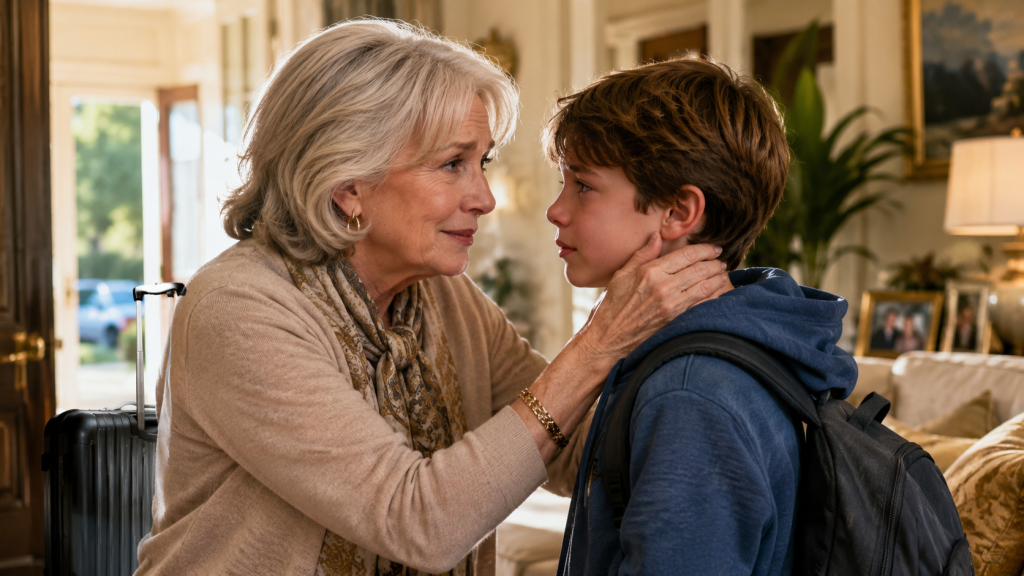
He was sitting on a plastic chair beside a security officer, clutching his backpack against his chest like it was the only thing keeping him safe.
His eyes were red.
The sleeve of his blue hoodie was damp where he had cried into it.
He looked smaller than ten.
Much smaller.
He stood when he saw me.
But he did not run.
That hurt more than tears would have.
A child who has been left behind learns caution too quickly.
I knelt down and opened my arms.
He stepped into them carefully, as if he was afraid even I might decide not to keep him.
I held him tightly.
“I didn’t do anything that bad,” he whispered.
“I know,” I said. “And you are not in trouble.”
He buried his face against my shoulder.
I smelled airport air on him.
Cold metal.
Floor cleaner.
Fear.
The officer asked me questions.
I showed him my ID, the emergency documents, a copy of Noah’s birth certificate, and the text Lauren had sent.
His expression changed as he read it.
He looked at me, then at Noah, then back at the phone.
“Ma’am,” he said quietly, “this is serious.”
“I know,” I replied.
Before we left the airport, I called my son, Daniel.
He answered on the fourth ring.
There was music in the background.
Loud, cheerful resort music.
“Mom,” he said, sounding annoyed before I even spoke. “Please don’t start.”
I looked at Noah.
Then at the officer standing beside me.
“Oh, Daniel,” I said. “I haven’t even started.”
There was a pause.
“What is that supposed to mean?”
“It means I am standing at the airport with your son, who was left here alone.”
Daniel sighed like I had interrupted his vacation with a minor inconvenience.
“Lauren said you were picking him up.”
“Lauren informed me after she abandoned him.”
“He wasn’t abandoned. Mom, don’t exaggerate.”
The officer’s eyebrows lifted.
I put the phone on speaker.
“Noah was alone at Gate B14,” I said. “He called me from an airport phone in tears.”
Daniel’s voice lowered.
“Mom, this is a family matter.”
“No,” I said. “The moment your child was left alone in an airport while you boarded a plane, it stopped being just a family matter.”
“Can you please not ruin this trip? The kids have been looking forward to it.”
I stared at my grandson’s pale face.
“The kids?” I repeated.
“My son is one of the kids, Daniel.”
“He argued with Mason. Lauren thought he needed consequences.”
“Leaving a child alone at an airport is not a consequence. It is neglect.”
“Mom—”
“No. Listen to me. I have already called airport police. I have the text. I have officers as witnesses. I am taking Noah home with me.”
“You can’t just do that.”
I almost laughed.
“Watch me.”
Then I hung up.
Noah flinched at the sound of the call ending.
I softened immediately.
“Come on, sweetheart,” I said. “Let’s go home.”
In the car, he was silent for the first ten minutes.
He sat with both hands wrapped around his backpack straps, staring out the window.
Finally, he said, “Dad didn’t know.”
I kept my eyes on the road.
“Did he see you before they boarded?”
“No. Lauren told him I was in the bathroom. She said I had been acting spoiled and needed to learn not everything was about me.”
I breathed in slowly.
“And what happened with Mason?”
Noah swallowed.
“Mason took my Nintendo charger and wouldn’t give it back. I grabbed it. He pushed me. I called him a jerk. Lauren said I ruined vacation before it even started.”
Mason was Lauren’s twelve-year-old son from her first marriage.
Her daughter, Ava, was eight.
Lauren called all three children “the kids” when it suited her.
But when something went wrong, Noah suddenly became “Daniel’s son.”
I had noticed it for years.
The smaller dessert.
The last choice of movie.
The forgotten permission slip.
The way Lauren’s voice sharpened when Noah interrupted but softened when Mason did the same.
I had spoken to Daniel before.
He always made excuses.
“She’s adjusting.”
“You’re too sensitive.”
“Noah needs to learn he’s part of a blended family.”
I had been a teacher for thirty-six years.
I knew what a child looked like when he was being slowly pushed to the edge of a family.
And I knew what adults sounded like when they were defending it.
When we reached my apartment, I made Noah tomato soup and grilled cheese.
He ate only half.
Then he curled up on my couch under the blue quilt my sister had made years ago.
I put cartoons on the television, but he barely watched them.
His eyes kept drifting to the door.
“You’re safe here,” I told him.
He nodded, but he did not fully believe me yet.
That was another thing that angered me.
Not the loud kind of anger.
The kind that settles in your bones.
After Noah fell asleep, I sat at my kitchen table and opened my laptop.
Lauren thought I was just an old woman who would pick up the mess and keep quiet.
She forgot what I had done before I became “Grandma.”
I had spent decades in classrooms.
I had reported bruises, hunger, emotional neglect, unsafe homes, and parents who thought children were property.
I knew how to document.
I knew how to write facts without emotion.
I knew what words mattered.
Minor child left unattended at airport.
Parent boarded flight.
Written admission by stepmother.
Father failed to ensure child was present before departure.
Child distressed and afraid.
Airport police involved.
By sunset, I had filed a formal report.
I had called a family attorney I knew from my teaching years.
I had contacted child protective services.
I had sent screenshots of Lauren’s text, Daniel’s call log, and the officer’s name to everyone who needed them.
Then I called Noah’s mother.
Her name was Rebecca.
She and Daniel had divorced when Noah was four.
She lived in Columbus now and worked as a nurse.
She had shared custody with Daniel, though Daniel had Noah most weekends and some school breaks.
Rebecca answered with the tired voice of someone coming off a long shift.
“Evelyn? Is Noah okay?”
The fact that she asked that immediately told me everything about her instincts.
“He’s physically safe,” I said. “But something happened.”
I explained.
For a moment, there was no sound.
Then Rebecca said, very softly, “They left my son at an airport?”
“Yes.”
“Where is he now?”
“With me.”
“I’m coming.”
“Rebecca, you just finished a shift. It’s late.”
“I’m coming,” she repeated.
She arrived at my apartment just after midnight, hair pulled into a messy bun, still wearing her nurse’s shoes.
The moment Noah saw her, he broke.
He ran to his mother and sobbed so hard his whole body shook.
Rebecca dropped to the floor and held him.
She did not ask him why he had argued.
She did not tell him to calm down.
She just held him and said, “I’ve got you. I’ve got you. I’m so sorry.”
I turned away to give them privacy, but not before I saw Rebecca’s face.
It was not only grief.
It was fury.
The next morning, Daniel called thirty-two times.
I did not answer.
Lauren called twelve times.
I did not answer.
Then the texts started.
From Daniel:
“Mom, you are blowing this out of proportion.”
From Lauren:
“He was safe. Airports have security everywhere.”
From Daniel:
“You’re making me look like a bad father.”
From Lauren:
“You always hated me.”
From Daniel:
“Call me NOW.”
From Lauren:
“If Rebecca hears about this, it will be your fault.”
I stared at that last message for a long time.
Then I forwarded it to Rebecca and the attorney.
By noon, Daniel finally left a voicemail.
His voice had changed.
The annoyance was gone.
Now there was fear underneath it.
“Mom, listen. The hotel manager came to our room this morning because someone from child services called. Lauren is freaking out. The kids are upset. This is getting out of hand. Please call me.”
I played the voicemail twice.
Then I looked at Noah, who was building a small Lego car at my coffee table with Rebecca sitting beside him.
He looked up at me.
“Is Dad mad?”
I put the phone down.
“Your father is facing the consequences of his choices.”
Noah looked back at the Legos.
“I don’t want him to hate me.”
Rebecca closed her eyes.
I sat beside him.
“Noah, adults are responsible for adult choices. You are not responsible for what your father or Lauren did.”
“But if I didn’t argue with Mason, maybe they would’ve taken me.”
That sentence was the one that made Rebecca cry.
Quietly.
She turned her face away, but I saw.
I had heard children blame themselves for adult cruelty my entire career.
It never got easier.
“No,” I said firmly. “A child can argue. A child can make a mistake. A child can be angry. But a child should never be abandoned.”
Noah nodded slowly, but I knew one conversation would not undo what had been done.
That afternoon, my attorney, Mr. Caldwell, came to my apartment.
He was in his seventies, sharp-eyed, and still wore suits even on Saturdays.
He had helped many families in our old school district.
He sat at my kitchen table, reviewed every document, and spoke gently to Rebecca.
“You have grounds to request an emergency custody modification,” he said. “Given the written message, the airport report, and the child’s statement, I would advise filing immediately.”
Rebecca nodded.
“Do it.”
Mr. Caldwell looked at me.
“Evelyn, your documentation is excellent.”
“I wish it didn’t need to be.”
“So do I.”
By evening, legal paperwork had been filed.
An emergency hearing was scheduled.
Daniel and Lauren were notified.
Their vacation was no longer a vacation.
On the second day, the story began spreading through the family.
I did not post anything online.
I did not call relatives to gossip.
I did not need to.
Lauren had apparently called her sister crying, claiming I had “kidnapped” Noah from the airport.
Her sister called Daniel’s aunt.
Daniel’s aunt called me.
I answered because Aunt Margaret was eighty-two and had earned the right to ask direct questions.
“Evelyn,” she said, “tell me plainly. Did Lauren leave that boy at the airport?”
“Yes.”
“Did Daniel know?”
“He says he didn’t know until afterward. But he boarded a plane without seeing his son.”
There was a long silence.
Then Margaret said, “Your late husband would have torn the roof off the house.”
“Yes,” I said. “He would have.”
“Good,” she replied. “Then you do it for him.”
I almost smiled.
Almost.
That night, Daniel finally reached Rebecca.
She put him on speaker while Noah was asleep in my guest room.
“Rebecca, I swear I didn’t know,” he said. “Lauren told me he was in the bathroom and then said you and Mom had agreed he should stay home.”
Rebecca’s voice was cold.
“You boarded a plane without physically seeing your ten-year-old child?”
“I thought he was with Lauren.”
“Lauren was on the plane.”
“I was dealing with bags and boarding passes and Ava was crying—”
“And Noah was missing.”
Daniel went silent.
Rebecca continued, “At what point during boarding did you ask where your son was?”
No answer.
“At what point when the plane door closed did you ask where your son was?”
Still no answer.
“At what point during takeoff did you look at the empty seat and wonder why your child wasn’t in it?”
Daniel’s voice broke.
“Lauren said she changed his seat.”
Rebecca laughed once, but there was no humor in it.
“She changed his seat to Gate B14?”
“Rebecca, please.”
“No. You don’t get to ask for please. You left my child. Whether you planned it or allowed it through carelessness, you left him.”
“I’m coming back.”
“You should have come back the moment you knew.”
“We couldn’t just get off the plane.”
“You could have landed and taken the first flight home. Instead, you checked into a resort.”
Daniel had no defense for that.
Because there was none.
On the third morning, the phone rang while I was making pancakes.
Noah had asked for chocolate chips in his.
I said yes.
Children who have been abandoned at airports get chocolate chips in pancakes.
It was Mr. Caldwell.
“Evelyn,” he said, “the court has granted temporary emergency custody to Rebecca. Daniel’s unsupervised visitation is suspended pending investigation.”
I closed my eyes.
“Thank God.”
“There’s more,” he said. “Child services has requested in-person interviews with Daniel and Lauren. They’ve been advised to return to Ohio immediately.”
I looked toward the kitchen table.
Noah was carefully pouring syrup onto his pancakes while Rebecca watched him like he might disappear if she blinked.
“Good,” I said.
Less than an hour later, Lauren called me.
This time, I answered.
Not because I wanted to hear her voice.
Because sometimes people tell on themselves when they are angry.
“Do you have any idea what you’ve done?” she screamed.
I put the call on speaker and set my phone on the counter.
Rebecca looked up.
“You ruined everything! The hotel asked us to leave because Daniel was yelling in the lobby. Mason is crying. Ava is scared. We had to cancel the character breakfast. Do you know how expensive this trip was?”
I looked at Noah.
He had gone very still.
I picked up the phone and took it off speaker.
Then I walked into the hallway.
“Lauren,” I said quietly, “you are talking about a character breakfast. I am talking about a child.”
“He was fine! He was in an airport, not on the street.”
“He is ten.”
“He needs discipline!”
“Then you take away a game. You cancel dessert. You make him apologize. You do not leave him alone in an airport and fly to Florida.”
“He’s dramatic. Just like you.”
I almost laughed.
There it was.
The old excuse cruel people use when someone reacts to cruelty.
Dramatic.
Sensitive.
Difficult.
Ungrateful.
“No, Lauren,” I said. “He was terrified. And you knew he would be.”
She went quiet.
Just for a second.
Enough for me to hear the truth.
Then she said, “You can’t prove anything.”
I looked down at my phone, where her text message still sat like a signed confession.
“You already did.”
I hung up.
That afternoon, Daniel sent me one text.
“Mom, I’m sorry.”
I stared at it.
Two words.
Not enough.
Not even close.
I did not reply.
They returned to Ohio that evening.
Not tanned.
Not smiling.
Not carrying souvenir bags.
Their perfect vacation had lasted less than three days.
The emergency hearing was held the next morning.
I wore my navy dress, the one I used to wear for school board meetings.
Rebecca wore a gray blazer and held Noah’s hand until the clerk called the case.
Daniel looked terrible.
His face was pale, his eyes swollen, his shirt wrinkled.
Lauren sat beside him with her arms crossed, her mouth tight, and her chin lifted like she was the injured party.
Mr. Caldwell presented the timeline.
The flight details.
The airport report.
The text.
The voicemail.
The messages where Lauren called Noah dramatic and warned that Rebecca hearing about it would be my fault.
The judge read silently.
The courtroom felt very still.
Then the judge looked at Daniel.
“Mr. Harper, when did you realize your son was not on the plane?”
Daniel swallowed.
“After takeoff.”
“And what did you do?”
“I argued with my wife. I called my mother when we landed.”
The judge looked at the paperwork.
“You did not return immediately.”
“No, Your Honor.”
“Why not?”
Daniel’s eyes filled with tears.
“I made a terrible mistake.”
The judge did not soften.
“Yes,” she said. “You did.”
Then she turned to Lauren.
“Mrs. Harper, did you send this message?”
Lauren shifted.
“I was overwhelmed. Noah had been acting out.”
“That is not what I asked. Did you send this message?”
“Yes.”
“You instructed a ten-year-old child to remain behind at an airport while the family boarded a flight?”
“I knew his grandmother would pick him up.”
“After you boarded.”
Lauren’s lips pressed together.
“He was safe.”
The judge leaned forward.
“No, Mrs. Harper. He was lucky. There is a difference.”
For the first time since I had met her, Lauren had nothing to say.
Temporary custody remained with Rebecca.
Daniel was granted supervised visitation only.
Lauren was not allowed contact with Noah during the investigation.
Parenting classes were ordered.
Counseling was recommended for Noah.
The judge warned Daniel that future custody would depend on whether he could demonstrate sound judgment and a willingness to protect his child.
Outside the courtroom, Daniel approached me.
He looked like a little boy himself.
“Mom,” he said.
I held up one hand.
Not cruelly.
Firmly.
“No. Not here.”
His face twisted.
“I really didn’t know she was going to do that.”
I looked at my son.
The baby I had rocked.
The teenager I had argued with.
The man who had somehow forgotten that being a father required more than believing whatever made life easiest.
“You didn’t know because you didn’t look,” I said.
He flinched.
“I trusted Lauren.”
“You trusted Lauren more than you checked on your son.”
He covered his face with one hand.
I wanted to comfort him.
A mother’s instincts do not vanish just because her child has failed.
But another instinct was stronger.
The instinct to protect the child he had failed.
“You have work to do, Daniel,” I said. “Real work. Not apologies. Not excuses. Work.”
He nodded, crying now.
“I know.”
“I hope you do.”
Lauren walked past us without speaking.
Her heels clicked sharply against the courthouse floor.
Mason and Ava were not there.
For their sake, I was glad.
Children should not have to watch adults face the consequences of using them as weapons.
In the weeks that followed, Noah stayed mostly with Rebecca.
He spent afternoons with me after school while she worked.
At first, he asked the same questions over and over.
“Did Dad call?”
“Is Lauren mad?”
“Will Mason hate me?”
“Do I have to go to their house?”
Each time, we answered gently.
Truthfully.
No, you do not have to go there right now.
Yes, your dad called.
No, adults being upset does not mean you did something wrong.
Yes, you are loved.
Slowly, the tightness in his shoulders began to loosen.
He started eating full meals again.
He laughed at a cartoon one afternoon, then looked surprised by the sound.
He slept through the night after two weeks.
That felt like a victory bigger than any court order.
Daniel began supervised visits at a family center.
The first one lasted only thirty minutes because Noah asked to leave.
Daniel did not argue.
That mattered.
The second visit lasted forty-five minutes.
Daniel brought no gifts, which I had advised him against.
No toys.
No bribes.
Just himself.
He apologized to Noah.
Not the adult version, full of explanations.
A real apology.
“I failed you,” he said. “I should have checked your seat. I should have come back right away. I should have protected you. None of this was your fault.”
Noah listened.
He did not hug him.
Daniel cried after the visit, Rebecca told me.
Good.
Some tears water the ground where change has to grow.
Lauren did not change as quickly.
Or perhaps she did not change at all.
She told relatives I had always wanted to control Daniel.
She said Rebecca was using this to steal custody.
She said Noah had exaggerated because he wanted attention.
But her words had less power now.
Because facts are stubborn things.
The airport report existed.
The text existed.
The court order existed.
And Noah’s fear existed.
You can deny many things.
But you cannot deny the way a child stops trusting the people who left him behind.
Two months later, Daniel came to my apartment alone.
He asked first.
That was new.
I let him in.
He stood in my living room, looking at the couch where Noah had slept the night after the airport.
“I’m filing for separation,” he said.
I did not react right away.
“From Lauren?”
He nodded.
“I should have seen it before. The way she treated him. I kept telling myself blending families was hard. I kept asking Noah to be patient. But I was really asking him to be quiet.”
That sentence stayed with me.
Because it was true.
Too many children are called difficult when they are only reacting to being hurt.
Too many adults call silence peace.
I sat down slowly.
“What made you decide?”
Daniel rubbed his hands together.
“At the last supervised visit, Noah asked me if I would still love him if Lauren didn’t want me to.”
His voice broke.
“I realized my son thought my love needed permission.”
For the first time, I felt a small crack in my anger.
Not forgiveness.
Not yet.
But something like hope.
“What did you tell him?”
“I told him no one gets to decide whether I love him. Then I went home and packed a bag.”
I nodded.
“That’s a beginning.”
Daniel looked at me.
“Do you hate me?”
I sighed.
“No, Daniel. I love you. But I am deeply disappointed in you.”
He looked down.
“That feels worse.”
“It should.”
He accepted that.
Another new thing.
Over the next year, Daniel worked harder than I had ever seen him work.
He attended parenting classes.
He went to counseling.
He showed up to every supervised visit early.
He stopped making excuses.
When Noah was angry, Daniel did not defend himself.
When Noah refused a hug, Daniel respected it.
When Noah asked hard questions, Daniel answered them.
Slowly, carefully, father and son began building something new.
Not the same trust as before.
That was gone.
But sometimes, after something breaks, people who are willing to do the work can build something stronger in its place.
Lauren and Daniel divorced eight months after the airport incident.
Mason and Ava remained in Daniel’s life for a while, but differently.
They were children too, and I never blamed them.
Mason eventually wrote Noah a note.
It was short.
“I’m sorry about the charger. I’m sorry my mom was mean to you.”
Noah read it three times.
Then he put it in his desk drawer.
He did not write back right away.
I told him he did not have to.
Forgiveness is not a school assignment.
It cannot be demanded by adults who want a tidy ending.
It comes when it comes.
Or it does not.
The following summer, Rebecca invited me to join her and Noah on a small trip to Lake Erie.
Nothing fancy.
No airplanes.
No theme parks.
Just a little rented cottage, two bedrooms, a screened porch, and a beach full of smooth stones.
On the second evening, Noah and I walked along the water while the sun turned gold over the lake.
He was eleven by then.
Taller.
Still too thoughtful for his age, but lighter somehow.
He picked up a flat stone and skipped it twice across the water.
“Grandma?”
“Yes, sweetheart?”
“Did you know what would happen when you called everyone?”
I looked at him.
“I knew people would be angry.”
“Were you scared?”
I thought about that.
“Yes,” I said. “A little.”
“But you did it anyway.”
“Yes.”
“Why?”
The answer was simple.
So simple it almost hurt.
“Because you were worth making trouble for.”
He stared at the water.
Then he leaned against my side.
Not carefully this time.
Not like a child afraid of being rejected.
He leaned fully, with all his weight, trusting me to hold him up.
I put my arm around his shoulders.
The waves moved softly over the stones.
Behind us, Rebecca called that dinner was ready.
Noah turned back toward the cottage, then paused.
“Grandma?”
“Yes?”
“I’m glad I called you.”
My throat tightened.
“I’m glad too.”
And I was.
I was glad he remembered my number.
Glad the gate agent let him use the phone.
Glad the officer listened.
Glad I kept that emergency folder.
Glad I did not let anyone convince me to keep quiet for the sake of appearances.
Families love to protect their image.
They say, “Don’t make this dramatic.”
They say, “Handle it privately.”
They say, “Think about how this will look.”
But I have learned something in sixty-eight years.
When a child is hurt, the first thing you protect is not the family’s reputation.
It is the child.
Always.
The vacation ended in three days.
The consequences lasted much longer.
But so did the healing.
And if you ask me whether I regret making those calls, filing those reports, and turning my son’s perfect vacation into a legal emergency, my answer is no.
Not for one second.
Because Noah learned something that day too.
He learned that being left behind did not mean he was unwanted.
He learned that one adult’s cruelty could be answered by another adult’s courage.
He learned that his grandmother would come.
No matter where he was.
No matter who abandoned him.
No matter how dramatic they said I was being.
I would come.
And I would not come quietly.
💬THE END! THANK YOU FOR READING!