
I Worked 80-Hour Weeks in a Freezing Apartment to Buy My Parents Their Farmhouse in Cash—Six Years Later, I Found Them Being Treated Like Servants The first thing I noticed when I pulled into the long gravel driveway after six years in Chicago was the heat rising from the road in waves.
The second was the dry scrape of a broom dragging across dust. It was not the white farmhouse with the wraparound porch that caught my attention. The farmhouse I had bought in cash so my parents could grow old without rent, eviction notices, or another winter spent choosing between medicine and groceries.
It was not the porch swing my mother used to point at in old magazine clippings, saying, “One day, Arthur, I’m going to sit right there with lemonade and not one bill in my hand.” It was my father.
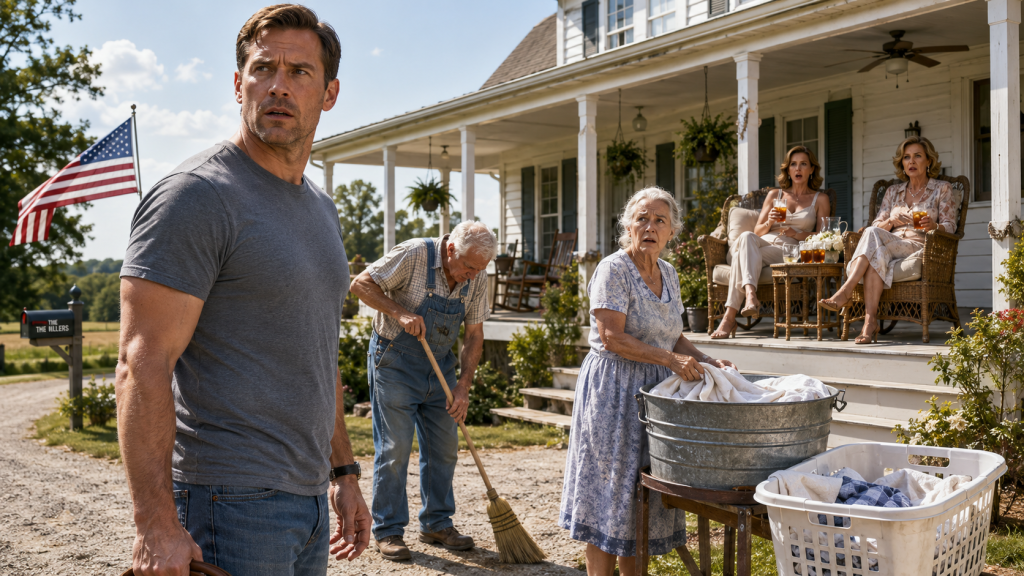
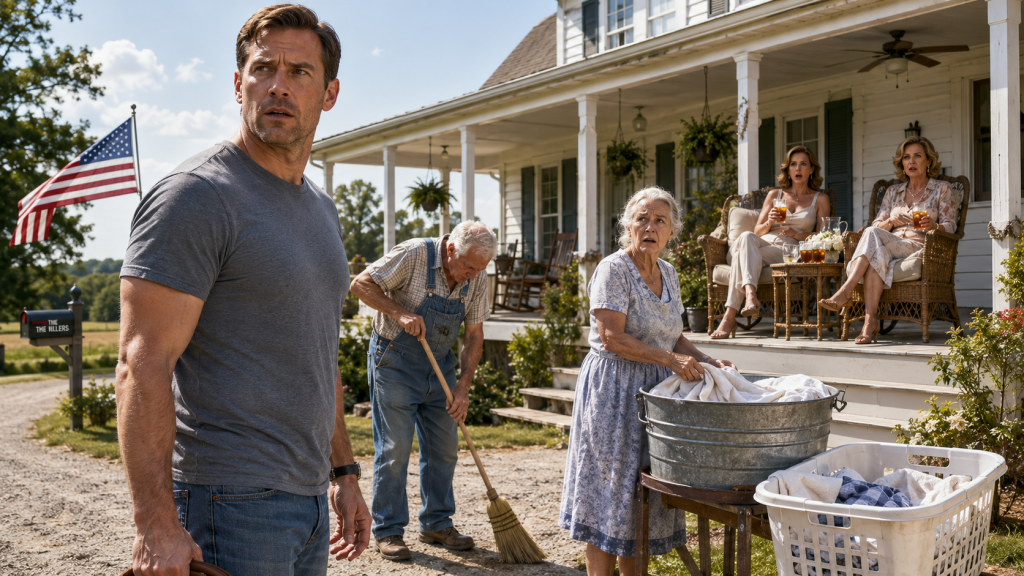
Arthur was bent over in the driveway beneath the brutal Midwestern sun, sweeping gravel dust away from the porch steps like a hired man terrified of missing a spot.
His flannel shirt was soaked dark down the back.
His thin hands shook around the broom handle.
His shoulders looked narrower than they had in the photographs my mother sent every Christmas.
Across the yard, my mother stood beside a plastic laundry basket, rinsing clothes in a metal washtub with her sleeves rolled past her elbows.
The sun had turned the back of her neck red.
A wet sheet sagged between her hands.
She moved slowly, as though every motion cost her something.
And on the porch, sitting in the shade I had paid for, were my sister-in-law Jessica and her mother, Susan.
They occupied cushioned chairs beside a little glass table. Two pitchers of iced tea sweated between them.
Jessica had one ankle crossed over the other while scrolling through her phone.
Susan wore oversized sunglasses, designer sandals, and too many gold bracelets.
Then my father’s broom pushed a thin cloud of dust too close to Susan’s feet.
“Watch it, old man!” she snapped, lifting one sandal as though the dirt had personally insulted her. “You’re getting dust all over my designer shoes.”
My hands locked around the steering wheel.
For one hard second, I imagined getting out of the truck and saying every ugly thing I had swallowed for six years.
I imagined flipping the glass table.
I imagined iced tea splashing across Susan’s white pants.
I imagined Jessica’s phone bouncing across the porch boards.
I did none of it.
Corporate life teaches you one useful lesson.
When something smells rotten, do not run in shouting.
Stand still.
Let people show you how comfortable they have become with cruelty.
So I sat there with the engine off and the cab still humming with trapped heat.
Six years returned all at once.
The eighty-hour weeks.
The freezing studio apartment with a radiator that knocked all night but barely produced warmth.
The ramen cups stacked beside my sink.
The winter I walked two miles to work in the same thin coat because every extra dollar went into the farmhouse account.
I had moved to Chicago at twenty-eight after accepting a junior operations position at a logistics company.
The salary sounded impressive until taxes, rent, transportation, and student loans took their share.
My apartment was a converted storage space above a laundromat.
The windows leaked cold air.
The pipes groaned.
The floor tilted toward the kitchen.
But I stayed because my parents were losing the house they had rented for almost twenty years.
My father’s factory had closed.
My mother’s arthritis made her housekeeping work impossible.
Their landlord raised the rent twice in eighteen months.
One evening, Mom called and admitted they had started cutting her medication in half to make it last longer.
That conversation changed everything.
I stopped eating out.
Canceled cable.
Sold my car.
Took weekend consulting jobs.
Worked until my eyes burned.
The farmhouse had belonged to an elderly couple moving closer to their children. It sat on eight acres outside a small Indiana town, with a vegetable garden, a red barn, and a porch facing west.
My mother loved it immediately.
My father kept saying it was too much.
I told them not to worry.
On March 18, at 6:12 in the morning, I wired the final payment.
At 9:40, the county clerk recorded the deed.
I kept the property in my name because I had purchased it outright, but my parents received lifetime occupancy rights. No one could remove them while they were alive.
Two weeks later, I established monthly deposits for medicine, utilities, groceries, and maintenance.
Every transfer had the same label.
Mom and Dad Medicine.
Not gifts.
Not favors.
Medicine.
Heat.
Food.
Peace.
My older brother, Daniel, lived only forty minutes away with Jessica and their two children.
When my job sent me overseas for a long-term expansion project, Daniel promised to check on our parents.
“I’ll handle everything,” he said.
Jessica told me not to worry.
“They’re family.”
I believed them.
That was my first mistake.
My second was believing silence meant everything was fine.
My mother had sounded tired on the telephone for months, but she blamed the weather.
My father stopped appearing on video calls because, according to Jessica, the internet “acted strange out there.”
Pharmacy receipts came late.
The grocery account emptied faster.
Every time I asked questions, Jessica laughed and said, “You worry too much from all the way up in Chicago.”
I had returned without warning because my company’s project ended early.
I wanted to surprise my parents.
Instead, they surprised me with the truth.
A person can age from years, illness, and hard work.
There is another kind of aging that comes from being ordered around inside your own home while everyone pretends not to notice.
My father looked like that kind of old.
Jessica glanced toward my truck, but sunlight covered the windshield, and she did not recognize me.
Six years had changed me too.
My work boots were better.
My truck was newer.
My face was harder.
Susan pointed her straw toward my mother.
“Linda, those towels better not smell like mildew this time. Jessica’s guests are coming Saturday.”
My mother flinched so quickly I almost missed it.
That ended my waiting.
I opened the truck door.
Gravel crunched beneath my boots.
My father raised his head.
For several seconds, he stared at me.
Then the broom slipped in his hands.
His mouth opened as though my name had become trapped somewhere in his chest.
“Michael?”
My mother turned so quickly that the wet sheet slid from her hands and slapped into the washtub.
Water splashed over her shoes.
Her expression changed from disbelief to joy and then to something too close to fear.
Jessica stood slowly.
Susan remained seated.
She looked me over as if I were a delivery driver who had wandered too far onto private property.
“Can we help you?”
I walked past the mailbox with the small American flag clipped to its side.
Past my father’s broom lying crooked in the dust.
Past my mother’s laundry basket.
I stopped at the bottom of the porch steps.
Jessica finally recognized me.
Her face went pale beneath her makeup.
“Michael,” she said too brightly. “You didn’t tell us you were coming.”
“I know.”
Dad moved toward me, but Susan snapped her fingers without looking at him.
“Arthur, don’t track dirt up here. Finish the driveway first.”
The entire yard froze.
My mother stopped breathing.
Jessica’s hand tightened around her telephone.
My father lowered his eyes as though apology had become a reflex someone trained into him without ever raising a fist.
I climbed one step.
Then another.
For the first time, Susan’s sunglasses slid low enough for me to see her eyes.
I stopped directly in front of her.
“Get your things off my porch.”
She laughed.
Not loudly.
It was the dismissive laugh of someone who had not yet understood that the room had changed.
“Excuse me?”
“This is my house. Get your things and leave.”
Jessica stepped between us.
“Michael, you’re tired. Let’s go inside and talk.”
“No.”
“You don’t understand what has been happening.”
I reached inside my jacket and removed a copy of the deed.
“This property is in my name.”
Susan stood at last.
“We live here.”
“You have been staying here without my permission.”
“Daniel invited us.”
“Daniel does not own the house.”
My mother whispered, “Michael, please.”
I turned toward her.
Her hands were red and swollen.
There were cracks across her knuckles.
“What happened to your washing machine?”
She looked at Jessica.
That glance told me everything.
Jessica forced a laugh.
“It broke. We were going to replace it.”
“When?”
“We’ve been busy.”
I looked at my father.
“What happened to the lawn service?”
No answer.
“The housekeeper?”
Silence.
“The pharmacy deliveries?”
My mother’s eyes filled with tears.
Jessica stepped closer.
“Your parents wanted to contribute.”
“Contribute to what?”
“This household.”
I stared at her.
The farmhouse had no mortgage.
The utility account was funded.
The medicine account was funded.
Property taxes were automatically paid.
“What household expenses?”
She crossed her arms.
“Children cost money. Food costs money. Everything has gone up.”
“So you moved into a house you did not own and made two sick people work for you?”
“That is not what happened.”
Susan adjusted her bracelets.
“Your parents enjoy being useful. Sitting around all day is unhealthy at their age.”
My father’s hand trembled.
I took the broom from him.
Jessica’s expression changed.
“Michael, don’t make a scene.”
“I haven’t started yet.”
Behind my truck, another vehicle turned into the driveway.
A county sheriff’s cruiser.
Susan looked toward it, then back at me.
“You called the police before you even spoke to us?”
“I spoke to the bank first.”
Jessica’s face went white.
“What bank?”
“The one receiving my monthly transfers.”
A deputy stepped from the cruiser.
Behind him arrived a woman in a dark sedan.
Her name was Rachel Monroe, a forensic accountant I had hired before leaving Chicago.
I had not returned completely unprepared.
Two weeks earlier, I noticed that the pharmacy account showed no charges for my father’s heart medication.
Jessica told me he had changed pharmacies.
When I contacted the doctor, I learned Dad had missed three appointments.
That was when I stopped asking family members and started checking records.
Rachel found that most of my monthly deposits had been transferred within twenty-four hours into an account controlled by Daniel and Jessica.
Payments from that account went toward a luxury SUV, credit-card balances, vacations, Susan’s cosmetic procedures, and an online boutique Jessica claimed was profitable.
My parents’ medicine had not been purchased consistently in nearly a year.
The household maintenance fund was empty.
Daniel and Jessica had also attempted to use the farmhouse as collateral for a business loan.
They failed only because the deed remained in my name.
Rachel walked up the porch carrying a folder.
Jessica stared at her.
“Who is that?”
“The person who traced the money.”
Susan removed her sunglasses.
“What money?”
“The money you used for those shoes.”
For the first time, she looked uncertain.
Rachel handed me copies of the account statements.
I placed them on the glass table beside the iced tea.
Jessica glanced down.
Her eyes moved quickly across the pages.
“Daniel handled the accounts.”
“Your signature appears on the transfers.”
“He told me your parents approved them.”
Dad finally spoke.
“We never approved anything.”
His voice was quiet, but the effect was immediate.
Jessica looked at him as though he had violated an agreement.
“Arthur, be careful.”
I stepped between them.
“You do not warn my father inside my house.”
The deputy approached.
“Mr. Carter?”
I nodded.
He handed Jessica a formal notice.
Because Daniel and Jessica had established residency, I could not drag them into the yard immediately.
But an emergency protective order prohibited them from controlling my parents’ money, medicine, transportation, or personal documents.
A removal action had also been filed.
Their access to the household accounts was frozen.
Jessica read the first page.
Her lips parted.
“You cannot do this.”
“I already did.”
“We have children.”
“The children are staying with Daniel’s sister this week. I confirmed that before arriving.”
Her eyes widened.
I had learned where they were from Daniel’s public posts.
He had taken them to a sports camp while leaving his wife and mother-in-law at the farmhouse.
Susan pointed toward the deputy.
“This is a family disagreement. You have no authority here.”
The deputy remained calm.
“Ma’am, the order is signed by a judge.”
Her iced-tea glass slipped from her fingers.
It struck the porch and shattered.
My mother flinched.
Susan did not apologize.
Jessica began crying.
“Please, Michael. Give us a week.”
I stood beside my father.
“You had six years.”
“We took care of them.”
“You took their money.”
“They ate our food.”
“This was their food.”
Susan’s voice rose.
“We gave up our apartment to move here.”
Rachel turned another document toward her.
“You kept the apartment and rented it to someone else.”
Susan stared at her.
Rachel had traced those deposits too.
The confidence drained from both women.
“Three minutes,” I said.
Jessica blinked.
“What?”
“Three minutes ago, you ordered my father to finish sweeping. Now you want mercy.”
She lowered her voice.
“Please end this humiliation.”
I looked at Mom and Dad.
“Pack nothing. You’re staying. They’re leaving.”
My mother covered her mouth and cried.
Dad sat down on the porch step.
For the first time since I arrived, he looked relieved.
Daniel drove up forty minutes later.
He jumped out before fully closing the door.
“What have you done?” he shouted.
I had heard that question too many times from people facing consequences.
Not what did we do?
What have you done?
He climbed the steps, but the deputy blocked him.
“This is my family’s home.”
“No,” I said. “It is our parents’ home. You treated it like your private bank.”
Daniel looked toward Jessica.
“You showed him the accounts?”
“She didn’t have to.”
He tried anger first.
Then denial.
Then brotherhood.
He reminded me of childhood fishing trips.
He said he had protected Mom and Dad while I lived in Chicago.
He claimed I had abandoned everyone.
My father stood.
“Michael never abandoned us.”
Daniel turned toward him.
“Dad, stay out of this.”
The words left his mouth before he understood what they revealed.
Dad’s expression changed.
For years, he had lowered his eyes.
This time, he did not.
“This is my home,” he said. “You stay out of it.”
Daniel stared at him.
My mother stepped beside Dad.
“You took my medicine money.”
“Mom, we were going to replace it.”
“You told me the insurance stopped paying.”
Daniel looked at Jessica again.
Their entire arrangement was collapsing because the two people they controlled had begun speaking.
The legal investigation uncovered more than theft from my monthly transfers.
Daniel had opened credit cards using Dad’s information.
Jessica forged Mom’s signature on checks.
Susan pressured my parents to complete household work by threatening to place them in a nursing facility if they complained.
They had hidden mail.
Canceled appointments.
Changed passwords.
Whenever I called, someone stood nearby listening.
The cruelty was not one dramatic act.
It was a system built slowly enough that my parents did not know when inconvenience became control.
Daniel and Jessica eventually accepted plea agreements involving financial exploitation, fraud, and identity theft.
Restitution consumed most of their assets.
The SUV was sold.
Jessica’s boutique closed.
Susan moved back into her apartment after her tenant’s lease ended.
She sent me a letter demanding reimbursement for “caregiving services.”
Rachel framed it in her office.
I took a leave from work.
For three months, I stayed at the farmhouse.
The first week, we replaced the washing machine.
The second, I repaired the porch railing and hired a nurse to organize their medicine.
I installed cameras at the doors, not to watch my parents but to help them feel secure.
The porch swing was still in the barn, wrapped in plastic.
Dad and I carried it out together.
Mom cried when we hung it.
That evening, she sat there with a glass of lemonade and no bill in her hand.
Exactly as she had imagined.
Healing was slower than removing the people who hurt them.
Dad apologized whenever he rested.
Mom asked permission before using money from the household account.
They had been trained to believe comfort required justification.
I reminded them repeatedly that the house existed for them.
Not for Daniel.
Not for Jessica.
Not for me.
For them.
One afternoon, I found Dad holding the old broom.
He looked embarrassed.
“I was going to clean the driveway.”
I took it gently.
“You can sweep if you want to sweep.”
He nodded.
“But you never have to sweep because someone is afraid of dirt on her shoes.”
He looked toward the porch.
Then he laughed.
It was the first real laugh I had heard from him since returning.
A year later, I transferred the property into a protected trust that guaranteed my parents’ lifetime use and prevented anyone from borrowing against it.
A professional fiduciary managed the household account.
Every pharmacy charge came directly to me and the fiduciary.
No family member could access a dollar without review.
I had once believed trust meant leaving the door unlocked.
Now I understood that protection sometimes required locks, records, and people willing to ask uncomfortable questions.
My relationship with Daniel did not recover.
He accused me of choosing money over family.
I told him he had confused family with access.
Jessica wrote apologies during the court process, but each one ended by asking for something.
Reduced restitution.
Help with rent.
A recommendation for work.
I stopped answering.
Susan never apologized.
That made her the most honest of the three.
On the second anniversary of my return, I drove up the same gravel driveway.
The heat shimmered above the road.
But this time, Dad was not sweeping.
He sat beneath the porch shade with a newspaper.
Mom rocked beside him with lemonade.
A small American flag moved in the breeze near the mailbox.
When Dad saw my truck, he stood slowly and smiled.
Not with fear.
Not with surprise.
With peace.
Mom waved from the porch.
The washing machine hummed inside.
A lawn-service truck worked near the barn.
Their medicine had been delivered that morning.
I climbed the steps and sat between them.
For a while, none of us spoke.
We watched the sun lower over the fields.
I thought about the freezing apartment.
The ramen.
The eighty-hour weeks.
The years I believed money alone could protect the people I loved.
Money bought the farmhouse.
But money could not guarantee kindness.
A deed could secure the walls.
It could not stop cruelty from entering through the front door when it wore a familiar face.
That required attention.
Questions.
Courage.
My parents had once believed speaking up would destroy the family.
In the end, silence had nearly destroyed them.
The day I returned, Jessica and Susan begged me to end their pain after only three minutes of consequences.
My parents had endured years without asking anyone to end theirs.
That was the difference I would never forget.
I did not save the farmhouse because I cared more about property than people.
I saved it because the house represented a promise.
My parents would never again live beneath someone else’s threat.
They would never choose between food and medicine.
They would never apologize for resting.
And no one would ever order my father to sweep dust away from designer shoes on the porch I had built for his peace.
Thanks for reading❤️ Follow Page For More Real Life Stories.