
I never told my in-laws that I was the daughter of the Chief Justice of the Supreme Court. Not because I was ashamed of my father. I adored him. But because I had spent my whole life trying to be seen as Anna, not as Justice Raymond Ellison’s daughter. I wanted my marriage to be mine. I wanted my husband to love me for who I was, not for the family name I carried quietly behind my smile.
So when I married David Whitmore, I introduced myself as Anna Ellison, a school counselor, a woman who liked quiet mornings, old books, and lemon tea. I did not mention that my father’s signature had shaped national decisions. I did not mention that judges stood when he entered a room. I did not mention that when I was a child, security officers checked our mailbox before I was allowed to open birthday cards.
David never asked much about my family anyway. He liked that I was “simple.” That was the word he used when we first dated. “You’re not like the women at my firm,” he said once, smiling over wine. “You don’t try to impress people.”
Back then, I thought it was a compliment.
Later, I understood it was a preference. He wanted a wife who did not take up space.
By the time I was seven months pregnant, David had stopped pretending to be the charming man who brought me flowers on our third date. He had become sharp around the edges, proud of his career, obsessed with appearances, and increasingly controlled by his mother, Sylvia.
Sylvia Whitmore believed her son had married beneath him.
She never said it in those exact words at first. She said it in smaller ways, with smaller knives.
“Anna doesn’t need a new dress. She’s not used to formal events.”
“Anna, dear, the salad fork goes on the outside.”
“David works so hard. The least you can do is keep a proper home.”
When I became pregnant, I hoped things would soften. I hoped the baby would make us a real family. I hoped David would see my swollen feet and tired eyes and remember that I was carrying his child.
Instead, Sylvia moved closer.
She came over without calling. She rearranged my kitchen. She criticized the nursery colors. She told David that motherhood would “teach me discipline.” And David let her.
Christmas was supposed to be the final dinner before the baby came. David had invited partners from his law firm, a county judge, two wealthy clients, and Sylvia’s church friends. It was not a family meal. It was a performance.
And I was the unpaid staff.
By 5:00 a.m., the house already smelled like roasting turkey, melted butter, cinnamon, and the sharp pine cleaner Sylvia sprayed over everything before guests arrived. I had been awake since four, rubbing my aching back while checking the oven and peeling potatoes with fingers so swollen my wedding ring had left a red mark.
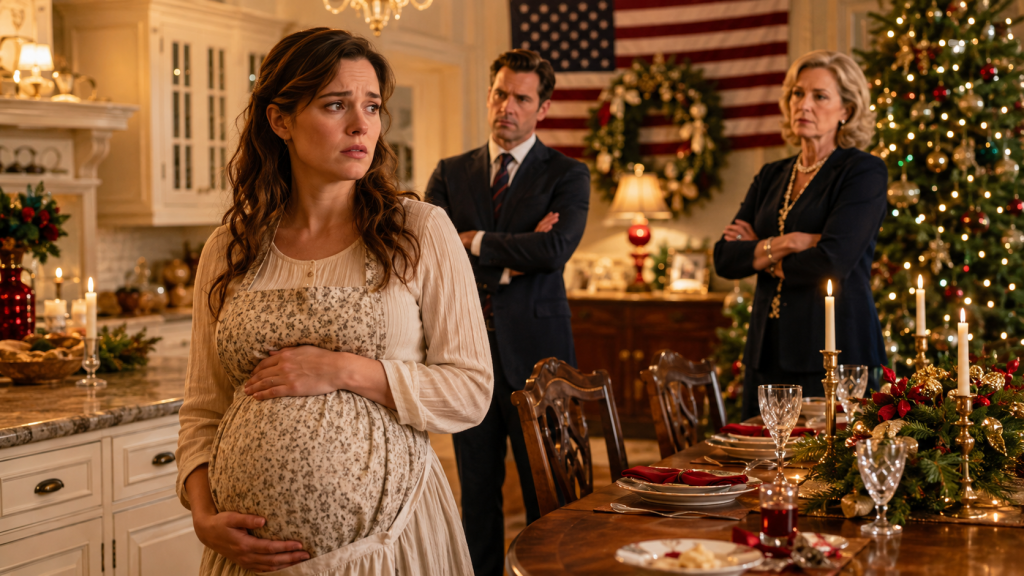
David came downstairs at seven wearing a robe and carrying his coffee.
“Mother wants the dining room reset,” he said, without greeting me.
“I reset it last night,” I answered.
“She wants the silver chargers, not the porcelain ones.”
“David, I need help. My feet are killing me.”
He looked down at them briefly, then at his phone.
“You wanted to host Christmas,” he said.
“I didn’t. Your mother did.”
His jaw tightened.
“Don’t start today, Anna. This dinner matters.”
That was always the warning. Don’t start. Don’t embarrass me. Don’t make things difficult. Don’t be yourself when people are watching.
By noon, the house glittered. Candles burned on the mantel. Garland curled around the staircase. Wine glasses stood in perfect rows. David’s colleagues filled the living room with loud laughter and expensive cologne. Sylvia floated among them in a cream church dress, smiling like a saint while I sweated in the kitchen.
No one asked why the pregnant woman was carrying trays.
No one noticed when I paused beside the counter and pressed both hands under my belly, breathing through a contraction that came too early and too strong.
At four, the turkey came out golden. The stuffing was finished. The gravy was warm. The potatoes were whipped. The table looked like something from a magazine.
I leaned against the doorway between the kitchen and dining room, dizzy from heat.
“David,” I said quietly, “can I sit down for a minute before dinner?”
Sylvia turned before he could answer.
Her smile vanished.
“Sit down?” she repeated, loud enough that three people at the table looked over.
“Just for a minute,” I said. “My back hurts.”
Sylvia’s palm struck the table so hard the silverware jumped.
“Servants don’t sit with the family,” she snapped.
The room froze.
For a second, I thought David would stand. I thought even he would draw a line there. His pregnant wife, humiliated in front of strangers, carrying his child.
But David only lifted his wineglass.
“Listen to my mother, Anna,” he said quietly. “Don’t embarrass me in front of my colleagues.”
Something inside me went cold.
The baby shifted, then my stomach tightened again, sharper this time. I caught the doorway with one hand.
“It hurts,” I whispered.
Sylvia gave a little laugh.
“Oh, stop it. You always perform when work needs doing.”
I stepped back into the kitchen and reached for the chair beside the breakfast nook.
I only wanted to sit.
Sylvia followed me, her heels clicking like tiny hammers on the tile.
“I said not there,” she hissed.
I turned toward her, exhausted and frightened.
“Sylvia, please. I’m pregnant.”
Her face hardened.
“And pregnancy has made you lazy.”
Then both her hands hit my shoulders.
It was not a slap. It was not a warning touch. It was a shove.
I fell backward into the granite counter. Pain exploded across my lower back, bright and white, and the air left my lungs. My hand flew to my stomach as a low, terrible cramp tore through me.
I slid to the floor.
A serving spoon clattered beside my hip. A dish towel fell across my knees. Somewhere in the dining room, a woman laughed, unaware that my whole world was collapsing on cold tile.
“My baby,” I gasped.
David rushed in. For one wild second, I thought he had come to help me.
He looked down, saw me clutching my stomach, saw the fear on my face, and frowned as if I had ruined the evening.
“Anna,” he hissed, “get up. Clean this before the guests see.”
“Call 911,” I begged. “Please. Something is wrong.”
I reached for my phone on the counter, but David snatched it first.
Then he threw it against the wall.
The crack cut through the kitchen like a gunshot.
“There will be no ambulance,” he said.
I stared at him.
“The neighbors will talk,” he continued. “I just got promoted. I don’t need police cars in my driveway on Christmas.”
I could feel warmth spreading beneath me. My body knew before my mind accepted it.
“David,” I whispered, “I’m losing the baby.”
His eyes flicked toward the dining room.
“Lower your voice.”
That was the moment something in me changed.
I had been afraid of David for a long time. Not in the beginning. At first, his anger came dressed as concern. Then as correction. Then as disappointment. Then as threats. Every time he crossed a line, he convinced me I had moved it.
But lying on that kitchen floor, seven months pregnant, with my broken phone under his shoe and my child’s life in danger, I saw him clearly.
Not as my husband.
As a coward in a tailored suit.
He crouched beside me, his voice dropping into the smooth courtroom tone he used when he wanted people afraid.
“I play golf with the sheriff,” he said. “If you say one word, I’ll tell everyone you’re unstable. You’re an orphan, Anna. Who do you think they’ll believe?”
That was his first mistake.
I was not an orphan.
I had simply never brought my father into his house.
I looked up at him through the harsh kitchen light, through pain, through fear, through the ringing in my ears.
“You’re right,” I said.
David blinked.
“You know the law,” I continued. “But you don’t know who raised me.”
His mouth tightened.
“What is that supposed to mean?”
I forced myself to breathe.
“Give me your phone.”
“No.”
“Then call my father.”
Sylvia laughed from behind him. She had stepped into the kitchen and was staring down at me with disgust.
“Her father?” Sylvia said. “The invisible man?”
David laughed too, cruel and easy.
“What, Anna? Is Daddy going to come rescue you?”
“Yes,” I said. “Call him.”
Maybe it was arrogance. Maybe it was curiosity. Maybe David wanted one more person to mock me in front of.
He pulled out his phone.
“What’s the number?”
I gave it to him slowly, every digit carved out of pain.
He put the call on speaker.
The dining room had gone quiet now. A few guests had gathered near the kitchen doorway. No one stepped forward. Not one person.
The phone rang twice.
Then a man answered.
“Identify yourself.”
David’s smile weakened.
“This is David Whitmore,” he said, forcing his voice into confidence. “I’m calling on behalf of my wife, Anna.”
There was silence.
Then my father said, “Where is my daughter?”
Something about his tone changed the air in the room. It was not loud. It was not emotional. It was colder than shouting.
David glanced at me.
“She’s having a little emotional episode,” he said. “Pregnancy hormones. Nothing serious.”
I raised my head from the tile.
“Dad,” I said, loud enough for the phone to hear. “Sylvia pushed me. David broke my phone. They won’t call an ambulance.”
The silence that followed was absolute.
Then my father spoke.
“David, listen carefully. You will call 911 now. You will unlock the front door. You will move away from my daughter. If you touch her again before emergency services arrive, the next voice you hear will belong to a prosecutor.”
David’s face drained of color.
Sylvia whispered, “Who is that?”
My husband stared at the phone as if it had become a living thing.
“Anna,” he said slowly, “who is your father?”
I looked at him.
“Chief Justice Raymond Ellison.”
The wineglass in David’s hand slipped from his fingers and shattered across the tile.
For the first time since I had known him, David had nothing to say.
My father’s voice came again.
“Anna, sweetheart, stay with me. Help is coming.”
That nearly broke me.
Not the pain. Not Sylvia. Not David.
The word sweetheart.
I had not realized how long it had been since someone in that house had spoken to me like I mattered.
Within minutes, sirens cut through the winter evening. Red and blue lights flashed across the snow outside. Paramedics entered first, followed by two police officers. One of the guests, the county judge, had quietly called 911 too after hearing my father’s name. Later, I would remember that with gratitude. In that room of silent witnesses, one person had finally chosen decency.
David tried to take control.
“My wife fell,” he said. “She’s confused.”
A paramedic knelt beside me.
“Ma’am, did you fall or were you pushed?”
I looked past her at Sylvia, who stood rigid by the stove.
“I was pushed.”
David opened his mouth, but one of the officers stepped between us.
“Sir, step back.”
“I’m an attorney,” David snapped.
The officer did not blink.
“Then you understand instructions.”
They lifted me onto a stretcher. As they carried me through the dining room, I saw the faces of David’s colleagues. Some looked ashamed. Some looked horrified. Sylvia would not meet my eyes.
Outside, snow was falling softly over the perfect lawn.
My father arrived just as they were loading me into the ambulance.
He wore a black overcoat over a charcoal suit, his silver hair damp with snow. Two security officers stood near the vehicle, but he waved them back and came straight to me.
For one moment, he was not the Chief Justice.
He was just my father.
His hand wrapped around mine.
“I’m here,” he said.
“I’m scared,” I whispered.
His jaw tightened, but his voice stayed gentle.
“I know. But you are not alone anymore.”
At the hospital, everything became bright lights and urgent voices. Nurses cut away my dress. Doctors spoke quickly. Someone said placental abruption. Someone said fetal distress. Someone asked how far along I was. I answered seven months, then cried because it felt too early, too soon, too dangerous.
My father stayed outside the operating room doors until they made him move.
Hours later, I woke to the soft beep of monitors and the taste of medicine in my mouth.
My father sat beside my bed.
His eyes were red.
“The baby?” I asked.
He leaned forward.
“She’s alive.”
A sob tore out of me.
“She?”
He smiled then, but only barely.
“A daughter. Small, stubborn, and apparently very much like her mother.”
They had delivered her by emergency C-section. She was in the NICU, tiny and fragile, with tubes taped to her skin and one little hand curled like a rosebud. I was not allowed to hold her at first. I could only touch her through the incubator opening with one finger.
I named her Grace.
Because she had survived what hate tried to take.
David came to the hospital the next morning with flowers.
Police were waiting.
He did not expect that.
He also did not expect the formal complaint already filed, the statements taken from guests, the paramedic report, the broken phone collected as evidence, or the hospital documentation of injuries consistent with a shove.
He especially did not expect my father to be standing at the end of the hallway, watching silently as officers questioned him.
David tried his lawyer voice again.
“This is a private family misunderstanding,” he said.
My father stepped forward.
“No,” he said. “It is not.”
David swallowed.
“Justice Ellison, with respect, you should not interfere. It could look improper.”
My father’s expression did not change.
“I am not handling your case. I am not calling a judge. I am not pulling a string. I am standing beside my daughter as her father. The evidence will do the rest.”
And it did.
David’s firm placed him on leave within forty-eight hours. The story did not become public immediately, but the legal community is smaller than people think. His colleagues had witnessed enough to speak. The county judge gave a statement. One of Sylvia’s church friends admitted she had heard Sylvia call me a servant. The officers documented David’s refusal to call for medical help and the destruction of my phone.
Sylvia tried to deny pushing me.
Then a detail ruined her.
David had security cameras outside the kitchen entrance, installed because he was paranoid about deliveries and theft. He had forgotten that one camera caught the reflection in the glass cabinet doors near the breakfast nook.
It was not perfect footage.
It was enough.
Enough to show Sylvia following me.
Enough to show her hands rising.
Enough to show me falling.
When the investigator told me, I closed my eyes and thanked God for David’s own arrogance.
The criminal case moved slowly, as cases do. There were motions, delays, arguments, statements. David tried to paint me as unstable. He suggested I had exaggerated. He said pregnancy made me emotional. He said my father’s position intimidated everyone.
But every lie had a record standing against it.
Hospital records.
Witness statements.
The broken phone.
The emergency call.
The camera reflection.
And finally, me.
When I gave my statement, I did not scream. I did not perform. I sat with my hands folded and told the truth clearly.
I told them about Christmas morning.
About being forced to cook.
About Sylvia saying servants did not sit with the family.
About the shove.
About David refusing medical help.
About his threat that no one would believe an orphan.
When the prosecutor asked what I felt in that moment, I looked at David across the room.
“I felt afraid,” I said. “But I also felt finished. Finished protecting the people who were hurting me.”
David looked away first.
That was when I knew I had already won something bigger than a case.
I had won my voice back.
The court proceedings around my separation were different. David fought the divorce with the same ugliness he brought to everything. He demanded access to Grace, then argued about hospital bills. He claimed I was alienating him from his child, though he had not once asked the NICU nurse how to hold her safely.
My father never once used his office to influence the process. He was careful, almost painfully careful. He hired me a family attorney from another state, someone with no connection to him. He refused private conversations with judges. He told me again and again, “The law must remain clean, Anna. Even when our hearts are not.”
I respected him for that.
But David mistook integrity for weakness.
At a custody hearing months later, David arrived polished, confident, and smiling for people in the hallway. He wore a navy suit and the expression of a man who still believed charm could erase cruelty.
My attorney presented the evidence calmly.
The emergency medical records.
The criminal charges.
The witness statements.
The documented refusal to seek help.
The pattern of coercive control.
David’s attorney argued that marriage was complicated, that emotions ran high during the holidays, that David had been under professional stress.
The judge listened.
Then she looked at David and asked one question.
“Mr. Whitmore, when your pregnant wife told you she believed she was losing the baby, why did you break her phone instead of calling emergency services?”
David’s mouth opened.
No answer came.
Not a good one.
Not even a bad one.
Just silence.
I was granted full custody with supervised visitation pending the criminal matter. David’s visits lasted less than two months. Grace cried whenever he held her. He complained that the supervision center was humiliating. Eventually, he stopped showing up.
That was David. He wanted ownership, not responsibility.
Sylvia tried once to come to my father’s house, where I stayed while Grace grew stronger. She arrived with a casserole and tears, saying it had all been a misunderstanding.
My father met her at the gate.
I watched from the upstairs window, Grace sleeping against my chest.
Sylvia clasped her hands.
“I only wanted what was best for my son,” she said.
My father looked at her for a long moment.
“Then you should have raised him to be better.”
She left without seeing us.
Grace came home after seven weeks in the NICU. She was still small, but fierce. Her fingers wrapped around mine with surprising strength. At night, when I rocked her in the nursery my father had prepared, I thought about how close I had come to losing her.
I also thought about how close I had come to losing myself.
For years, I had shrunk to survive. I had smiled through insults. I had apologized when I was hurt. I had mistaken silence for peace. I had believed that endurance was the same as love.
It was not.
Love does not make you eat standing in the kitchen while everyone else sits.
Love does not break your phone when you beg for help.
Love does not care more about neighbors talking than a baby breathing.
The criminal case ended almost a year later. Sylvia accepted a plea agreement for assault and reckless endangerment. David faced professional discipline and separate charges related to obstruction and failure to seek aid. His law license was suspended pending review, and the firm that had once paraded him around as a rising star removed his name from every case.
The day I heard that, I did not celebrate.
I simply sat in the garden with Grace asleep in her stroller and let the sunlight touch my face.
Revenge had never been the point.
Safety was.
Truth was.
Freedom was.
Two years later, Grace took her first steps in my father’s living room. She wobbled from the sofa toward him, arms lifted, laughing with her whole tiny body. My father, the man who had faced presidents, senators, and history itself, dropped to his knees with tears in his eyes.
“Come on, little Justice,” he whispered.
She fell into his arms.
I laughed for the first time in a way that did not feel borrowed.
Sometimes people ask why I never told David who my father was. They think the answer is strategy, pride, or secrecy. It was none of those things.
I did not tell him because I wanted to believe I was enough without my father’s name.
And I was.
That was what David never understood.
My father’s title did not save me because it made me powerful. It saved me because, in the worst moment of my life, I remembered I had somewhere to turn. I remembered I was loved by someone who would not ask me to make myself smaller for comfort.
Years later, when Grace was old enough to ask why there were no pictures of her father in our home, I told her the truth in a way a child could carry.
“Some people hurt others instead of loving them,” I said. “And when that happens, we leave. We tell the truth. We choose safety.”
She looked at me seriously.
“Did you choose me?”
I pulled her into my arms.
“Every time.”
The Christmas after Grace turned five, we hosted dinner at my house. Not David’s house. Not Sylvia’s stage. Mine.
There was turkey, though I ordered it from a restaurant. There were candles, though I did not care whether they matched. There were wine glasses, but no one inspected them. My father carved the turkey badly, my aunt burned the rolls, and Grace spilled cranberry sauce on the tablecloth within ten minutes.
Everyone laughed.
No one shouted.
No one made me stand in the kitchen.
At one point, I looked at the chair beside me. It was empty for a moment because Grace had crawled into my father’s lap to steal mashed potatoes from his plate.
I touched the back of that chair and thought of the woman I had been that Christmas morning, swollen feet aching, hands raw from cooking, asking for one minute of rest.
I wished I could go back and sit beside her.
I wished I could tell her that one day, she would have a table where she belonged.
A table where no one had to earn kindness.
A table where her daughter would grow up loud, safe, and loved.
After dinner, Grace helped me carry plates to the kitchen. She insisted on wearing a tiny apron, though she mostly just licked frosting from a spoon.
My father stood in the doorway, watching us.
“You look happy,” he said.
I glanced at my daughter, at the warm kitchen, at the snow falling gently beyond the window.
“I am,” I said.
And I meant it.
For years, David had believed the law was a weapon because that was how he used it. He believed connections were shields, titles were crowns, and silence was consent. He believed I had no one.
But he was wrong about all of it.
The law became a record.
The truth became a door.
My father became my witness.
And I became my own rescue.
David once mocked me while I lay on the kitchen floor, bleeding and terrified. He told me I was not going to win.
He was wrong.
I won the moment I stopped begging him to become decent.
I won the moment I asked him to call my father.
I won the moment I told the truth.
And every Christmas since, when I sit at the head of my own table with Grace beside me and my father smiling across from us, I remember Sylvia’s cruel words.
“Know your place.”
Now I do.
My place is not in the kitchen, standing alone in pain.
My place is not beneath a husband’s pride or a mother-in-law’s contempt.
My place is here, in the home I rebuilt, beside the child I fought for, surrounded by people who know that love is not control, marriage is not ownership, and family is not proven by blood or titles.
Family is proven by who comes when you call.
And when I called, my father came.
But more importantly, I finally came back to myself.
THE END! THANKS FOR READING!