
I adopted twins I found abandoned on a plane.Eighteen years later, their mother showed up at my door and handed them a document.I am seventy-three years old now, and there are parts of my life I still cannot speak about without feeling my chest tighten.Grief changes the shape of a person.It hollows you out.
It makes ordinary sounds feel cruel.A ringing phone.A child laughing in a grocery store.A bedroom door you know will never open again.Eighteen years ago, I boarded a plane with a black dress folded in my suitcase and a funeral program already waiting for me in another city.
My daughter, Emily, had died in a car accident.
My grandson, Noah, only three years old, had died with her.
When the police called, I did not understand the words at first.
I remember asking the officer to repeat himself three times.
Not because I could not hear him.
Because my mind refused to let the truth enter.
By the time I got on that flight, I was not really alive.
I was a body moving through airport security.A woman holding a boarding pass.A mother traveling home to bury her child.I sat by the window and stared at the clouds as the plane lifted into the sky.People around me complained about delays.Someone laughed at a movie on their screen.
A man across the aisle ordered whiskey.
The world continued.
That felt like the cruelest part.
Then, somewhere over the middle of the country, the crying started.
At first, it was soft.
A baby’s whimper.
Then another joined it.
A little boy and a little girl, no more than six months old, were sitting alone three rows ahead.
They were strapped into aisle seats with small blankets tucked around them.
Their faces were red.
Their tiny hands trembled.
Their cries came in broken waves, as if they had already learned no one was coming.
People started muttering.
“Where is their mother?”
“Can someone shut those kids up?”
“This is ridiculous.”
A flight attendant passed by twice, looking worried and helpless.
She checked the overhead bins.
She walked toward the back.
She returned with another attendant.
They whispered.
No one picked the babies up.
No one held them.
Every time someone leaned close, the infants flinched.
The woman beside me touched my arm gently.
She was young, maybe in her early twenties, with polished nails and a soft perfume that smelled expensive.
Her eyes were fixed on the babies.
“Someone needs to be the bigger person here,” she whispered. “Those babies need someone.”
I looked at her.
Something about her voice made me uneasy, though I could not have explained why.
Maybe it was the calmness.
Maybe it was the way she looked at the babies without moving toward them herself.
But grief had made me slow, and sorrow had made me soft.
I looked at those two crying infants.
The boy’s face was pressed against the seatbelt.
The girl was hiccuping from exhaustion.
And suddenly, I saw Noah.
Not in their faces.
In their helplessness.
In the way the world was moving around them while they suffered.
Before I could stop myself, I stood.
The flight attendant looked relieved when she saw me.
“Ma’am, do you know them?”
“No,” I said.
But I held out my arms.
The moment I lifted the boy against my shoulder, he stopped crying.
Not gradually.
Instantly.
His little body shook once, then softened into me.
When I picked up the girl too, she pressed her cheek against mine and clutched my collar with all the strength in her tiny fingers.
The entire cabin fell quiet.
I stood there in the aisle, holding two abandoned babies while strangers watched like I had performed a miracle.
I called out, “Is there a mother on this plane? Please, if these are your children, come forward.”
No one answered.
Not one person moved.
The young woman beside my seat smiled sadly.
“You just saved them,” she said. “You should keep them.”
I thought she was only being kind.
I did not know she was planting the first lie.
When we landed, I took the babies straight to airport security.
There were announcements.
Questions.
Cameras checked.
Passenger lists reviewed.
Social services arrived before I left the airport.
I told them everything.
I told them I had held the babies only because no one else would.
I told them I could not take responsibility for children when I was on my way to bury my daughter and grandson.
But when the social worker carried them away, the little girl started crying again.
The boy reached over the woman’s shoulder toward me.
That sound followed me into the funeral home the next morning.
I buried Emily under a gray sky.
Noah was buried beside her.
I remember standing there, watching the dirt fall, thinking there were no more reasons for me to stay in this world.
My husband had died years earlier.
Emily had been my only child.
Noah had been my sunlight.
After the funeral, relatives came to my house with casseroles and sad eyes.
They told me I was strong.
I hated that word.
Strong people had something left to protect.
I had nothing.
But every night, when I closed my eyes, I saw those two babies on the plane.
I heard the boy’s frightened breathing against my shoulder.
I felt the girl’s tiny hand gripping my collar.
Three days after the funeral, I called social services.
“Have you found their mother?” I asked.
“No,” the woman told me. “No one has come forward.”
No one.
Not a mother.
Not a father.
Not an aunt.
Not a neighbor.
It was as if the babies had fallen from the sky with no history at all.
I drove to the office the next morning.
I was still wearing black.
My hands shook as I signed the visitor forms.
When they brought the babies into the room, the girl looked at me first.
I do not believe babies that young can truly remember faces.
But I swear she knew me.
She reached out.
That was the moment my life began again.
The process took months.
There were investigations.
Hearings.
Temporary custody.
Home visits.
Questions about my age, my grief, my finances, my support system.
Some people thought I was too old to start over.
Maybe I was.
But grief had made me empty, and those children filled the empty places with cries, bottles, diapers, and need.
Need saved me.
I named the boy Ethan.
I named the girl Sophie.
Their last name became mine.
Margaret Ellis.
For eighteen years, I raised them.
Not perfectly.
No mother raises children perfectly.
But I loved them with everything I had left.
Ethan was serious even as a child.
He lined up his toys by size.
He asked questions until adults sighed.
When he was nine, he wrote a letter to the principal because he believed the lunch workers were throwing away too much uneaten food.
By sixteen, he wanted to study law.
He said justice was only meaningful if it protected people who could not protect themselves.
Sophie was different.
She felt everything.
She brought injured birds home in shoeboxes.
She cried during commercials.
She remembered birthdays, favorite teas, the names of grocery clerks and neighbors’ dogs.
She was brilliant in the quiet way some people are brilliant.
She noticed what others missed.
Together, they gave me back a family.
Our house became loud again.
There were shoes by the door.
School papers on the counter.
Birthday cakes.
Arguments over bathroom time.
Christmas mornings.
Graduation photos.
Every year on the anniversary of the flight, I told them the truth in age-appropriate pieces.
That I had found them.
That someone had left them.
That the abandonment was not their fault.
That love was not only blood.
They knew I had adopted them.
They knew I was not their birth mother.
But I was their mother.
There was never confusion about that.
At least, I thought there wasn’t.
Then last week, everything changed.
It was a Thursday afternoon.
Ethan and Sophie had just come home from college orientation weekend.
They were both eighteen, standing at the edge of adulthood, bright and nervous and full of plans.
Ethan had received a scholarship.
Sophie had been accepted into a medical humanities program.
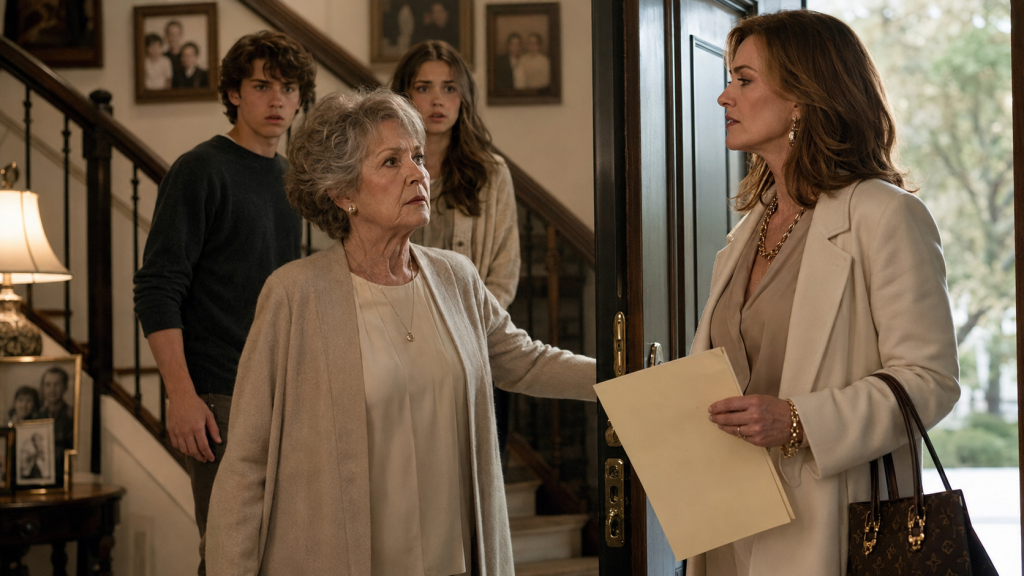
I was making tea in the kitchen when the doorbell rang.
Through the glass panel, I saw a woman standing on my porch.
She wore a cream designer coat, high heels, and sunglasses too large for her narrow face.
Her hair was smooth and expensive-looking.
Even before she took the sunglasses off, I recognized something about her.
Not her face exactly.
Her stillness.
Her calm.
The way she looked at my home as if she had already entered it in her mind.
I opened the door.
“Margaret,” she said.
My name in her mouth felt like a cold hand at the back of my neck.
“I’m sorry,” I said. “Do I know you?”
She smiled.
“I’m Alicia. We met on the plane eighteen years ago.”
The world tilted.
The woman beside me.
The one who had whispered that the babies needed someone.
The one who had told me I should keep them.
“You were sitting next to me,” I said.
“I was.”
She stepped forward without being invited.
I was so stunned I moved back.
Her perfume entered before she did.
Sharp.
Floral.
Familiar.
Her eyes moved across my living room walls.
Graduation photos.
Birthday pictures.
Ethan with braces.
Sophie holding a puppy.
The three of us at the beach.
A life built frame by frame.
Then Alicia turned to me and dropped the truth like a bomb.
“I’m also the mother of those twins you took from the plane.”
The cup in my hand slipped.
Tea spilled across the floor.
Behind me, the stairs creaked.
Ethan and Sophie had heard.
They froze halfway down.
Sophie’s hand gripped the railing.
Ethan’s face changed in a way I had never seen before.
Not shock.
Defense.
He stepped in front of his sister without thinking.
“You’re our birth mother?” he asked.
Alicia looked at him.
For a moment, something flickered in her expression.
Recognition.
Regret.
Fear.
Then it vanished.
“Yes,” she said. “I’m your mother.”
Sophie flinched.
I heard it in the silence.
Not because of Alicia’s claim.
Because of the word.
Mother.
“You abandoned them,” I said, my voice trembling. “You left two infants alone on a plane.”
Alicia sighed, as if I had opened an old argument instead of a wound.
“I was twenty-three. Terrified. I had a job opportunity that could change my life. I never planned for twins.”
Sophie whispered, “So you just left us?”
Alicia turned toward her.
“I gave you a better life than I could have.”
“You left us crying,” Ethan said.
“I saw Margaret,” Alicia replied. “I saw her grief. I knew she needed you as much as you needed someone.”
My stomach turned.
“You set me up.”
“I made a choice,” Alicia said. “And clearly, it worked out.”
She gestured to the photos.
“Look at them. Educated. Healthy. Loved. I did what I had to do.”
“No,” I said. “You did what was easy.”
Her expression hardened.
“I didn’t come here to be judged.”
“Then why did you come?”
Alicia reached into her purse and pulled out a thick envelope.
“I need them to sign something.”
Ethan laughed once, coldly.
“You came after eighteen years with paperwork?”
“It’s a medical matter.”
She placed the envelope on my kitchen table like she was serving a bill.
Not reopening eighteen years of wounds.
Ethan came down first.
Sophie followed slowly.
None of us sat.
“What document?” Ethan asked.
Alicia slid the papers forward.
Across the top, in bold letters, were the words:
Genetic Inheritance Release and Medical Compatibility Agreement.
I felt my blood turn cold.
“Explain,” I said.
For the first time, Alicia’s perfect mask cracked.
“I’m sick,” she said. “A rare kidney disease. I need a donor. My doctors say biological children are my best chance.”
The room went silent.
Ethan stared at her.
“So you didn’t come because you missed us.”
Sophie’s voice was barely above a whisper.
“You came because you need our bodies.”
Alicia’s eyes filled with tears.
Even her tears looked rehearsed.
“I gave you life.”
Sophie stepped down the final stair.
“No. You left us on an airplane and watched a stranger pick us up.”
Alicia’s mouth tightened.
“Margaret raised you because I allowed it.”
That sentence changed the room.
Ethan reached for the document.
For one second, I thought he was going to read it.
Instead, he tore it clean in half.
Alicia gasped.
“You have no right!”
“Actually,” Ethan said, his voice steady, “we do. We’re adults. And she is our mother.”
He pointed at me.
My knees nearly gave out.
Sophie crossed the room and stood beside me.
“You don’t get to return after eighteen years and call love a medical debt.”
Alicia stared at them.
Then panic twisted her face.
“Fine,” she snapped. “Then maybe you should know the truth.”
She reached into her purse and pulled out one more paper.
“This is why I knew Margaret would take you. Your adoption was paid for.”
My heart stopped.
“What are you talking about?”
She threw the paper onto the table.
It was old.
Folded carefully.
A photocopy of a bank transfer and a handwritten note.
I picked it up.
My eyes found the signature at the bottom before my mind understood the words.
Emily Ellis.
My dead daughter.
The room disappeared.
For a moment, I was back at the cemetery.
Gray sky.
Wet dirt.
A tiny coffin beside a larger one.
My daughter’s name carved into stone.
Sophie touched my arm.
“Mom?”
I could not speak.
Ethan took the paper from my hand and read aloud.
Alicia,
I know you are afraid. I know you think you cannot raise them. If you truly cannot keep the babies safe, then do exactly as we discussed. Sit beside my mother on the flight. Let her notice them. Let her choose. Do not tell her I arranged it. She will refuse if she thinks I am trying to replace myself.
Use the money to disappear and never contact them unless their lives depend on it.
Please give my mother a reason to survive.
Emily.
My knees buckled.
Sophie caught me.
“No,” I whispered. “No, no.”
Alicia folded her arms.
“She knew she was going to die.”
I looked at her.
“What?”
Alicia’s voice was quieter now, but not kinder.
“Emily contacted me through a private support group. Young mothers, financial crisis, complicated pregnancies, fear, adoption. She said she had cancer markers. Then she said the doctors found something else. She didn’t tell you?”
My mouth opened, but no sound came.
Emily had died in a car accident.
That was what I knew.
That was what the police report said.
A rainy highway.
A truck that crossed the line.
No time to brake.
No survival.
Alicia continued.
“She told me she was terrified of leaving you alone. She said you had already lost your husband. She said if she died, you would follow her into the grave without meaning to.”
Tears blurred the room.
“My daughter arranged this?”
“She arranged for you to meet them,” Alicia said. “She did not know the accident would happen so soon.”
I pressed a hand to my mouth.
Eighteen years of memory rearranged itself inside me.
Emily calling more often the month before she died.
Emily asking strange questions.
“Mom, do you think you could ever start over?”
“Mom, would you be angry if someone gave you a second chance you didn’t ask for?”
“Mom, promise me you’ll keep living.”
I had thought she was worried because I was lonely.
I had not known she was preparing a goodbye.
Ethan looked at Alicia.
“So you took money from our adoptive mother’s dead daughter and abandoned us on a plane.”
Alicia’s face flushed.
“That is a cruel way to put it.”
“It’s the true way,” he said.
“I was desperate.”
Sophie shook her head.
“You weren’t desperate today. Today, you came dressed like someone who could hire lawyers.”
Alicia lifted her chin.
“I built a life.”
“On money meant to keep us safe?”
Alicia’s eyes flashed.
“I kept my part of the arrangement. I gave you to her.”
“No,” Ethan said. “You left us terrified in public so she would be forced to act.”
Alicia turned to me.
“Margaret, tell them. If I had walked up and handed you two babies, would you have taken them?”
I closed my eyes.
The terrible thing was, I did not know.
On that flight, I was broken.
If someone had said, “Here, replace your dead daughter and grandson with these,” I might have recoiled in pain.
Emily knew me well enough to know that.
She had not forced me.
She had simply placed need in front of my grief.
And trusted that my heart, even shattered, would know what to do.
I opened my eyes.
“My daughter gave me a second chance,” I said. “You turned that chance into abandonment.”
Alicia’s face hardened again.
“I don’t have time for moral lectures. I am dying.”
The word landed heavily.
For all her cruelty, she was still human.
Still afraid.
Sophie’s hand slipped into mine.
Ethan folded his arms.
Alicia looked at them both.
“I need testing. Not a promise. Just bloodwork. You owe me that much.”
Ethan’s jaw tightened.
“We owe you nothing.”
Sophie looked at Alicia for a long time.
Then she said, “I will get tested.”
Ethan turned to her.
“Sophie.”
She squeezed my hand.
“Not because she deserves it,” Sophie said. “Because I need to know I made my choice from who I am, not who she is.”
Alicia’s eyes brightened with hope.
Sophie lifted one finger.
“But listen carefully. Testing is not consent. If I am a match, I will decide with doctors, counselors, and Mom. You will not call yourself my mother to manipulate me. You will not come to this house without permission. You will not contact Ethan unless he agrees. And you will give us every document connected to Emily.”
Alicia looked stunned.
Perhaps she had expected tears.
Or guilt.
Or gratitude.
She had not expected boundaries.
Ethan looked at his sister, then exhaled slowly.
“I’ll test too,” he said. “For information. Not for her.”
Alicia nodded quickly.
“Yes. Of course.”
I recognized that tone.
A person agreeing only because refusal would cost her.
I called Elliot Hayes, an attorney who had handled Emily’s estate years ago.
By sunset, Alicia was sitting in his office instead of my living room.
She signed a release for every email, transfer record, medical message, and note related to Emily and the twins.
She was not allowed to contact the children directly.
Everything would go through counsel.
That night, after the lawyers finished, we came home exhausted.
Sophie went straight to her room.
Ethan sat on the porch steps until midnight.
I sat at the kitchen table with a box of Emily’s old things.
I had not opened it in years.
Inside were photographs, birthday cards, a scarf that still faintly smelled like her perfume, and a small yellow envelope I had somehow never noticed.
On the front, in Emily’s handwriting, were the words:
For Mom, when you are ready to forgive me.
My hands trembled as I opened it.
Dear Mom,
If this letter reaches you, then I did something you may not understand.
I am sorry.
I know you hate secrets.
I know you will think I should have told you everything.
But I also know you.
You would have spent whatever strength you had trying to save me, and if you could not, you would have blamed yourself forever.
I met a woman who was pregnant with twins and planning to abandon them badly. I could not fix her. I could not save every broken thing. But I thought maybe I could save them, and maybe they could save you.
Please do not think they replaced me.
No one replaces a child.
But love does not run out, Mom.
It finds new rooms.
If you chose them, then they are yours.
Not because I arranged it.
Because your heart said yes.
Live.
Please live.
I love you.
Emily.
I pressed the letter to my chest and wept until Sophie came downstairs and wrapped her arms around me.
Ethan joined us a moment later.
The three of us sat on the kitchen floor, surrounded by the past.
No one knew what to say.
So we said nothing.
Sometimes silence is not empty.
Sometimes it is a place where love sits down because words are too small.
The medical testing happened two weeks later.
Ethan was not a match.
Sophie was.
When the results came, Alicia called the attorney within minutes.
She wanted meetings.
Schedules.
Promises.
Sophie listened to the message once.
Then she turned the phone face down.
“I need time,” she said.
So we took time.
We met with doctors.
A transplant counselor.
A therapist.
A lawyer.
We learned the risks.
The pain.
The recovery.
The emotional weight of giving part of your body to someone who had given you life but not love.
In the end, Sophie made her decision.
She would not donate.
Not because she wanted Alicia to die.
But because a kidney is not a signature on a debt.
Because motherhood is not a contract you can abandon and collect on later.
Because compassion without consent is just another form of being used.
When Alicia heard, she came to the house anyway.
Despite the agreement.
Despite the warning.
She stood on my porch in the rain, pounding the door.
“You selfish girl!” she screamed. “I gave birth to you!”
Sophie opened the door before I could stop her.
She stood straight, calm, heartbroken but certain.
“You gave birth to me,” she said. “Margaret gave me life.”
Alicia’s face crumpled.
Maybe it was illness.
Maybe fear.
Maybe finally understanding what she had lost.
“I was scared,” Alicia whispered.
Sophie’s eyes filled with tears.
“So were we.”
Then she closed the door.
Alicia did not come back.
Months passed.
We heard through the attorney that she found another donor through a registry.
A distant cousin.
The surgery was difficult but successful.
She sent one letter afterward.
Not to ask for anything.
Just one page.
I do not know how to be a mother.
I am sorry I came back as a patient before I came back as a person.
I do not ask forgiveness.
I only wanted you to know I survived.
Sophie read it.
Ethan read it.
Then they placed it in Emily’s box.
Not as a treasure.
Not as a wound.
As a fact.
Life is full of facts we do not know what to do with.
Eighteen years ago, I thought I found two abandoned babies on a plane by accident.
Now I know my daughter, dying and terrified for me, placed them in my path.
Not to replace what I lost.
But to prove that even grief can become a doorway.
I still miss Emily every day.
I still miss Noah.
There are mornings I wake and for one soft second forget they are gone.
Then memory returns.
But now, when grief comes, it does not find me alone.
Ethan calls from law school to complain about professors and injustice.
Sophie sends photos from campus of stray cats she absolutely does not plan to adopt, then adopts them anyway.
They come home on holidays and fill the house with noise.
They still call me Mom.
That word is the greatest mercy of my life.
Last week, on my seventy-third birthday, Sophie gave me a framed copy of Emily’s letter.
Ethan placed it beside a photo from their high school graduation.
In the picture, I am standing between them, smaller than both by then, laughing because Ethan’s cap was crooked and Sophie had lipstick on her teeth.
A life.
A real life.
Built from impossible loss.
That night, after they went to bed, I sat alone in the kitchen with a cup of tea.
The house was quiet.
Not empty.
Quiet.
There is a difference.
I thought about the plane.
The crying babies.
The young woman beside me whispering that someone needed to be the bigger person.
I thought about Emily, somewhere in her own fear, making a plan she hoped would save us all.
I thought about Alicia, flawed and frightened, doing the wrong thing for reasons that were partly selfish and partly desperate.
And I thought about myself.
A grieving woman who stood up in the aisle.
Who held two infants she did not know.
Who asked if their mother was on the plane.
No one answered then.
But eighteen years later, I finally understood.
Their mother was there.
Not Alicia.
Not yet me.
Emily was there, in the choice.
In the timing.
In the love she left behind.
Motherhood is not always born in a hospital room.
Sometimes it begins in an airplane aisle, with two crying babies and a broken woman who thinks she has nothing left to give.
Sometimes it begins with a secret.
Sometimes with a goodbye.
Sometimes with a document placed on a kitchen table eighteen years too late.
But real motherhood does not ask for repayment.
It does not arrive only when it needs saving.
It stays.
It feeds.
It waits outside bedroom doors.
It signs school forms.
It holds feverish children at three in the morning.
It tells the truth even when the truth hurts.
It loves without keeping score.
I adopted twins I found abandoned on a plane.
Their birth mother came back with a document.
But my daughter left behind something stronger.
A choice.
A family.
A reason to live.
And after all these years, I finally understand what Emily meant.
Love does not run out.
It finds new rooms.
And Ethan and Sophie were the rooms where my broken heart learned to beat again.
THE END! THANKS FOR READING!😍