
When my fifteen-year-old daughter, Lucy, came home with red, puffy eyes, I knew something was wrong before she said a word.Lucy was not the kind of girl who cried easily.She had fallen off her bike at eleven and walked home with a scraped knee and blood on her sock without shedding a tear.She had lost a school art contest she spent three months preparing for and only said, “Next time I’ll use better shading.”
But that afternoon, she stepped through our front door with her backpack hanging from one shoulder and her lips pressed together like she was trying to hold herself together by force.I was in the kitchen drying a plate.The second I saw her face, I set the towel down.
“Lucy?”
She looked at me and tried to smile.
That almost hurt worse than the tears.
“What happened?”
“Nothing,” she whispered.
I crossed the kitchen slowly.
“Don’t give me ‘nothing’ with that face.”
Her chin trembled.
She dropped her backpack beside the table and sat down, staring at her hands.
“It’s Mrs. Carpenter.”
My shoulders tightened.
Mrs. Carpenter lived three houses down in the gray colonial with the white shutters, perfect flower boxes, and a lawn so green it looked fake.
For one week, Lucy had been babysitting her two boys while Mrs. Carpenter’s regular sitter was away.
Eleven dollars an hour.
Four hours a day.
Monday through Friday.
Lucy had done the math herself.
Two hundred twenty dollars.
She planned to buy a professional watercolor set and save the rest for her school trip.
“What did Mrs. Carpenter do?” I asked.
Lucy wiped her eyes with her sleeve.
“She didn’t pay me.”
For a moment, I honestly thought I had misunderstood.
“What do you mean she didn’t pay you?”
“She said it was a life lesson.”
The words entered my ears and sat there, ugly and unbelievable.
“A life lesson?”
Lucy nodded, tears spilling again.
“She said I should get things in writing and never trust someone’s word. Then she said hard work was payment enough because I got experience.”
My jaw clenched so hard it hurt.
“She said hard work was payment enough?”
Lucy nodded.
“I told her we agreed on eleven dollars an hour. She laughed and said, ‘Do you have proof?’ Then she closed the door.”
There are moments in motherhood when anger does not explode.
It becomes silent.
Sharp.
Useful.
I saw my daughter walking home alone from that woman’s house, trying not to cry, carrying the weight of being cheated by an adult who enjoyed feeling clever.
I opened the kitchen drawer where I kept emergency cash.
Lucy shook her head immediately.
“Mom, no.”
I counted out two hundred twenty dollars and placed it in front of her.
“This is what you earned.”
“That’s your money.”
“No,” I said. “This is your money. I’m covering it until Mrs. Carpenter learns her own lesson.”
Lucy looked frightened.
“Please don’t make it worse.”
That sentence broke my heart more than anything Mrs. Carpenter had done.
A grown woman had refused to pay a child and somehow made the child feel guilty for wanting fairness.
I sat beside Lucy and pulled her into my arms.
“Baby, standing up for yourself is not making it worse.”
She cried into my shirt.
I held her until her breathing steadied.
But inside, something cold and firm settled into place.
Mrs. Carpenter thought she had taught Lucy that people could lie, use her labor, and slam a door in her face.
What she had really done was teach me exactly who she was.
That night, after Lucy went upstairs, I opened my laptop at the kitchen table.
I found the text messages.
Mrs. Carpenter had asked if Lucy was available for the week.
The schedule was clear.
Monday through Friday.
Three-thirty to seven-thirty.
She had not written the pay rate in the text, but she had written, “Same as we discussed.”
That was enough to begin.
Then I checked our doorbell camera.
Every afternoon, Lucy left home with her backpack.
Every evening, she returned tired, sometimes carrying one of Mrs. Carpenter’s boys’ toy cars in her hand because he had accidentally sent it home with her.
The times lined up perfectly.
I printed everything.
Texts.
Doorbell timestamps.
Dates.
Then I called two other mothers on our street.
I started casually.
“Has Mrs. Carpenter ever used your kids for babysitting?”
The first mother went quiet.
Then she said, “Why?”
That one word told me more than a paragraph.
Apparently, Mrs. Carpenter had once paid a sixteen-year-old with a Starbucks gift card after promising cash.
Another time, she told a neighbor’s niece that because the boys had slept for half the time, she only owed half the rate.
By midnight, I had a folder on the table and a plan in my head.
The next morning, I drove Lucy to school.
Before she got out of the car, she looked at me nervously.
“Mom, you’re not going to yell at her, right?”
I smiled.
“No yelling.”
That was true.
Yelling would have been too easy.
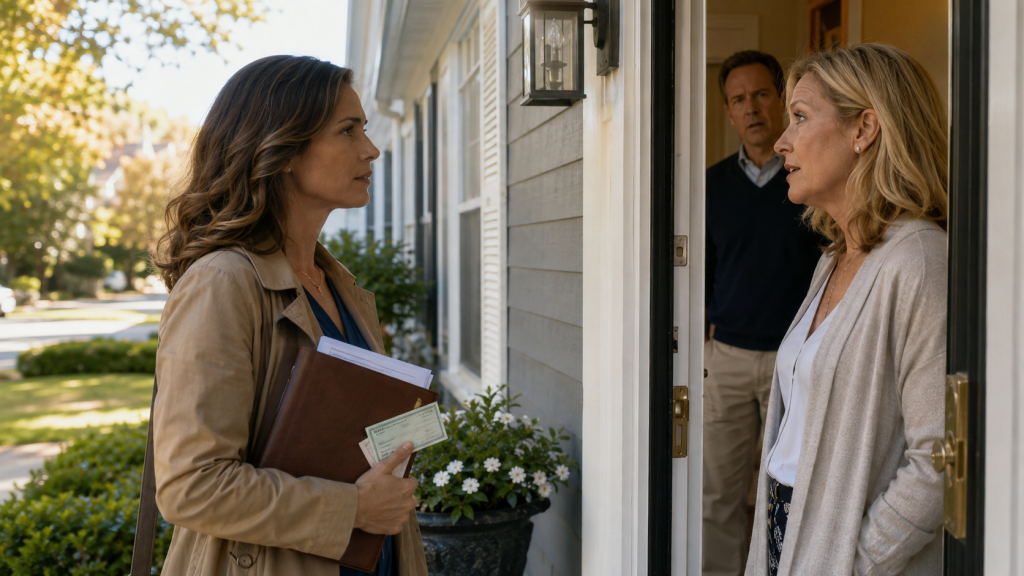
At nine o’clock, I walked up Mrs. Carpenter’s perfect stone path and rang her doorbell.
She opened the door in yoga clothes, holding a green smoothie, with a smile that vanished the second she saw the folder in my hand.
“Good morning,” I said. “I’m here for Lucy’s two hundred twenty dollars.”
Her face tightened.
“I already explained the situation to your daughter.”
“Yes. She told me about your life lesson.”
Mrs. Carpenter crossed her arms.
“Then you understand. Your daughter is old enough to know that verbal promises are difficult to enforce.”
I looked at her beautiful porch, the polished brass numbers beside the door, the expensive wreath hanging behind her.
“What I understand,” I said, “is that you hired a fifteen-year-old to care for your children and refused to pay her because you thought she was too young to fight back.”
Her eyes narrowed.
“You’re being dramatic.”
I opened the folder.
“Monday to Friday. Three-thirty to seven-thirty. Twenty hours. Eleven dollars an hour. Two hundred twenty dollars.”
She laughed.
“Can you prove the rate?”
I smiled.
“I was hoping you’d ask that.”
Behind her, a man’s voice called from inside.
“Carla? Who’s at the door?”
Mrs. Carpenter’s face changed.
Just a flicker.
But I saw it.
Her husband appeared in the hallway wearing a work shirt and confusion.
“What payment?” he asked.
Mrs. Carpenter shifted her body as if she could block him from the conversation.
“Nothing, Tom. She’s upset about a misunderstanding.”
I held out the printed schedule.
“There’s no misunderstanding. Your wife hired my daughter for twenty hours of babysitting and refused to pay her.”
Tom Carpenter took the paper.
His brow furrowed as he read.
“Carla?”
Mrs. Carpenter snapped, “She should have gotten it in writing.”
I nodded.
“Exactly. So I did.”
I handed him the doorbell timestamps, the text messages, and the notes from two other neighborhood parents who had experienced similar problems.
Tom’s face darkened with every page.
“She watched the boys every day this week?” he asked.
Mrs. Carpenter’s cheeks turned red.
“She sat on the couch while they played.”
“Did you hire her?”
“She should have learned—”
“Did you hire her?”
Mrs. Carpenter glared at me before answering.
“Yes.”
“And did you pay her?”
Silence.
That silence was the first honest thing she gave us.
Tom looked embarrassed.
Then angry.
“Carla.”
“She’s a teenager,” Mrs. Carpenter hissed. “It’s not like this is a real job.”
That was when my smile disappeared.
“She fed your children snacks. Helped with homework. Kept them safe. Settled an argument over a broken toy car. Cleaned juice off your couch. And walked home exhausted every evening. If that isn’t real work, then why did you need someone else to do it?”
Tom looked at his wife as if seeing her from a new angle.
Mrs. Carpenter folded her arms tighter.
“You can’t threaten me over babysitting money.”
“No threat,” I said. “Just choices.”
I raised the folder.
“You can pay Lucy what she earned this morning, or I can file a small claim. I can also share the facts in the neighborhood parents’ group. Not insults. Not drama. Just facts and dates.”
Her eyes widened.
“You wouldn’t.”
Tom quietly said, “She should.”
Mrs. Carpenter turned on him.
“Excuse me?”
He looked tired suddenly.
“Pay the girl, Carla.”
“She doesn’t even have a contract.”
“She watched our children.”
“She should have been smarter.”
Tom’s voice hardened.
“No. You should have been decent.”
For the first time, Mrs. Carpenter had no clever answer.
She stood there, furious, humiliated, and cornered by her own lesson.
Tom reached for his wallet.
I lifted a hand.
“No cash from you.”
He paused.
Mrs. Carpenter’s mouth fell open.
“What?”
“I want a check from her,” I said. “Signed by the person who decided hard work was payment enough.”
Tom looked at his wife.
“Write it.”
The silence stretched.
Then Mrs. Carpenter turned and disappeared into the house.
She came back two minutes later with a check.
Her hand pressed so hard while writing that the pen nearly tore the paper.
She shoved it toward me.
I looked at it.
Pay to the order of Lucy Bennett.
Two hundred twenty dollars.
I folded it carefully and placed it in my folder.
“Thank you.”
Mrs. Carpenter gave a brittle laugh.
“Congratulations. You taught your daughter to run to Mommy.”
I stepped closer, keeping my voice calm.
“No, Mrs. Carpenter. I taught my daughter that when someone steals from her, shame belongs to the thief.”
Her face went pale.
Tom looked down.
I turned and walked away.
That afternoon, I picked Lucy up from school and handed her the check.
She stared at it like it might disappear.
“She paid?”
“She paid.”
Lucy’s eyes filled again, but this time the tears were different.
“Did you yell?”
“No.”
“What happened?”
I pulled out of the school parking lot.
“I gave her the chance to learn.”
Lucy laughed softly through her tears.
At the bank, she deposited the check herself.
The teller smiled and said, “First paycheck?”
Lucy looked at me.
Then she straightened a little.
“Yes.”
On the way home, she held the receipt in both hands.
“Mom?”
“Hmm?”
“Do you think I should have gotten it in writing?”
I nodded.
“Yes.”
Her face fell.
“But not because you did something wrong. Because adults who are willing to cheat kids often hide behind technicalities. Getting things in writing protects you from people like that.”
Lucy looked out the window.
“Mrs. Carpenter made me feel stupid.”
“She wanted you to feel powerless,” I said. “That’s different.”
That evening, I helped Lucy make a simple babysitting agreement template.
Name.
Date.
Hours.
Rate.
Emergency contact.
Payment due.
Nothing complicated.
Just clear.
By the next week, three parents had asked Lucy to babysit.
Word travels fast in a neighborhood.
So does fairness.
Mrs. Carpenter stopped waving when she saw us.
That did not bother me.
Tom Carpenter came by two weeks later with his boys and a small card.
He apologized to Lucy directly.
Not to me.
To Lucy.
“I’m sorry,” he said. “You worked hard and should have been paid without your mother needing to come over.”
Lucy was nervous, but she nodded.
“Thank you.”
The card had been made by his boys.
It showed Lucy with a superhero cape and two stick-figure children beside her.
Inside, Tom had placed an extra twenty-dollar gift card to the art store.
Lucy looked at me for permission.
I said, “That one you can keep.”
Mrs. Carpenter never apologized.
Some people would rather choke on pride than swallow honesty.
But I did not need her apology.
Neither did Lucy.
Because months later, when Lucy earned enough money to buy her watercolor set, she painted a picture of a little girl standing in front of a closed door while sunlight rose behind her.
She titled it:
Lesson Learned.
I asked her what the lesson was.
She smiled.
“Get it in writing.”
Then she added, “And don’t let mean people decide what your work is worth.”
That was worth more than two hundred twenty dollars.
Mrs. Carpenter thought hard work was payment enough.
She thought she was teaching my daughter how the world worked.
Maybe she did.
But not in the way she intended.
She taught Lucy that some people will take advantage if they think you are too young, too kind, or too embarrassed to speak.
And I taught Lucy the rest.
Speak anyway.
Keep records.
Know your worth.
And never confuse being unpaid with being unvaluable.
THE END! THANKS FOR READING!