
Hours before my eighteenth birthday, my family raised a toast to “my future” while my mother kept asking what time my trust fund would finally become accessible.I smiled.I cut the cake.I said nothing.Because by then, I had already signed something she never saw coming.My mother had a special voice for money.Soft enough to sound like concern.Sharp enough to make you feel she had already spent it.
“Olivia,” she would say, touching my shoulder like she was comforting me, “when the trust becomes accessible, everything will finally be easier for all of us.”All of us.That was another phrase she loved.It made her plans sound generous.It made my grandmother’s money sound like a family solution instead of the protection it was always meant to be.
My grandmother, Eleanor Hart, had left the trust for me when she died.
She used to say, “Livvy, money cannot buy happiness, but it can buy distance from people who confuse love with control.”
I was thirteen when she told me that.
I did not understand it then.
By sixteen, I understood perfectly.
Money in our house never moved toward me.
It moved toward Brent, my stepfather, and his failing construction business.
It moved toward my stepbrother Tyler, who always had emergencies that involved broken phones, unpaid tickets, or “temporary” loans he never repaid.
It moved toward bills my mother said were urgent right before she suggested I should help more.
The only money that ever came directly for me was from my grandmother.
Birthday checks.
School clothes.
Savings for college.
And somehow, even those gifts disappeared into household needs.
When I asked about them, my mother would sigh.
“Olivia, don’t be selfish. Families support each other.”
Selfish.
That was what she called me whenever I wanted to keep something that belonged to me.
As my eighteenth birthday came closer, the atmosphere in the house changed.
My mother became sweeter.
Brent became patient.
Tyler suddenly started calling me “little sis” again, even though most days he barely looked up from his phone.
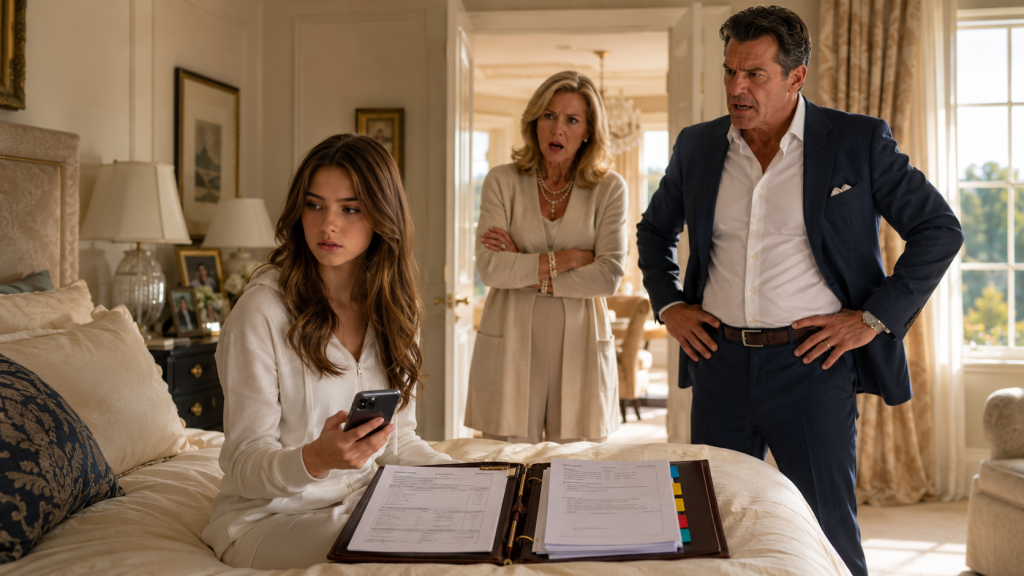
My mother bought a leather folder.
She printed forms.
She asked twice if I still had the trust officer’s business card.
She asked the exact time I was born.
Not because she wanted to remember the moment I came into the world.
Because she wanted to know when the account unlocked.
At dinner three nights before my birthday, she said, “Midnight counts, right?”
I looked up from my plate.
“For what?”
She smiled too quickly.
“For adulthood, honey. Technically, you’ll be eighteen at midnight.”
Brent chuckled.
“That’s when mature decisions begin.”
Tyler lifted his soda.
“Finally. Liv can help stabilize the family.”
I stared at all three of them.
Stabilize.
There it was.
The word they used whenever their problems needed my sacrifice.
That night, I went to my room and opened the old wooden box under my bed.
Inside were letters from my grandmother.
Cards.
Photographs.
A silver bracelet she had given me on my twelfth birthday.
And one sealed envelope marked:
Open before you sign anything.
My hands trembled when I opened it.
The letter inside smelled faintly like lavender, the way her house always had.
My dearest Olivia,
By the time you read this, someone may be telling you that love means sharing everything. Be careful. Sometimes people use the language of family when they really mean ownership.
The trust was created for your education, safety, housing, and freedom. Not for anyone else’s debts. Not for someone else’s business. Not for guilt.
Mr. Keading knows what to do. Call him before your eighteenth birthday.
Do not wait until after.
Protect yourself first.
Love, always,
Grandma.
I read the letter three times.
Then I cried into my pillow because for the first time in years, I felt like someone had seen exactly what was happening to me.
The next afternoon, while my mother and Brent were at the grocery store buying cake and champagne, I called Mr. Keading.
He remembered me immediately.
“Olivia,” he said gently. “I wondered if you would call.”
My throat tightened.
“Grandma told me to.”
There was a pause.
Then he said, “Can you come to my office today?”
Three hours before midnight, I sat across from him in a quiet office that smelled like paper, coffee, and polished wood.
A notary sat beside him.
A pen rested on the table.
I was wearing jeans, sneakers, and a sweater with a tiny hole near the sleeve.
I did not feel powerful.
I felt terrified.
“What can I do before tomorrow?” I asked.
Mr. Keading folded his hands.
“You can decide whether access means spending power or protection.”
He explained that my grandmother had built conditions into the trust.
At eighteen, I could access benefits.
But I could also sign a protective amendment requiring review before any large withdrawal, transfer, co-signed agreement, or shared authorization.
It would prevent emotional pressure from becoming financial damage.
It would not stop me from using the trust for college, housing, medical expenses, or my own future.
It would only stop other people from using me.
“So,” he said quietly, “what do you want?”
I thought of my mother’s leather folder.
Brent’s calm voice.
Tyler’s smirk.
My grandmother’s letter.
Then I picked up the pen.
“I want protection.”
I signed.
The notary stamped.
Mr. Keading slid copies into an envelope and said, “Tomorrow morning, I’ll call to confirm everything is active.”
When I left the office, the sky was already dark.
At home, my mother had decorated the dining room with gold balloons and white candles.
The cake was chocolate with raspberry filling, my favorite, though she kept reminding everyone how expensive it was.
At 11:58, she poured champagne for herself and Brent, sparkling juice for me and Tyler.
“At midnight,” she said, lifting her glass, “our Olivia steps into her future.”
Our Olivia.
Our future.
Brent smiled.
“You’re finally old enough to make mature decisions.”
Tyler leaned back in his chair.
“Big day tomorrow.”
I looked at the candles flickering on the cake.
My mother stood beside me, glowing with expectation.
She did not look like a villain.
That was the hardest part.
She looked like my mother.
The woman who braided my hair before kindergarten.
The woman who held my hand after my first heartbreak.
The woman who could still make me feel guilty with one disappointed glance.
That was why it had taken me so long to understand.
Some people can love you and still use you.
At midnight, they sang.
I blew out the candles.
My mother hugged me tightly and whispered, “Tomorrow, everything changes.”
I whispered back, “I know.”
She smiled, not hearing the difference.
The next morning, she walked into my bedroom at 8:07 without knocking.
No happy birthday.
No breakfast tray.
No soft kiss on the forehead.
Just my mother with the leather folder in one hand and a coffee mug in the other.
Brent stood behind her.
Tyler hovered in the hallway, pretending not to listen.
My mother sat on the edge of my bed like the meeting had already been approved.
“Good morning, birthday girl,” she said.
Her smile was bright.
Too bright.
She opened the folder.
There were tabs.
Not notes.
Not questions.
Tabs.
Household.
Brent.
Tyler.
Stabilization.
Olivia future.
That last one almost made me laugh.
My future came after everyone else’s problems.
She slid a typed page across my blanket.
“We’ve done the math.”
Of course she had.
Some people only respect numbers when the total comes out in their favor.
I picked up the page.
The language was polite.
Responsible.
Adult.
Shared family obligations.
Temporary redistribution.
Household recovery plan.
Signature authorization.
It was theft wearing perfume.
Brent stepped closer.
“We’re not taking anything from you,” he said. “We’re organizing it.”
Tyler crossed his arms.
“Honestly, Liv, it’s not like you need all of it right now.”
My mother tapped the signature line.
“This just keeps things simple.”
I looked at her fingernail resting on the blank line.
Then my phone buzzed on the nightstand.
Mr. Keading’s name appeared on the screen.
My mother saw it.
Her smile vanished so fast it felt like someone had turned off a light.
“Why is he calling you?” she asked.
I answered before she could reach for the phone.
“Good morning, Olivia,” Mr. Keading said. “I’m calling to confirm that the protective amendment you signed last night is now active.”
The room went silent.
He continued.
“No withdrawals, transfers, shared authorizations, or financial agreements may be approved without your written request and review through this office. Your grandmother’s protections are now in place.”
My mother stood slowly.
“What protective amendment?”
I put the phone on speaker.
Mr. Keading’s voice remained calm.
“Mrs. Hart, your daughter exercised a right granted to her by the trust terms. The trust remains available for Olivia’s education, housing, health, and personal future. It cannot be reassigned to household debts, business obligations, or third-party expenses.”
Brent’s face darkened.
“That’s unnecessary,” he snapped. “We’re her family.”
Mr. Keading said, “Then you should be relieved her future is secure.”
I nearly smiled.
My mother grabbed the paper from my blanket.
“Olivia, turn that off.”
“No.”
She blinked.
I had never said no so clearly before.
Not loudly.
Not angrily.
Just no.
And somehow that frightened her more.
“Olivia,” she said, using the soft voice. “You are young. You don’t understand what kind of pressure this family is under.”
“I understand perfectly.”
Brent scoffed.
“You signed something behind your mother’s back?”
I looked at him.
“Like you printed spending plans behind mine?”
Tyler muttered, “Wow. Dramatic.”
I turned to him.
“Which tab were you under? Tyler or emergencies?”
His face flushed.
My mother stepped closer.
“Do you know how much we have sacrificed for you?”
The old guilt rose automatically.
It knew the path.
It had lived inside me for years.
But this time, my grandmother’s letter stood between the guilt and my heart.
“You raised me,” I said. “That was your job. It doesn’t make my future your repayment plan.”
Her eyes filled with tears.
I almost broke.
Then she said, “After everything I did, your grandmother still turned you against me.”
And just like that, my sadness hardened.
“No,” I said. “Grandma protected me because she knew you would call protection betrayal.”
Brent slammed his hand against the doorframe.
“That money could save this house.”
“This house is in foreclosure because of your loans.”
His mouth opened.
My mother spun toward him.
“What loans?”
Brent went pale.
I stared at them both.
“You didn’t tell her?”
That was the first crack.
The second came an hour later, when Mr. Keading arrived with a full copy of the trust records.
He had asked me if I wanted him present.
I said yes.
My mother tried to regain control by making coffee and acting offended, but her hands shook as she set down the mugs.
Mr. Keading laid out everything.
The trust.
The restrictions.
The history.
And then, carefully, he revealed something I had not known.
My grandmother had documented years of missing checks, redirected gifts, and requests my mother had made before the trust became active.
“She attempted to access the trust twice while Olivia was still a minor,” he said.
I looked at my mother.
Her face had gone gray.
“Mom?”
She whispered, “I was trying to help us.”
“No,” I said. “You were trying to help yourself.”
Brent began arguing.
Tyler disappeared upstairs.
My mother cried.
But the tears did not move me the way they once had.
Because now I understood something important.
Not every crying person is sorry.
Some are only grieving the loss of control.
By sunset, the house felt different.
The balloons still floated in the dining room.
The cake sat half-eaten under plastic wrap.
But the celebration was over.
My mother stood in the kitchen doorway.
“Where will you go?” she asked.
It was not concern.
It was calculation.
I lifted my backpack.
“Grandma arranged another option.”
Mr. Keading had helped me secure temporary housing near the community college I planned to attend.
Small.
Quiet.
Mine.
My mother looked stunned.
“You planned this?”
“I survived this.”
That sentence broke something open in me.
I walked to the front door.
Brent did not speak.
Tyler avoided my eyes.
My mother followed me onto the porch.
For one moment, she looked smaller.
“Olivia,” she whispered, “you’re really leaving?”
I looked back at the house where I had learned to shrink myself so other people could expand.
“Yes.”
“You’ll regret this.”
I shook my head.
“No. I regret not believing Grandma sooner.”
Then I stepped off the porch.
Mr. Keading waited by the car.
The air smelled like rain and cut grass.
I took one last look at the gold balloons in the window.
Eighteen.
Most people think turning eighteen means freedom arrives all at once.
It does not.
Sometimes freedom is a signature no one knows about.
Sometimes it is a phone call at 8:07 in the morning.
Sometimes it is saying no to people who taught you obedience and calling it love.
That night, in my small new room, I opened my grandmother’s letter again.
At the bottom, beneath her signature, was one line I had missed before.
Choose the life that still feels like yours.
So I did.
I chose college.
I chose peace.
I chose a locked door.
I chose a bank account no one else could touch.
And for the first time in my life, when I thought about my future, I did not hear my mother’s money voice.
I heard my grandmother.
Soft.
Steady.
Proud.
And finally, I slept.
THE END! THANKS FOR READING!🙏