
When I found out that my ex-wife had married a poor laborer, I went to her wedding with the intention of mocking her.But the moment I saw the groom, I turned around and burst into tears of pain.My name is David Harris. I am thirty-two years old, and I live in New York City.For many years, I believed success was measured by expensive suits, glass offices, luxury cars, and the kind of address people said with admiration. I believed a man became important when others feared losing his attention.
And because I believed that, I destroyed the only pure love I had ever known.Her name was Sophie Moore.I met Sophie at Columbia University. She was not the loudest woman in the room, but somehow everyone noticed her. She had a soft voice, gentle eyes, and a heart that seemed incapable of cruelty.
She worked part-time at the campus library, saving money for her tuition, while I walked around like I already owned the world.
Back then, Sophie believed in me more than I believed in myself.
When I failed exams, she stayed up helping me study. When I doubted my future, she reminded me I was capable. When I had no money for food, she quietly brought sandwiches and pretended she had made too much.
I promised her forever.
At twenty-two, I meant it.
At twenty-seven, I broke it.
After graduation, I got hired by an international company. My salary was higher than anything my family had ever seen. I wore tailored suits. I worked in a tower with marble floors and elevators that moved silently like secrets.
Sophie, despite trying hard, only found work as a receptionist in a small hotel.
At first, I told her it did not matter. Then I started noticing the difference between us. I attended company dinners where women wore diamonds and men spoke about investments. Sophie came home tired, smelling faintly of hotel lobby flowers and cheap coffee.
One evening, as she folded laundry in our small apartment, I looked at her and thought, with disgusting arrogance, “I deserve better than this.”
Those words became the beginning of my downfall.
Not long after, Valerie Richards entered my life. She was the daughter of my company’s CEO. Rich, elegant, confident, and proud in a way that made people step aside when she entered a room.
She wanted me.
And I was foolish enough to feel honored.
I told Sophie I wanted a divorce on a rainy Thursday night. She stood in the kitchen, still wearing her hotel uniform, her hands trembling around a mug of tea.
“David,” she whispered, “is there someone else?”
I looked away.
That was answer enough.
She cried quietly. She did not scream. She did not curse me. She simply said, “I hope one day you find what you are looking for.”
I laughed coldly.
“I already have.”
But I had not found anything.
I had only lost everything.
I married Valerie six months later. The wedding was held in a luxury hotel, with crystal chandeliers, champagne towers, and guests who cared more about my father-in-law’s name than my vows. Everyone said I was lucky.
For a while, I believed them.
Five years later, I was Deputy Director of Sales. I had a BMW, a spacious apartment, and an office with my name on the door.
But my marriage felt like a prison wrapped in silk.
Valerie never let me forget where I came from. Whenever we argued, she used my past like a knife.
“Without my father,” she would say, “you would still be some miserable salesman begging for commission.”
At dinner parties, she corrected my stories. In private, she mocked my family. She hated that my mother had once cleaned houses. She hated that my younger brother worked with his hands. She hated anything that reminded her I had not been born into her world.
And I, coward that I was, allowed it.
I became quiet in my own home. I slept beside a woman who saw me as a project, not a husband. I smiled in public and died slowly in private.
Then one evening, at a gathering with old college friends, someone mentioned Sophie.
“Hey, David,” my friend Marcus said, lifting his drink. “Remember Sophie Moore?”
My chest tightened, though I pretended not to care.
“What about her?”
“She’s getting married next weekend.”
I almost dropped my glass.
“Married? To whom?”
Marcus shrugged. “Some construction worker, I heard. Poor guy. Lives upstate. But people say she looks happier than ever.”
I let out a sarcastic laugh before I could stop myself.
“Happy with a poor laborer? Sophie truly never knew how to choose the right people.”
Marcus gave me a strange look.
“Maybe she chose better this time.”
Those words irritated me more than they should have.
That night, I could not sleep. I kept picturing Sophie in a simple dress beside a man with dirty boots and rough hands. A bitter part of me wanted to see it. Wanted to prove to myself that leaving her had been the right choice.
So I decided to go.
Not to congratulate her.
To mock her.
The wedding was in a small town in Upstate New York. I drove there in my black BMW, wearing a dark designer suit and polished shoes. I imagined Sophie seeing me arrive and realizing what she had lost.
The ceremony was held in a backyard.
There were no chandeliers. No expensive flowers. No orchestra. Just string lights hanging between trees, wooden tables covered with white cloth, mason jars filled with wildflowers, and children running barefoot through the grass.
It was simple.
Too simple, I thought.
I parked near the entrance and stepped out slowly, adjusting my cuffs. A few guests turned to look at me. I felt their eyes on my car, my watch, my suit.
For a moment, my pride returned.
Then I saw Sophie.
She stood near a wooden arch covered in ivy and white roses. Her dress was modest, not designer, but she looked more beautiful than she had on the day I married her. Her face glowed with peace. Not excitement. Not nervousness.
Peace.
The kind of peace I had not felt in years.
Then I looked at the groom.
My heart stopped.
The man standing beside her was not some random poor laborer.
He was Daniel Harris.
My younger brother.
The world around me blurred.
Daniel.
The brother I had not seen in nearly nine years.
The brother I abandoned when our father died and our mother became sick.
The brother who once stood outside my office in worn-out shoes, asking for help with Mom’s hospital bills.
I remembered that day like a punch to the chest.
He had come to my company building, nervous and ashamed. His jacket was old. His hands were cracked from work. He waited in the lobby while people in suits walked past him like he was invisible.
When my secretary told me my brother was downstairs, I panicked.
Valerie was visiting the office that day. My father-in-law was there too.
I was embarrassed.
Embarrassed of my own blood.
So I went downstairs, pulled Daniel aside, and whispered angrily, “Why did you come here?”
His eyes were red.
“Mom needs treatment, David. The hospital wants another payment. I don’t know what to do.”
I looked around, terrified someone important might hear.
“You should have called.”
“I did. You never answered.”
I still remember his voice cracking when he said it.
Instead of helping him, I called security and told them to escort him out.
Daniel did not fight. He only looked at me and said, “One day, you’ll understand what you threw away.”
I did not see him again.
And now he stood before me, wearing a simple white shirt, with Sophie’s hand in his.
The groom I had come to mock was my own brother.
Daniel saw me before Sophie did.
His smile faded.
Sophie followed his gaze, and when her eyes met mine, time seemed to stop.
I expected hatred.
I expected anger.
But Sophie only looked at me with quiet sadness, as if she had already mourned the man I used to be.
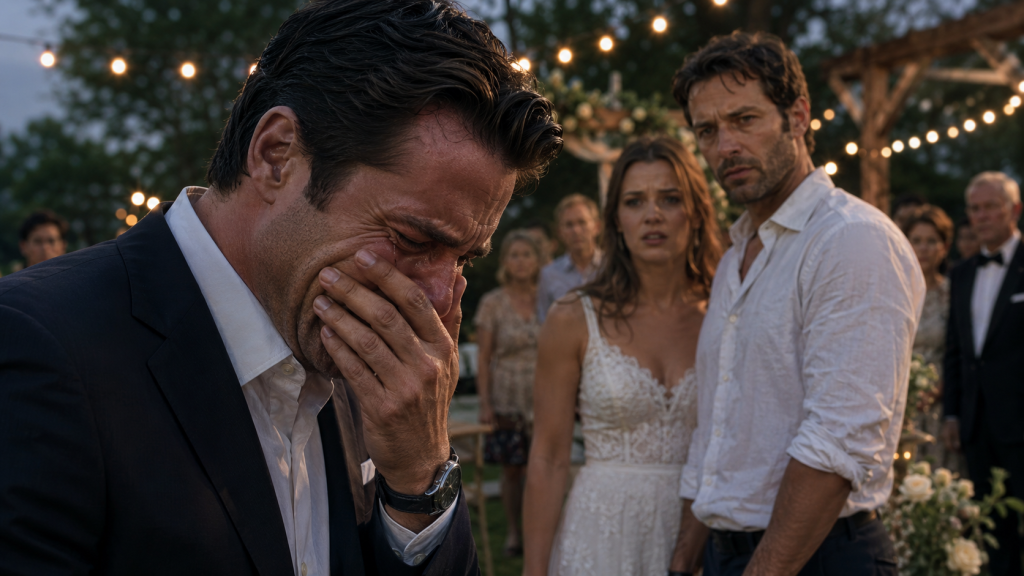
My legs moved before my mind could stop them. I turned away from the wedding, walked behind a large oak tree, and covered my face with both hands.
Then I cried.
Not softly.
Not politely.
I broke.
Years of arrogance, shame, regret, and loneliness poured out of me all at once. I cried for Sophie. I cried for Daniel. I cried for my mother. I cried for the version of myself who had traded love for status and called it ambition.
I heard footsteps behind me.
“David.”
It was Daniel.
I wiped my face quickly, but there was no hiding what I had become.
He stood a few feet away, his expression guarded.
“You came,” he said.
I swallowed hard.
“I didn’t know it was you.”
“I figured.”
His voice was calm, but that calm hurt more than anger.
I looked at his hands. Rough, scarred, strong. Hands that had worked while mine signed contracts. Hands that had cared for our mother while mine held champagne glasses.
“How?” I whispered. “How did you and Sophie…”
Daniel glanced back toward the yard.
“We met at the hospital,” he said. “When Mom was sick. Sophie was volunteering there on weekends.”
My chest tightened.
“Sophie knew Mom?”
“She visited her every Sunday.”
I stared at him, unable to speak.
Daniel continued, “After you left Sophie, she moved up here for a quieter life. She worked at a hotel, then started helping at the community clinic. She met Mom there. Mom loved her.”
I felt the ground tilt beneath me.
“Our mother knew Sophie?”
Daniel nodded.
“She knew you had divorced her. She never understood why. But Sophie never spoke badly of you. Not once.”
That destroyed me more than any insult could have.
Daniel’s voice softened, but his eyes remained firm.
“Mom waited for you, David. Until the end.”
I pressed my fist against my mouth.
“She asked about you every week. Even when she was weak. Even when she could barely breathe. She kept saying, ‘My David is busy. He’ll come when he can.’”
A sob escaped me.
“I didn’t know.”
Daniel’s jaw tightened.
“You didn’t want to know.”
He was right.
That was the cruel truth.
I had changed my number. Ignored calls. Avoided letters. Told myself family drama would distract me from success. I had not been too busy.
I had been too ashamed.
“I’m sorry,” I whispered.
Daniel looked at me for a long moment.
“I wanted to hate you,” he said. “For years, I did. But Sophie taught me something.”
I looked past him and saw her standing beneath the string lights, watching us with tears in her eyes.
“What?”
“That bitterness doesn’t punish the person who hurt you. It only keeps them living inside your heart.”
I lowered my head.
“I came here to mock her,” I confessed. “I thought she had married beneath herself.”
Daniel gave a sad smile.
“She married a man who loved her.”
Those words hit me harder than any punch.
Because suddenly, I understood.
I had thought money made me superior.
But Daniel, the poor laborer, had something I never did.
He had loyalty.
He had kindness.
He had courage.
He had Sophie’s heart.
And he deserved it.
A few minutes later, Sophie walked over. She looked at me carefully, not with fear, but with the calm strength of someone who had survived heartbreak and rebuilt herself from the ground up.
“Hello, David,” she said.
My voice trembled.
“Sophie… I don’t deserve to be here.”
“No,” she said gently. “But maybe you needed to be.”
Tears burned my eyes again.
“I’m sorry,” I said. “For everything. For leaving you. For humiliating you. For thinking your worth depended on what job you had. For being blind.”
Sophie looked down for a moment.
“When you left,” she said, “I thought my life was over. Then I realized you had not taken my future. You had only stepped out of it.”
I nodded, ashamed.
“And Daniel?” I asked quietly. “He’s good to you?”
For the first time, Sophie smiled.
“He is the safest place I have ever known.”
I looked at my brother.
He did not look rich. He did not look powerful. He did not look like a man important people would fear.
But he looked loved.
And that made him richer than I had ever been.
I did not stay for the ceremony. I could not sit among those people and pretend I belonged there. Before leaving, I took off my expensive watch and placed it in Daniel’s hand.
He frowned.
“I don’t want your money.”
“It’s not money,” I said. “It’s an apology. Sell it. Use it for the house, the honeymoon, anything.”
He tried to give it back, but Sophie touched his arm.
“Let him start somewhere,” she whispered.
Daniel closed his hand around the watch.
Then, after a long silence, he stepped forward and hugged me.
I froze.
Then I held him like a drowning man holding the shore.
“I missed you,” I cried.
Daniel’s voice broke against my shoulder.
“I missed you too.”
When I drove back to New York, the city looked different. The towers no longer impressed me. My apartment no longer felt luxurious. My BMW felt like a coffin with leather seats.
Valerie was waiting when I arrived.
“Where were you?” she demanded. “You look terrible.”
I looked at her, really looked at her, and for the first time I felt no fear.
“I went to my brother’s wedding.”
She laughed.
“The construction worker? How embarrassing.”
Something inside me went still.
“No,” I said quietly. “What’s embarrassing is that I became the kind of man who would be ashamed of him.”
Her smile disappeared.
The next morning, I called a lawyer.
My divorce from Valerie was not simple, but nothing about my life had been simple since the day I betrayed Sophie. I lost my position at the company soon after. Valerie’s father made sure of that.
For the first time in years, I had no title to hide behind.
No powerful family.
No luxury office.
Just myself.
And the weight of what I had done.
Months later, I visited Daniel and Sophie in their small house upstate. Daniel was building a porch with his own hands. Sophie was planting flowers near the steps.
They did not treat me like a hero.
They did not pretend the past had vanished.
But they let me come.
Sometimes forgiveness does not arrive like thunder. Sometimes it comes quietly, one cup of coffee at a time, one honest conversation at a time, one Sunday dinner where nobody mentions old wounds unless they are ready.
I started visiting our mother’s grave. At first, I could barely stand there without crying. I told her everything I should have said when she was alive.
I told her I was sorry.
I told her Daniel had become a better man than me.
I told her Sophie was happy.
And I told her I was finally trying to become someone worth forgiving.
People used to envy my life in New York.
They saw the suit, the car, the office, the wife from a wealthy family.
They thought I had won.
But the truth is, I only began to understand success on the day I stood in a simple backyard, under warm string lights, watching the woman I once abandoned marry the brother I once rejected.
I went there to mock a poor laborer.
Instead, I found a rich man.
Not rich in money.
Rich in love.
Rich in loyalty.
Rich in the things I had thrown away.
And as I watched Daniel kiss Sophie beneath the wooden arch, surrounded by wildflowers and ordinary people with extraordinary hearts, I finally understood the lesson life had been trying to teach me.
A man is not poor because his hands are dirty.
A man is poor when his heart is empty.
And mine had been empty for far too long.
THE END! THANKS FOR READING!