
When my 15-year-old daughter, Lucy, came home with red, puffy eyes, I knew something was wrong.She had spent the entire week babysitting for our neighbor, Mrs. Carpenter, who had promised her eleven dollars an hour.“What happened, Lucy?” I asked.She stood in the doorway with her backpack hanging from one shoulder, her face pale and her lips trembling.“Mrs. Carpenter… she didn’t pay me,” she whispered….More article below👇
I frowned. “What do you mean?”Lucy wiped her eyes quickly, like she was embarrassed to be crying. “She said it was a life lesson. She said I should get things in writing and never trust someone’s word.”My stomach tightened.“She said what?”“She said hard work was payment enough,” Lucy said. “Then she slammed the door in my face.”For a few seconds, I couldn’t speak.
Lucy had spent five afternoons at that woman’s house. She had fed Mrs. Carpenter’s two boys, helped them with homework, cleaned up juice spills, read bedtime stories, and missed hanging out with her friends because she wanted to earn money for a new laptop.
And that woman had looked a child in the eyes and cheated her.
I pulled Lucy into my arms.
“You did nothing wrong,” I told her. “Nothing.”
Then I went to my purse, took out two hundred and twenty dollars, and placed it in her hand.
Her eyes widened. “Mom, no. You don’t have to—”
“Yes, I do,” I said. “You earned this.”
She hugged me so tightly I felt her shoulders shake.
But while I comforted my daughter, something cold and sharp settled inside me.
Mrs. Carpenter thought she had taught Lucy a lesson.
She was right.
But it wasn’t the lesson she thought.
The next morning, I woke up early and made coffee before the sun had fully risen. I sat at the kitchen table with my laptop open and started gathering everything.
Text messages.
Voice notes.
Screenshots.
Mrs. Carpenter had written clearly: “Can Lucy watch the boys this week? Monday to Friday, 4 to 9. I’ll pay her $11 an hour.”
Lucy had replied politely: “Yes, Mrs. Carpenter. Thank you.”
There it was.
In writing.
I printed everything and placed the papers in a folder.
Then I checked our porch camera footage. Every evening, Lucy had left our house at 3:50 and returned after 9, tired but smiling. On Wednesday, Mrs. Carpenter herself had walked her to the door and said, loud enough for the camera to catch, “You’re a lifesaver, Lucy.”
A lifesaver.
Not a volunteer.
Not a neighbor doing a favor.
A worker.
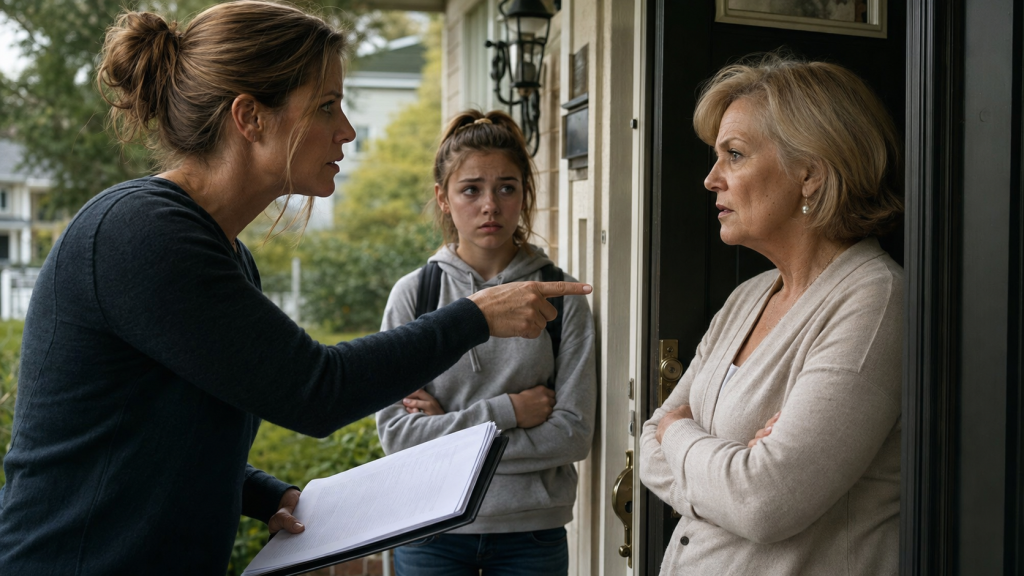
At nine o’clock, I walked across the street.
Mrs. Carpenter opened the door wearing a silk robe and an annoyed expression.
“Oh,” she said. “This is about Lucy, isn’t it?”
I smiled. “Yes.”
She folded her arms. “I already explained it to her. Young people need to learn how the real world works.”
I nodded slowly. “I agree.”
That made her smile.
For one second, she thought I was on her side.
Then I opened the folder.
“This is your text message promising eleven dollars an hour,” I said.
Her smile disappeared.
“This is Lucy’s confirmation. This is the schedule. This is the porch camera footage showing her leaving and returning each day.”
Mrs. Carpenter’s face tightened. “Are you threatening me?”
“No,” I said calmly. “I’m educating you.”
She scoffed. “She’s a teenager. It was babysitting. Don’t be dramatic.”
“She is a minor who worked twenty hours because an adult promised to pay her.”
Mrs. Carpenter looked over her shoulder, probably hoping her husband would appear and rescue her.
He didn’t.
I stepped closer, still calm.
“You have two choices. Pay my daughter today, or tomorrow morning every parent in this neighborhood will know exactly what you did.”
Her lips parted.
I continued. “And after that, I’ll file a complaint in small claims court. Not because I need the money, but because Lucy needs to see that people like you don’t get to steal from children and call it wisdom.”
For the first time, Mrs. Carpenter looked nervous.
“You’re making this ugly,” she muttered.
“No,” I said. “You made it ugly when you made my daughter cry.”
She stared at me for a long moment. Then she turned, grabbed her purse from the table, and counted out the money with shaking fingers.
Two hundred and twenty dollars.
I didn’t touch it right away.
“Put it in an envelope,” I said.
“What?”
“Put it in an envelope and write Lucy’s name on it.”
Her face burned red, but she did it.
Then I said, “And write what it’s for.”
She glared at me.
I waited.
Finally, she wrote: Payment for babysitting.
I took the envelope and walked home.
Lucy was sitting on the stairs when I came in, still in her pajamas, eyes worried.
“Mom?”
I handed her the envelope.
She opened it, and her mouth fell open.
“She paid?”
“She did.”
Lucy stared at the money, but she didn’t smile. Not at first.
“She only paid because you scared her,” she said quietly.
I sat beside her. “Maybe. But she also paid because you had proof. And because what she did was wrong.”
Lucy looked down. “I felt so stupid.”
I touched her chin gently and made her look at me.
“You were not stupid. You trusted an adult who should have known better.”
Her eyes filled again.
I said, “The lesson is not never trust anyone. The lesson is trust carefully, and always protect yourself.”
That afternoon, Lucy asked me to help her make a simple babysitting agreement. Nothing fancy. Just names, dates, times, payment, and signatures.
We printed five copies.
I thought that was the end of it.
But Mrs. Carpenter was not finished.
Two days later, my phone started buzzing while I was at work.
One neighbor messaged me first.
Then another.
Then another.
“Is it true Lucy tried to scam Mrs. Carpenter?”
My hands froze over my keyboard.
I opened the neighborhood Facebook group and saw the post.
Mrs. Carpenter had written:
“Parents, please be careful. A teenage girl in our neighborhood tried to pressure me for money after volunteering to help with my children. Her mother came to my house acting aggressive. Sad what people will do for cash.”
She didn’t use Lucy’s name.
But everyone knew.
My daughter’s face went white when I showed her.
“She’s lying,” Lucy whispered.
“I know.”
“She’s making me look bad.”
“No,” I said. “She’s making a mistake.”
This time, I didn’t walk across the street.
I sat down and replied publicly.
“Mrs. Carpenter, since you brought this into the neighborhood group, I’ll clarify. You texted my 15-year-old daughter and offered her $11 an hour to babysit your two children from Monday through Friday, 4 p.m. to 9 p.m. She worked the full week. When she asked for payment, you told her it was a life lesson and slammed the door in her face. I have the messages, camera footage, and the envelope you later wrote ‘Payment for babysitting’ on. Please remove this post.”
For three minutes, nothing happened.
Then the comments began.
“Wait, she didn’t pay a child?”
“Lucy babysat for me last summer. She’s wonderful.”
“Mrs. Carpenter, is this true?”
“Please post the screenshots.”
I didn’t post the screenshots right away.
I didn’t need to.
Mrs. Carpenter deleted her post within ten minutes.
But screenshots travel faster than apologies.
By evening, half the neighborhood knew what had happened.
The next morning, Mrs. Carpenter knocked on our door.
Lucy was in the kitchen eating cereal. When she heard the knock, she looked at me with panic.
“Stay here,” I said.
I opened the door.
Mrs. Carpenter stood there without makeup, clutching a folded piece of paper.
“I want to speak to Lucy,” she said.
“No.”
Her face tightened. “I came to apologize.”
“You can apologize from there.”
She swallowed hard.
Then Lucy appeared behind me.
“It’s okay, Mom,” she said softly.
I stepped aside but stayed close.
Mrs. Carpenter looked at my daughter, and for once, she didn’t look proud.
“I was wrong,” she said. “I was angry because money has been tight, and I took it out on you. That was unfair. You worked hard. You deserved to be paid. I should not have embarrassed you.”
Lucy stared at her.
Mrs. Carpenter held out the paper. “This is a written apology. I also posted one in the group.”
Lucy didn’t take it.
She asked, “Did you only apologize because people got mad?”
Mrs. Carpenter’s eyes flickered.
That was answer enough.
Lucy nodded slowly. “Then I don’t accept it yet.”
Mrs. Carpenter looked shocked.
Lucy’s voice trembled, but she kept going.
“You made me feel stupid for trusting you. Then you lied about me. I’m glad you said sorry, but I don’t have to make you feel better.”
I had never been prouder of my daughter.
Mrs. Carpenter lowered the paper.
“You’re right,” she whispered.
Then she walked away.
For the next few weeks, Lucy refused every babysitting request.
She said she was done.
I didn’t push her.
Sometimes betrayal hits harder when it comes from someone familiar. Mrs. Carpenter wasn’t a stranger. She was the woman who waved at us from her flower beds, borrowed sugar, and brought cookies to block parties.
That was what hurt Lucy most.
But one Saturday afternoon, Mrs. Alvarez from two streets over came by.
Her husband had been hospitalized suddenly, and she needed someone to watch her little girl for three hours.
“I know Lucy may not want to,” she said gently. “But I wanted to ask properly.”
Then she handed Lucy a signed agreement before Lucy could even answer.
Lucy looked at the paper.
Then at me.
Then back at Mrs. Alvarez.
“How much?” Lucy asked.
“Fifteen an hour,” Mrs. Alvarez said. “Paid before I leave.”
Lucy blinked.
Mrs. Alvarez smiled. “Your time matters.”
Lucy took the job.
When she came home that evening, she looked different.
Not innocent like before.
Stronger.
She placed the money in her laptop jar and taped her new babysitting agreement template to the inside of her notebook.
A month later, Lucy had more babysitting jobs than she could accept. Parents trusted her. Kids loved her. And every single family signed her agreement before she worked.
One evening, I found her at the kitchen table helping her best friend, Maya, write one too.
“You need the hours, the pay, cancellation rules, and emergency contacts,” Lucy explained seriously.
Maya groaned. “You sound like a lawyer.”
Lucy smiled. “No. I sound like someone who learned.”
I stood in the hallway listening, my heart full.
Mrs. Carpenter had tried to teach my daughter that the world was cruel and that kindness made you weak.
But Lucy learned something better.
She learned that being kind does not mean being careless.
She learned that standing up for yourself does not make you rude.
And she learned that when someone tries to turn your pain into a lesson, you are allowed to choose what the lesson becomes.
Two months later, Lucy bought her laptop with her own money.
She placed it on the kitchen table, opened the box carefully, and ran her fingers over the keyboard like it was made of gold.
“I did it,” she whispered.
I hugged her from behind. “Yes, you did.”
Across the street, Mrs. Carpenter’s curtains moved.
Maybe she saw us celebrating.
Maybe she didn’t.
Either way, I hoped she remembered the lesson.
Because my daughter certainly did.
Never cheat someone just because you think they are too young to fight back.
Sometimes the smallest voice in the room grows strong enough to make the whole neighborhood listen.
THE END! THANKS FOR READING!