
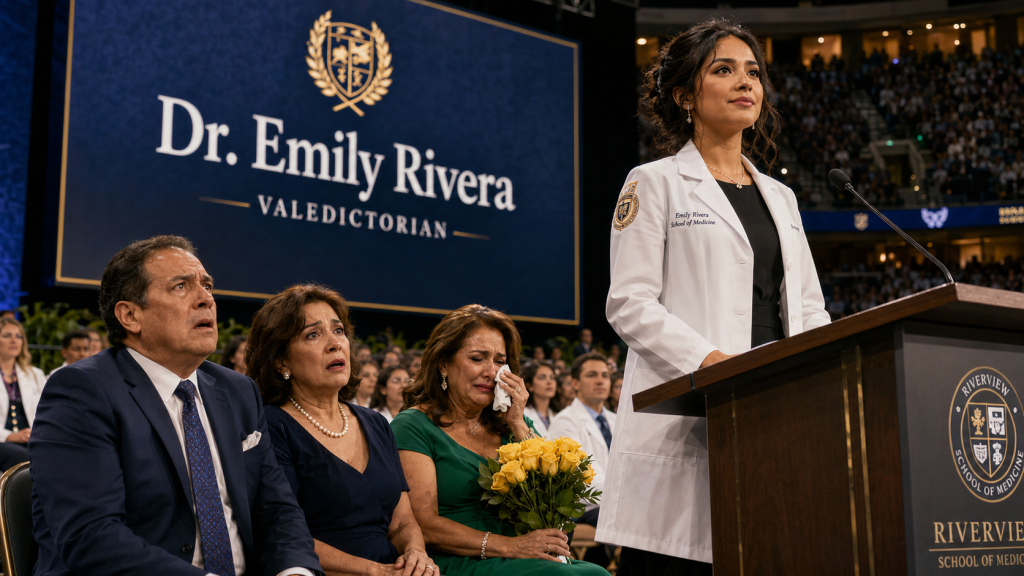
The first time I saw my biological parents after fifteen years, they were sitting in the premium VIP section at Madison Square Garden, pretending they belonged among the proud families of graduating doctors.My mother wore pearls.I remembered those pearls.She used to wear them to church, to charity luncheons, to parent-teacher conferences when she wanted other mothers to know she was important.
My father sat beside her in a navy suit, flipping through the graduation program with the same impatient fingers he used to tap on restaurant tables when service was slow.Two seats away sat Megan Rivera in an emerald green dress, holding yellow roses in her lap.Her eyes were already full of tears.My father glanced at her once, then looked away.He had no idea that the woman sitting near him had done what he and my mother refused to do.She had stayed.
My name is Emily Rivera.I was born Emily Parker, but I buried that name in a hospital room when I was thirteen years old.That was the day Dr. Collins told my parents I had acute lymphoblastic leukemia.I still remember the smell of the consultation room.Coffee.
Hand sanitizer.
Rain on my mother’s wool coat.
Dr. Collins spoke gently. He used words I didn’t fully understand yet, words like treatment plan, chemotherapy, survival rate, inpatient care.
My mother cried into a tissue.
At first, I thought she was crying for me.
Then my father asked the question that split my childhood in half.
“How much?”
Dr. Collins paused.
He explained that treatment would be long and expensive. Insurance would cover some of it, but not everything. There would be hospital stays, medications, specialist appointments, complications, months of uncertainty.
My father leaned back in his chair as if someone had just handed him a bill for a car repair he didn’t want.
My mother stared at the floor.
I waited for one of them to reach for my hand.
Neither did.
That night, I heard them arguing outside my room.
My sister Ashley had a college fund.
One hundred eighty thousand dollars, set aside because she was “gifted,” because she was “going somewhere,” because she was the daughter they proudly introduced first.
I was thirteen, sick, and terrified.
My father’s voice carried through the cracked door.
“We’re not ruining a promising future for an average one.”
Average.
That was the word he used for me.
Not daughter.
Not child.
Not Emily.
Average.
By the next afternoon, emergency custody papers were signed.
I didn’t understand all the legal words, but I understood enough.
My parents were leaving.
My mother came into my hospital room holding her purse with both hands.
She stood near the foot of my bed, not close enough to touch me.
“This is for the best,” she said.
Her voice shook, but her feet did not move toward me.
My father stood behind her, checking his watch.
I asked, “When are you coming back?”
My mother looked at the blanket.
My father said, “Be brave.”
Then they walked out.
No hug.
No kiss on my forehead.
No goodbye.
I watched the door close behind them, and something inside me went silent.
That night, I lay awake under the thin hospital blanket, listening to machines beep and nurses move softly in the hallway.
I did not cry loudly.
I was afraid that if I made too much noise, someone else would leave.
Around midnight, a nurse stepped into my room.
She had kind eyes, dark curls pulled into a messy bun, and a coffee stain on the sleeve of her scrub top.
Her name tag said Megan Rivera.
She checked my IV, then looked at my face.
“You heard everything, didn’t you?” she asked softly.
I nodded.
She sat beside my bed.
Most adults tried to comfort children with lies.
Megan didn’t.
“There are no polite words for what they did,” she said.
That was the first honest thing anyone had said to me all day.
Then she reached for my hand.
And she stayed.
Megan stayed after her shift ended.
She stayed when I threw up until my throat burned.
She stayed when my hair began falling out in clumps and I screamed at the mirror.
She stayed when I begged her not to let me die.
She read to me on the nights I couldn’t sleep.
She learned that I hated orange Jell-O and liked grape Popsicles.
She brought me soft hats in bright colors.
She taped my school assignments to the wall and told me that cancer could take my hair, my strength, and my appetite, but it was not allowed to take my mind.
After induction chemotherapy, when the hospital social worker started talking about long-term placement, Megan said something that made the whole room go quiet.
“I want to take her home.”
The social worker blinked.
“Megan, that is a serious commitment.”
Megan looked through the glass window at me.
“I know.”
“It won’t be easy.”
“I know.”
“She is still in treatment.”
“I know.”
Then Megan said, “She deserves someone who chooses her.”
That was how I became Emily Rivera.
Megan adopted me before my fourteenth birthday.
Her apartment was small, with creaky floors and a radiator that hissed in the winter.
She gave me the bedroom and slept on a pullout couch for six months because she said healing required a real bed.
I didn’t find out until years later that she had taken out a second mortgage on her late mother’s house to help pay for the parts of my treatment insurance didn’t cover.
She never told me then.
Not once.
She never sighed over bills in front of me.
Never made me feel like a burden.
Never said, “Do you know how much this costs?”
Instead, every time I apologized for being sick, she would lift my chin and say, “You are not expensive. You are priceless.”
Priceless.
It became the word that saved me.
When I was well enough to return to school, I was behind.
Very behind.
My hands shook when I wrote.
I got tired walking up stairs.
Some kids stared at my short hair.
Some teachers treated me like glass.
But Megan treated me like steel.
Every night, she sat at the kitchen table with me after her shift, helping me study biology, algebra, history, anything I had missed.
When I got my first A after returning, she taped it to the refrigerator like it was a national award.
When I graduated high school as salutatorian, she screamed so loudly from the bleachers that three people turned around.
When I told her I wanted to become a doctor, she didn’t laugh.
She didn’t say it was too hard.
She said, “Then we start tomorrow.”
I chose medicine because of the doctors who saved my life.
I chose pediatric oncology because of the children who reminded me of myself.
Scared.
Bald.
Brave before they should ever have to be.
Children listening to adults discuss money, survival rates, and risks while pretending not to understand.
I understood them.
I had been them.
Years passed.
College.
Scholarships.
Research.
Sleepless nights.
Medical school interviews.
Rejections.
One acceptance letter that made Megan drop to her knees in the hallway and thank God through tears.
Columbia University College of Physicians and Surgeons.
When I received that letter, I stared at my name until the words blurred.
Emily Rivera.
Not Parker.
Rivera.
During medical school, I worked harder than I knew a body could work.
I studied until sunrise.
I lost patients.
I celebrated remissions.
I learned how to tell parents terrible news with compassion.
I learned how to stand beside a hospital bed and not look away from fear.
In April of my final year, the Dean called me into his office.
I thought I had done something wrong.
Instead, he smiled and said, “Emily, you’ve been selected as valedictorian.”
For a moment, I could not speak.
Then I thought of a thirteen-year-old girl in a hospital bed, abandoned because she was “average.”
I thought of Megan sitting beside her, holding her hand.
I went home that night and told Megan.
She covered her mouth.
Then she cried so hard I had to hold her.
“My girl,” she kept saying. “My girl.”
Two weeks later, an email arrived from the university office.
Karen and Richard Parker have contacted us claiming to be your parents and requesting access to premium seating for the commencement ceremony. Should we add them to your guest list?
I read it three times.
My hands went cold.
Fifteen years.
Fifteen years without a birthday card.
Without a phone call.
Without a “Did you survive?”
Without an apology.
But now that my name came with honors, a white coat, and a stage, they wanted seats.
Not just seats.
Premium seats.
They wanted to be seen.
I called Megan.
She was quiet while I read the email aloud.
Then she said, “What do you want to do?”
“I don’t know,” I admitted.
A long silence passed.
Then Megan said, “Let them come.”
I stared at the phone.
“Why?”
“Because the truth deserves an audience.”
So I gave them the best seats in the house.
On commencement day, Madison Square Garden was filled with families, flowers, cameras, proud grandparents, excited siblings, crying mothers, fathers trying not to cry.
I stood backstage in my gown, watching through a small gap in the curtain.
There they were.
Karen and Richard Parker.
My mother lifted her chin as though she had raised me with discipline and sacrifice.
My father pointed at my name in the program, showing it to the man beside him.
Dr. Emily Rivera.
He frowned slightly at the last name.
Good.
Let him wonder.
Megan sat nearby, clutching her roses.
She didn’t know I had arranged something more than a speech.
Not everything.
Only enough.
A coordinator touched my arm.
“Dr. Rivera, you’re next.”
Dr. Rivera.
The name settled over me like armor.
The Dean stepped to the podium.
His voice echoed through the arena.
“It is my great honor to introduce the valedictorian of the Columbia University College of Physicians and Surgeons Class of 2026.”
My mother sat taller.
My father closed the program.
The Dean continued.
“Dr. Emily Rivera.”
The applause rose like thunder.
I walked onto the stage.
My legs were steady.
My hands were calm.
I looked first at Megan.
She was crying already.
Then I looked at Karen and Richard.
My mother’s smile was frozen.
My father’s face had gone tight.
I reached the podium.
Before I could speak, the Dean turned back to the microphone.
“Before Dr. Rivera gives her address, she has asked us to recognize the person who made this day possible.”
My mother’s expression changed instantly.
She smoothed her dress.
My father straightened his tie.
They thought the moment was theirs.
They thought abandoned children forget.
They thought success washes away the past.
Then the Dean said, “Dr. Rivera dedicates this honor to her mother, Megan Rivera, the nurse who adopted her, raised her, and helped save her life.”
The camera turned toward Megan.
Her face appeared on the giant screen above the stage.
The arena erupted.
People stood.
Doctors, professors, families, strangers, all rising for the woman in the emerald green dress holding yellow roses.
Megan shook her head, overwhelmed, tears streaming down her face.
My mother’s smile collapsed.
My father went pale.
I watched him understand.
Slowly.
Publicly.
Completely.
When the applause finally softened, I stepped to the microphone.
I unfolded my speech, but I did not read from it.
I didn’t need to.
“Fifteen years ago,” I began, “I was a thirteen-year-old girl in a hospital bed, diagnosed with leukemia.”
The arena quieted.
“My parents were told the treatment would be difficult. Expensive. Uncertain. And that day, they made a choice.”
I looked down at the front row.
“They left.”
A ripple moved through the crowd.
My mother’s lips parted.
My father stared straight ahead.
“They decided my life cost too much. They decided another child’s future was worth more than mine. They signed papers, walked out of the hospital, and did not come back.”
I paused.
My voice did not break.
“For years, I thought that meant I was unwanted. I thought it meant I was not worth saving.”
Megan pressed the roses against her heart.
“Then a night nurse named Megan Rivera sat beside my bed and told me the truth. She told me there were no polite words for what had been done to me. And then she did something more powerful than comforting me.”
I smiled through my tears.
“She stayed.”
The applause began again, softer this time, full of emotion.
“She stayed through chemotherapy. Through fear. Through schoolwork. Through bills I never knew she was paying. She adopted me when loving me was not easy, not convenient, and not cheap.”
I looked at Megan.
“She never once made me feel like a burden. She taught me that family is not the people who share your blood. Family is the people who show up when leaving would be easier.”
My mother covered her face.
My father stood abruptly, but an usher stepped into the aisle.
He sat back down.
I continued.
“So today, as I become a doctor, I carry two lessons with me. The first came from the people who abandoned me: never measure a human life by its cost.”
I turned back to the graduates behind me.
“The second came from my mother, Megan: one person who chooses to stay can change the entire ending of a life.”
This time, the standing ovation shook the room.
Megan stood slowly, trembling.
I left the podium, crossed the stage, and walked down the steps.
Protocol disappeared.
The cameras followed me.
The Dean did not stop me.
I went straight to Megan.
She rose just as I reached her, and I wrapped my arms around her.
She smelled like lavender lotion and roses.
The same as home.
“I’m so proud of you,” she whispered.
I held her tighter.
“I’m here because of you.”
Behind her, Karen was crying silently.
Richard looked smaller than I remembered.
Not powerful.
Not important.
Just old.
Just exposed.
After the ceremony, they waited near the hallway leading to the reception.
For a moment, I considered walking past them.
But I didn’t.
I stopped.
My mother reached for me.
“Emily,” she said, voice shaking. “We didn’t know what else to do.”
I stepped back before she could touch me.
“You knew how to leave,” I said. “You just didn’t know how to love.”
My father’s jaw tightened.
“That speech was unnecessary.”
I looked at him, really looked at him, and felt nothing but distance.
“No,” I said. “What you did was unnecessary. The truth was overdue.”
My mother started crying harder.
“We are your parents.”
I glanced over my shoulder.
Megan was standing a few feet away, waiting for me, holding the yellow roses.
“No,” I said quietly. “You are the people who gave me away.”
Then I walked to my mother.
My real mother.
Megan handed me the roses.
I took them and smiled.
Outside, camera flashes caught the graduates in their gowns, families laughing and crying beneath the bright New York sky.
Megan linked her arm through mine.
“Are you okay?” she asked.
I looked back once.
Karen and Richard stood alone by the doorway, surrounded by all the prestige they had come to claim and none of the love they had refused to give.
Then I looked at Megan.
“I’m better than okay,” I said.
Because at thirteen, I had been left in a hospital room as if my story was over.
But it wasn’t.
A stranger had walked in.
A nurse had stayed.
A mother had chosen me.
And fifteen years later, I gave the people who abandoned me exactly what they asked for.
Front-row seats.
Not to my success.
To the truth.
THE END! THANKS FOR READING!