It was fear that I would discover something more. Teresa lunged at me to take the phone away.
Not with force. With desperation. “Arthur, please, don’t open it.” That hurt me more than the message itself.
Because a wife doesn’t beg like that to protect a son’s privacy. She begs like that when she knows that behind a screen lies a ruin that has already caught up to her. “What are you hiding from me?” I asked. Teresa covered her mouth.
The phone vibrated again. “Mau: Remember, if your boss doesn’t loosen up tomorrow, we’re selling the old man’s computer. He won’t even notice.” I felt my chest tighten. I opened the phone. Daniel used the same password for everything: his mother’s birthday. That was the first slap in the face. The chat with Mau looked like a sewer. Messages about gambling. Money. Threats. Photos of pawn shop tickets. My credit card. Teresa’s credit card. Screenshots of small transfers that, added up, were a massive hole.
“Tell her you’re feeling sick, the bosses cave in fast.” “Cry to her for a while.” “Your dad is a donkey, but your boss gets it.” “Today, get them for the app payment, dude, they’re already coming after me.”
I looked at Teresa. She was crying in silence. “How much?” She didn’t answer. “Teresa, how much money have you given him?” “I don’t know.” “Don’t lie to me.” She sat in the kitchen chair as if her body could no longer support the weight of her shame. “More than fifty thousand.” I froze. Fifty thousand dollars. Fifty thousand that I didn’t see because I trusted that our household was breathing normally. “Where did you get it from?” She closed her eyes. “From my savings. From the savings club. From a loan at the credit union. I pawned my earrings.” I looked at her ears. She wasn’t wearing the gold earrings her mother left her when we married. I hadn’t even noticed. I hated myself in that moment, too. “Why didn’t you tell me?” “Because he swore to me that if you found out, you’d kick him out.” “And he was right.” “He told me he was sick, Arthur. That he couldn’t stop. That he owed money to some guys. That if he didn’t pay, they were going to hurt him.”
I went back to the chat. There were voice notes. I opened one. Daniel’s voice filled the kitchen: “Come on, Mau, my boss is falling for it. I just tell her I’m going to kill myself and she gets all worked up. It makes me laugh, but it works.”
Teresa let out a whimper. I squeezed the phone until my fingers ached. That wasn’t my “lost boy.” That was a man using his mother’s love as an ATM. “Teresa…” She covered her face. “I thought I was saving him.” “No. You were financing him.” She folded over the table. I didn’t have the strength to console her. Not yet.
I kept reading. I discovered that Daniel wasn’t just asking for food and money. He had taken out quick loans using Teresa’s information. He had sent photos of her ID. He had sold my drill, an old flat-screen, the bicycle from when my nephew, Nicholas, used to come stay over. He had promised to take my laptop the next day. And the worst was at the end. “Mau: Tomorrow, come over to the apartment. Bring the lady’s card or don’t bother coming in.” “Mau: And if the old man kicks you out, even better. That way you scare them.” “Mau: Those old folks would rather pay than see you out on the street.”
I sat down. The kitchen smelled of the rice I had thrown away, of spilled soda, of old exhaustion. Outside, an out-of-tune organ grinder was passing through the street, as if Chicago insisted on playing music even when a house was falling down. “We have to go get him,” Teresa said. I looked up. “No.” “Arthur, he’s on the street.” “He’s on the street because I put him there. And for the first time in months, he doesn’t have his mother serving him dinner.” “But those messages…” “Those messages prove that if he comes back right now, he wins again.”
Teresa stood up. “He’s my son!” “He’s mine, too.” “Then act like a father.” That hit me. I walked over to her. “That is exactly what I’m doing. What you’re asking me to do is act like an accomplice.”
Teresa cried harder. But she didn’t open the door. For half an hour, we stayed there, with Daniel’s cell phone on the table, vibrating every few minutes like a trapped animal. Then another message arrived. “Mau: I’m outside the Oxxo. If you don’t bring cash, don’t even bother.” The Oxxo was four blocks away. Teresa stood up before I did. “Now you go.”
I didn’t go get Daniel to bring him back. I went because, even if a son becomes cruel, one doesn’t stop knowing that there are worse wolves out there. I walked down the stairs with my jacket on. Teresa wanted to come. “No,” I told her. “You’ve already done too much alone. Now it’s my turn to watch.”
The night in the Chicago suburbs was damp. It had rained a little, and the sidewalks glistened under the yellow streetlights. A bus with loud music roared past heading toward the L-train station, and a man was pushing a tamale cart, shouting that there were still green and sweet ones left. I walked to the corner. Daniel was in front of the Oxxo, sitting on one of his black bags. Still barefoot. His face red with anger. His pride shredded, but not defeated. Beside him was a skinny kid, black cap, oversized hoodie, and a nervous gaze. Mau. He saw me coming and smiled. “Good evening, boss.” “I’m not your boss.” Daniel stood up. “Did you come to beg me?” I looked at his dirty feet on the wet pavement. “I came for your phone.” His face changed. “Did you check it?” “Yes.” “That’s illegal.” “Stealing from your mother is too.”
Mau took a step back. “I’m not getting involved, man.” I walked up to him. “You are involved. You have messages asking him to sell my things and take money from my wife. If you want, we can continue this conversation with a patrol car.” Mau lost his smile. “It’s his problem. I didn’t put a gun to his head.” Daniel looked at him. “What?” “Yeah, dude. Don’t be a crybaby.” That was when he saw it. Maybe for the first time. The “friend” who called him “brother” as long as there was money just dropped him like a broken bag. Daniel swallowed hard. “Mau, no way.” “I don’t have anywhere to put you if you don’t bring cash.” Mau walked away quickly, looking back only once.
Daniel stood still. With his black bags. Without control. Without a screen. Without a mother running to save him. “Let’s go,” I said. His eyes brightened. “Home?” “No.” “Then?” “To sleep at your Uncle Ramon’s. He has a cot in the back of his workshop. He heads to the wholesale market at five. You’re going with him.” Daniel let out a bitter laugh. “Not a chance.” “Then find somewhere else to sleep.” I turned around. I hadn’t taken three steps when I heard his voice. “Dad.” I stopped. Not because of the word. Because of the tone. He hadn’t called me Dad without mockery in years. “I’m cold.” I looked at the black city sky. Then at him. “Put on the jacket that’s in the bag.” “I don’t have socks.” I took a hundred dollars out of my wallet and gave it to him. “For socks and a sandwich. Not for reloads. Not for gambling. Not for Mau.” He took it with rage. “You’re a real prick.” “Yeah. Today I am.”
I took him to Ramon’s. My brother has a workshop near the industrial district, smelling of grease, iron, and reheated coffee. He’s one of those men who doesn’t talk pretty, but shows up when needed. When Daniel walked in carrying bags, Ramon didn’t even ask. He just pointed to a cot in the back. “Sleep there. Bathroom’s on the right. I’m waking you up at 4:30.” “I’m not going to work with you.” Ramon raised an eyebrow. “Then you don’t sleep here.” Daniel looked at me. I didn’t rescue him. That night, I went home alone. Teresa was awake in the living room, her rosary between her fingers, even though she hadn’t truly prayed in years. “Where is he?” “With Ramon.” “Did he eat?” “I don’t know.” “What do you mean you don’t know?” “Teresa, he’s 22. If he’s hungry, he’s going to have to say so without humiliating anyone.” She wanted to argue. But she stayed quiet. The silence was strange. It wasn’t peace. It was withdrawal. Because in our house, we were all addicts: Daniel to receiving, Teresa to saving him, me to holding on until I exploded.
At 4:00 AM, my cell phone rang. It was Ramon. “I woke him up.” “And?” “He cursed me out, but he’s putting his sneakers on.” I hung up. I couldn’t help but cry. I sat in the kitchen, alone, with my swollen hands on the table. Outside, the city noises were just beginning: trucks, dogs, the first subway train breathing underground, people heading out to work before dawn. People like me. Like Teresa. Like so many who didn’t have time to be depressed on a couch because rent doesn’t forgive.
At seven, Ramon sent a photo. Daniel was loading tomato crates at the market. He had a furious face, a sweaty shirt, and eyes swollen with sleep. Behind him, you could see the bustle of laborers, trucks, sacks, shouts of sellers, and mountains of fruit as if the whole city were eating breakfast thanks to those tired bodies. Teresa saw the photo and cried. “Poor thing.” I gently took the phone from her. “We’re poor things, too.”
That day, I went to work with a heavy chest. On the way, the train was packed. Workers, students, ladies with bags, a man asleep while standing. I looked at my hands and thought of Daniel. Of how easy it had been to give him everything so he wouldn’t suffer. Of how expensive it cost us to spare him the effort.
When I got home at night, Teresa had prepared soup. Only for two. That detail broke me a little. We ate without the TV. Without video game screaming. Without thrown plates. The house felt bigger and sadder. “I called a crisis hotline today,” she said suddenly. I looked at her. “What for?” “I asked for psychological guidance.” I didn’t know what to say. Teresa squeezed her spoon. “Not for Daniel. For me.” That was when I took her hand. She cried softly. “I don’t know how to tell him no, Arthur. When he was a baby and cried, I would hold him and he’d calm down. I think I got stuck there. As if I could still carry him every time he cries.” “He weighs too much now.” “I know.” It was the first time I heard her say it.
Daniel lasted three days with Ramon. On the fourth, he left. He didn’t warn us. He didn’t answer. Teresa almost went insane. I was scared too, but I didn’t tell her. We looked for him in hospitals, asked acquaintances, checked subway stations, drove around the neighborhood. Nothing.
On the sixth day, he appeared. Not at home. At my job. He found me at the exit. “I’m hungry,” he said. He didn’t apologize. Just hungry. I bought him some street tacos at the corner. He ate six without speaking. Then he wiped his mouth with the back of his hand. “Mau stole my sneakers.” “And what did you expect?” He looked down. “I slept two nights on the street.” The father in me wanted to hug him. The tired man wanted to say, “I told you so.” I did neither. “There’s a place where you can sleep,” I said. “But not at home.” “With my uncle again?” “No. A support center for youth dealing with addiction and gambling. I already checked. There’s therapy, too. If you agree, we’re going.” He laughed weakly. “Am I a drug addict now?” “I don’t know what you are, Daniel. What I do know is that you’re a liar, abusive, and sinking. The specialist will give it a name.” He looked at me with hatred. “I’m not going.” “Then finish your tacos and we’ll go our separate ways.” He went quiet. The street noise surrounded us: vendors, honking horns, a patrol car passing slowly, the smell of burnt oil and cilantro. Chicago doesn’t stop so a son can decide if he wants to save himself. After a while, he said: “Did my mom ask about me?” “Every day.” His face broke. “Is she angry?” “She’s learning.” That seemed to hurt him more than a scolding.
He agreed to go. Not out of conviction. Out of exhaustion. Sometimes life begins like this: not with courage, but with being worn down.
The first days were terrible. Daniel called us crying. Then angry. Then threatening to leave. Teresa trembled every time the phone rang. I would sit next to her and repeat: “Listen, but don’t rescue.” She would squeeze her eyes shut and breathe.
In family therapy, they told us things that hurt. That we put love where there should have been limits. That we confused providing with parenting. That Daniel learned to manipulate because we taught him it worked. I walked out of one session wanting to send everything to hell. Teresa caught up to me on the sidewalk. “Don’t leave.” “I’m tired.” “Me too. But if we leave, we go back to the same thing.” I looked at her. My wife looked older. But also more awake. I hugged her. Not like before, to quiet the problem. I hugged her because, for the first time, we were finally standing on the same side.
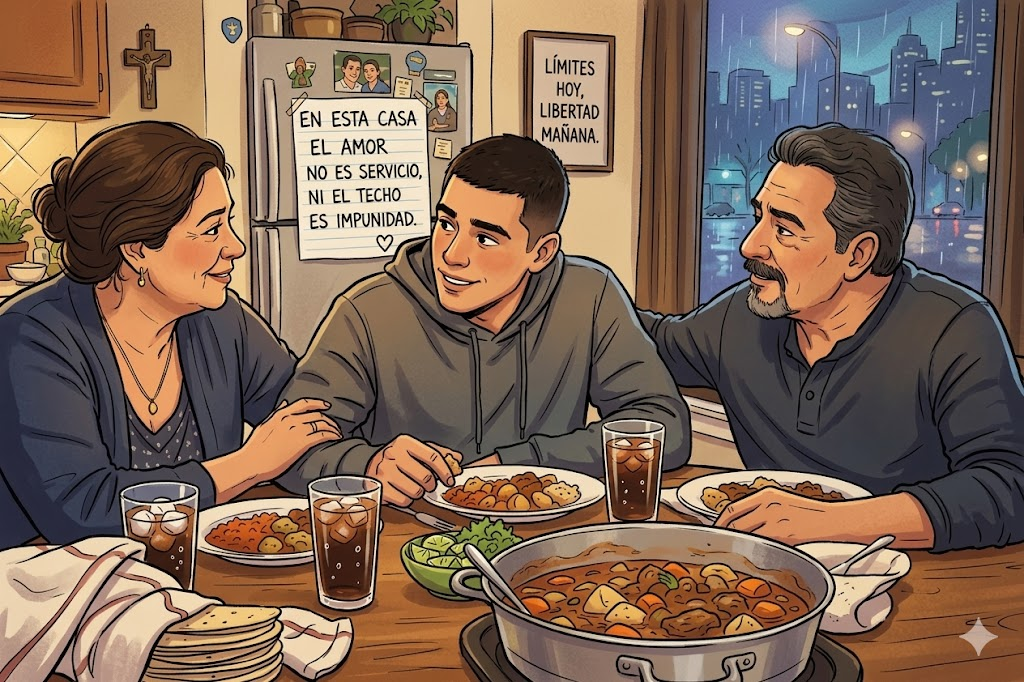
Three months passed. Daniel got a job at a grocery warehouse near the market. He started work before dawn. He made little money. He came home with dirty hands, an aching back, and a silent rage against the world. One Sunday he came to eat. Not to live. To eat. Teresa made beef stew. I put tortillas on the griddle. The table felt tense, as if we were all sitting on glass. Daniel arrived with short hair and a bag in his hand. He put it in front of his mother. “They’re your earrings.” Teresa stood motionless. “What?” “I got them out of pawn. I still owe for other things.” She opened the little box. Her mother’s earrings were shining there, small, old, rescued. Teresa cried. Daniel didn’t move to hug her. He just said: “Sorry.” It wasn’t a pretty apology. It had no music. It didn’t fix anything. But it was the first clean word to come out of his mouth in a long time. Then he pulled out something else. My drill. “This too.” I looked at him. “And my laptop?” He lowered his head. “Mau sold that one. I’m going to pay you back.” “Yes.” He was surprised I didn’t say, “It doesn’t matter.” Because it did matter. It had to matter.
We ate almost in silence. When Teresa got up to serve him more stew, Daniel stopped her. “I’ll do it.” She stayed there with the ladle in her hand, as if she didn’t know what to do with that gesture. Daniel took his plate, went to the kitchen, and served himself. He dropped a little bit on the stove. Before, he would have screamed, “Mom!” This time, he grabbed a rag. He cleaned it. I looked the other way so he wouldn’t see me cry.
He didn’t return home that night. He went to his rented room with two coworkers near the industrial district. It wasn’t pretty. It wasn’t comfortable. But it was his, to the extent that he paid for it. Before he left, he stopped at the door. “Dad.” “Tell me.” “That day… when you kicked me out…” I waited. “I hated you.” “I imagine.” “It still hurts.” “Me too.” He clenched his jaw. “But if you hadn’t done it, I don’t think I would’ve stopped.”
Teresa let out a sob. Daniel looked at her. “Mom, don’t save me again if I start screwing up.” She cried with her hand over her mouth. “Don’t say that.” “You say it.” Teresa took a while. A long while. But in the end, she said: “I won’t save you if you abuse us again.” Daniel closed his eyes. As if that sentence were a door closing and another, harder one, opening at the same time. “Thank you,” he murmured. He left.
The house fell silent. But it wasn’t the sick silence from before. It was a tired silence. With room to breathe.
That night, Teresa and I washed the dishes together. She soaped, I rinsed. Outside, the sweet potato carts whistled their sad tune, and from some apartment, a soccer match played on TV. “Do you think he’ll relapse?” she asked. “Maybe.” “And what do we do?” “The same. Love without kneeling.” Teresa looked at me. Her eyes were swollen, but firm. “I called myself a monster for letting you kick him out.” “I called myself a monster for doing it.” “And are we?” I thought of Daniel carrying tomato crates. Of his bare feet in front of the Oxxo. Of Teresa recovering her earrings. Of my house without loud video games. “I don’t know,” I said. “But sometimes a father has to close the door so the son can find his own.”
A year later, Daniel was still working. It wasn’t a perfect story. He had relapses into gambling. He was late on two rent payments. He asked us for money once, and we said no. He got angry, disappeared for two weeks, and then went back to therapy. He also finished the high school diploma he had abandoned. That day, he sent us a photo of his certificate. Teresa cried all over her phone. I wrote: “Proud of you. Keep going.” I deleted “son” three times before sending it. Then I put it in. Because it was also the truth.
The last time he came to eat, he brought sodas. Cold ones. He put them on the table and smiled, embarrassed. “So nobody sends me to hell again.” Teresa laughed. I did, too. Not like before. Not with innocence. With a scar. Daniel poured the glasses. First his mother’s. Then mine. Finally his own. That order, so small, was worth more than a thousand speeches.
As we ate, I looked at my son. He was no longer on the couch with a crown. He wasn’t a completely new man, either. He was someone learning to carry his own weight. And I understood that the night of the black bags, I hadn’t kicked my son out of the house to lose him. I had kicked him out so that life, finally, could catch up to him.
Teresa placed her hand on mine under the table. Daniel told us he wanted to save money to study mechanics. Outside, the city roared as always: crowded trains, taco stands, trucks, rain threatening from the gray sky. Life didn’t become easy. But it became life again. And when Daniel finished eating, he picked up his plate without anyone asking him to. That simple sound—a plate carried to the sink—was the most beautiful music I had heard in years. Because in my house, finally, no one would ever again confuse love with servitude. Or a roof with impunity. Or a mother with a waitress. And even though it still hurt to remember his black bags in the hallway, I understood something that took me fifty-five years to learn: Sometimes loving a child isn’t opening the door for them. Sometimes, it’s leaving them outside long enough for them to learn how to knock without demanding.