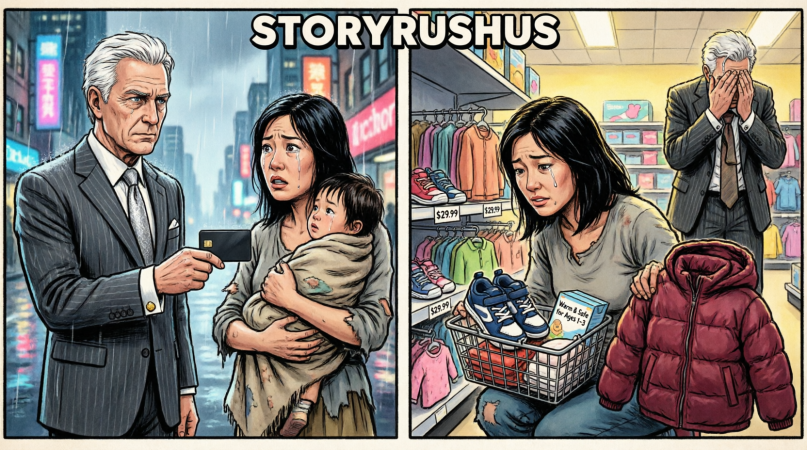
The first alert came while Brennan was sitting at the head of a glass conference table, surrounded by fourteen people who were paid obscene amounts of money to pretend they were not afraid of him.
His CFO was halfway through explaining a distribution problem in Europe when Brennan’s phone vibrated against the polished wood.
Normally, he would have ignored it.
No one at Ashford Global checked personal notifications during board meetings.
Not because of discipline.
Because people like Brennan had other people to check things for them.
But this alert came from his private banking app.
He looked down.
Purchase approved: Boston Children’s Hospital Pharmacy — $47.82
For a moment, Brennan did not understand what he was seeing.
Not a hotel.
Not a restaurant.
Not clothing.
Not cash.
A hospital pharmacy.
His thumb hovered over the screen.
Then the second alert arrived.
Purchase approved: Boston Children’s Hospital Emergency Registration — $250.00
The room blurred slightly.
“Mr. Ashford?”
His CFO’s voice sounded far away.
Brennan stood.
Every head turned.
“I need ten minutes.”
His assistant, Caleb, immediately rose.
“Sir, the vote—”
“Delay it.”
“The European contract requires—”
Brennan looked at him.
Caleb stopped talking.
Brennan walked out of the boardroom and into the private corridor overlooking Boston Harbor.
His phone buzzed again.
Purchase approved: Boston Children’s Hospital Cafeteria — $6.45
Six dollars and forty-five cents.
A billionaire’s black card with no limit, and Grace Miller had bought something for less than seven dollars at a hospital cafeteria.
Brennan stared at the number until it became meaningless.
Then he called the number he had given her.
She answered on the fourth ring.
Her voice was low and breathless.
“Mr. Ashford?”
“Where are you?”
A pause.
“The hospital.”
“I can see that.”
“I’m sorry. I should have asked first.”
That sentence made something inside him tighten.
She had his unlimited card in her hand, and she was apologizing for taking a sick child to the hospital.
“What happened?”
Grace inhaled shakily.
“Lily has been coughing for days. I thought it was just the cold. But this morning, after you left, she woke up and couldn’t breathe right. I tried to take her to urgent care, but they said because of her fever and her breathing, I needed to bring her here.”
Brennan turned toward the window.
The harbor was steel gray beneath the winter sky.
“Is she all right?”
“I don’t know yet.”
Her voice broke on the last word.
Then she swallowed it back down quickly, as mothers do when fear has no permission to become sound.
“They’re checking her lungs. They said pneumonia is possible. Maybe dehydration too. I bought her medicine from the pharmacy because they said she needed it right away.”
Brennan closed his eyes.
His father’s voice rose again.
The poor are the most dangerous.
But Grace had not run to a jewelry store.
She had not emptied a boutique.
She had not vanished.
She had taken her daughter to a hospital.
“Which department?” he asked.
“Emergency pediatrics.”
“I’m coming.”
“No,” she said quickly.
He frowned.
“No?”
“You gave me help. You don’t need to come watch me use it.”
“I’m not coming to watch you.”
“Then why?”
He did not know how to answer.
Because his heart had started beating strangely when he saw the hospital charge.
Because the number six dollars and forty-five cents had embarrassed every expensive dinner he had ever eaten.
Because a little girl wrapped in a pink coat had slept for three nights on a train station floor while he owned homes he had not entered in months.
“I’ll be there soon,” he said.
Then he hung up before she could refuse again.
When he turned around, Caleb was standing a few feet away with his tablet held to his chest.
“Sir,” Caleb said carefully, “is this about the woman from the station?”
Brennan slipped the phone into his coat pocket.
“Yes.”
Caleb’s mouth tightened.
“With respect, this is exactly the kind of situation your father warned about.”
Brennan looked at him.
For years, that sentence would have ended the conversation.
His father’s warnings had been treated inside Ashford Global like scripture.
Montgomery Ashford had built an empire on suspicion, and Brennan had inherited not only the company, but the fear that everyone wanted a piece of him.
But now, all Brennan could think about was a child struggling to breathe.
“My father is not here,” he said.
Caleb lowered his eyes.
“No, sir.”
“And maybe that’s the first useful thing about today.”
He left without returning to the boardroom.
At Boston Children’s, Brennan Ashford was recognized before he reached the front desk.
That happened everywhere.
Restaurants.
Airports.
Private clinics.
Charity galas.
His name moved faster than his body.
A hospital administrator appeared within minutes, smoothing her blazer, voice tight with professional eagerness.
“Mr. Ashford, we weren’t expecting—”
“I’m looking for Grace Miller and her daughter, Lily.”
The administrator blinked.
“I can check—”
“Now.”
She checked.
Then her expression shifted.
A little less polished.
A little more human.
“They’re in Pediatric Emergency. Room twelve.”
Brennan followed her through bright hallways that smelled of disinfectant, coffee, and fear.
He hated hospitals.
Not because he was afraid of illness.
Because hospitals had been the one place money could not fully negotiate with God.
His younger sister, Eliza, had died in one.
He had been fourteen.
She had been six.
Pneumonia after complications from an immune disorder his father insisted was “being handled by the best doctors in the country.”
The best doctors had not saved her.
Montgomery Ashford had never cried in public.
At the funeral, he told Brennan:
“Remember this. Weakness takes what it wants. We survive by being stronger than need.”
For years, Brennan thought that meant never needing anyone.
Now, walking toward a little girl named Lily, he wondered if his father had simply turned grief into cruelty because it was easier than admitting terror.
Room twelve had a glass door.
Grace was sitting beside a narrow hospital bed, still wearing her thin coat.
Lily lay beneath a warmed blanket, an oxygen tube under her nose, cheeks flushed with fever.
Her pink coat was folded neatly on the chair.
Grace held one of her daughter’s small hands between both of hers.
She looked up when Brennan entered.
Embarrassment crossed her face before relief could.
“I told you not to come.”
“I’m bad at being told no.”
“That must be convenient for a billionaire.”
The sentence was tired, but there was a spark in it.
Brennan almost smiled.
Almost.
Then he looked at Lily.
“How is she?”
Grace’s eyes moved back to her daughter.
“They’re giving fluids. Antibiotics. The doctor said we brought her in just in time.”
Just in time.
The words struck him hard enough that he had to grip the back of the chair.
Grace noticed.
“Are you okay?”
He should have said yes.
Instead, he asked:
“What was the first thing you bought?”
She blinked.
“What?”
“The first purchase alert. Pharmacy. What was it?”
Grace reached into a plastic hospital bag and pulled out a small box.
Children’s fever reducer.
A cheap thermometer.
Saline spray.
A packet of cough drops for herself, unopened.
“That,” she said. “She had a fever. I needed to know how bad.”
Brennan stared at the items.
Forty-seven dollars and eighty-two cents.
His hand tightened on the chair.
Grace watched him with growing confusion.
“Mr. Ashford?”
He heard his sister’s cough.
Not really.
Memory does that.
It does not ask before entering.
Eliza in a hospital bed.
Eliza asking if they could go home.
Eliza’s little hand inside his.
Eliza’s fevered whisper:
“Bren, don’t let Daddy be mad I got sick.”
Brennan’s knees weakened.
For one horrifying second, the room tilted.
Grace jumped up.
“Mr. Ashford?”
He sat down hard in the chair.
Not gracefully.
Not like a billionaire.
Like a man whose body had betrayed him.
Grace reached for the call button.
“I’ll get someone.”
“No.”
“You nearly fainted.”
“I’m fine.”
“You are absolutely not fine.”
He looked at Lily, then at the thermometer in Grace’s hand.
“My sister died from pneumonia when she was six.”
Grace stopped moving.
The room changed.
Her face softened, not with pity, but recognition.
Loss recognizes loss without needing an introduction.
“I’m sorry,” she said.
Brennan looked down at his hands.
“I haven’t said that out loud in years.”
Grace slowly sat back down.
For a while, neither of them spoke.
Machines beeped.
A cart rolled past in the hallway.
Lily slept, breathing through the oxygen tube, unaware that she had just shattered a man’s entire philosophy with a thermometer and a bottle of fever medicine.
Finally, Grace said:
“I didn’t mean to make you remember something painful.”
“You didn’t.”
He looked at her.
“You made me remember something true.”
Her eyes filled, but she blinked the tears away.
“I was scared to bring her here.”
“Why?”
“Because hospitals ask questions. Addresses. Insurance. Emergency contacts. I don’t have good answers anymore.”
“Where were you living before the station?”
Her face closed slightly.
“A shelter for two weeks. Before that, a friend’s sofa. Before that, an apartment in Dorchester.”
“What happened?”
She glanced at Lily.
“Her father happened.”
Brennan went still.
Grace shook her head quickly.
“He’s not in our lives now. But he left debt, threats, broken rent payments, and one locked apartment door I couldn’t open after he changed the lease without telling me.”
Brennan felt anger rise, clean and immediate.
“Name?”
She gave him a tired look.
“Do billionaires always ask for names like they’re about to send someone to war?”
“Usually only before breakfast.”
Despite everything, she almost smiled.
Then she looked down.
“I’m not asking you to fix my life.”
“I know.”
“I mean it.”
“So do I.”
Grace studied him.
“You really did think I’d steal from you.”
“Yes.”
The honesty landed between them.
She nodded once.
“Thank you for not lying.”
“I’m not proud of it.”
“You shouldn’t be.”
That should have offended him.
It did not.
In fact, it felt strangely good to be spoken to without polishing.
Everyone in Brennan’s life adjusted themselves around his money.
Their words wore suits.
Grace’s did not.
A nurse came in to check Lily’s vitals.
She smiled at Grace.
“Her oxygen levels are improving.”
Grace closed her eyes.
Her lips moved without sound.
A prayer.
A thank-you.
A collapse held inside the shape of a mother.
Brennan stood.
“I’ll handle the hospital bill.”
Grace opened her eyes.
“No.”
“Yes.”
“No, Mr. Ashford. You said twenty-four hours. I’m using the card for what I need. Don’t turn this into something where I owe you forever.”
He stared at her.
People rarely refused him.
Even more rarely did they refuse him with dignity intact.
“You don’t owe me,” he said.
“Men like you always say that before the bill arrives in another form.”
That sentence hit him differently.
Not because it was unfair.
Because it was probably true.
Maybe not about him today.
But about the world that made him.
He nodded slowly.
“Then use the card. No conditions.”
“Really?”
“Yes.”
She looked at him as if trying to find the trap.
Then she looked back at Lily.
“Then I’m getting her admitted if the doctor recommends it.”
“Good.”
“And a hotel after. A safe one. Not fancy.”
“Get fancy.”
“No.”
“Grace.”
“No. Clean is enough. Safe is luxury.”
Brennan had no answer to that.
His phone buzzed again.
He glanced down.
Caleb.
Your father is asking why you left the board meeting. He’s furious.
Brennan typed back:
Let him be.
Then he switched the phone to silent.
The next purchases came over the next several hours.
Hospital cafeteria — $12.90
Two bowls of soup.
One juice box.
Coffee.
Children’s clothing store near Longwood — $86.34
Warm socks.
Thermal leggings.
A clean sweatshirt.
Underwear.
Hospital parking garage kiosk — $18.00
Brennan frowned at that one until Grace texted him a photo.
It was not her purchase.
She had paid parking for another mother whose card had declined while her baby was upstairs.
The message below said:
You said whatever we need. She needed to get back to her son. I hope that counts.
Brennan sat in his car outside the hospital and read the text three times.
Then he laughed.
Not loudly.
Not happily exactly.
But with disbelief.
He had given a desperate woman unlimited access to his money.
And within hours, she was using it to help someone even more cornered than herself.
His father would have called her foolish.
Brennan was starting to think she might be the first sane person he had met in years.
By evening, Lily was admitted overnight.
Grace finally agreed to leave the hospital only after a nurse promised to call if Lily woke.
Brennan had his driver take them to a hotel two blocks away.
Not the Ritz.
Grace refused three luxury options with the stubbornness of a woman who understood that extravagance can feel like another form of danger.
She chose a clean business hotel with heated rooms, laundry service, and a front desk clerk who looked at Lily’s hospital bracelet and quietly upgraded them without making a speech.
The card alert came through.
Hotel stay — $312.00
Then:
Laundry service — $28.00
Then:
Room service — $24.50
Brennan stared at that last one.
Grace texted a minute later.
Grilled cheese. Tomato soup. Hot tea. I’m sorry it’s expensive.
He wrote back:
Order dessert.
She replied:
No.
Then, after five minutes:
Fine. One brownie. Lily would want me to.
Brennan smiled for the first time that day.
At 10:14 p.m., his father called.
Brennan considered ignoring it.
Then he answered.
Montgomery Ashford’s voice came through cold and sharp.
“You walked out of a board meeting.”
“Yes.”
“For what?”
“A child in the hospital.”
A pause.
Then a short, humorless laugh.
“Tell me this is not about the woman from the station.”
Brennan looked out at the harbor from his penthouse window.
He had gone home only to shower and change, but the place felt unbearable now.
Too quiet.
Too expensive.
Too untouched by need.
“It is.”
“You gave her your card.”
“Yes.”
“Have you lost your mind?”
“Not yet.”
“You think this makes you noble? You think she won’t drain you dry if given the chance?”
“She bought medicine.”
“Today. Tomorrow she’ll want housing. Then legal help. Then a job. Then a lawsuit when you stop playing savior.”
Brennan closed his eyes.
There it was.
The old sermon.
Need as infection.
Trust as weakness.
Compassion as liability.
For most of his life, he had mistaken that sermon for wisdom.
Tonight, it sounded like fear.
“She has a name,” Brennan said.
His father went quiet.
“What?”
“Grace. Her daughter’s name is Lily.”
“I don’t care what their names are.”
“I know.”
The words came out before Brennan could soften them.
For the first time in years, Montgomery had no immediate reply.
Brennan continued.
“I think that’s the problem.”
His father’s voice lowered.
“Careful.”
There it was.
The same warning from childhood.
Careful.
Careful before you embarrass me.
Careful before you feel too much.
Careful before you become like your mother.
Careful before you become weak.
Brennan looked at the framed photograph on his desk.
His family, twenty-five years earlier.
Montgomery standing stiffly.
Brennan in a navy blazer.
His mother thin and unsmiling.
Eliza in a yellow dress, holding a stuffed rabbit.
The rabbit was the only thing in the picture that looked loved.
“I’m done being careful the way you taught me,” Brennan said.
Then he hung up.
The next morning, the twenty-four hours had not yet ended.
Grace called him at 8:03 a.m.
“I need to buy something expensive,” she said.
Brennan sat up in bed.
“Okay.”
“I need you not to ask questions until I do it.”
That made him pause.
“What kind of expensive?”
“A storage payment.”
He frowned.
“How much?”
“Eight hundred and seventy dollars.”
“That’s not expensive.”
“It is to me.”
Fair.
“What’s in storage?”
A silence.
Then:
“Everything we have left.”
He heard the fear beneath her control.
“Our clothes. Lily’s school drawings. My documents. My nursing certificates. My mother’s quilt. Photos. If I don’t pay by noon, they auction it.”
“Nursing certificates?”
“I was a pediatric nurse.”
Brennan’s hand tightened around the phone.
Was.
“What happened?”
“Later,” she said. “Please. I need to make the payment before they open.”
“Use the card.”
The alert came fifteen minutes later.
Metro Secure Storage — $870.00
Then another.
Ride share — $22.60
Then another.
Metro Secure Storage — $35.00
Brennan called.
“What was the thirty-five?”
“A new lock.”
“Good.”
“And bolt cutters.”
“Why?”
“The old lock was damaged.”
He almost laughed.
“Grace Miller, are you committing a crime with my black card?”
“For once, no.”
“For once?”
She paused.
Then said dryly:
“I slept in a train station. I have jaywalked recently.”
He laughed then.
A real laugh.
It startled him.
It startled her too.
The line went quiet afterward, but not uncomfortably.
Then Grace said:
“Mr. Ashford?”
“Brennan.”
“I found something in the storage unit.”
Her voice had changed.
“What?”
“My old hospital badge.”
“And?”
“I worked at Saint Bartholomew’s Pediatric Center.”
Brennan stopped breathing.
Saint Bartholomew’s.
Ashford Global had acquired its parent medical network four years earlier.
A scandal had followed.
Lost records.
Improper billing.
Wrongful termination claims.
Internal reports buried under legal settlements.
Brennan had been told it was administrative noise from disgruntled employees.
He had signed off on the consolidation without reading every file personally.
His father had overseen the acquisition.
“Grace,” he said slowly, “why did you leave?”
She did not answer.
“Grace.”
Her voice came back thin.
“I was fired after I reported missing medication and falsified patient assistance records.”
Brennan stood.
The room seemed to shift under him.
“What year?”
“Four years ago.”
His pulse began pounding.
“Who handled the case?”
“I don’t know all their names. But the outside executive who came in for the review was an Ashford man.”
Brennan closed his eyes.
No.
“Do you remember his name?”
“Yes,” Grace said quietly. “Montgomery Ashford.”
The truth did not arrive all at once.
It arrived like ice cracking underfoot.
One line.
Then another.
Then the terrible understanding that the surface had never been solid.
Brennan reached for the edge of the dresser.
“What exactly did you report?”
Grace’s breathing changed.
“Medication meant for low-income pediatric patients was being diverted. Assistance funds were marked as distributed but never reached families. Children were denied subsidized treatment while reports showed they had been approved.”
Brennan felt sick.
Ashford Global.
His company.
His empire of polished charity statements and pharmaceutical innovation.
His father’s empire first.
“And you were fired.”
“Escorted out. Blacklisted. My license wasn’t revoked, but every hospital I applied to suddenly said the position had been filled. I lost income. Then housing. Then everything else.”
Brennan thought of Lily sleeping on a station floor.
Three nights.
Six days without a bed.
A pediatric nurse fired for protecting children by the company that had made him a billionaire.
No wonder the first thing she bought was medicine.
She knew exactly how fast a child could decline when adults failed.
“Do you have proof?” he asked.
Grace’s voice went cold.
“I had copies. That’s why the storage unit mattered.”
Brennan stared at his reflection in the dark window.
For the first time in his life, he looked like his father and hated it.
“What copies?”
“Emails. Patient assistance ledgers. Medication inventory records. My termination papers. A recording from a meeting where I was told to stop asking questions.”
His phone buzzed.
Another alert.
Office supply store — $19.82
“What did you just buy?”
“A flash drive.”
Brennan almost smiled.
Then he realized his hands were shaking.
Grace spoke again.
“Brennan, I didn’t know who you were at the station. Not really. I saw the name on the card later.”
“Do you hate me?”
She was silent long enough to make the answer honest.
“I wanted to.”
“And now?”
“Now I think maybe God has a cruel sense of timing.”
He sank onto the bed.
“My father buried your report.”
“I think so.”
“I signed the acquisition documents.”
“You may not have known.”
“That doesn’t mean I’m clean.”
“No,” Grace said. “It means you still have a choice.”
That sentence did what no accusation could have done.
It gave him no place to hide.
By noon, Grace brought the documents to Brennan’s office.
She arrived wearing clean clothes bought from a department store sale rack, Lily’s pink coat folded over one arm because the little girl was still at the hospital under observation.
Brennan’s entire executive floor seemed to notice her.
Some with curiosity.
Some with disdain.
Some with the polished blankness of people trained not to react near wealth.
Grace noticed all of it.
She kept her chin up anyway.
Caleb met them at the elevator.
His face tightened when he saw the storage box in her arms.
“Mr. Ashford is waiting.”
Grace looked at him.
“I’m sure he is.”
Brennan stood when she entered his office.
Not out of politeness.
Out of something closer to shame.
She placed the box on his desk.
“This is what I saved.”
He looked at it.
A cardboard box.
Water-stained at one corner.
Tape peeling from the side.
Inside it, perhaps, enough truth to stain his family name permanently.
Montgomery Ashford entered without knocking five minutes later.
Of course he did.
He took one look at Grace and smiled.
Not kindly.
Recognition flickered in his eyes.
“Well,” he said. “The nurse.”
Grace went pale.
Brennan saw it.
His father did too.
Montgomery enjoyed that.
“You remember her,” Brennan said.
“I remember many employees.”
“She reported stolen medication and falsified patient assistance records.”
Montgomery removed his gloves slowly.
“She misunderstood operational discrepancies.”
Grace’s hands curled into fists.
“Children went without medicine.”“Children are always going without something, Ms. Miller. That does not make every administrative error a conspiracy.”
looked at his father.
For the first time, the man seemed smaller.
Not weak.
Not harmless.
Just visible.
The monster had shape now.
“She was blacklisted,” Brennan said.
Montgomery’s eyes shifted to him.
“Careful, son.”
There it was again.
Careful.
Brennan opened the storage box.
“Grace has records.”
Montgomery laughed softly.
“Records can be interpreted.”
“She has a recording.”
The room went silent.
For one second, Montgomery Ashford’s face changed.
Just one.
But Brennan saw fear.
Grace reached into the box and placed a small digital recorder on the desk
“I kept the original,” she said. “Copies are with someone safe.”
Montgomery looked at her with open contempt.
“You have no idea what you’re doing.”
Grace’s voice trembled, but she did not look away.
“Yes, I do. I’m doing what I tried to do four years ago.”
Brennan pressed the recorder.
A voice filled the office.
Montgomery’s voice.
You are confusing compassion with compliance, Ms. Miller.
Then Grace’s younger voice.
Patients approved for assistance never received medication.
Then Montgomery again.
Those families were never profitable accounts.
Brennan stopped the recording.
The room was so quiet he could hear the city traffic far below.
Montgomery’s expression hardened.
“You release that, and you damage thousands of employees, investors, patients, contracts—”
“No,” Brennan said.
His father turned on him.
“You stupid boy.”
Brennan almost laughed.
Thirty-seven years old.
CEO.
Billionaire.
And still, one insult from his father found the child beneath the suit.
But this time, the child did not answer.
The man did.
“You used sick children as numbers.”
“I protected the company.”
“You destroyed her life.”
“She was replaceable.”
Grace flinched.
Brennan stepped between them.
“No, she wasn’t.”
Montgomery’s eyes narrowed.
“You are risking everything for a homeless woman you found yesterday.”
Brennan looked at Grace.
Then at the cardboard box.
Then at the office walls covered in awards for humanitarian innovation.
“No,” he said. “I’m risking everything because she found yesterday what I should have found four years ago.”
By evening, Ashford Global’s legal department was in crisis.
By midnight, Brennan had contacted outside federal counsel.
By morning, Montgomery Ashford was removed from all advisory authority pending investigation.
Within forty-eight hours, the first sealed disclosures were made to regulators.
Within a week, the story broke.
Not all of it.
Not Grace’s name at first.
Brennan protected that until she chose otherwise.
But the headlines were brutal.
Ashford Global Opens Internal Investigation Into Pediatric Medication Assistance Fraud
Former Executive Montgomery Ashford Named in Records Review
Whistleblower Evidence Reopens Saint Bartholomew’s Scandal
Brennan lost contracts.
Investors panicked.
His father called him a traitor.
Board members threatened removal.
But every time Brennan wondered if the empire was burning too fast to control, he thought of a hospital alert for forty-seven dollars and eighty-two cents.
Fever reducer.
Thermometer.
Saline spray.
The first purchase.
The collapse.
The truth.
Lily was discharged four days after Brennan met them.
Grace used the card one final time before the twenty-four hours ended.
Children’s bookstore — $18.99
Brennan called her.
“A book?”
“She wanted a story.”
“What kind?”
“A girl who finds a hidden garden.”
“That sounds appropriate.”
Grace was quiet for a moment.
Then she said:
“I’m returning the card.”
“Keep it longer.”
“No.”
“Grace—”
“No. You said twenty-four hours. I trusted the condition because it had an end.”
He understood then.
Boundaries were not rejection.
For Grace, they were safety.
So he met her at the hospital entrance.
Lily stood beside her, still pale but smiling shyly, clutching the book against her chest.
Grace handed him the black card.
No ceremony.
No trembling.
No greed.
Just a woman giving back what was not hers after using it to save what was.
Brennan took it.
“Thank you,” he said.
Grace raised an eyebrow.
“You’re thanking me?”
“Yes.”
“For spending your money?”
“For proving my father wrong.”
She looked at him for a long moment.
Then she shook her head.
“No, Brennan. I proved nothing. I just did what any mother would do.”
He looked at Lily.
Then back at Grace.
“That’s exactly what proved him wrong.”
Months later, Grace testified.
Not as a homeless woman.
Not as a charity case.
As a nurse.
As a whistleblower.
As a mother who had kept evidence in a storage unit while sleeping in a train station because truth was the last property no one had managed to auction.
Montgomery Ashford was indicted.
Others followed.
Funds were recovered.
Patient assistance programs were rebuilt under independent oversight.
Brennan resigned as CEO for six months during the investigation, then returned only after the board accepted a public accountability plan he wrote himself.
His father never forgave him.
That hurt less than Brennan expected.
Grace slowly rebuilt her life.
A small apartment first.
Then reinstatement support.
Then a position at a pediatric clinic that knew exactly who she was and hired her because of it, not despite it.
Lily got stronger.
She started school again.
She sent Brennan drawings sometimes.
Mostly gardens.
Sometimes trains.
Once, a picture of a man in a very expensive suit holding a thermometer like he did not know what to do with it.
Brennan framed that one.
Not in the penthouse.
In his office.
Where everyone could see it.
One year after that January morning, Brennan returned to Back Bay Station.
Not for a meeting.
Not by accident.
He stood near the Orange Line entrance where he had first seen Grace and Lily curled against the wall.
People rushed past.
A businessman stepped around a spilled coffee.
A student laughed into her phone.
A woman carrying shopping bags slowed down near a man sitting with a cardboard sign.
This time, Brennan did not look away.
He approached the man, crouched, asked his name, and listened to the answer.
No cameras.
No assistant.
No legal memo.
No strategy.
Just a man learning, very late, how to spend trust differently.
His phone buzzed while he was still there.
A message from Grace.
Lily wants you to know she got the lead role in her school play. She is playing a tree. Apparently, a very important tree.
Brennan smiled.
He typed back:
Tell her important trees deserve flowers. I’ll be there.
Then he paused and added:
Only if invited.
Grace replied:
You’re invited. Don’t wear a billionaire suit. You’ll scare the children.
He laughed in the middle of the station.
People looked at him strangely.
He did not care.
Once, Brennan Ashford thought desperate people would take everything if given the chance.
Then he gave a homeless single mother his black card for twenty-four hours.
The first thing she bought was medicine for her child.
And that purchase did not just make him collapse.
It broke the lock on a life built from fear.
It opened a box of buried evidence.
It exposed the cruelty behind his family’s fortune.
And it taught him that the most dangerous thing in the world was not desperation.
It was a person with power who had forgotten how to care.
Grace Miller had nothing when he met her.
No house.
No savings.
No safety.
But she still had the one thing his father had spent a lifetime treating as weakness.
A heart that chose someone else first.
And in the end, that was the only kind of wealth Brennan had ever seen that did not make a person poorer.
PART 1 — Viral Fallout
The story exploded forty-three hours after the first federal filing.
Not slowly.
Not quietly.
Like glass under pressure finally breaking all at once.
By sunrise, every major news network in Boston was running some version of the same headline:
ASHFORD HEIR TURNS ON BILLIONAIRE FATHER AFTER HOMELESS MOTHER EXPOSES CHILD MEDICATION SCANDAL
By noon, it had spread nationwide.
Photos of Montgomery Ashford entering federal court flooded the internet.
Clips of Brennan leaving Ashford Global headquarters without security circulated across social media.
But the image people could not stop sharing was much simpler.
A blurry cellphone photo taken inside Back Bay Station.
Grace asleep against the tiled wall.
Lily curled against her chest in the oversized pink coat.
The cardboard sign beside them.
Single mother. Lost our home. Any help appreciated.
No one knew who had taken the picture.
No one knew who leaked it.
But within hours, millions of people had seen it.
And millions more were furious.
“She worked as a pediatric nurse and ended up homeless?”
“They blacklisted her for protecting children?”
“That little girl slept in a train station while billionaires stole medical assistance money?”
The internet turned vicious fast.
Especially toward Montgomery Ashford.
Especially toward Ashford Global.
Especially toward every smiling charity advertisement the company had released over the past decade featuring children holding medicine bottles beneath carefully edited slogans about compassion.
Brennan watched the collapse unfold from his office in silence.
Three screens glowed in front of him.
Stock numbers falling.
Legal updates arriving every few minutes.
Public statements from board members trying desperately to distance themselves from Montgomery.
And beneath all of it—
The photograph.
Grace and Lily on the station floor.
Brennan stared at it too long.
Because now he noticed details he had missed that morning.
Lily’s shoes were mismatched.
Grace’s hand rested protectively over her daughter’s ear even while asleep, as if she were still shielding her from noise.
And near the bottom corner of the photo sat a coffee cup.
Empty.
Turned upside down.
Someone had dropped change into it.
Three quarters.
Two pennies.
That was what the world had decided a mother and child were worth while billionaires passed by pretending not to see them.
A knock sounded at his office door.
Caleb stepped inside holding a tablet.
“You need to see this.”
Brennan looked up.
Caleb hesitated.
Then turned the screen toward him.
A live interview.
A woman in blue scrubs stood outside a hospital entrance, eyes red from crying.
“I worked with Grace Miller,” she said into the microphone. “She tried to report missing medication for low-income pediatric patients years ago. Administration buried it.”
Another clip followed.
A former billing coordinator.
Then a pharmacist.
Then a doctor.
One after another.
People who had stayed silent for years were suddenly speaking.
Fear was cracking.
Brennan leaned back slowly.
“How many now?”
“Seven confirmed witnesses,” Caleb replied quietly. “Possibly more coming.”
Brennan rubbed his jaw.
“And the board?”
“They’re panicking.”
“Good.”
Caleb almost smiled.
Almost.
Then his expression tightened again.
“There’s another issue.”
Brennan looked at him.
“The internet found Grace.”
His stomach dropped immediately.
“What do you mean found?”
“She was recognized leaving the pediatric clinic this morning.”
“Damn it.”
“Someone followed her.”
Brennan stood instantly.
“Was Lily with her?”
“Yes.”
The room went cold.
“Where are they now?”
“We moved them.”
Brennan frowned.
“We?”
Caleb cleared his throat awkwardly.
“The hotel manager called me directly after reporters started showing up outside the building. I relocated them to a private residence under company security.”
Brennan blinked once.
“You did that on your own?”
“Yes.”
“Why?”
Caleb looked genuinely uncomfortable.
Then he said quietly:
“Because six dollars and forty-five cents.”
Brennan stared at him.
Caleb shifted slightly.
“I kept thinking about it,” he admitted. “Your father always said desperate people take everything they can. But she had unlimited access to your account and bought cafeteria soup.”
Silence settled between them.
Then Brennan nodded once.
“Thank you.”
Caleb looked startled by the words.
Perhaps because Ashford executives rarely heard gratitude spoken without strategy attached to it.
Before Brennan could say more, his phone buzzed violently against the desk.
Unknown number.
He answered immediately.
“Hello?”
Heavy breathing filled the line.
Then Grace’s voice.
“They found Lily’s school.”
Brennan’s pulse slammed hard.
“What?”
“I never removed her from enrollment officially after we lost the apartment,” Grace said quickly. “Reporters were outside this morning asking teachers questions.”
“Where are you right now?”
Another pause.
Then quietly:
“I’m scared.”
That sentence hit harder than panic would have.
Because Grace Miller was not a woman who frightened easily.
Brennan grabbed his coat immediately.
“I’m coming.”
“No cameras followed us here yet,” she whispered. “But Brennan… someone else came too.”
His hand tightened around the phone.
“Who?”
“They didn’t look like reporters.”
Every instinct sharpened at once.
“What did they want?”
“They asked if I still had copies.”
Brennan stopped moving.
Copies.
The evidence.
The recordings.
The files.
“Did they threaten you?”
“No.”
“That’s not what I asked.”
Grace inhaled shakily.
“One man said some powerful people were going to lose a lot more than money if this investigation kept growing.”
Brennan’s expression darkened.
Not just his father then.
Others were involved.
Maybe many others.
Grace continued quietly:
“I think they’re afraid.”
“They should be.”
“No,” she whispered. “I think dangerous people get cruel when they’re afraid.”
That landed deep because Brennan knew it was true.
He had been raised by one.
“Listen to me carefully,” he said. “Until we understand how large this is, you and Lily don’t go anywhere alone.”
“Brennan—”
“I mean it.”
Silence.
Then softer:
“You sound angry.”
“I am.”
“At me?”
“No.”
He looked out the office windows toward the gray Boston skyline.
“At everyone who let this happen.”
The line stayed quiet.
Then Grace spoke again.
Very softly.
“Lily keeps asking if we did something bad.”
Brennan closed his eyes.
Of course she was asking that.
Children always think chaos is their fault.
“What did you tell her?”
“That sometimes people get loud when the truth embarrasses them.”
Despite everything, Brennan smiled faintly.
“That’s a good answer.”
“She inherited stubbornness from me.”
“I noticed.”
For a second, he heard Lily laughing faintly in the background.
Tiny.
Alive.
Normal.
The sound steadied something inside him.
Then Grace’s voice lowered again.
“There’s something else.”
“What?”
“The woman at the hotel showed me the internet.”
Brennan’s stomach tightened.
“Don’t read comments.”
“Too late.”
He could already imagine them.
Some compassionate.
Some cruel.
Some suspicious.
The internet fed on pain like fire fed on oxygen.
Grace continued quietly:
“There are people calling me a liar.”
“There are people who think the moon landing was fake. Ignore them.”
A small sound escaped her.
Not quite a laugh.
But close.
Then she said:
“They posted the station photo everywhere.”
Brennan looked again at the image on his screen.
Grace asleep sitting upright because mothers do not fully relax in unsafe places.
Lily pressed against her.
Tiny fingers twisted in her mother’s sweatshirt even while sleeping.
“I’m sorry,” he said.
Grace went silent.
Then:
“Why are you apologizing?”
“Because while you were sleeping on a train station floor, I was arguing over Italian marble samples for a vacation property I barely use.”
The words came out harsher than intended.
Grace answered gently.
“That’s not the part you should apologize for.”
He frowned slightly.
“Then what should I apologize for?”
“For believing people like me deserve what happens to us.”
That sentence stayed with him long after the call ended.
Hours later, the next blow arrived.
Brennan was leaving a meeting with federal attorneys when Caleb intercepted him again.
This time his face was pale.
“What now?”
Caleb handed him the tablet silently.
Another leaked image.
But this one was worse.
Far worse.
Grace sitting inside Boston Children’s Hospital beside Lily’s bed.
Taken through the glass of the hospital room.
Private.
Secret.
Predatory.
Brennan’s entire body went cold.
Below the image, one anonymous account had written:
Funny how fast homeless people become celebrities when billionaires need redemption arcs.
Thousands of comments followed.
Arguments.
Conspiracies.
Cruelty.
Support.
Hatred.
Entertainment.
Human suffering turned into public consumption.
Brennan stared at the screen in disbelief.
Then suddenly:
Enough.
He looked at Caleb.
“Find who leaked it.”
“We’re trying.”
“No. Not PR. Not internal security. I want actual investigators.”
Caleb nodded immediately.
Then hesitated.
“There’s more.”
“Of course there is.”
“The board wants you removed temporarily.”
Brennan laughed once.
Cold.
Short.
“For exposing fraud?”
“For becoming emotionally compromised.”
That almost made him smile.
Emotionally compromised.
As though compassion were a corporate illness.
As though Lily’s oxygen tube had somehow damaged shareholder value.
Brennan looked again at the hospital photo.
Then at the comments underneath.
Then finally at his own reflection in the dark screen.
For the first time in years, he understood something clearly.
The scandal was never the real disease.
The disease was a world that looked at a sick child and immediately calculated profit, blame, leverage, or public relations value before humanity.
And suddenly he understood why Grace frightened powerful people.
Not because she was loud.
Not because she was dramatic.
But because she had suffered terribly and still refused to become cruel.
That kind of person exposed everyone else.
His phone buzzed.
A text from Grace.
Lily says if reporters come again, she’s going to charge them five dollars each.
Brennan stared at it.
Then another message appeared.
She says rich people understand money better than manners.
For the second time that week, Brennan laughed in public without caring who saw.
But the smile faded when a third message arrived.
Brennan…
Someone just left flowers outside the house.
No card.
Only one sentence.
WE KNOW WHAT YOU KEPT.
And suddenly, the scandal no longer felt like a corporate crisis.
It felt like the beginning of a war.
PART 2 — The Secret About Brennan’s Mother
The flowers arrived in a crystal vase worth more than most people’s rent.
White lilies.
Grace hated them immediately.
Not because they were ugly.
Because funeral flowers should never appear without a name attached.
The security team removed them within minutes.
But the sentence remained burned into Brennan’s mind.
WE KNOW WHAT YOU KEPT.
By midnight, he had doubled security around the safe house.
By 2:00 a.m., he still had not slept.
And by 3:17 a.m., another message arrived.
Not from an unknown number.
From his mother.
Come alone tomorrow morning.
Please.
No assistants.
Brennan stared at the screen.
His mother almost never contacted him directly.
Not for years.
After Eliza died, Evelyn Ashford had slowly disappeared inside her own life like someone learning how to exist quietly enough not to be noticed.
Montgomery dominated every room.
Every conversation.
Every silence.
Evelyn survived by becoming smaller inside them.
As a child, Brennan used to think she was weak.
As an adult, he began to suspect she was afraid.
The next morning, snow fell lightly over Boston.
Brennan drove himself.
No driver.
No security convoy.
Just a black coat, exhaustion, and the growing feeling that his entire life had been built on rooms full of things nobody said aloud.
His mother still lived in the old Ashford estate outside the city.
The house looked exactly the same.
Massive iron gates.
Stone walls.
Perfect windows.
The kind of wealth designed to look untouchable.
Brennan hated it now.
A house that large should have contained warmth somewhere.
Instead, it mostly held echoes.
A maid opened the door quietly.
“Mrs. Ashford is in the conservatory.”
Of course she was.
It had been Eliza’s favorite room.
Glass walls.
Winter light.
Plants his mother kept alive with a tenderness she never spent on herself.
Brennan found Evelyn sitting beside a small lemon tree wrapped in a cream-colored shawl.
She looked older than he remembered.
Not physically.
Spiritually.
Like time had pressed against her for too many years.
When she saw him, her eyes filled immediately.
Not dramatic tears.
The exhausted kind people carry privately for decades.
“You came.”
“You sounded frightened.”
“I am.”
Brennan sat across from her slowly.
For a moment, neither spoke.
The silence between them felt crowded.
Finally, Evelyn whispered:
“Your father knows I contacted you.”
Brennan’s jaw tightened.
“Does that scare you?”
“Yes.”
The honesty stunned him.
No performance.
No denial.
Just truth.
“When did you become afraid of him?” Brennan asked quietly.
Evelyn looked down at her hands.
Then gave a sad smile.
“That question only sounds simple when someone hasn’t lived inside it.”
Snow tapped softly against the glass ceiling overhead.
Somewhere deeper in the house, a clock chimed.
Evelyn inhaled slowly.
“I saw the news,” she said. “About the nurse.”
“Grace.”
“Yes. Grace.”
His mother said the name gently.
Like it mattered.
Unlike Montgomery.
“I listened to the recording.”
Brennan leaned forward slightly.
“And?”
Evelyn closed her eyes briefly.
“And I knew immediately it was real.”
The room seemed to narrow.
“You knew?”
“Not specifically about Grace,” she said quickly. “But about… things.”
“What things?”
Evelyn looked toward the snow outside.
“The patient assistance program changed after your father took control.”
“How?”
“At first, quietly. Certain applications denied. Certain medications delayed. Certain clinics suddenly receiving less support.”
Brennan felt anger begin rising again.
“And you said nothing?”
The question came out sharper than intended.
His mother flinched anyway.
Shame crossed her face instantly.
“Yes,” she whispered.
That one word carried years inside it.
Brennan stood abruptly and walked toward the windows.
Because suddenly he was angry at everyone.
His father.
The board.
The company.
The silence.
The wealth.
Himself.
“You knew children were suffering.”
“I suspected.”
“That’s not better.”
“I know.”
He turned toward her.
“Then why stay?”
The question cracked through the conservatory harder than he meant it to.
But Evelyn did not defend herself.
That frightened him more.
Instead, she asked softly:
“Do you remember the winter Eliza got worse?”
Brennan froze.
Of course he remembered.
Hospitals.
Fever.
Doctors whispering outside doors.
His father becoming colder every day like grief was freezing him alive from the inside.
“She needed treatment in Switzerland,” Evelyn continued quietly. “The experimental program.”
Brennan frowned.
“Yes.”
“Your father refused.”
The room tilted slightly.
“What?”
Evelyn looked at him with hollow eyes.
“He said the treatment odds were too low for the cost.”
Brennan stared at her.
“No.”
“He called it emotional spending.”
The words hit like physical force.
“No,” Brennan repeated again, weaker this time.
Evelyn’s voice broke.
“I begged him.”
The conservatory disappeared.
Or maybe Brennan simply stopped seeing it.
All he could hear was blood rushing in his ears.
“She was six.”
“I know.”
“She was his daughter.”
“I know.”
“And he calculated whether she was financially worth saving?”
Evelyn covered her mouth as tears escaped finally.
“He said weak investments destroy strong futures.”
Brennan staggered back slightly.
That sentence.
He had heard versions of it his entire life.
In business meetings.
At dinner tables.
During childhood.
He never realized how far his father truly meant it.
“I threatened to leave,” Evelyn whispered. “I told him I would expose everything I knew about the assistance programs already disappearing inside the company.”
Brennan looked at her sharply.
“And?”
Her next words came so quietly he almost missed them.
“He said if I destroyed him, he would make sure I never saw you again.”
Silence.
Terrible silence.
Then Brennan understood.
Not weakness.
Captivity.
His mother had not stayed because she admired Montgomery.
She stayed because powerful men rarely need chains when fear works better.
Evelyn wiped at her face quickly.
“I hated myself for staying.”
Brennan could not speak.
“I told myself I was protecting you after Eliza died,” she continued. “But after enough years… survival starts disguising itself as obedience.”
Brennan slowly sat down again.
For the first time in his adult life, he saw his mother clearly.
Not fragile.
Not weak.
A woman emotionally buried alive for decades.
And suddenly Grace made even more sense to him.
The way she guarded dignity.
The way she measured safety carefully.
The way she distrusted generosity with invisible strings attached.
Women learned those instincts surviving men like Montgomery.
Evelyn looked at him carefully.
“Grace Miller scares your father.”
“She should.”
“No,” Evelyn whispered. “You still don’t understand.”
Brennan frowned.
“She scares him because she reminds him of someone.”
A cold feeling crept through his chest.
“Who?”
His mother’s eyes filled again.
“Me. Before I became afraid.”
The words shattered something quietly inside him.
He looked away immediately because suddenly he understood why Montgomery hated defiance in women so much.
Because once, long ago, his mother had probably stood exactly like Grace did now:
Calm.
Moral.
Unwilling to look away from suffering.
And Montgomery had spent decades crushing that version of her until silence became survival.
Evelyn reached into her shawl slowly.
Then handed Brennan a folded envelope.
“What’s this?”
“I kept copies too.”
His pulse stopped.
“What?”
“Not evidence like Grace has,” Evelyn said quickly. “But internal correspondence. Private memos. Charitable funding revisions. Transfer approvals your father made quietly.”
Brennan opened the envelope carefully.
Inside were photocopied documents.
Highlighted sections.
Handwritten notes.
Dates.
Amounts.
Patient assistance reductions hidden beneath executive language.
His father’s signature across all of it.
And one handwritten sentence near the bottom of a memo:
Low-income dependency programs create unsustainable return ratios.
Brennan stared at the page in disbelief.
Human lives reduced to return ratios.
Evelyn watched him carefully.
“I should have given those to someone years ago.”
“Yes,” Brennan said honestly.
She nodded like she deserved that answer.
“I know.”
The room fell quiet again.
Then Brennan asked the question sitting heavily inside him now.
“Why give them to me today?”
Evelyn’s expression changed.
Fear.
Real fear.
“Because your father came into my room last night.”
Brennan went still.
“He asked whether I had spoken to you.”
“And?”
“I lied.”
That alone felt enormous.
“He didn’t believe me.”
The snow outside thickened softly.
Evelyn’s fingers trembled slightly around her teacup.
Then she whispered:
“Brennan… I think your father is becoming dangerous in a way even I haven’t seen before.”
His jaw tightened.
“What did he say?”
Her eyes lifted slowly to his.
“He said people are about to start disappearing behind this scandal.”
The words landed like ice water.
For a second, Brennan genuinely forgot how to breathe.
Then immediately:
“Grace.”
He stood so fast the chair scraped hard across the floor.
Evelyn grabbed his wrist suddenly.
“Be careful.”
The old warning.
But unlike Montgomery’s version, this one carried love instead of control.
Brennan squeezed her hand once.
Then released it.
As he reached the conservatory door, Evelyn spoke again.
“Brennan?”
He turned.
Her voice cracked softly.
“You were not born like him.”
For years, Brennan had secretly feared the opposite.
And somehow, hearing that from the woman who survived Montgomery Ashford felt more valuable than every dollar he owned.
But before Brennan could answer, his phone vibrated violently in his pocket.
Three missed calls.
All from Grace.
And one text message.
Brennan.
Someone was inside the house.
PART 3 — Grace Gets Threatened
Brennan did not remember leaving the estate.
One second he was standing in the conservatory holding his mother’s documents.
The next he was driving through snow-covered streets far too fast, one hand gripping the steering wheel hard enough to hurt.
Grace answered on the first ring.
“Where are you?” he demanded.
A shaky breath.
“In the bathroom.”
“What?”
“The bathroom,” she repeated quietly. “Lily’s asleep in the bathtub because it’s the only room without windows.”
Ice flooded his chest.
“Are you hurt?”
“No.”
“Did you see who came in?”
“No. I heard footsteps downstairs about twenty minutes ago. Then the security alarm stopped working.”
Brennan’s jaw clenched instantly.
The alarm had stopped working.
Not failed.
Stopped.
Someone knew the system.
“Where’s the security team?”
“I don’t know.”
That terrified him more than anything else she had said.
“Listen carefully,” Brennan said. “Do not leave the bathroom until I get there.”
“Brennan—”
“No arguments.”
Silence.
Then softly:
“Lily’s trying not to cry.”
His grip tightened harder.
“I’m five minutes away.”
It was closer to twelve.
The entire drive felt endless.
Every red light unbearable.
Every slow car in front of him an enemy.
By the time Brennan reached the safe house, snow swirled violently across the streetlights.
Two black SUVs sat outside.
One security vehicle.
One unfamiliar.
Brennan stopped breathing for half a second.
Then he was out of the car immediately.
The front door stood slightly open.
No police lights.
No ambulance.
Too quiet.
Dangerous quiet.
“Grace!”
No answer.
Brennan shoved the door open fully.
The living room looked untouched at first glance.
Lamp still on.
Blanket folded on the sofa.
Lily’s small boots near the heater vent.
Then he saw it.
One kitchen chair knocked sideways near the hallway.
And beside it—
Blood.
Not much.
But enough.
Every muscle in Brennan’s body locked.
“Grace!”
Footsteps upstairs suddenly thundered.
Brennan spun instantly—
Then froze as Grace appeared at the top of the stairs clutching Lily against her chest.
Lily burst into tears the second she saw him.
Grace looked pale but standing.
Alive.
Brennan exhaled so hard it almost hurt.
“Oh thank God.”
Grace hurried downstairs carefully.
“She’s okay,” she whispered to Lily. “You’re okay.”
Lily buried her face against Grace’s shoulder.
Tiny body trembling.
Brennan looked quickly over Grace.
“Are you injured?”
She shook her head.
“That blood isn’t mine.”
“Then whose is it?”
Before she could answer, another figure stepped into view from the kitchen.
Caleb.
Holding his arm tightly with a dish towel soaked red.
Brennan stared.
“What happened?”
Caleb looked furious.
“Someone inside the security company sold the address.”
The room went still.
Grace’s face tightened immediately.
“I knew it.”
Brennan turned sharply.
“You knew?”
“No,” she said quickly. “Not specifically. But people don’t find hidden houses by accident.”
Caleb lowered the bloody towel slightly.
“He got through the back entrance before I arrived. I think he expected Grace and Lily to be alone.”
Brennan’s voice became dangerously calm.
“Where is he now?”
“Gone.”
That answer hit badly.
Too badly.
Brennan walked toward the broken security panel near the wall.
Cleanly disabled.
Professional.
No smashed glass.
No random vandalism.
This was targeted.
Calculated.
“Did he say anything?” Brennan asked quietly.
Grace hesitated.
Then nodded once.
“He knew my name.”
Silence.
“He asked where the copies were.”
Brennan closed his eyes briefly.
Not random intimidation then.
Evidence recovery.
Cover-up behavior.
Exactly the kind powerful people used when fear became desperation.
Lily suddenly looked up from Grace’s shoulder.
Small voice.
“Mommy, are we bad guys?”
The question cut through the room like a knife.
Grace immediately held her tighter.
“No, baby.”
“Then why do scary people keep coming?”
Grace’s mouth opened.
Closed again.
Because how do you explain corruption and greed to a child who still sleeps holding stuffed animals?
Brennan crouched slowly in front of Lily.
“Can I tell you something?”
She nodded cautiously.
“The scary people are scared too.”
Lily frowned slightly.
“They are?”
“Yes.”
“Of what?”
Brennan looked at Grace briefly.
Then back at Lily.
“Of the truth.”
Lily considered that seriously the way children do.
Then quietly:
“That’s silly.”
Brennan almost smiled.
“It really is.”
Grace watched him carefully during the exchange.
Noticing things.
The softness in his voice.
The instinctive gentleness.
The grief hidden beneath it.
Brennan stood again.
“We’re leaving.”
Grace stiffened immediately.
“No.”
His patience cracked slightly.
“No?”
“I’m not running forever.”
“This isn’t about pride.”
“It’s not pride.”
“Someone broke into the house!”
“And if we keep running every time rich men get nervous, Lily grows up believing powerful people own every room she enters.”
The words landed hard.
Because Brennan understood them immediately.
Grace had spent too much of her life being pushed out of places already.
Hospitals.
Homes.
Jobs.
Safety.
Dignity.
Fear shrinks people slowly.
And she was refusing to shrink again.
Still—
“You could’ve been killed,” Brennan said quietly.
Grace met his eyes directly.
“So could you.”
That silenced him.
Because she was right.
This stopped being only her danger the moment Brennan publicly turned against Montgomery.
Caleb interrupted carefully.
“There’s more.”
Both looked at him.
He pulled a folded sheet of paper from the counter.
“He left this.”
Brennan took it immediately.
Typed in clean black letters:
YOU SHOULD HAVE STAYED HOMELESS.
The rage that entered Brennan then felt frighteningly cold.
Grace read over his shoulder.
For a moment, all color drained from her face.
Not because of herself.
Because Lily was reading too.
Children notice more than adults think.
Grace quickly turned the paper over.
But too late.
Lily whispered:
“Why would somebody say that?”
Nobody answered immediately.
Because there was no answer clean enough for a six-year-old.
Finally Grace kissed the top of her daughter’s head.
“Because some people become ugly inside when they’re afraid of losing.”
Lily nodded slowly.
Accepting that explanation with heartbreaking trust.
Caleb moved toward the kitchen.
“I called a private medical team already. My arm’s fine.”
Brennan frowned.
“You fought him?”
Caleb looked uncomfortable.
“He shoved Grace.”
The room changed instantly.
Brennan’s expression darkened so fast even Grace noticed.
“What?”
Caleb nodded toward the overturned chair.
“She grabbed Lily and tried to get upstairs. He blocked the hallway.”
Grace spoke quietly.
“I hit him with a lamp.”
Brennan blinked once.
“You what?”
“I panicked.”
Caleb almost smiled despite the blood loss.
“She has good aim.”
For the first time since arriving, Brennan looked at the broken lamp pieces near the wall.
Then at Grace.
Then suddenly, unexpectedly—
He laughed.
One short disbelieving sound.
Grace stared at him.
“I assaulted an intruder with home décor and you think that’s funny?”
“No,” Brennan said, still breathless from adrenaline. “I think the man probably regrets underestimating you.”
To his surprise, Grace laughed too.
Tiny.
Shaky.
But real.
The sound changed the atmosphere immediately.
Not safer.
But human again.
Then Lily tugged Brennan’s sleeve gently.
“Mister Brennan?”
He looked down.
“Yes?”
Her small voice dropped to a whisper.
“I was really brave.”
Brennan felt his throat tighten instantly.
“You were unbelievably brave.”
She nodded seriously.
Then asked:
“Do brave people still get scared?”
Brennan glanced at Grace before answering.
“All the time.”
Lily seemed relieved by that.
A few minutes later, after Caleb’s arm was bandaged, Brennan moved toward the window overlooking the snowy street.
His phone buzzed.
Unknown number.
He answered immediately.
Silence.
Then breathing.
Slow.
Controlled.
Brennan’s entire body went still.
Finally, a voice spoke.
Male.
Older.
“You should have listened to your father.”
The line disconnected.
Grace had walked close enough to hear it.
“What did he say?”
Brennan looked at the dead phone screen.
Then toward Lily sitting wrapped in a blanket on the sofa.
Tiny hands still trembling slightly despite how brave she tried to look.
Finally he answered quietly:
“That this is bigger than we thought.”
Grace stared at him.
Not frightened now.
Resolved.
And somehow that scared Brennan even more.
Because people who lose everything stop negotiating with fear the same way.
Outside, snow continued falling over Boston.
Soft.
Quiet.
Beautiful.
And somewhere beneath that peaceful winter silence, powerful people were starting to panic.
Which meant things were about to become far more dangerous.
PART 4 — Lily’s School Scene
Three days after the break-in, Lily insisted on going back to school.
Grace said no immediately.
Absolutely not.
No discussion.
But Lily crossed her arms from the hospital clinic chair and delivered the kind of devastating logic only children can produce.
“If scary people make me stop being normal, then they win.”
Grace stared at her daughter in exhausted disbelief.
“Who taught you to say things like that?”
Lily pointed directly at Brennan.
Brennan nearly choked on his coffee.
“I absolutely did not.”
“You talk like a lawyer in sad movies,” Lily informed him.
Grace covered her mouth suddenly.
Not crying.
Laughing.
A real laugh.
The kind that escaped before fear could stop it.
Brennan froze slightly when he heard it.
Because he realized something quietly horrifying.
He had become addicted to that sound.
Not romantically.
Not yet.
Something gentler.
More dangerous.
Hope.
The school agreed to increased security quietly.
No reporters allowed near campus.
No media disclosures.
No parent emails mentioning the scandal.
For Lily, normal mattered more than publicity.
And surprisingly, Brennan understood that perfectly.
The morning of the school play, Grace stood in the small apartment kitchen staring at Brennan in open disbelief.
“No.”
Brennan looked down at himself.
“What?”
“The suit.”
“It’s a normal suit.”
“It looks like you’re about to purchase the school.”
“It’s navy blue.”
“It’s billionaire navy blue. There’s a difference.”
Brennan looked genuinely offended.
“I changed ties twice.”
Grace pinched the bridge of her nose.
“You own sweaters, right?”
“Yes.”
“Then wear one.”
“I don’t know where they are.”
She blinked slowly.
“You don’t know where your sweaters are?”
“I have staff.”
Grace stared at him for three full seconds.
Then muttered:
“That sentence should legally embarrass you.”
From the living room, Lily shouted:
“I vote sweater!”
Twenty minutes later, Brennan returned wearing dark jeans and a charcoal-gray sweater that still probably cost more than most laptops.
But it was progress.
Grace opened the apartment door.
Stopped.
Then smiled despite herself.
“There. Now you look like a human being.”
“I was unaware that was the previous concern.”
“It was everyone’s concern.”
Lily ran into the hallway wearing paper leaves attached to her costume with visible excitement.
“I’m a tree!”
Brennan crouched slightly.
“A very intimidating tree.”
“I have three lines.”
“That’s basically Broadway.”
Lily beamed proudly.
Grace watched the interaction quietly.
And something inside her shifted painfully.
Because Lily trusted Brennan completely now.
Not because he was rich.
Children rarely care about wealth the way adults do.
She trusted him because he showed up.
Hospital rooms.
Phone calls.
Soup.
Security.
School plays.
Presence.
That was the dangerous thing about kindness.
Once someone gave it consistently, people started building emotional homes inside it.
The school auditorium smelled faintly like crayons, coffee, and winter coats.
Parents filled the folding chairs while children raced backstage in handmade costumes.
Normal chaos.
Beautiful chaos.
Brennan stood awkwardly near the entrance holding a tiny bouquet of flowers Lily had specifically requested for “important trees.”
He looked deeply uncomfortable.
Grace noticed immediately.
“You’ve negotiated billion-dollar acquisitions without blinking,” she whispered. “But a second-grade auditorium terrifies you?”
“These chairs are extremely small.”
“That’s your fear?”
“There are glitter particles everywhere, Grace.”
She laughed again softly.
“You’re surviving bravely.”
His expression softened hearing her laugh.
Then Lily’s teacher approached.
A tired woman in her fifties with reading glasses hanging from a chain around her neck.
“You must be Brennan.”
The fact she used his first name startled him instantly.
Not Mr. Ashford.
Not CEO.
Not billionaire.
Just Brennan.
“Yes.”
She smiled warmly.
“Lily talks about you constantly.”
Grace looked horrified.
“Oh no.”
The teacher nodded seriously.
“She informed another student you once fought corporate corruption with a thermometer.”
Brennan closed his eyes briefly.
“That is not entirely inaccurate.”
The teacher laughed.
Then her expression softened.
“She’s doing much better.”
Grace’s face changed immediately.
The protective tension mothers carry.
“How can you tell?”
“She smiles before class again.”
The answer hit Grace harder than expected.
Because trauma steals joy first.
And Lily had smiled less after the shelters.
Less after the station.
Less after learning adults could become frightening without warning.
Now slowly, pieces of childhood were returning.
The auditorium lights dimmed.
Children shuffled onto the stage.
Paper stars hung crookedly overhead.
One painted moon tilted sideways.
The set looked imperfect in the way only deeply loved things do.
Brennan watched quietly from beside Grace.
Then suddenly—
His breathing changed.
Grace noticed instantly.
“What’s wrong?”
Brennan stared at the stage without answering.
At first she thought he was emotional seeing Lily.
Then she followed his gaze.
A little girl stood near center stage wearing a yellow costume.
Yellow.
Like Eliza’s dress in the photograph.
Understanding crossed Grace’s face immediately.
“Oh,” she whispered softly.
Brennan swallowed hard.
“I’m fine.”
“No, you’re remembering.”
That sentence nearly undid him.
Because yes.
He was.
Eliza laughing in hospital hallways.
Eliza singing badly on purpose to annoy him.
Eliza begging him to braid her doll’s hair even though he never learned properly.
Grief does not disappear with time.
It simply learns how to wait quietly until something innocent opens the door again.
Onstage, Lily stepped forward proudly.
Tiny paper leaves shaking slightly.
Then she delivered her first line with enormous seriousness.
“Even trees get scared during storms.”
Several parents smiled.
One laughed softly.
But Brennan felt something break open inside his chest.
Even trees get scared during storms.
Children accidentally tell the truth better than adults do.
Grace glanced sideways and realized Brennan’s eyes were wet.
He turned away immediately.
Too late.
She had already seen.
“You loved her very much,” Grace whispered.
Brennan nodded once.
Still watching the stage.
“I was supposed to protect her.”
Grace’s expression softened painfully.
“No,” she said quietly. “You were supposed to love her. Adults always confuse those things.”
That sentence reached somewhere deep.
Because Brennan suddenly understood something terrible:
His father believed protection meant control.
Grace believed protection meant care.
And those two philosophies built entirely different worlds.
Onstage, Lily forgot her second line completely.
The auditorium went silent.
Panic flooded her little face.
Grace half-rose immediately—
But Brennan touched her arm gently.
“Wait.”
Lily stood frozen beneath the bright lights.
Then suddenly looked into the audience.
Straight at Brennan.
He smiled calmly.
Placed one hand dramatically over his heart like a dying Shakespeare actor.
Lily burst out laughing instantly.
The audience laughed with her.
And just like that, fear disappeared.
She remembered her line.
The play continued.
Grace stared at Brennan in shock.
“What was that?”
“I have no idea.”
“You just saved the entire second grade production.”
“I panicked artistically.”
She laughed quietly again.
Then stopped.
Because Brennan was still smiling at Lily with an expression Grace had never seen on him before.
Peace.
Not complete.
Not healed.
But real.
And suddenly Grace realized something dangerous too.
Lily was not the only one rebuilding a home around Brennan’s presence.
After the play ended, children exploded into chaos across the auditorium.
Parents taking photos.
Teachers collecting costume pieces.
Tiny voices everywhere.
Lily sprinted toward them proudly.
“I DIDN’T THROW UP.”
Grace blinked.
“That was apparently one of the possible outcomes?”
Lily nodded gravely.
“Public speaking is serious.”
Brennan handed her the flowers.
“For the most important tree.”
Lily gasped dramatically.
“These are real flowers!”
“I considered buying fake ones but feared your criticism.”
“Correct choice.”
Grace shook her head softly.
“You two are becoming a problem together.”
“Mom,” Lily whispered loudly, “I think Brennan needs friends.”
Brennan looked deeply wounded.
“I have friends.”
Grace raised an eyebrow.
“Name three.”
He opened his mouth.
Paused.
Then narrowed his eyes suspiciously.
“This feels like a trap.”
“It absolutely is.”
Before he could answer, someone nearby spoke sharply.
“Oh my God.”
All three turned.
A woman stood near the auditorium entrance staring directly at Brennan.
Then at Grace.
Recognition spreading fast.
Within seconds, phones appeared.
Whispers.
Movement.
Someone had recognized them.
The fragile normal evening cracked instantly.
Grace’s entire body tensed.
Lily noticed immediately.
And Brennan saw the exact moment joy disappeared from both their faces again.
That destroyed something inside him.
Because children should not have fear attached to school plays.
Reporters began moving toward them rapidly.
Questions already starting.
“Ms. Miller, is it true federal investigators—”
“Mr. Ashford, are there more whistleblowers?”
“Did your father threaten—”
Brennan stepped in front of Grace and Lily immediately.
Not dramatic.
Instinctive.
Protective.
Flashbulbs exploded across the auditorium.
Teachers looked alarmed.
Children confused.
And then one reporter shouted the question that changed the entire room.
“Grace, is it true another child may have died because of Ashford Global?”
Silence.
Grace froze completely.
Brennan turned sharply toward the reporter.
But not before seeing the horror that drained all color from Grace’s face.
Because she already knew the answer.
And suddenly Brennan realized:
There was another file.
Another secret.
And Grace had not told him yet.
PART 5 — The Final Hidden File
The auditorium noise disappeared around Brennan.
Parents.
Children.
Reporters.
Flashing cameras.
Everything blurred into meaningless sound behind one terrible detail:
Grace looked guilty.
Not dishonest.
Not manipulative.
Devastated.
Which meant the reporter’s question was true.
Brennan moved immediately.
“Everyone back away,” he said sharply.
A teacher hurried children toward backstage exits while security finally pushed through the crowd.
Lily clung tightly to Grace’s hand.
Confused.
Scared again.
The reporter kept shouting questions.
“Ms. Miller, did Ashford Global cover up a pediatric death?”
“Was the patient denied medication assistance?”
“Did Montgomery Ashford know?”
Grace looked physically ill.
Brennan stepped closer instantly.
“We’re leaving.”
She barely nodded.
The drive back to the apartment happened in silence.
Not angry silence.
The kind where truth sits heavily between people waiting to be spoken aloud.
Lily eventually fell asleep in the backseat still holding part of her tree costume in one hand.
Grace watched her daughter carefully the entire drive.
Like making sure she was still there.
Still safe.
Still breathing.
Only after Lily was asleep in her room did Brennan finally speak.
“Tell me.”
Grace stood near the apartment window wrapped in silence for several seconds.
Then quietly:
“I didn’t know the reporter already had it.”
“What?”
“The file.”
Brennan’s pulse tightened.
“What file, Grace?”
She turned slowly.
And for the first time since he met her, Brennan saw fear stronger than exhaustion.
Not fear for herself.
For him.
“There was one patient record I never copied completely.”
“Why?”
“Because after what happened… I was afraid to even keep it.”
Brennan walked closer carefully.
“Who was the child?”
Grace looked down.
Then whispered:
“A seven-year-old boy named Daniel Mercer.”
The name hit Brennan instantly.
Not because he recognized the child.
Because he recognized the surname.
Mercer.
As in Senator Richard Mercer.
One of Ashford Global’s largest political allies.
One of Montgomery Ashford’s closest friends.
One of the loudest public defenders of the company since the investigation began.
Brennan went cold.
“No.”
Grace’s eyes filled.
“Daniel had a rare autoimmune condition. Medication assistance had already been approved for him through Saint Bartholomew’s pediatric fund.”
Brennan already knew where this was going.
And he hated that he knew.
Grace continued softly.
“But weeks before distribution, the approval vanished from the system.”
His chest tightened painfully.
“Why?”
“Because his treatment cost exceeded the revised financial cap your father implemented quietly.”
Brennan turned away immediately.
Not because he doubted her.
Because he believed her completely.
Grace’s voice cracked slightly.
“His mother kept calling every day asking when the medication would arrive.”
The apartment felt too small suddenly.
Too warm.
Too hard to breathe inside.
“What happened to him?”
Grace closed her eyes.
“He died three months later.”
Silence.
Terrible silence.
Then Brennan asked the question already haunting him.
“And Senator Mercer knew?”
Grace looked at him carefully.
“I don’t think so.”
That shocked him.
“What?”
“The records suggested someone hid the denial from the family entirely. They were told administrative delays caused treatment complications.”
Brennan stared at her.
Meaning Senator Mercer publicly defended Ashford Global without knowing the company may have killed his son.
Or helped kill him.
God.
Grace walked toward the kitchen slowly.
Like carrying the memory physically hurt.
“I tried to report it internally after Daniel died,” she whispered. “That was when things got dangerous.”
Brennan’s voice lowered.
“What do you mean dangerous?”
Grace laughed once bitterly.
“The first time I reported missing medication, they treated me like an inconvenience.”
She looked up at him.
“But after Daniel… they treated me like a threat.”
Brennan felt sick.
Not metaphorically.
Actually sick.
Because suddenly pieces aligned too perfectly.
The threats.
The break-in.
The desperation.
The panic spreading through powerful people.
This was never only about fraud.
It was about death.
And if the truth came out fully, careers would not merely end.
People could go to prison.
Grace opened a kitchen drawer slowly.
Reached deep beneath old paperwork.
Then removed a sealed yellow envelope.
Brennan stared.
“You kept it here?”
“I didn’t know where else to put it.”
Inside the envelope sat:
- photocopied patient assistance logs
- treatment approval forms
- internal emails
- medication inventory records
And finally—
One death certificate.
Daniel Mercer.
Age 7.
Cause of death complications listed clinically and coldly across the page.
Brennan sat down heavily.
The room tilted slightly again like it had in the hospital.
Grace watched him carefully.
“I’m sorry.”
His head snapped up immediately.
“Why are you apologizing?”
“Because every time I tell you another truth about your family, you look like someone grieving all over again.”
That almost destroyed him.
Because she was right.
He was grieving.
Not just Eliza.
Not just innocence.
He was grieving the version of his father he spent his life trying to earn love from.
And maybe worse—
The version of himself built from that man’s teachings.
Brennan stared again at Daniel’s file.
Then suddenly:
“Does Senator Mercer know now?”
Grace shook her head slowly.
“I don’t think so.”
Before Brennan could respond, his phone rang.
Caleb.
Brennan answered immediately.
“What happened?”
Caleb sounded breathless.
“Someone leaked the Mercer file to the press thirty minutes ago.”
Grace closed her eyes instantly.
“Damn it.”
Caleb continued:
“Senator Mercer just publicly withdrew support from Ashford Global and demanded independent federal review.”
Brennan looked toward the envelope again.
Too late now.
The truth was moving on its own.
Then Caleb said something worse.
“And Brennan… your father disappeared.”
The apartment went silent.
“What do you mean disappeared?”
“He left the estate an hour ago. Security lost track of his vehicle near the harbor.”
Grace whispered:
“No.”
Brennan’s jaw tightened.
“What else?”
Caleb hesitated.
Then quietly:
“Before he vanished, he emptied several offshore accounts.”
Not fleeing panic.
Preparation.
Brennan understood immediately.
Montgomery Ashford was not running from embarrassment anymore.
He was preparing for war.
Then another call beeped through.
Unknown number.
Brennan answered slowly.
This time there was no breathing.
No silence.
Only Montgomery’s voice.
Calm.
Controlled.
Terrifying.
“You should not have opened that box, son.”
Grace went pale instantly hearing him through the speaker.
Brennan’s voice hardened.
“Where are you?”
“A question you’re not ready for.”
“You threatened a mother and child.”
A soft laugh came through the line.
“No. I warned them.”
“You terrorized them.”
“I protected what I built.”
Brennan looked at Grace.
At the envelope.
At Lily’s small shoes near the hallway.
And suddenly something inside him settled permanently.
Not rage.
Clarity.
“No,” Brennan said quietly. “You protected your ego.”
Silence.
Then Montgomery’s voice changed slightly.
Colder.
“You think you’re different from me because you feel guilty.”
“I know I’m different from you because I still can.”
For the first time in Brennan’s life, his father sounded genuinely angry.
Real anger.
Not controlled intimidation.
“How many people depend on Ashford Global?” Montgomery snapped. “How many employees? Investors? Patients? Entire systems survive because men like me make hard decisions weak people avoid.”
Grace whispered under her breath:
“Oh my God…”
Because suddenly they both understood.
Montgomery truly believed himself righteous.
That was the horrifying part.
He did not see cruelty as cruelty.
He saw it as efficiency.
Brennan answered quietly:
“You let children become acceptable losses.”
“I built an empire.”
“You built it on graves.”
Silence exploded across the line.
Then Montgomery spoke one final sentence.
“If you continue this, more people will suffer than you can imagine.”
The line disconnected.
Grace stared at Brennan.
“He’s threatening you.”
“No,” Brennan said slowly.
“He’s promising escalation.”
Outside, snow began falling again over Boston.
Soft.
Beautiful.
Silent.
The kind of night that hides terrible things well.
Brennan looked toward Lily’s bedroom door.
Then at Daniel Mercer’s death certificate.
Then finally at Grace.
And for the first time since this began, he admitted the truth aloud.
“I think my father is capable of anything now.”
Grace nodded once.
Not surprised.
Only sad.
Then quietly she said:
“Brennan…”
He looked at her.
“What happens if powerful people decide the truth costs more than human lives?”
The question stayed hanging between them.
Heavy.
Because both already knew the answer.
And somewhere out in the dark city, Montgomery Ashford was preparing to prove it.
PART 6 — The Harbor
At 2:13 a.m., Brennan stood in the apartment kitchen staring at a map of Boston spread across the counter.
Three federal agents had arrived.
Two private investigators.
Caleb.
Grace sat nearby wrapped in a blanket, exhaustion carved deep beneath her eyes.
No one had slept.
No one trusted sleep anymore.
Montgomery Ashford had vanished with money, leverage, and decades of secrets.
Which meant danger no longer felt theoretical.
One investigator pointed toward the harbor district.
“We tracked his vehicle entering this area before traffic cameras lost visual.”
“Lost visual?” Brennan repeated sharply.
The investigator exchanged a look with the other agent.
“Several cameras were manually disabled.”
Grace looked sick immediately.
“He planned this.”
“Yes,” Brennan said quietly. “He always plans.”
The apartment felt colder suddenly.
Then Lily appeared sleepily in the hallway holding her stuffed rabbit.
Every adult in the room immediately softened.
Fear does that around children.
It remembers what matters.
“Mommy?”
Grace stood instantly.
“What is it, baby?”
Lily rubbed her eyes.
“Why are there so many serious people here?”
Nobody answered quickly enough.
Finally Brennan crouched beside her.
“We’re figuring something out.”
“About the scary grandpa?”
The room went still.
Grace blinked.
“What?”
Lily pointed vaguely toward Brennan.
“The one from the phone.”
Brennan’s chest tightened.
She heard more than they realized.
Children always do.
Lily frowned sleepily.
“He sounds mean.”
Brennan almost smiled sadly.
“Yes,” he admitted. “He does.”
Lily thought about that seriously.
Then asked the question that quietly destroyed every adult in the room.
“Did somebody forget to love him when he was little?”
Silence.
One federal agent actually looked away.
Grace closed her eyes briefly.
And Brennan—
Brennan felt something inside him crack wide open.
Because children simplify truths adults spend lifetimes complicating.
Did somebody forget to love him?
Maybe.
Maybe that was exactly where monsters begin.
Not born.
Built slowly inside empty places where tenderness should have been.
Grace gently guided Lily back toward bed.
But before disappearing down the hallway, Lily looked back at Brennan.
“You’re not mean though.”
He swallowed hard.
“Thank you.”
“You’re just sad in expensive clothes.”
Caleb made a choking sound that suspiciously resembled suppressed laughter.
Even Brennan laughed weakly.
And somehow the tension broke just enough for everyone to breathe again.
A moment later, Caleb’s phone buzzed.
His expression changed instantly.
“What?”
One of the investigators looked up.
Caleb lowered the phone slowly.
“We found Montgomery’s driver.”
Brennan went still.
“Alive?”
“Yes.”
“Where?”
“Harbor medical clinic.”
Grace’s face tightened immediately.
“What happened?”
Caleb hesitated.
Then quietly:
“He was beaten badly.”
Twenty minutes later, Brennan and Grace entered the private clinic together.
The driver, Arthur Nolan, looked terrible.
Bruised jaw.
Split lip.
One arm in a sling.
Fear visible beneath every movement.
When he saw Brennan, he looked genuinely relieved.
“Mr. Ashford.”
Brennan stepped closer immediately.
“What happened?”
Arthur glanced nervously toward the hallway first.
Then lowered his voice.
“Your father dismissed security after leaving the estate.”
“Why?”
“He said he needed privacy.”
Brennan’s jaw tightened.
“Then what?”
Arthur swallowed painfully.
“He made me drive to Pier Forty-Seven.”
Grace exchanged a look with Brennan.
The harbor.
Arthur continued shakily.
“There was another man waiting there.”
“Who?”
“I don’t know. Tall. Gray coat. Foreign accent maybe.”
Fear flickered visibly across Arthur’s face again.
“They argued.”
Brennan frowned.
“About what?”
“I only heard pieces.”
Arthur’s breathing grew uneven.
“Your father kept saying the documents should have been destroyed years ago.”
Grace froze beside Brennan.
Then Arthur whispered the sentence that changed everything.
“The other man said Daniel Mercer wasn’t the only child.”
The room went silent.
Brennan felt the air leave his lungs slowly.
Grace looked horrified.
“No…”
Arthur nodded weakly.
“They mentioned multiple settlements. Missing assistance records. Children denied treatment.”
Brennan gripped the edge of the hospital bed.
Not one child.
Not one cover-up.
A system.
Arthur continued:
“Then your father saw me listening.”
Fear fully overtook his expression now.
“He pulled me out of the car himself.”
Grace covered her mouth.
Arthur’s voice trembled.
“He said loyal people know when not to hear things.”
Brennan’s entire body went cold.
“Did he hit you?”
Arthur laughed weakly.
“No. The other man did.”
The investigator stepped forward slightly.
“Why?”
Arthur looked down.
“Because I asked if children died.”
Silence again.
Then Arthur whispered:
“He told me dead children don’t bankrupt companies. Talking employees do.”
Grace physically recoiled hearing that.
Brennan stared at Arthur with horror growing deeper every second.
“How many people know about this?”
Arthur shook his head quickly.
“I don’t know. But your father wasn’t running from prison tonight.”
Brennan frowned.
“Then what was he doing?”
Arthur looked directly at him.
“He was protecting someone.”
The words landed heavily.
Because Brennan understood immediately.
Montgomery Ashford was ruthless.
But ruthless men rarely destroy themselves unless someone even more powerful stands behind them.
Grace spoke softly.
“The man at the harbor…”
Arthur nodded.
“He wasn’t scared of your father.”
That frightened Brennan more than anything else so far.
Because Montgomery spent his life becoming the most dangerous man in every room.
If someone else frightened him—
Then this reached far beyond Ashford Global.
Arthur suddenly grabbed Brennan’s sleeve weakly.
“There’s more.”
“What?”
“He mentioned a storage facility.”
Grace stiffened instantly.
Brennan saw it.
“What kind of storage facility?”
Arthur swallowed.
“I heard your father say one phrase clearly before they attacked me.”
His voice lowered.
“Burn everything before sunrise.”
Every muscle in Brennan’s body locked.
Grace whispered:
“Oh my God.”
The copies.
The records.
The settlements.
Potential evidence.
Brennan turned immediately toward Caleb.
“Find every storage property connected to Ashford shell companies.”
Caleb was already typing.
“Working.”
The investigator stepped closer.
“If there’s physical evidence being destroyed, federal warrants—”
“Will take too long,” Brennan interrupted.
Grace looked at him sharply.
“What are you thinking?”
He already knew.
And judging by her expression—
So did she.
“You cannot seriously be considering going yourself,” Grace said.
“I know my father.”
“That’s exactly why this is dangerous.”
“He’s destroying evidence.”
“He threatened people!”
Brennan stepped closer.
“And if those records disappear, how many families never learn the truth?”
Grace looked away instantly.
Because that argument hurt.
She knew exactly what buried truth costs.
Still—
“You could get arrested.”
“Probably.”
“You could get hurt.”
“Likely.”
“You could get killed.”
Brennan held her gaze steadily.
“So could every truth your father buried.”
The room fell quiet again.
Then unexpectedly—
Grace laughed once softly.
Not because anything was funny.
Because exhaustion sometimes disguises itself that way.
“You know what the worst part is?” she whispered.
“What?”
“You’re starting to sound exactly like the kind of reckless person I would’ve admired before my life fell apart.”
Brennan almost smiled.
“Good or bad?”
“Extremely inconvenient.”
For one dangerous second, neither looked away.
And suddenly the air between them changed.
Not dramatically.
Not romantically.
Worse.
Honestly.
Then Caleb interrupted carefully.
“I found the property.”
Everyone turned instantly.
He rotated the tablet screen toward them.
Warehouse district near the harbor.
Owned through three shell corporations linked quietly to Ashford Global legal holdings.
And scheduled for emergency demolition at 6:00 a.m.
Brennan looked at the clock.
4:11 a.m.
Grace whispered:
“He’s really trying to erase everything.”
Brennan stared at the warehouse address.
Then slowly reached for his coat.
Grace watched him.
Already knowing.
Already afraid.
“Brennan…”
He looked at her.
And for the first time since this all began, she said his name like losing him would hurt.
“Don’t go alone.”