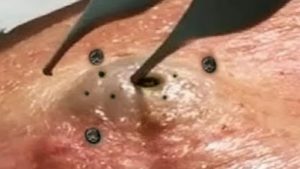
In the modern era of skincare awareness, the topic of pimple popping, blackhead removal, and cyst extraction has grown from a niche dermatological practice into a widely viewed fascination across social media. The image above appears to show a close-up view of a skin extraction procedure. A tool is being used to press gently on a swollen pore or opening, likely to remove sebum, keratin buildup, or an inflamed blackhead. The skin looks slightly irritated and reddish, suggesting that the procedure may be ongoing or recently started. Around the opening, several small dark dots can be observed—possibly pores, marks, extraction points, or antiseptic indicators.
Although videos and images like this attract millions of curious viewers, the process behind it is rooted in medical practice, cleanliness, and an understanding of human skin anatomy. Let’s explore how and why such procedures are performed, what is happening beneath the surface, and how proper technique can promote healing rather than damage.
What Are Blackheads and Cysts?
Before discussing extraction, it’s important to understand what is being removed.
Blackheads (Open Comedones)
Blackheads occur when a hair follicle becomes clogged with oil, dead skin cells, and bacteria. Unlike whiteheads, their opening remains exposed to the air, causing oxidation that turns the clog black. Though small, they can become deeply lodged within pores.
Sebaceous Cysts & Epidermoid Cysts
Cysts are larger, sac-like lumps under the skin containing keratin or sebum. They may develop due to blocked glands, irritation, or ingrown hairs. They tend to grow slowly and may become inflamed, uncomfortable, or infected if untreated.
In either case, extraction is often the most effective method of relief—when done correctly.
The Extraction Process
The image shows tools being used to apply pressure around a central pore. This is a method commonly used in dermatology:
-
Sterilization:
The skin is cleaned to reduce infection risk. Antiseptic solution may be applied. -
Identification of the Core:
The practitioner locates the pore or cyst entrance, sometimes marking surrounding areas. -
Applying Pressure Carefully:
Using a comedone extractor or gloved fingers, pressure is applied around the clogged pore. In the image, a tool is inserted into the pore to lift out the blockage. -
Release of Sebum or Keratin:
Once loosened, the material may be expelled. For cysts, a small incision is sometimes made to help remove the contents. -
Post-Extraction Care:
The area is usually cleaned again, treated with antibacterial ointment, and covered if needed.
The most important aspect is hygiene—an improper attempt can cause infection, scarring, or spread of bacteria deeper into the skin.
Why People Find Extraction Satisfying
It’s no secret that millions of viewers watch extraction content. The reasons include:
-
Psychological relief: Watching pressure release can feel metaphorically cleansing.
-
Curiosity about the human body: We rarely see what lies inside pores.
-
Visual transformation: Before-and-after improvement satisfies the brain’s reward system.
-
Stress reduction: Strangely, some find it calming—similar to ASMR effects.
What seems shocking or uncomfortable to some is incredibly soothing to others.
When Should Someone Seek Professional Help?
Not every blemish is safe to remove at home. A person should consult a dermatologist if:
-
The lump is large, painful, or rapidly growing.
-
The skin is very red or warm, suggesting infection.
-
A cyst keeps returning.
-
There is pus or a foul smell from the area.
-
Home extraction fails or worsens the condition.
Professionals use sterile tools and minimize long-term scarring.
Tips for Safe Skin Care at Home
If someone deals with regular blackheads, prevention is key:
-
Wash the face daily with gentle cleanser.
-
Use exfoliants like salicylic acid or AHAs/BHAs (as tolerated).
-
Avoid heavy comedogenic oils.
-
Never squeeze with dirty nails or tools.
-
Use warm compresses to open pores before treatment.
-
Moisturize—even oily skin needs hydration.
Conclusion
The image captures a moment within a dermatological extraction procedure—an intimate look at how clogged pores or cysts are cleared. While such visuals may appear intense, they represent an important aspect of skin health. Proper extraction can relieve discomfort, improve appearance, and prevent infection. However, it must be performed carefully to protect the skin and ensure healing.
As skin care interest continues to rise globally, understanding what happens beneath the surface helps demystify the process. What may seem simple actually involves technique, precision, and knowledge. When done by a trained professional, extraction is not only satisfying to watch—but also beneficial to skin health.