
Last night, my son hit me, and I didn’t cry.This morning, I made pancakes and bacon, laid out the good tablecloth, and poured fresh coffee like it was a special occasion.
It wasn’t a celebration. It was the final breakfast of a mother who used to forgive everything. And when Dylan came downstairs smiling, he found the one man at my table he never thought he’d have to face again.“If you ever tell me no again, I swear you’re going to regret giving birth to me.”
That was what my son told me at half-past eleven last night, in the kitchen of my house in Evanston, Illinois.My son. The boy who used to sleep with a little red toy car under his pillow. The same one who, as a toddler, would hug my legs and say, “Mom, when I grow up, I’m never going to let anyone make you cry.”
Last night, he was the one who raised his hand. My name is Eleanor Miller. I am forty-nine years old. I work at a school library, and for years, I confused being a mother with enduring everything. I endured his yelling.
His slammed doors. His lies. His late nights coming home smelling of stale beer. His jobs that never lasted. His promises of “I’ll change tomorrow.” His “You’re overreacting.” His “You always try to make me look like the bad guy.”
Dylan is twenty-three years old. He has broad shoulders, a loud voice, and a rage that did not feel like pain anymore. It felt like a habit.
As a child, he was sweet, restless, and affectionate. He left smooth rocks on the kitchen table because he said they were treasures. He brought me dandelions with their stems crushed in his tiny fist. When thunderstorms frightened him, he crawled into my bed and tucked his cold feet against my legs.
Then came the divorce.
His father, Richard, moved to Milwaukee.
Dylan filled up with a bitterness that first made me pity him and later made me fear him.
I defended him far too much.
When he dropped out of college, I said he was confused.
When he lost his first job, I said the manager did not appreciate him.
When he lost his second job, I said he was depressed.
When he started asking for money to go out, I said he needed a distraction.
When he stopped asking and started demanding, I said it was just a bad phase.
Mothers are experts at putting pretty names on the things that are destroying us.
Yesterday, I got home late from the library. My feet were swollen, my back was aching, and I was carrying a grocery bag with bread, eggs, and cheap coffee.
I was setting everything down on the counter when Dylan walked into the kitchen.
He did not say hello.
He did not ask whether I had eaten dinner.
He held out his hand.
“I need cash.”
I looked at him.
“I don’t have any.”
“I didn’t ask if you had any. I said I need it.”
My fingers trembled, but this time I did not reach for my purse.
“It’s over, Dylan.”
He frowned.
“What?”
“I’m not giving you any more money for your drinking, your partying, or your lies. If you want to go out, get a job.”
His smile was slow, ugly, and humorless.
“And who do you think you are now?”
I took a deep breath.
“I think I’m the person who pays for this house.”
That was when I lost him.
Or perhaps that was when I truly saw him for the first time.
His jaw tightened. His eyes went cold. He stepped toward me, and I knew a line was about to be crossed.
“Don’t talk to me like that.”
“I’m talking to you the way I should have a long time ago.”
He gave a short laugh.
“Then learn your place.”
I did not see the hand coming.
I only felt the blow.
Dry.
Hard.
My face snapped to the side. I grabbed the edge of the counter to keep from falling. The refrigerator buzzed. The wall clock ticked too loudly. The kitchen smelled of coffee, bread, and shame.
Dylan stared at me for one second.
I waited for him to become frightened by what he had done.
I waited for an apology.
I waited for tears.
I waited for my son to return.
Nothing happened.
He shrugged.
“Just so you understand.”
Then he went upstairs and slammed his bedroom door.
I stood alone in the kitchen with my cheek burning and a heavy truth lodged in my chest.
I was no longer safe in my own home.
I did not cry.
That was what frightened me most.
Not because it did not hurt, but because something inside me had finally stopped begging.
At one-twenty in the morning, I picked up my phone.
I stared at Richard’s name for almost a full minute.
My pride said no.
My shame said no.
The mother who still wanted to protect Dylan also said no.
But the woman who had just been struck by her adult son pressed the call button.
Richard answered with a sleep-heavy voice.
“Eleanor?”
I hesitated for two seconds.
Then I said the sentence I had never imagined saying.
“Dylan hit me.”
On the other end of the line, there was a heavy silence.
Not empty.
Heavy.
As though everything Richard and I had done wrong as parents had just collapsed between us.
Then he spoke.
“I’m on my way.”
“Richard—”
“Don’t ask me to stay out of it. Not this time.”
He hung up.
I did not sleep.
At four in the morning, I turned on the stove.
I made pancakes, scrambled eggs, hash browns, and bacon. I brewed fresh coffee. I brought out the good plates, the ones I used only for Thanksgiving. I ironed the embroidered tablecloth my mother had left me before she died.
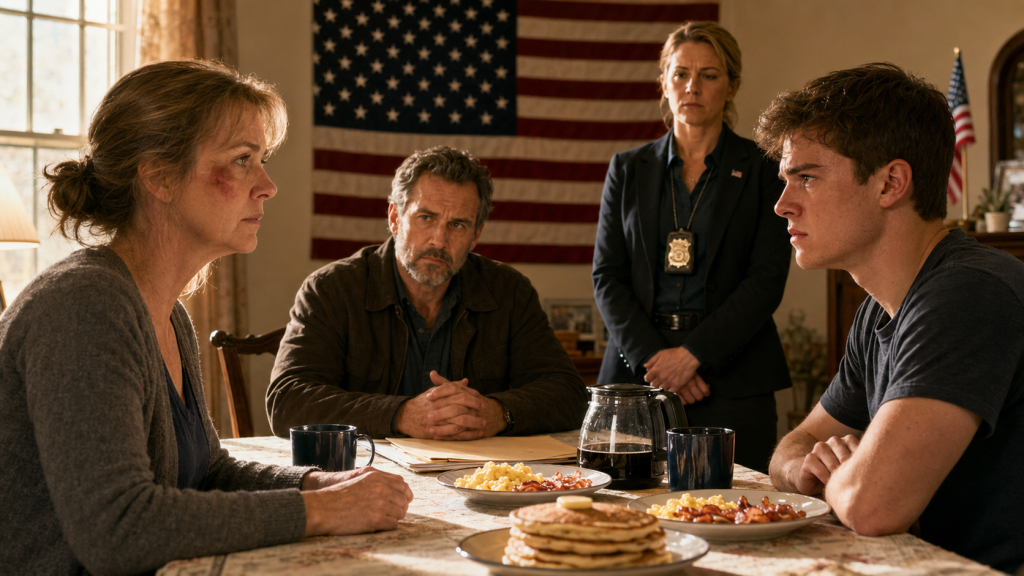
It was not a party.
It was a funeral.
The funeral of the mother who justified everything.
Shortly before six, Richard knocked on the door.
He arrived with grayer hair, a dark coat, and a brown manila folder under his arm.
He did not ask useless questions.
He looked at my cheek.
He looked at my hands.
He looked at the table.
He understood everything.
“Is he upstairs?”
“Sleeping.”
Richard clenched his jaw.
“Since when has this been happening?”
I could not answer quickly.
That, by itself, was an answer.
“Eleanor…”
“I didn’t call you to discuss old guilt.”
“But it’s there.”
“Yes. And today it ends.”
He placed the folder on a chair.
“I need to ask you something. I need you not to answer as a mother. Answer as a woman.”
I looked at him.
“Ask.”
“Is he leaving this house today?”
The question hurt like a knife twisting slowly.
I thought of Dylan as a little boy with scraped knees.
I thought of him as a teenager screaming that everyone always abandoned him.
I thought of him striking me and walking upstairs as though I were a piece of furniture.
“Yes,” I said.
The word came out broken, but it came out.
Richard lowered his head. He did not celebrate. He did not smile. He simply exhaled like someone who was also burying something.
“Then brace yourself when he comes downstairs.”
“I know.”
“He will insult you.”
“I know.”
“He will blame you.”
“He already does.”
Richard opened the folder.
Inside were documents, copies, a lawyer’s phone number, and a prepared police report that did not yet have my signature.
I stared at the blank line.
Eleanor Miller.
Mother.
Victim.
Woman.
For years, those words had not managed to fit together in my head.
“I don’t want to destroy him,” I whispered.
Richard looked at me with deep sorrow.
“Eleanor, letting him continue is not saving him.”
That sentence struck me harder than Dylan had.
Because it was true.
At seven-seventeen, we heard footsteps upstairs.
Heavy.
Slow.
The steps of someone who believed everyone in the house was afraid of him.
Dylan came downstairs with messy hair, wearing the same T-shirt as the previous night and a lazy smirk on his face.
He smelled the food.
He saw the tablecloth.
He saw the plated breakfasts.
His chest puffed out.
“So you finally learned,” he said.
I did not answer.
He walked toward the table as though nothing had happened.
As though my cheek was not bruised.
As though his hand had not crossed a boundary from which there was no return.
Then he looked toward the head of the table.
He saw Richard sitting there.
He saw the folder in front of him.
And he saw, standing beside the front window, a woman in a dark suit with a detective’s badge hanging from her neck.
His smile disappeared.
“What is this?”
Richard did not raise his voice.
“Sit down, Dylan.”
Dylan looked at the detective and then at me.
“What did you do, Mom?”
For the first time in years, I did not lower my eyes.
I placed my hand on the folder.
I felt the paper beneath my fingers.
I felt my face burning.
I felt everything I had kept silent for years stand up beside me.
“What I should have done the first day you made me afraid.”
Dylan stared at me.
For one second, he looked genuinely confused.
Not guilty.
Not ashamed.
Confused.
He could not understand why the rules had suddenly changed.
Then the confusion hardened into anger.
“You called the police on me?”
Detective Lena Alvarez stepped away from the window.
“Mrs. Miller reported an assault.”
“I didn’t assault anybody.”
My cheek pulsed beneath the bruise.
Richard’s hands tightened around his coffee cup.
Detective Alvarez’s expression did not change.
“She has visible injuries.”
Dylan laughed.
“That? She probably walked into a cabinet. She’s always clumsy.”
The ease with which he lied made something inside me turn cold.
He did not hesitate.
He did not look at me first.
He did not even need time to invent the lie.
It was already waiting inside him.
Detective Alvarez took out a small notebook.
“Your mother says you struck her after she refused to give you money.”
“My mother says a lot of things.”
“Did you ask her for money?”
“So what if I did?”
“Did she refuse?”
“This is ridiculous.”
“Did you hit her?”
Dylan looked at Richard.
“You believe this?”
Richard’s voice was quiet.
“I believe the bruise on her face.”
“You don’t know anything. You left.”
There it was.
The old wound.
The weapon Dylan used whenever he wanted to escape responsibility.
Richard absorbed the words without flinching.
“Yes,” he said. “I left this house after the divorce. I should have fought harder to remain part of your life. I should have noticed what was happening sooner. But my failures do not excuse yours.”
Dylan’s face reddened.
“You turned her against me.”
Richard shook his head.
“She called me because she was afraid of you.”
“No, she called you because she loves drama.”
I pushed my chair back and stood.
The room went silent.
“I called him because you hit me.”
Dylan looked at me with open contempt.
“I barely touched you.”
A strange calm settled over me.
“You hit me hard enough to turn my face.”
“You were yelling.”
“I was standing by the counter.”
“You were provoking me.”
“I told you to get a job.”
“You know I’m going through things.”
“I have known that for years.”
His eyes narrowed.
“Then why are you doing this?”
The question nearly broke me.
Because beneath the rage, for one brief moment, he sounded young again.
Not innocent.
But young.
A lost boy asking why his mother had stopped protecting him.
I held the edge of the chair.
“Because I love you enough to stop helping you become this person.”
His face twisted.
“Don’t give me that.”
“I paid your bills. I covered your lies. I called employers and begged them to reconsider after you cursed at supervisors. I gave you money after you promised it was for gas, even when I knew you spent it at bars. I apologized to neighbors when you screamed in the driveway. I told myself you were hurting. I told myself you needed time. I told myself a good mother never gives up.”
My voice began to tremble.
“But I was not helping you. I was teaching you that every terrible thing you did would be cleaned up by someone else.”
Dylan shoved the chair away from him.
It crashed against the floor.
Detective Alvarez moved forward immediately.
“Keep your hands where I can see them.”
Dylan froze.
He looked at her badge again, and reality finally began to enter the room.
“You can’t arrest me for a family argument.”
“This is not an argument,” she replied. “This is an allegation of domestic battery.”
His eyes darted toward the front door.
Richard stood.
“Don’t.”
Dylan turned on him.
“You think you can walk in after fifteen years and act like my father?”
“No,” Richard said. “I think I can stand beside the woman you hit.”
“I knew it. This is about you two getting back together.”
Despite everything, I almost laughed.
Dylan still believed every event in the world revolved around him.
“No,” I said. “This is about you leaving my house.”
He stared at me.
“What?”
“You are moving out today.”
His face went blank.
“You can’t throw me out.”
“The house is in my name.”
“I live here.”
“You are an adult guest who has threatened and assaulted the owner.”
“You’re my mother.”
The words came out as an accusation.
I swallowed the ache rising in my throat.
“Yes, I am.”
“Then act like it.”
“I am acting like it for the first time in years.”
He stepped toward me.
Detective Alvarez blocked his path.
“That is close enough.”
Dylan lifted both hands.
“I’m not doing anything.”
“You need to remain calm.”
“I am calm.”
He was not.
His breathing had become rapid. A vein stood out in his forehead. His eyes moved from Richard to the detective to me, searching for the weakest point.
For years, that weakest point had always been me.
“Mom,” he said, softening his voice. “Come on.”
I hated how quickly my heart reacted.
That single word nearly turned him back into the child who used to call for me after nightmares.
“Tell them it got out of hand,” he continued. “Tell them you don’t want to press charges. I’ll apologize.”
I waited.
He looked at me expectantly.
“Well?” he said.
“You haven’t apologized.”
He blinked.
“What?”
“You said you would apologize. But you still haven’t.”
His mouth tightened.
“Fine. Sorry.”
“For what?”
“For what happened.”
“What happened?”
He glanced at Detective Alvarez.
“You know.”
“I want to hear you say it.”
His expression hardened again.
“You’re enjoying this.”
“No. I am trying to find out whether there is any part of you that understands what you did.”
He looked away.
That was my answer.
Detective Alvarez asked whether I wanted to continue with the report.
My hand moved toward the folder.
Dylan saw it.
“Mom, don’t.”
For the first time that morning, fear appeared in his voice.
Not fear for me.
Fear for himself.
I thought of every morning I had woken before dawn to pack his lunches.
Every fever I had sat through.
Every school play I had attended.
Every birthday cake I had made.
Every excuse.
Every lie.
Every time he had frightened me and then behaved normally the next day until I questioned my own memory.
My hand trembled as I picked up the pen.
“Eleanor,” Richard said softly, “you don’t have to rush.”
Dylan seized on it.
“See? Even Dad thinks this is crazy.”
Richard looked at him.
“That isn’t what I said.”
I placed the pen on the signature line.
Then I signed my name.
The scratching sound seemed louder than the clock.
Dylan stared at the paper.
“You chose him over me.”
I put the pen down.
“No. I chose myself over your violence.”
Detective Alvarez stepped closer.
“Dylan Miller, turn around and place your hands behind your back.”
His face changed completely.
The arrogance vanished.
“You’re arresting me?”
“You are being taken into custody while the complaint is processed.”
“This is insane.”
“Turn around.”
He looked at me one final time.
“Mom.”
I nearly broke.
Then I remembered the shrug after he hit me.
Just so you understand.
I kept my hands at my sides.
Dylan cursed, kicked the fallen chair, and turned around.
Detective Alvarez secured his wrists.
As she led him toward the door, he twisted his head toward me.
“You’ll regret this!”
The words echoed through the hallway.
Richard stepped between us.
Detective Alvarez guided Dylan outside.
The door closed.
The house became quiet.
I stood in the kitchen staring at the untouched breakfast.
The pancakes were cooling.
The bacon had gone stiff.
Steam no longer rose from the coffee.
For several seconds, I felt nothing.
Then my knees gave way.
Richard caught me before I hit the floor.
I cried against his coat.
Not gentle tears.
Not dignified tears.
I cried from a place deep inside me that had been sealed shut for years.
“I let this happen,” I sobbed.
Richard held my shoulders.
“No.”
“I kept covering for him.”
“You made mistakes.”
“I taught him there were no consequences.”
“We both did.”
“He hates me.”
Richard closed his eyes.
“Maybe he does right now.”
“I’m his mother.”
“And you are still alive.”
That silenced me.
Richard helped me into a chair.
He poured fresh coffee into my cup, although neither of us drank.
We sat at the table in the aftermath of the family we had failed to protect.
After a while, he opened the folder again.
There was more inside than the police report.
A notice from an attorney.
Information about an emergency protective order.
A list of counseling services.
A brochure for families affected by domestic violence.
I stared at it.
“I feel foolish taking that,” I said. “There are women whose husbands beat them for years. Women who are trapped.”
Richard leaned forward.
“Violence does not become less real because the person who caused it is your son.”
I looked toward the staircase.
His bedroom door was still open.
Clothes lay across the floor. Empty cans stood on the dresser. A cracked gaming controller rested beside the bed. On the shelf was the little red toy car he had once slept with.
I picked it up.
The paint was chipped.
One wheel was missing.
I pressed it into my palm and finally understood something I had resisted for years.
The child I remembered was real.
But he was not the man who had hit me.
Loving who he had been did not require surrendering to who he had become.
Later that morning, Richard and I packed Dylan’s belongings.
We did not throw them into garbage bags. I could not do that.
We folded his clothes into boxes.
We wrapped his computer monitor in blankets.
We gathered his books, shoes, and childhood photographs.
Richard found several unpaid bills hidden beneath the mattress. There were collection notices, betting slips, and a letter from a former employer warning Dylan to stop contacting another employee.
There were also three credit cards in my name.
I had never applied for them.
My hands turned cold.
Richard read the statements.
Thousands of dollars had been charged to bars, online gaming sites, delivery services, and electronics stores.
“He stole your identity,” Richard said.
I sat on the edge of the bed.
“No.”
“Eleanor, these are in your name.”
“He must have thought he’d pay them back.”
Richard looked at me.
We both heard the excuse.
We both recognized how quickly I had spoken it.
I covered my mouth.
“Oh, God.”
The violence had not begun with the slap.
It had begun slowly.
With entitlement.
With manipulation.
With stolen money.
With threats disguised as frustration.
With fear I kept renaming as worry.
Richard called the bank with me sitting beside him. We froze the accounts and reported the fraud.
Each phone call felt like another thread being cut.
By afternoon, the locks had been changed.
A locksmith installed new bolts on the front and back doors. I changed the garage code, the alarm password, and every banking PIN.
Richard stayed.
He slept on the living-room sofa that night because I could not bear the idea of being alone.
At three in the morning, I heard the pipes creak and sat upright in bed, certain Dylan had returned.
My heart pounded until I realized the sound had come from the heating system.
That was when I understood how afraid I had become.
Not in one dramatic moment.
Gradually.
Quietly.
My body had learned the truth long before my mind accepted it.
The next day, Richard drove me to court.
Dylan appeared through a video screen from the detention facility.
His hair was uncombed. His face looked pale.
When he saw me, his eyes widened.
For a moment, I thought he might apologize.
Instead, he leaned toward his attorney and whispered something.
The judge reviewed the report, the photograph of my injury, the threats, and the fraudulent credit accounts.
Dylan was ordered to remain away from my house and workplace.
He was released under conditions that required him to stay with Richard temporarily, avoid alcohol, attend an anger-management assessment, and have no direct contact with me.
Richard had volunteered to supervise him.
I had resisted at first.
“You don’t owe him this,” I told him.
“He is still my son,” Richard said. “But helping him will not mean protecting him from consequences.”
Dylan moved into Richard’s small apartment in Milwaukee.
The first weeks were ugly.
He refused counseling.
He blamed me.
He told relatives I had exaggerated the incident because I wanted him gone.
My sister called and said, “He’s your only child, Eleanor. Are you really going to let one mistake ruin his future?”
“One mistake?” I asked.
“He says he only pushed you.”
“He hit me.”
“He was upset.”
“So was I. I didn’t hit him.”
She became quiet.
Some relatives stopped calling me.
Others sent messages saying a mother should never involve police in family matters.
I read each message once.
Then I deleted it.
For years, I had believed silence protected families.
Now I knew silence protected the person causing harm.
The school principal encouraged me to take leave, but I returned to the library after one week.
I needed the ordinary sounds.
Pages turning.
Children whispering.
The stamp of the return-date machine.
The squeak of sneakers between shelves.
One afternoon, a little boy named Marcus approached the desk with a book about race cars.
“This one is for my mom,” he said.
“Does your mother like race cars?”
“No, but she reads everything I like.”
His answer tightened my throat.
For a second, I saw Dylan at six years old, holding up a book with both hands.
I went to the staff restroom and cried.
Healing did not move in a straight line.
Some days I felt strong.
Other days, the sound of a young man raising his voice in a grocery store made my hands shake.
I began meeting with a counselor named Dr. Patel.
During our third session, she asked me why I thought saying no to Dylan felt like abandoning him.
“Because his father left,” I said.
“Richard moved after the divorce.”
“To Dylan, it was the same thing.”
“And so you decided never to leave?”
“I decided never to make him feel unwanted.”
Dr. Patel waited.
I looked down at my hands.
“Even when he made me feel unsafe.”
She nodded.
“You tried to compensate for one parent’s absence by erasing your own boundaries.”
The words hurt.
But unlike Dylan’s hand, that pain opened something instead of closing it.
Three months passed.
Then a letter arrived.
It was from Dylan.
The protective order allowed written communication through his attorney.
The envelope sat on my kitchen table for two days before I opened it.
Mom,
I know you think I’m some kind of monster. Dad says I need to take responsibility, but nobody cares what I went through. You and Dad ruined my childhood. You made me believe people always leave. I drank because I was angry. I took the credit cards because you would have said no. I hit you because you pushed me too far.
But I am sorry you got hurt.
I read it twice.
Then I brought it to Dr. Patel.
“What do you think?” she asked.
“He says he is sorry.”
“Read the sentence again.”
I did.
I am sorry you got hurt.
Not: I am sorry I hurt you.
The difference was only a few words.
But it held an entire world.
I did not reply.
Two months later, a second letter came.
Mom,
Dad made me read the first letter out loud in counseling. I hated him for it.
Then the counselor asked me to replace every excuse with the thing I actually chose.
I chose to drink.
I chose to lie.
I chose to steal your identity.
I chose to frighten you.
I chose to hit you.
You did not make me do those things.
I don’t know how to apologize without asking you to make me feel better, so I won’t ask you to forgive me.
I am attending treatment. I have been sober for sixty-one days. I work mornings at a warehouse. Dad makes me pay rent.
I am ashamed.
I am sorry I hit you.
Dylan
I cried after reading that letter.
But I still did not invite him home.
Love could recognize progress without surrendering boundaries.
The criminal case did not disappear.
Dylan pleaded guilty to a reduced charge and received probation, mandatory counseling, community service, and restitution for the fraudulent debts.
Some people said he had gotten off easily.
Others said I had punished him too harshly.
For once, I stopped measuring my decisions through other people’s opinions.
A year after the final breakfast, I agreed to meet Dylan in a counselor’s office.
Richard came with him but waited outside.
When Dylan entered, I almost did not recognize him.
He had lost weight. His hair was shorter. His shoulders no longer seemed inflated with challenge.
He sat across from me and kept his hands folded.
For several seconds, neither of us spoke.
Then he looked at my face.
The bruise had vanished long ago.
But he looked toward the place where it had been.
“I remember the sound,” he said.
I said nothing.
“I remember hitting you. I spent months telling myself it wasn’t hard. Then I realized I was trying to decide how much violence should count.”
His voice broke.
“All of it counts.”
I felt tears gathering, but I did not rescue him from the discomfort.
“I was angry at Dad,” he continued. “I was angry at you for not fixing everything. I was angry at every boss who told me no. Every girlfriend who left. Every person who didn’t treat me like I was special.”
He stared at his hands.
“But mostly, I was angry because deep down I knew I had become someone I hated. Instead of changing, I punished everyone who could see it.”
I finally spoke.
“Why me?”
His eyes filled.
“Because I thought you would never leave.”
The truth settled between us.
He had mistaken my unconditional love for unlimited permission.
“I didn’t leave,” I said. “I stopped allowing you to hurt me.”
He nodded.
“I know that now.”
“I love you.”
His mouth trembled.
“I love you too.”
“But you cannot move back into my house.”
“I know.”
“You cannot ask me for money.”
“I know.”
“You cannot call me names, threaten me, or blame me for your choices.”
“I know.”
“And if you ever raise your hand to me again, there will be no second meeting.”
He began crying.
“I understand.”
We did not hug that day.
That surprised me.
I had imagined that if we ever reconciled, music would swell inside my heart and I would throw my arms around him.
Instead, I simply stood and said goodbye.
It was enough.
Over the next year, we rebuilt our relationship slowly.
Coffee in public places.
Short phone calls.
Lunch with Richard present.
No loans.
No emergency excuses.
No secrets.
Dylan remained sober.
He completed his community service at a youth center, where he helped teenagers repair donated bicycles.
One afternoon, he sent me a photograph of a little red bike with new wheels.
For a long time, I stared at the picture.
Then I looked at the toy car still sitting on my bookshelf.
I typed back:
It looks beautiful.
He replied:
It finally runs straight.
Two years after the night he hit me, Dylan came to my house for breakfast.
He did not have a key.
He knocked.
That mattered.
I opened the door.
He held a paper bag from a bakery and a small bunch of yellow tulips.
“I brought food,” he said. “And I can leave if today doesn’t feel right.”
I stepped aside.
“You can come in.”
He paused in the hallway as though crossing sacred ground.
The kitchen looked almost the same.
Same cupboards.
Same clock.
Same table.
But there was no embroidered tablecloth.
No detective.
No brown folder.
Richard arrived twenty minutes later, carrying coffee.
We ate together.
Not as though nothing had happened.
We ate together because it had happened, because it had been confronted, and because all three of us had survived the truth.
At one point, Dylan looked toward the counter where he had struck me.
His face changed.
“I still hate that room sometimes,” he whispered.
“So do I,” I said.
He nodded.
Then he reached into his coat pocket and placed something on the table.
A small red toy car.
The missing wheel had been replaced.
The chipped paint remained, but the car could roll again.
“I found the same model online,” he said. “I used the wheel from it to fix this one.”
I touched the toy.
“You kept it?”
“You kept it first.”
Richard looked away, blinking hard.
Dylan drew a slow breath.
“I know fixing this doesn’t fix what I did.”
“No,” I said.
“It’s just a car.”
“Yes.”
“But I wanted you to have it.”
I pushed it gently across the table.
It rolled in a straight line.
For the first time, I reached across and took my son’s hand.
Not because the past had disappeared.
Not because forgiveness had erased consequences.
Not because a mother must accept everything.
I held his hand because he had finally learned that love without responsibility becomes destruction.
And I had finally learned that boundaries are not the opposite of love.
Sometimes they are its bravest form.
People still ask me whether I regret calling Richard that night.
I do not.
I regret waiting so long.
I regret every excuse I made.
I regret teaching Dylan that my fear was less important than his comfort.
But I do not regret the final breakfast.
That morning, I believed I was burying the mother I used to be.
In truth, I was saving her.
I was saving the woman beneath the apologies.
The woman beneath the guilt.
The woman who had a right to sleep without listening for angry footsteps.
The woman who had a right to say no.
The woman whose love did not require bruises.
And perhaps, in the end, I saved part of Dylan too.
Not by hiding what he had done.
Not by paying another bill.
Not by pretending his rage was only pain.
I helped him by making him face the one thing I had protected him from his entire life.
Consequences.
That was the morning my son lost his home.
It was also the morning he was given his first real chance to become a better man.
And it was the morning I finally understood that being his mother did not mean offering myself as the place where all his anger could land.
It meant loving him enough to step away.
It meant loving myself enough to lock the door.
It meant opening that door again only when respect stood on the other side.
THE END! THANKS FOR READING!