
My husband visited his mother in the hospital alone because she “needed peace.” That was what Michael told me. For almost a month, I believed him. I believed him because Patricia was his mother. I believed him because she had suffered a stroke.
I believed him because marriage, at least the way I understood it, meant trusting the person who slept beside you every night. But trust can be a blindfold. And mine was tied so tightly, I did not notice the truth standing right in front of me.
Patricia had never been an easy woman. She was proud, sharp-tongued, and difficult to please. From the first day Michael brought me home, she looked me up and down as though I were a coat he had chosen badly. “You’re very quiet,” she said that day.
I smiled politely. “I’m just nervous.” She gave a small laugh. “Nervous women usually hide something.” That was Patricia. Cold on the outside. Harder underneath. But after I married Michael, I tried. I brought her soup when she was sick.
I remembered her birthday.
I invited her for holidays even when she criticized my cooking, my curtains, my weight, and once, the way I folded napkins.
Michael always said, “Don’t take it personally. Mom is like that with everyone.”
So I learned not to take it personally.
Or at least I pretended I had learned.
Then the stroke happened.
It was a rainy Tuesday evening.
Michael and I were eating dinner when his phone rang.
His face changed before he even said hello.
By the time he hung up, his hands were shaking.
“Mom collapsed,” he said.
We drove to the hospital in silence.
Patricia was alive, but barely awake.
Her face drooped slightly on one side.
Her words came slowly.
The doctor explained that she needed close monitoring, therapy, and time.
“She’s lucky,” he said. “But recovery will not be simple.”
For the first few visits, I went with Michael.
I sat beside Patricia’s bed.
I adjusted her blanket.
I spoke softly even when she turned her face away.
Sometimes she looked at me with a strange expression.
Not kindness.
Not anger either.
Almost like warning.
But she could barely speak, so I told myself I was imagining things.
Then, suddenly, Michael stopped letting me come.
The first time, I was already putting on my coat when he placed a hand on my arm.
“Not today, honey.”
I looked at him.
“Why?”
He sighed, tired and gentle.
“Mom needs peace and quiet right now. The doctor says too many visitors upset her.”
“I’m not too many visitors,” I said. “I’m your wife.”
“I know,” he replied, kissing my forehead. “But she’s fragile. The hospital is far too. I’ll check on her and come straight back.”
I wanted to argue.
But he looked exhausted.
So I nodded.
That became the pattern.
Every other day, Michael drove to the hospital alone.
Sometimes he was gone for three hours.
Sometimes six.
Sometimes he came home smelling faintly of hospital soap and cafeteria coffee.
He would drop his keys into the bowl by the door and say, “Mom was tired today.”
Or, “She barely spoke.”
Or, “Physical therapy is draining her.”
I would ask, “Did she ask about me?”
He always paused before answering.
“Not really. She’s confused.”
That hurt more than I admitted.
Still, I sent flowers.
I cooked meals for Michael to bring.
I even gave him money to help with Patricia’s hospital bills.
Her insurance wasn’t covering everything, he said.
“The rehabilitation wing is expensive,” he told me one night, rubbing his face.
“How much do you need?”
He hesitated.
“Only if we can manage it.”
“How much, Michael?”
“Three thousand for now.”
I transferred it that same evening.
He hugged me so tightly I could barely breathe.
“You’re helping save my mother’s life,” he whispered.
Those words made me cry.
Because despite everything, I wanted Patricia to recover.
I wanted Michael to have his mother.
I wanted our family to survive this hard season.
For nearly a month, I lived inside his version of the truth.
I packed his lunches.
I washed his shirts.
I asked about his mother every night.
And every night, he gave me just enough answers to keep me quiet.
Then Michael left on a three-day business trip.
He kissed me goodbye in the driveway with his suitcase beside him.
“I hate leaving while Mom is still recovering,” he said.
“I can visit her while you’re gone,” I offered immediately.
His expression tightened.
Then softened too quickly.
“No, honey. Please. The doctors still want limited visitors. I’ll call the hospital from the hotel.”
“Are you sure?”
“I’m sure.”
He smiled.
I believed him again.
The next day, I received a call from a number I did not recognize.
“Is this Mrs. Bennett?” a woman asked.
“Yes.”
“This is Dr. Elaine Morris from St. Catherine Medical Center. I’m calling about Patricia Bennett.”
My stomach dropped.
“Is she okay?”
There was a short silence.
“Her condition has suddenly worsened. We tried reaching your husband several times, but he isn’t answering. You need to come immediately.”
I did not think.
I grabbed my purse, ran to the car, and drove like the world was ending.
The hospital was nearly an hour away, but that day it felt farther.
My hands gripped the steering wheel until my fingers ached.
I kept calling Michael.
No answer.
Again.
No answer.
Again.
Voicemail.
By the time I reached St. Catherine, I was breathless.
I rushed through the front doors, past the information desk, and down the long white corridors toward the rehabilitation wing.
I was searching for Patricia’s room when a nurse stepped in front of me.
She was young, maybe early thirties, with tired eyes and a badge that read “Nora.”
“Mrs. Bennett?” she whispered.
“Yes. Where is Patricia?”
Instead of answering, she pressed a folded note into my hand.
Her fingers were cold.
“I’m the one who called you,” she said quickly. “Read this immediately. Your husband is lying to you.”
My body went numb.
“What?”
“Please,” she whispered. “Read it. Not here.”
I looked down at the paper.
My hands were already shaking before I opened it.
Inside, in uneven handwriting, were the words:
Go to Room 120. I’ll show you the security camera footage. Please stay calm and don’t tell anyone.
I stared at the note.
For a moment, the hospital sounds faded.
The beeping monitors.
The rolling carts.
The distant voices.
Everything became one dull roar inside my head.
“Nora,” I whispered, “what is going on?”
Her eyes filled with pity.
“Room 120,” she said. “Please.”
I followed her.
Room 120 was not a patient room anymore.
It had been converted into a small staff office with old cabinets, a desk, and a security monitor.
Nora closed the door behind us.
Another woman sat inside wearing a cardigan over scrubs.
Dr. Morris.
She stood when she saw me.
“I’m sorry,” she said.
Those two words frightened me more than anything else.
Nora motioned for me to sit.
I did not.
She turned the monitor toward me and clicked on a video file.
“This is from three weeks ago,” she said.
The footage showed Patricia’s hallway.
The angle was high, grainy, and silent.
I saw Michael enter the frame holding flowers.
My chest tightened.
He walked into Patricia’s room.
For one minute, nothing happened.
Then he came back out.
He still had the flowers.
He looked both ways down the hall.
Then he crossed to another door.
Room 118.
A woman opened it.
Young.
Blonde.
Wearing a soft pink robe.
She smiled when she saw him.
Then she wrapped her arms around his neck and kissed him.
Not a quick kiss.
Not a friendly kiss.
The kind of kiss a wife gives a husband.
My knees buckled.
Dr. Morris caught my arm.
“No,” I whispered.
Nora clicked another file.
Then another.
Michael entering Patricia’s room for less than two minutes.
Michael leaving.
Michael going to Room 118.
Michael staying there for hours.
Michael bringing takeout.
Michael holding the woman’s hand.
Michael laughing in the hallway.
Michael kissing her again.
Again.
Again.
My stomach turned.
“That’s what he’s been doing?” I said, my voice barely human.
Nora’s face hardened.
“Yes.”
“Who is she?”
Dr. Morris folded her hands.
“Her name is Vanessa Cole. She was recovering from a minor surgery. She was discharged two weeks ago.”
“Then why did Michael keep coming here?”
Nora swallowed.
“Because after Vanessa left, he kept using the visits as an excuse.”
She clicked another video.
This one showed Michael leaving the hospital with Vanessa.
They were walking close together.
He carried a weekend bag.
My weekend bag.
The gray one from our closet.
I pressed a hand over my mouth.
Dr. Morris spoke gently.
“Mrs. Bennett, there is more.”
I did not want more.
But more came anyway.
Nora opened a folder.
Inside were copies of hospital payment records.
My name appeared beside payments I had sent through Michael.
Three thousand dollars.
Two thousand five hundred.
One thousand eight hundred.
But Patricia’s account balance had barely changed.
“Where did the money go?” I asked.
Nora looked away.
Dr. Morris answered.
“We cannot prove everything yet. But the billing department confirmed most payments Michael claimed were for Patricia were never made to the hospital.”
The room tilted.
“He stole from me?”
No one answered.
They did not have to.
I thought of Michael hugging me.
You’re helping save my mother’s life.
I thought of my savings account.
The sacrifices.
The canceled repairs.
The groceries I had stretched.
My eyes burned.
“And Patricia?” I asked suddenly. “Does she know?”
Nora’s face softened.
“Yes.”
I turned toward her.
“She knows?”
“She has been trying to reach you for weeks.”
My heart cracked.
“What?”
Nora opened the top drawer and took out a small envelope.
Inside were several notes.
All written shakily.
All addressed to me.
Please tell Laura.
Michael lies.
Not for me.
Room 118.
Money gone.
Don’t trust him.
Laura, come.
My name in Patricia’s broken handwriting made my chest cave in.
“She asked me to call you,” Nora said. “But Michael told staff you were unstable. He said you had caused stress before and weren’t allowed near her.”
I stared at her.
“He said what?”
Dr. Morris looked furious now.
“He claimed there was a family conflict and that Patricia became agitated whenever your name was mentioned. We had no reason at first to doubt her son.”
I laughed once.
A broken sound.
“So while I was at home praying for his mother, he was telling everyone I was dangerous.”
Nora’s eyes filled with tears.
“Patricia kept trying to say your name. At first we thought she was confused. Then she managed to write.”
I looked at the notes again.
The woman who once criticized everything about me had been trying to save me.
“Take me to her,” I said.
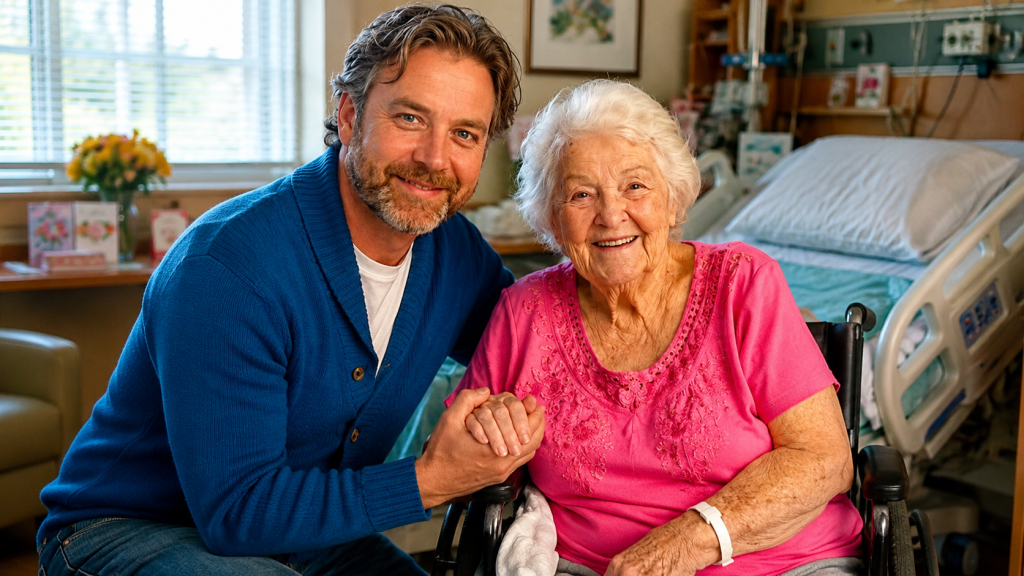
Patricia’s room was dim and quiet.
She looked smaller than I remembered.
Her gray hair lay thin against the pillow.
Her right hand trembled on top of the blanket.
When she saw me, her eyes filled instantly.
I rushed to her bedside.
“Patricia,” I whispered.
Her mouth moved.
No sound came out.
I took her hand.
“I’m here.”
A tear slid down her temple.
She squeezed my fingers weakly.
“I’m sorry,” I said, crying now. “I didn’t know. Michael told me you needed peace. He told me I couldn’t come.”
Her face twisted.
She tried to speak.
Nora leaned close.
“Slowly, Patricia.”
Patricia’s lips trembled.
“Lies,” she forced out.
I nodded through tears.
“I know now.”
Her hand tightened.
“Money,” she whispered.
“He took it?”
A tiny nod.
My grief turned into something colder.
Something steady.
Michael had not only cheated.
He had used his sick mother as a curtain to hide behind.
He had stolen from me.
He had isolated Patricia.
He had lied to doctors.
He had let his own mother lie helpless in a hospital bed while he played devoted son for an audience.
I bent close to Patricia.
“I promise you something,” I said. “He will not control this anymore.”
Her eyes stayed locked on mine.
For the first time since I had known her, Patricia did not look at me like an outsider.
She looked at me like family.
I spent the next hour with Dr. Morris and Nora.
They gave me copies of everything they legally could.
Visitor logs.
Billing statements.
Notes Patricia had written.
A written explanation of Michael’s claims about me.
Nora helped me save the security footage to a secure file.
“You need an attorney,” Dr. Morris said.
“I have one,” I replied.
I did not.
Not yet.
But by the time I left the hospital, I would.
I sat in my car and called the first family attorney whose office was still open.
Then I called my bank.
Then I called Michael again.
This time, he answered.
“Hey, honey,” he said casually. “Sorry, meetings have been crazy.”
I looked through the windshield at the hospital entrance.
My voice came out calm.
Too calm.
“How is your business trip?”
“Exhausting,” he said. “You know how these conferences are.”
“What hotel are you staying at?”
There was a pause.
“The Grand West.”
“Room number?”
Another pause.
“Why?”
“I wanted to send something.”
“Oh. That’s sweet, but don’t worry about it.”
I smiled without feeling it.
“Michael.”
“What?”
“I went to the hospital today.”
Silence.
Pure silence.
Then a sharp breath.
“Why would you do that?”
“Patricia’s doctor called me.”
“She shouldn’t have done that.”
“She said your mother got worse.”
He changed his tone immediately.
“Oh my God. Is Mom okay?”
The performance was almost impressive.
Almost.
“She is alive,” I said.
“Good. I mean—thank God. Listen, Laura, you shouldn’t have gone there. Mom gets upset when—”
“When I appear?”
“That’s not what I mean.”
“When I appear after you told everyone I was unstable?”
This time, the silence lasted longer.
“Laura,” he said slowly, “whatever they told you, you misunderstood.”
“No,” I said. “For the first time in weeks, I understood perfectly.”
His voice hardened.
“What did that nurse say to you?”
Enough.
I ended the call.
He called back seven times.
Then came the messages.
Honey, please answer.
You’re upset.
Let me explain.
It’s not what it looks like.
Vanessa means nothing.
I was stressed.
Mom’s illness broke me.
Please don’t do anything stupid.
That last message made me laugh.
Because he still thought I was the woman waiting at home, desperate to believe him.
I was not.
By the time Michael returned the next afternoon, my attorney had already filed emergency motions to protect my accounts.
My bank had frozen the joint line of credit.
I had changed the locks.
And Patricia had signed, with help from hospital staff and legal witnesses, a medical authorization removing Michael as her primary contact.
When his car pulled into the driveway, I was sitting at the kitchen table.
The same table where I had once packed meals for him to take to his mother.
He walked in looking pale.
His suitcase rolled behind him.
“Laura,” he said.
I looked at him.
He tried a sad smile.
“I can explain everything.”
I placed a folder on the table.
“No, Michael. You can answer.”
He glanced at the folder.
“What is that?”
“Visitor logs. Billing records. Copies of Patricia’s notes. Security footage.”
His face drained.
“You had no right.”
That was the moment something inside me finally stopped hurting.
“No right?” I repeated softly. “You used your sick mother as an excuse to cheat. You stole money I gave you for her care. You told hospital staff I was unstable. You kept me away while Patricia begged for me.”
He dropped the suitcase handle.
“You don’t understand what I was going through.”
“You’re right,” I said. “I don’t understand cruelty that deep.”
His eyes flashed.
“Vanessa and I—”
“Don’t say her name like she matters more than what you did to Patricia.”
He flinched.
Good.
“She was lonely in that hospital,” I said. “She was scared. And you walked past her room to hold another woman.”
Michael looked away.
“I visited Mom.”
“For one minute at a time.”
His jaw tightened.
“Who told you that?”
“The cameras.”
He sank into the chair opposite me.
For a moment, he looked like a boy caught stealing candy.
Then like all cowards, he reached for anger.
“So what now?” he snapped. “You’re going to ruin our marriage over a mistake?”
I stared at him.
“A mistake is forgetting milk. This was a plan.”
His mouth opened.
Nothing came out.
“My attorney will contact you,” I said. “You need to leave.”
“This is my house too.”
“Not tonight.”
He laughed bitterly.
“You can’t just throw me out.”
I picked up my phone and placed it on the table.
“Try me.”
Something in my face must have convinced him.
He grabbed his suitcase.
At the door, he turned back.
“You’ll regret this.”
I stood.
“No, Michael. I regret believing you.”
He left.
The house became quiet.
Not peaceful.
Not yet.
But honest.
Over the next few weeks, the truth unfolded piece by piece.
Vanessa was not a random patient Michael had comforted.
She was a woman he had known for months.
Their affair had started before Patricia’s stroke.
The hospital had simply become a convenient cover.
The “business trip” had been a weekend with her two towns away.
The money I gave him for Patricia’s care had paid for hotel rooms, dinners, and a necklace Vanessa posted online with the caption: Spoiled by someone special.
Someone special.
I stared at that picture for a long time.
Then I saved it for my attorney.
Patricia slowly improved.
Not quickly.
Not perfectly.
But enough.
Her speech remained difficult, but her mind was clear.
I visited her every day.
At first, we sat in awkward silence.
Years of sharp words stood between us.
Then one afternoon, Patricia motioned for her notebook.
Her handwriting was shaky but readable.
I was wrong about you.
I swallowed hard.
“You were sick,” I said.
She shook her head.
Then wrote again.
Before.
I looked away.
She tapped the notebook.
I was wrong before.
Tears filled my eyes.
“I tried to be good enough for this family.”
Patricia stared at me.
Then slowly wrote:
You were.
That broke me.
I cried beside her bed while she patted my hand with the little strength she had.
The woman who had once made me feel small was now the only person in Michael’s family brave enough to tell the truth.
Michael tried everything.
He begged.
He blamed stress.
He blamed Vanessa.
He blamed his mother’s illness.
He blamed me for being “emotionally distant.”
Then he blamed Nora for interfering.
That was his biggest mistake.
Because Patricia heard about it.
And Patricia, weak as she was, demanded to make a statement.
With Dr. Morris present, she confirmed that Michael had isolated her, lied about me, and misused money meant for her care.
Her words were slow.
Painful.
But each one landed like a hammer.
Michael’s image as a devoted son collapsed.
His siblings stopped speaking to him.
The hospital opened an internal review into his false claims.
My attorney moved forward with the divorce.
And Vanessa disappeared the moment she realized Michael was no longer exciting, wealthy, or safe.
Funny how love built on lies often ends when the lies become expensive.
Three months later, Patricia was discharged to a smaller rehabilitation center closer to my home.
Not Michael’s.
Mine.
When the social worker asked who Patricia wanted listed as her emergency contact, she pointed to me.
“Laura,” she said clearly.
Just my name.
But it felt like forgiveness.
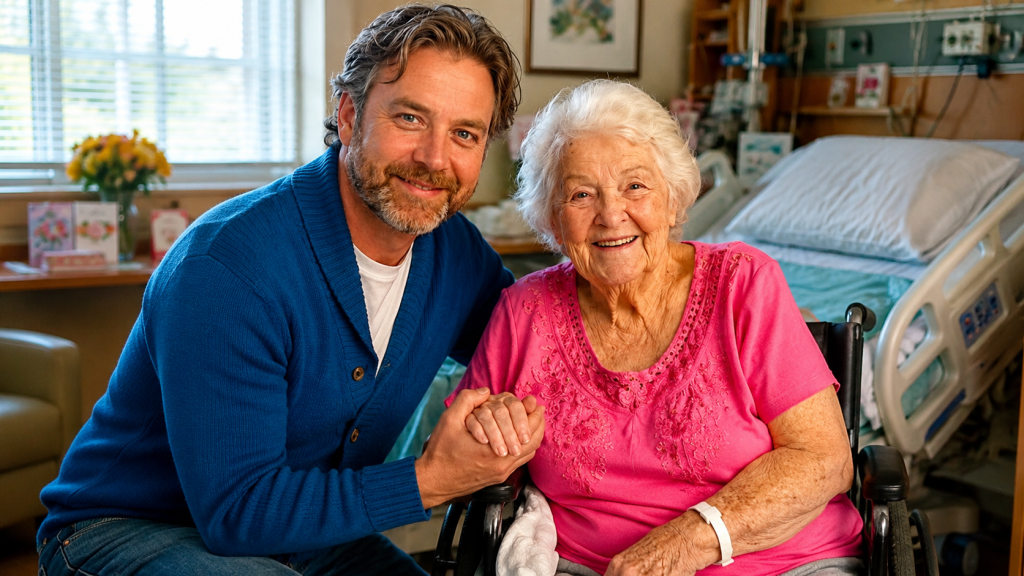
One evening, I wheeled her into the garden outside the rehab center.
The sun was setting.
The air smelled like cut grass and rain.
Patricia looked thinner, older, softer somehow.
She watched the sky for a long time.
Then she said, slowly, “I failed him.”
I knew she meant Michael.
“No,” I said. “He made his choices.”
Her eyes filled.
“I made excuses.”
“So did I.”
She looked at me then.
We sat quietly.
Two women betrayed by the same man in different ways.
A mother who had lost the son she thought she raised.
A wife who had lost the husband she thought she knew.
But we had not lost ourselves.
Not completely.
The divorce was finalized eight months after the day Nora handed me that note.
Michael lost more than he expected.
Money.
Reputation.
Family trust.
The comfortable life he thought he could control.
At the final hearing, he would not look at me.
But I looked at him.
Not with hate.
Hate takes energy.
I looked at him the way you look at a locked door after realizing you have the key.
When it was over, I drove to Patricia’s rehab center.
She was waiting by the window.
I held up the final papers.
“It’s done,” I said.
She nodded.
Then she reached for my hand.
“Free,” she whispered.
I smiled through tears.
“Yes,” I said. “Free.”
People always think betrayal begins with one dramatic moment.
A kiss caught on camera.
A missing payment.
A folded note passed in a hospital hallway.
But betrayal begins earlier.
It begins with the first lie you choose not to question.
The first excuse that sounds reasonable.
The first time someone uses your kindness as a hiding place.
Michael thought my love made me weak.
He thought Patricia’s illness made her powerless.
He thought distance, fear, and silence would protect him.
He was wrong.
Because sometimes the truth does not arrive shouting.
Sometimes it arrives folded in a nurse’s hand.
Sometimes it is written by a trembling mother who can barely speak.
Sometimes it waits behind a hospital door marked Room 120.
And when it finally opens, it does not just reveal the lie.
It sets you free.
THE END! THANKS FOR READING!