
I returned home from military service, hoping to see my wife’s smile. Instead, I found a coffin in the middle of my living room. “She died in childbirth,” my mother said in a cold voice that sent shivers down my spine.
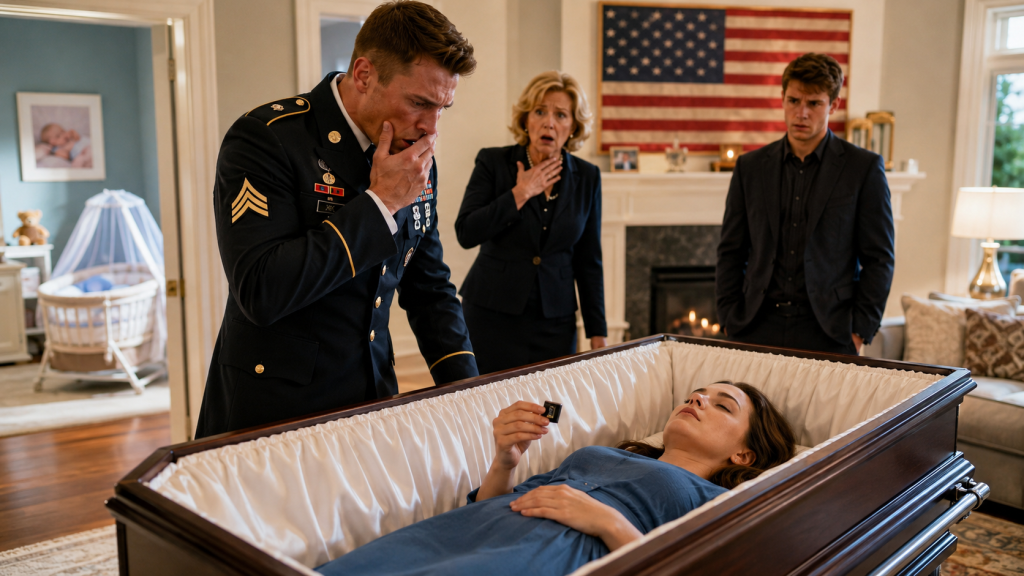
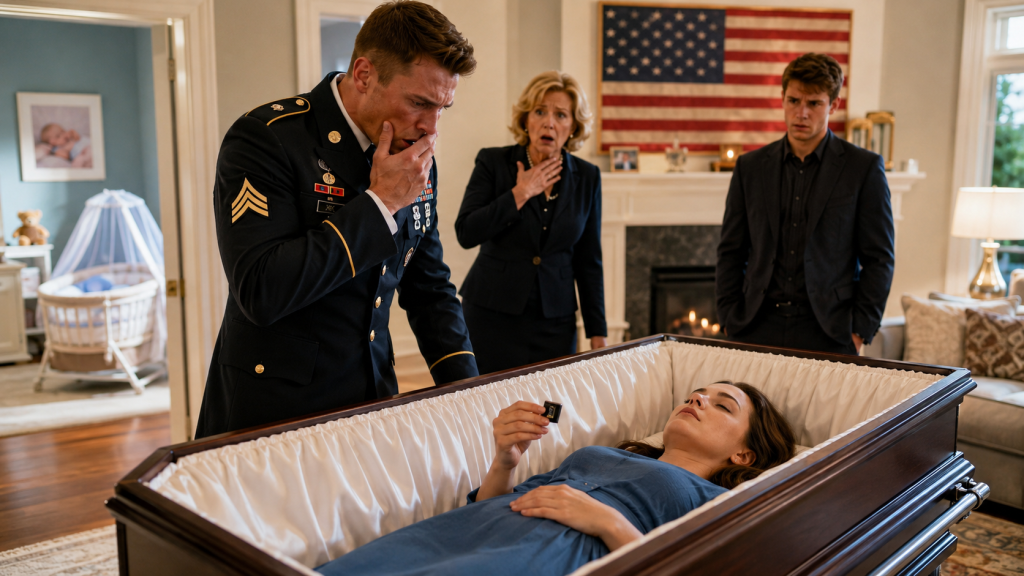
I approached, trembling, to see Emily one last time. And then I realized something that made every instinct in my body turn sharp. My wife’s stiff hand was still clutching something. When I tried to pry her fingers apart, my mother turned pale.
The coffin was waiting in my living room before I had even taken off my uniform. My mother, Margaret, stood beside it without a single tear. My younger brother Caleb leaned against the fireplace, whiskey glass in hand, like he had been waiting for a show to begin.
“Your wife died giving birth, Daniel,” my mother said. For three seconds, the world made no sound. Then I heard the weak crying of a newborn somewhere upstairs. My knees nearly failed. My son. The son I had only seen in ultrasound pictures Emily mailed to me overseas.
The son whose tiny socks she had packed in my last care package with a note that said, “Come home safe. Someone small is waiting for you.”
I dropped my duffel bag. It hit the floor like a body. “Where is my son?” I asked. Mother’s face did not soften. “He survived,” she replied. “Barely. Emily was careless.” Caleb took a slow sip from his glass.
“She always was dramatic.”
My hands shook as I walked toward the coffin.
Emily lay inside wearing the blue dress she had chosen for my homecoming.
She had sent me a photo of it six weeks earlier, smiling in the mirror, one hand under her pregnant belly.
“This is what I’ll wear when I run to you,” she had written.
Now the dress looked too neat.
Her dark hair was arranged too carefully around her face.
No hospital bracelet.
No flowers from the clinic.
No doctor waiting to explain what had happened.
No grief in the room.
Only my mother.
Only Caleb.
Only a coffin that looked more staged than sacred.
I had spent eleven months overseas as an intelligence warrant officer.
My job was not only to survive danger.
It was to notice what danger tried to hide.
Disturbed earth.
Fresh wires.
Patterns that did not belong.
People who spoke too quickly.
People who did not cry when they should.
Training had taught me that death left details behind.
And everything in that living room felt wrong.
Emily’s right hand was clenched against her hip.
“What is she holding?” I asked.
Mother’s face changed.
It lasted less than a second.
But I saw it.
“Nothing,” she said sharply. “Leave her dignity intact.”
I bent over the coffin.
Mother grabbed my arm.
“Daniel, stop.”
I looked at her hand on my sleeve, then at her eyes.
“Take your hand off me.”
She obeyed.
Emily’s fingers were stiff, but not impossible to move.
Beneath her nails were tiny crescent cuts, as though she had fought to keep her fist closed.
My chest tightened.
Gently, I worked her thumb loose.
A small black memory card slid into my palm.
Mother went white.
Caleb’s glass stopped halfway to his mouth.
“What is that?” he demanded.
I closed my fist around it.
“You tell me.”
Mother recovered first.
“Probably something from her phone. She was obsessed with recording everything. Pregnancy made her paranoid.”
Upstairs, the baby cried again.
I straightened and forced my face empty.
Rage was useful only when controlled.
Before deployment, I had transferred the house into a military family trust that only I could authorize.
I had also given Emily access to my encrypted evidence vault because she feared my mother was stealing from us.
They thought I was a grieving soldier with no idea how civilian paperwork worked.
They had forgotten what I did for a living.
I slipped the memory card into the hidden pocket inside my uniform.
Then I looked at my mother and said, “Tell me exactly how my wife died.”
Choose your next words carefully, Mother, because your freedom may depend on them.
Her lips tightened, but for the first time in my life, she looked afraid of me.
“There were complications,” she said. “The midwife couldn’t stop the bleeding.”
“What midwife?”
“The one Emily hired.”
“Name.”
Caleb slammed his glass down.
“You just came home and you’re interrogating us?”
I turned to him.
“My wife is in a coffin in my living room without a hospital record, and my newborn son is upstairs crying. Yes, Caleb. I’m interrogating everyone.”
Mother’s face hardened.
“Grief is making you cruel.”
“No,” I said. “Training is keeping me calm.”
I walked upstairs before they could stop me.
Every step felt like I was climbing through a nightmare.
The nursery door was half open.
Inside, my son lay in a bassinet, red-faced and hungry, bundled in a pale blanket I recognized from Emily’s baby shower photos.
A woman I did not know sat beside him.
She jumped when she saw me.
“Who are you?” I asked.
Her hands trembled.
“Nora. I’m a nurse. Mrs. Margaret hired me.”
“Where are the birth records?”
Her eyes flicked toward the hallway.
“She told me not to discuss it.”
I stepped closer, lowering my voice.
“My wife is downstairs in a coffin. My newborn son is here without any paperwork, and you are telling me my mother ordered silence. Nora, I need you to understand something. If you are part of what happened, silence will not protect you.”
Her face crumpled.
“I didn’t hurt anyone.”
“Then start talking.”
She looked toward the hallway again.
“She called me yesterday morning. Said the baby had been born at home, that the mother was gone, that the family wanted privacy. She paid cash and told me to care for the child until you returned.”
“Was there a midwife?”
“I never saw one.”
“Doctor?”
“No.”
“Ambulance?”
She shook her head.
The room tilted.
My son cried again, thin and desperate.
I picked him up carefully.
He was impossibly small.
Warm.
Alive.
His tiny hand curled against my uniform.
For one second, grief nearly swallowed me whole.
Emily should have been here.
She should have been laughing at how awkwardly I held him.
She should have been telling me his name.
She should have been alive.
Instead, I stood in the nursery with a stranger, holding the child she had died trying to protect.
I pulled out my phone and called Colonel Reeves, my commanding officer.
“Sir,” I said, keeping my voice steady, “I need military police liaison support, local authorities, and a forensic examiner at my residence immediately.”
Colonel Reeves did not waste time.
“Is your family safe?”
“My son is alive. My wife is not. Circumstances suspicious.”
“Secure evidence. Do not leave the body unattended. I’ll make calls.”
Downstairs, my mother screamed my name.
I looked at my son and whispered, “Your mother left me proof.”
Then I sat at the nursery desk, opened my encrypted vault on my military laptop, and inserted the memory card.
For a moment, the screen stayed dark.
Then Emily’s face appeared.
She was sitting in our bedroom, pregnant, exhausted, and terrified.
Her voice filled the room.
“Daniel, if you’re watching this, your mother lied about everything.”
My hand tightened around the edge of the desk.
Emily swallowed hard on the recording.
“I don’t know if I’ll have the courage to tell you before you come home, so I’m recording everything. Margaret has been moving money from the family trust. Caleb helped her. They told me I was imagining it because of pregnancy hormones, but I found the statements.”
The video cut to scanned documents.
Account transfers.
Signatures.
Emails.
My mother’s name.
Caleb’s.
A false power-of-attorney draft.
Emily appeared again, eyes red.
“She wants control of the house. She said if something happened to me, she would make sure the baby was raised properly. Daniel, she hates that you gave me access. She hates that the trust protects me and the baby. She told me I was a temporary wife in a permanent family.”
I closed my eyes.
I could hear my mother’s voice saying those words.
Cold.
Elegant.
Poisonous.
The next video file showed Emily in the kitchen, secretly recording from behind a cabinet.
My mother’s voice was clear.
“You will sign the postpartum guardianship paperwork before Daniel comes home.”
Emily answered, “I’m not signing anything.”
“You are young. Emotional. Alone. Daniel needs stability when he returns.”
“My husband needs the truth.”
Caleb’s voice entered.
“Emily, don’t be stupid. If you cooperate, everyone stays comfortable.”
“Comfortable for whom?” Emily asked.
“For the family,” Mother said.
Then the video ended.
My breathing changed.
Slow.
Measured.
Dangerously calm.
Nora whispered, “Oh my God.”
I looked at her.
“You saw none of this?”
“No. I swear.”
Another file opened automatically.
Emily was in the nursery.
Her hair was messy.
Her face was pale with fear.
“If the baby comes before Daniel returns, I am going to St. Mary’s Hospital. I do not want a home birth. I do not trust Margaret. I do not trust Caleb. I already told Dr. Willis and my friend Hannah.”
She leaned closer to the camera.
“If they say I chose a home birth, they are lying.”
My mother’s footsteps sounded in the hallway below.
“Daniel!” she shouted. “Come down here now.”
I removed the memory card, copied the files to my secure vault, and placed the original back in my uniform pocket.
Then I lifted my son again.
“What is his name?” I asked Nora.
She blinked.
“What?”
“My son. What did Emily name him?”
Nora looked at the bassinet card.
“Samuel.”
Samuel.
Emily had chosen my grandfather’s name.
My throat closed.
I kissed my son’s forehead.
“Hi, Samuel.”
Downstairs, my mother was still calling.
I handed Samuel carefully to Nora.
“Do not let anyone take him from this room.”
She nodded, shaking.
I walked back down.
Mother stood near the coffin now, her perfect posture cracked by panic.
Caleb was pacing.
“You called someone,” he said.
“Yes.”
Mother’s eyes narrowed.
“Daniel, you are being manipulated by grief.”
I walked to the coffin and looked at Emily.
“I just watched my wife tell me you were stealing from us.”
Mother’s face went still.
Caleb froze.
“She was confused,” Mother said.
“She recorded the bank documents.”
Caleb cursed under his breath.
Mother turned on him.
“Be quiet.”
That was all the confirmation I needed.
“You forged trust access documents,” I said. “You pressured Emily to sign guardianship papers. You planned to take my son.”
Mother lifted her chin.
“I planned to protect this family.”
“From whom?”
“From her.”
The word came out like a spit.
I looked at my mother and finally saw the truth that had been waiting behind years of small cruelties.
She had never loved Emily.
She had tolerated her because I loved her.
She had smiled at our wedding like a queen watching a servant step too close to the throne.
Emily had told me my mother made her uncomfortable.
I had told her Margaret was difficult but harmless.
That failure would haunt me for the rest of my life.
“She was my wife,” I said.
“She was weak.”
“She was carrying my child.”
“She was carrying my grandson,” Mother snapped. “And she would have turned him against us.”
Caleb muttered, “Mom.”
“No,” she said, losing control now. “I gave Daniel everything. I raised him. I sacrificed. Then he comes home with that girl and puts her name near our assets like she mattered more than blood.”
I stared at her.
“Our assets?”
She realized her mistake.
The sound of sirens began in the distance.
Caleb moved toward the hallway.
I stepped in front of him.
“Going somewhere?”
His face twisted.
“You don’t understand what she did.”
“Emily?”
“She found everything. She said she was going to call the police before you got back. Mom only wanted to scare her.”
Mother screamed, “Caleb!”
The room went silent.
There it was.
A crack in the wall.
I looked at Caleb.
“Scare her how?”
He shook his head.
“I didn’t mean—”
“How?”
Mother lunged toward him, but I caught her wrist.
“Do not.”
Her face contorted with rage.
For the first time, my mother looked less like a grieving matriarch and more like someone whose mask had ripped.
The police arrived minutes later.
Colonel Reeves had called ahead, and local officers entered with a forensic investigator and a medical examiner.
Mother tried to perform grief.
She placed one hand on the coffin and said, “My son is in shock. He needs rest.”
The lead detective, Angela Moore, looked at me.
“Mr. Hayes?”
“Warrant Officer Daniel Hayes,” I said. “My wife’s death was reported as childbirth complications. I have evidence contradicting that claim.”
I handed her a secure copy of the files.
Mother gasped.
“Daniel, how could you?”
I looked at her.
“You should have remembered Emily recorded everything.”
Caleb sank onto the sofa.
He looked like a man already halfway sentenced by his own conscience.
The medical examiner checked Emily’s body.
I stayed close, even when Detective Moore gently suggested I step away.
“No,” I said. “She was left alone enough.”
They found no record of a midwife.
No emergency call.
No home birth supplies consistent with the story.
The baby’s condition suggested he had been born safely enough to survive, but Emily had never received proper medical care afterward.
Later, after the full investigation, I learned enough to understand the horror without needing every detail repeated in my head.
Emily had gone into labor earlier than expected.
She had tried to leave for the hospital.
My mother and Caleb stopped her.
Not with violence at first.
With keys hidden.
Phone removed.
Promises that help was coming.
Threats about custody.
By the time Caleb panicked enough to call someone, it was too late to save her.
And instead of calling emergency services immediately, my mother called a funeral home contact she knew through church.
She called Nora.
She staged the living room.
She prepared a story for me.
She believed grief would make me obedient.
She forgot grief can also make a soldier very, very precise.
That night, my mother and Caleb were taken in for questioning.
Nora gave a statement.
Hannah, Emily’s best friend, arrived at the house sobbing after seeing the police cars.
She told Detective Moore that Emily had planned to stay with her for the final weeks before birth because she was afraid of Margaret.
“I begged her to come sooner,” Hannah cried. “She said Daniel was almost home and she didn’t want to make things worse.”
I stood in the hallway holding Samuel while Hannah broke down against the wall.
Another failure settled into my bones.
Emily had been protecting my peace while I was gone.
And it had cost her everything.
The funeral was delayed.
A real examination had to be done.
Real reports.
Real signatures.
Real truth.
My mother’s first story collapsed within twenty-four hours.
Caleb’s within forty-eight.
He confessed first.
Not fully.
Cowards rarely confess fully.
He claimed Mother planned everything.
Mother claimed Caleb mishandled everything.
Both blamed Emily.
That was what finally broke something in me.
Even after death, they tried to put the weight on her.
At the preliminary hearing, my mother wore black and pearls.
She looked at me across the courtroom like I was the one who had betrayed her.
When the prosecutor played Emily’s recording, Mother did not cry.
Not when Emily said she was afraid.
Not when Emily whispered, “If anything happens to me, protect our son.”
Not when my own hands shook so badly I had to grip the table.
Mother only closed her eyes when the bank records appeared.
Money embarrassed her more than death.
That told the room exactly who she was.
Caleb took a plea deal months later.
He admitted to fraud, coercion, obstruction, and withholding emergency care.
My mother fought everything.
She insisted she had been protecting family assets.
She insisted Emily was unstable.
She insisted I was being controlled by military trauma.
But the evidence was too complete.
Emily had built a map out of her fear.
Every message.
Every document.
Every recording.
Every hidden note.
My wife, terrified and pregnant, had done what I should have been home to do.
She protected our son.
She protected the truth.
And in the end, she reached from inside a coffin with a memory card clenched in her hand and saved us both.
My mother was convicted.
Caleb too.
The sentences did not bring Emily back.
People say justice brings closure.
It does not.
Justice locks one door.
Grief remains in the house with you.
For months, I barely slept.
Samuel woke every few hours, hungry and alive and innocent.
I learned how to warm bottles with one hand.
How to change diapers half-asleep.
How to fold tiny clothes.
How to answer people who said, “He has her eyes,” without falling apart.
Sometimes I would stand in the nursery doorway at dawn, holding him against my chest, and hear Emily’s voice from the recordings.
Daniel, if you’re watching this…
I watched them too many times.
Then not at all.
Then once a month.
Then only when I needed to remember that her last days were not only fear.
There were videos of her singing to Samuel before he was born.
Laughing when he kicked.
Recording messages for me.
One video was labeled For Daniel after the birth.
In it, she smiled tiredly at the camera, one hand on her belly.
“I know you’re scared you’ll be like your mother,” she said. “You won’t. The fact that you’re afraid of becoming cruel means you’re already different. Come home to us. We’re waiting.”
I played that video on Samuel’s first birthday.
Hannah came.
Colonel Reeves came.
Nora came too, after asking if it was appropriate.
It was.
She had told the truth when it mattered.
We placed a small cake on the kitchen table.
Samuel smashed frosting across his face.
For one moment, laughter filled the house again.
Not the same laughter.
Never the same.
But real.
I sold the house six months later.
Not because Mother had ruined it.
Because Emily had died there, and Samuel deserved walls without ghosts.
The military family trust protected everything.
My mother had no claim.
Caleb had no claim.
I bought a smaller house near Hannah and her husband, with a bright nursery, a fenced yard, and a porch where morning light came in soft.
In the hallway, I hung one framed photo of Emily.
Not from the coffin.
Never that.
From the day we found out she was pregnant.
She was laughing, one hand over her mouth, tears in her eyes, holding the test like it was a miracle too big to fit in the room.
When Samuel learned to walk, he would stop under that photo and point.
“Mama,” I taught him.
Not as a sad word.
As a sacred one.
He knows her voice now.
He knows her songs.
He knows the blue dress from photographs, not from the worst day of my life.
He knows she loved strawberries, hated folding laundry, sang off-key, and once mailed his father baby socks across an ocean because she believed home was a promise.
Years have passed.
I am no longer the man who walked into that living room in uniform and found a coffin where his homecoming should have been.
That man disappeared somewhere between the sirens and the courtroom and the first time Samuel slept through the night.
But I carry him.
I carry his rage.
His guilt.
His discipline.
His promise.
People sometimes ask how I knew something was wrong.
I could say training.
I could say the missing bracelet.
The staged room.
The coldness in my mother’s voice.
The absence of records.
All of that is true.
But the real answer is simpler.
Emily told me.
Not with words at first.
With her hand.
Even at the end, she refused to let go of the truth.
My wife’s final act was not fear.
It was evidence.
It was love.
It was a message pressed into my palm from a woman everyone underestimated.
And my mother turned pale because in that moment she understood what I did not yet know.
Emily had beaten her.
Not by surviving.
Not by shouting.
But by making sure the truth did.
Now, every year on Samuel’s birthday, I light a candle for Emily before he wakes.
I tell her he is growing strong.
I tell her he has her stubborn chin.
I tell her I am trying.
Then I go into his room, open the curtains, and let the morning light in.
He usually wakes smiling.
And when he does, I remember the sound I heard after my mother said Emily was gone.
A newborn crying upstairs.
A life still calling for me.
That cry saved me from collapsing.
That memory card saved us from lies.
And Emily, my Emily, saved our son before I ever got the chance to hold him.
THE END! THANKS FOR READING!