
My wife suddenly passed away, leaving me alone with our four kids. After the funeral, her mother handed me a sealed box and said, “She made me promise to give you this if anything ever happened to her.” For most of my adult life, I believed I was one of the lucky ones.
I had a wife I loved, four incredible children, and a home that was always full of life. Fifteen years ago, I met Sarah at a small coffee shop near the university where she worked. I had gone in because it was raining and I needed somewhere warm to wait for my bus.
She was sitting by the window with a stack of papers in front of her, chewing the end of a pen and frowning like the whole world depended on whatever she was grading.
When I accidentally spilled coffee on my own shirt, she laughed. Not a cruel laugh. A soft, bright laugh that made me feel less embarrassed. She handed me a napkin and said, “That shirt was probably too serious anyway.”
That was Sarah.
She could turn an ordinary disaster into a memory worth keeping.
Three years later, we got married in a small garden behind her aunt’s house. We didn’t have much money, but Sarah said it didn’t matter.
“We have enough,” she whispered when we danced under the string lights.
And she was right.
Then came Julie.
Then Joyce.
Then Joan.
Then Jeremy.
Four children in ten years.
Four different personalities.
Julie was careful and responsible, always trying to help before anyone asked.
Joyce was dramatic and funny, the kind of child who could turn a broken pencil into a full emotional performance.
Joan was quiet, observant, and sharper than most adults I knew.
And Jeremy, our youngest, was Sarah’s shadow. Wherever she went, he followed. If she sat down, he climbed into her lap. If she cooked, he stood beside her with a wooden spoon, pretending to help.
Our house was loud, messy, and always alive.
There were toys under the couch, school bags by the door, fingerprints on the windows, and drawings taped to the refrigerator.
Sometimes I came home from work exhausted, only to find cereal on the floor, someone crying over homework, and Sarah standing in the middle of it all with her hair tied up badly and a baby on her hip.
And still, she would smile at me.
“Welcome home,” she would say. “Choose your adventure. Dishes, math homework, or emotional support?”
I always chose her.
She was the center of us.
The warmth.
The rhythm.
The person who remembered dentist appointments, favorite snacks, school projects, missing socks, birthdays, and every tiny heartbreak our children carried home.
Then one ordinary Tuesday morning, everything changed.
Sarah woke up complaining of a headache.
At first, neither of us thought much of it. She had been tired for weeks, but we blamed it on life. Four kids, bills, work, errands, endless laundry.
She made breakfast anyway.
She packed lunches.
She kissed each child on the forehead before they left for school.
Jeremy held onto her longer than usual.
“Mommy, you look sleepy,” he said.
“I am sleepy,” Sarah replied, brushing his hair back. “But I’m okay, sweetheart.”
By the end of the day, she wasn’t okay.
Her headache became worse.
Her voice weakened.
When she stood from the couch, her knees buckled.
I drove her to the hospital with one hand on the wheel and the other gripping hers. She kept telling me not to scare the kids.
“Call my mom,” she whispered. “Ask her to stay with them.”
I called her mother, Margaret, from the parking lot.
She arrived at our house before I even finished checking Sarah in.
Less than forty-eight hours later, Sarah was gone.
Even now, those words feel impossible.
One day she was folding Jeremy’s dinosaur pajamas.
Two days later, I was standing beside a hospital bed, holding her hand while a doctor spoke in a voice that sounded far away.
I remember shaking my head.
I remember saying, “No. No, she has four children.”
As if that changed anything.
As if the universe would hear me and realize it had made a mistake.
The funeral came too quickly.
People filled the church with flowers and soft voices. They hugged me. They told me Sarah was loved. They said she was in a better place.
I nodded because I didn’t know what else to do.
Julie stood beside me, fourteen years old and trying too hard not to cry.
Joyce cried openly, her face buried against my coat.
Joan didn’t cry at all. She stared at the floor with her arms folded, as if refusing to accept any part of what was happening.
Jeremy held Sarah’s favorite scarf in both hands and kept asking when Mommy was coming home.
Every time he asked, something inside me broke again.
After the funeral, everyone came back to our house.
There was food everywhere.
Casseroles, sandwiches, cakes, fruit trays.
People kept opening my refrigerator and whispering in corners. Someone washed dishes. Someone gathered paper plates. Someone told me I needed to eat.
I couldn’t.
Food tasted like dust.
By evening, the house finally emptied.
The children were upstairs.
Julie was helping Jeremy change into pajamas. Joyce was crying in the bathroom. Joan had locked herself in the room she shared with Joyce and refused to speak.
I sat alone at the kitchen table, staring at a half-empty glass of water.
That was when Margaret walked in.
Sarah’s mother had always been difficult to read.
She was elegant, controlled, and careful with every word. Even at the funeral, she hadn’t broken down. She stood straight in her black dress, accepting condolences with a calmness that made people admire her strength.
But that night, she looked older.
Smaller.
She held a sealed wooden box against her chest.
It was dark brown, about the size of a shoebox, wrapped with plain twine.
She placed it on the kitchen table in front of me.
Then she looked at me and quietly said, “Sarah made me promise to give you this if anything ever happened to her.”
I stared at the box.
“What is it?”
Margaret’s fingers tightened around her purse.
“I don’t know everything.”
That answer made my stomach twist.
“What do you mean you don’t know everything?”
“She was very specific,” Margaret said. “She told me not to open it. She told me not to give it to you unless something happened to her.”
“Something happened to her?” I repeated, my voice rising. “Margaret, she was thirty-eight. She was healthy. Why would she prepare something like this?”
Margaret’s eyes flickered toward the stairs.
“Not here,” she whispered.
That made my skin go cold.
Before I could ask another question, she pushed the box closer.
“Read what she left. Then decide what kind of man you want to be.”
I stood so quickly the chair scraped against the floor.
“What is that supposed to mean?”
But Margaret was already backing away.
“I loved my daughter,” she said, and for the first time, her voice cracked. “Remember that.”
Then she left.
I didn’t open the box right away.
I sat there for nearly an hour, staring at it.
The house was too quiet.
Every sound felt wrong without Sarah.
The hum of the refrigerator.
The creak of the pipes.
The soft footsteps upstairs.
Finally, with trembling hands, I pulled the twine loose and broke the seal.
Inside was a stack of envelopes tied with a blue ribbon, a small silver key, a flash drive, and a folded photograph.
My name was written on the first envelope in Sarah’s handwriting.
Daniel.
Just seeing my name written by her hand made my chest ache so sharply I had to close my eyes.
I opened the envelope.
The letter inside began with three words.
My dearest Daniel,
I covered my mouth and read.
If you are reading this, then something has happened to me, and I am so sorry. I know you are hurting. I know you are angry. I know you are probably asking why I never told you about this while I was alive. I asked myself that same question for years.
My hands shook.
There is something about our family I never had the courage to tell you. Not because I didn’t trust you, but because I was afraid that once I said it out loud, everything would change.
I stopped reading.
My mind immediately went somewhere dark.
An affair.
A secret.
A betrayal.
Something that would destroy the beautiful life I thought we had built.
Then I forced myself to continue.
Jeremy is not in danger because of you. He is in danger because of a mistake I made before I met you. A mistake I thought I had buried.
I looked toward the stairs.
Jeremy.
Our little boy.
The child who still slept with a night-light and believed Sarah could hear him if he whispered into her scarf.
I kept reading.
Before I met you, I helped someone. I thought I was doing the right thing. I was young, scared, and pressured by people I trusted. That choice followed me. When Jeremy was born, I realized the past had not stayed buried.
The silver key opens a storage unit under my maiden name. The flash drive contains documents, recordings, and names. Please do not trust my mother until you see everything.
My breath caught.
Do not trust my mother.
Margaret.
The woman who had just handed me the box.
The woman who had watched my children during Sarah’s final hours.
The woman who had stood at the funeral like stone.
I picked up the folded photograph.
It showed Sarah at maybe twenty-two years old, standing beside a young woman I didn’t recognize. Between them was Margaret, smiling stiffly.
On the back, Sarah had written one word.
Elena.
I didn’t sleep that night.
After I made sure the kids were in bed, I plugged the flash drive into my laptop.
There were folders.
Documents.
Audio files.
Scanned letters.
A file labeled START HERE.
I opened it.
Sarah had recorded a video.
For a moment, I couldn’t press play.
The thumbnail showed her sitting in our bedroom, wearing the blue sweater she loved. Her eyes looked tired but steady.
When I finally clicked it, her face filled the screen.
“Daniel,” she began softly. “I hate that this is how I have to tell you.”
My vision blurred.
She took a shaky breath in the video.
“When I was twenty-two, my mother convinced me to sign documents for a family friend. She told me it was harmless. She said a young woman named Elena needed help getting away from a dangerous situation, and that some paperwork had to be handled quietly. I was naive. I trusted her.”
Sarah looked down at her hands.
“Elena was pregnant. She disappeared shortly after giving birth. My mother told me she had left the country. I believed her until years later, when I found out the baby had been placed through private arrangements with people connected to my mother.”
My heart pounded harder.
“I tried to find out what happened. Every time I got close, my mother warned me to stop. She said I had children now. She said the past could hurt them.”
Sarah’s voice broke.
“Then Jeremy was born.”
I leaned closer to the screen.
“When Jeremy was three, a woman approached me outside his preschool. She called him by another name. She said he looked just like Elena’s brother. I thought she was confused, but then she showed me a photograph. Daniel, Jeremy’s birthmark, his eyes, his face… everything matched a family I had been told never to ask about.”
I felt dizzy.
Sarah swallowed hard.
“I need you to understand something. Jeremy is ours. I carried him. I gave birth to him. You are his father in every way that matters. But my mother had reasons for watching him so closely. Reasons I never fully understood. I think she knew something about Elena’s child, about the people involved, and about why Jeremy’s existence scared them.”
The video paused for a second as Sarah wiped her face.
“I wanted to tell you. I tried so many times. But every time I did, my mother would appear with another warning. Another reminder that powerful people hate loose ends.”
I shut the laptop halfway, breathing hard.
None of it made sense.
Jeremy was our son.
There had never been a question.
Sarah had been pregnant. I had been at every appointment. I had held him the moment he was born.
So what was she saying?
That Jeremy looked like someone connected to a secret from her past?
That Margaret had been hiding something?
That Sarah believed our son was somehow connected to a missing woman?
The next morning, I took the kids to my sister’s house.
I told them I needed to handle paperwork.
Julie didn’t believe me.
She stood by the door with swollen eyes and whispered, “Dad, is something wrong?”
I almost lied.
Then I saw Sarah in her face.
So I knelt in front of her and said, “Something is confusing. Not dangerous right now. Just confusing. I’m going to figure it out.”
Julie looked scared.
“Is it about Mom?”
I nodded.
Her chin trembled, but she didn’t cry.
“Then don’t do it alone.”
Those words stayed with me the whole drive to the storage facility.
The silver key opened unit 114.
Inside were three boxes, a plastic file bin, and one old suitcase.
Everything was labeled in Sarah’s handwriting.
I opened the file bin first.
There were printed emails between Sarah and someone named Elena Reyes.
My breath stopped.
Elena had not disappeared before Sarah met her.
Sarah had known her.
The emails were from fifteen years earlier, just months before Sarah and I first met.
Elena wrote about being afraid.
She wrote about a child.
She wrote about Margaret arranging something she didn’t understand.
One line made my hands go numb.
Your mother says the baby will be safer if no one knows where he really came from.
He.
A baby boy.
But Jeremy was only six.
The timing didn’t match.
I dug deeper.
Then I found another envelope.
Inside was a hospital bracelet.
Not Jeremy’s.
A baby’s name was printed on it.
Mateo Reyes.
There was also a newspaper clipping about a young woman named Elena Reyes who had died in a car accident twelve years ago.
Three years after Sarah and I married.
Four years before Jeremy was born.
I sat on the floor of that storage unit, surrounded by Sarah’s secrets, feeling like the ground had vanished beneath me.
At the bottom of the suitcase was a second video.
This one was labeled FOR DANIEL AND JEREMY SOMEDAY.
I played it on my laptop right there.
Sarah appeared again, younger this time, sitting in her car.
“I found him,” she whispered. “I found Elena’s son.”
She looked terrified.
“My mother lied. Elena never gave her baby up willingly. He was taken through fake papers and hidden with another family. I don’t know how involved Mom was, but she knew. She knew everything.”
Sarah pressed a hand to her mouth, then continued.
“His name was Mateo. He would be nine now. I tried to report it, but the records were gone. The family had moved. Everyone told me I was chasing ghosts.”
Then Sarah looked directly into the camera.
“And then I got pregnant with Jeremy.”
My heart slammed in my chest.
“When Jeremy was born, my mother cried harder than she had with any of the others. At first, I thought it was joy. Then she whispered, ‘God is giving us another chance.’ I asked her what she meant. She denied saying it.”
Sarah’s eyes filled with tears.
“I believe Jeremy resembles Mateo because Mateo was my half-brother’s child.”
I froze.
Half-brother.
Sarah had never told me she had a brother.
The video continued.
“My father had a son before he married my mother. His name was Rafael Reyes. Elena was Rafael’s wife. Mateo was their baby. My mother hated that side of the family. She believed Rafael was a threat to the inheritance, to the family name, to everything she cared about.”
I stared at the screen, horrified.
“Elena came to me because she thought I could help. I failed her. I was young and afraid of my mother. By the time I understood, it was too late. Mateo was gone. Rafael disappeared trying to find him. Elena died before she could expose what happened.”
Sarah’s voice cracked.
“Jeremy is not Mateo. But he carries the same bloodline. He looks like the Reyes family. If anyone from my mother’s old circle sees him and realizes what he represents, they may come looking. Not because he did anything wrong, but because he proves my mother lied about everything.”
The video ended.
I sat there until the storage facility lights flickered above me.
When I got home that evening, Margaret was waiting on my porch.
My sister had brought the children back, and they were inside eating dinner.
Margaret stood perfectly still, her hands folded in front of her.
“You opened it,” she said.
It wasn’t a question.
I stepped onto the porch and closed the door behind me.
“What happened to Mateo?”
For the first time since I had known her, Margaret’s face completely changed.
Her mask fell.
She looked afraid.
“I don’t know.”
“Don’t lie to me.”
Her lips trembled.
“I don’t know where he is now.”
“But you knew then.”
She looked away.
I felt anger rise so quickly I had to grip the railing.
“Sarah spent years terrified because of you.”
Margaret’s eyes filled with tears.
“I tried to fix it.”
“You tried to hide it.”
She flinched.
For several seconds, neither of us spoke.
Then she whispered, “My husband’s family was cruel. When Rafael appeared, they were going to destroy everything. Your wife’s father wanted to acknowledge him. He wanted to give him a place in the family. I was angry. I was selfish. I listened to people I should never have trusted.”
“What did they do to Elena’s baby?”
Margaret covered her mouth.
“They said they would place him somewhere safe. A good family. They said Elena was unstable. They said Rafael was dangerous.”
“And you believed them?”
“I wanted to.”
Those three words were worse than any confession.
I stared at her.
“Sarah told me not to trust you.”
Margaret nodded, tears spilling down her cheeks.
“She was right.”
The front door opened behind me.
Julie stood there.
She had heard enough to know something was wrong.
“Grandma?” she said softly.
Margaret wiped her face at once.
“Hello, sweetheart.”
But Julie didn’t move toward her.
She looked at me.
“Dad?”
I stepped between them.
“Go inside, Julie.”
She hesitated, then obeyed.
Margaret watched the door close.
“I didn’t hurt Sarah,” she whispered. “Whatever you think, I didn’t. I loved her.”
I believed that.
And somehow, that made everything more painful.
“You loved her,” I said. “But you scared her into silence.”
Margaret bowed her head.
“I know.”
Over the next week, I followed every instruction Sarah had left.
I contacted the attorney named in her folder.
I gave him copies of the documents.
I learned Sarah had quietly created a trust for the children, with me as the primary guardian and my sister as backup.
Margaret had no legal authority over them.
Sarah had made sure of that.
The attorney also helped me contact a private investigator Sarah had hired years before.
His name was Paul Benson, and when he arrived at my house, he carried a folder that looked older than some of my children.
“I promised your wife I would keep looking,” he said.
“Did you find Mateo?”
Paul’s expression softened.
“Yes.”
The room went silent.
I gripped the edge of the table.
“Is he alive?”
“Yes.”
I closed my eyes.
“Where is he?”
Paul slid a photograph across the table.
A young man stood outside a community center, smiling shyly. He looked about twenty-one.
And he looked like Jeremy.
Not exactly.
But enough.
Same eyes.
Same brow.
Same quiet expression.
“His name is now Matthew Collins,” Paul said. “He was adopted through falsified private paperwork. His adoptive parents appear to have loved him and had no idea.”
I stared at the picture.
“Does he know?”
“Not everything.”
My throat tightened.
“What am I supposed to do with this?”
Paul looked toward the hallway, where the sound of my children’s voices drifted from the living room.
“Sarah wanted the truth preserved. She didn’t want revenge. She wanted protection. For her children, and for him.”
That night, after the kids went to bed, I sat in Sarah’s place at the kitchen table and read every letter she had written.
One was for me.
Four were for the children.
One was for Jeremy when he turned eighteen.
And one was for Mateo.
I cried hardest over that one.
Sarah wrote to a nephew she had never been allowed to know.
She apologized for being too young to save him.
She told him his mother had loved him.
She told him his father had searched for him.
She told him that none of what happened was his fault.
For days, I didn’t know whether to contact him.
I was grieving my wife.
My children were grieving their mother.
And now I was carrying the weight of a family secret that began before I ever met Sarah.
But grief has a strange way of clarifying things.
Sarah had spent years afraid.
I refused to let fear become her final legacy.
So I called Paul and asked him to arrange a meeting.
Two weeks later, I sat in a quiet park across from Matthew Collins.
He was polite, nervous, and confused.
He knew he was adopted, but not the details.
I didn’t tell him everything at once.
I gave him Sarah’s letter.
He read it in silence.
When he reached the part about Elena, his hands began to shake.
“My birth mother?” he whispered.
I nodded.
“Her name was Elena Reyes. She loved you.”
His eyes filled with tears.
No one spoke for a long time.
Then he looked at me and asked, “Why are you doing this?”
I thought of Sarah.
Her laugh.
Her fear.
Her secrets.
Her courage in leaving the truth behind even when she couldn’t speak it aloud.
“Because my wife wanted you to know where you came from,” I said. “And because my son deserves to grow up in a family that doesn’t bury the truth.”
Matthew eventually met my children.
Not immediately.
Not dramatically.
Slowly.
Carefully.
Julie liked him first because he listened when she talked about Sarah.
Joyce liked him because he laughed at her jokes.
Joan watched him suspiciously for two full visits before finally asking if he played chess.
Jeremy stared at him the longest.
Then he climbed onto the couch beside him and said, “You kind of look like me.”
Matthew smiled with tears in his eyes.
“Yeah,” he said softly. “I guess I do.”
Margaret asked to see the children many times.
For a while, I said no.
Not out of cruelty, but because I needed space to understand what kind of relationship was still possible.
Eventually, I allowed her to come once, with me present.
She arrived carrying no gifts, no excuses, no polished speeches.
Just herself.
Older.
Humbled.
She stood in the living room where Sarah’s photos still lined the wall and cried before saying a word.
Julie asked her, “Did you hurt Mom?”
Margaret shook her head.
“Not the way you mean,” she said. “But I hurt her by making her afraid to tell the truth.”
Joan crossed her arms.
“Why?”
Margaret looked at my daughter, then at all of us.
“Because I cared too much about appearances and not enough about people.”
It was the first honest thing I had ever heard her say.
Forgiveness did not come quickly.
For some of us, it still hasn’t fully come.
But the truth changed the shape of our grief.
Before the box, Sarah’s death felt like a door slamming shut.
After the box, it felt like she had left a window open.
A way for light to enter.
We learned more about her than we had known while she was alive.
Not because she had been dishonest in her love, but because she had carried a burden too heavy for one person.
I still wish she had told me.
Some nights, I sit on the edge of our bed and feel angry at her for keeping it all inside.
Then I remember the fear in her video.
The way she said my name.
The way she tried, even at the end, to protect us.
And my anger turns into sorrow.
Then love.
Always love.
Months later, on what would have been Sarah’s thirty-ninth birthday, the kids and I gathered in the backyard.
We planted a small dogwood tree near the fence, where she used to sit with her morning tea.
Matthew came too.
So did my sister.
Margaret stood at the back, quiet and uncertain, holding a folded tissue in both hands.
Jeremy placed Sarah’s scarf around the young tree for a moment.
“Mommy liked blue,” he said.
“Yes,” I told him. “She did.”
Julie read one of Sarah’s letters aloud.
Her voice shook, but she made it to the end.
My sweet children, if you ever feel lost, remember that love does not disappear just because someone leaves this world. It changes rooms. It changes shape. It becomes the voice in your heart telling you to be brave, kind, and honest.
By the time Julie finished, all of us were crying.
Even Joan.
Especially Joan.
That evening, after everyone left, Jeremy found me in the kitchen.
He was holding the small wooden box.
“Daddy,” he asked, “was Mommy scared?”
I looked at him.
I could have lied.
The old version of me might have.
But Sarah had left us the truth, and I would not dishonor it by building another wall of silence.
“Yes,” I said gently. “Sometimes she was.”
Jeremy climbed into my lap, even though he was getting too big for it.
“But she was brave too?”
I wrapped my arms around him.
“The bravest person I ever knew.”
He nodded against my chest.
Then he whispered, “I miss her.”
“I miss her too.”
We stayed like that for a long time.
The sealed box still sits in my closet now.
Not hidden.
Just kept safe.
Inside are Sarah’s letters, the silver key, copies of the documents, and the photograph of Elena.
But I added something new.
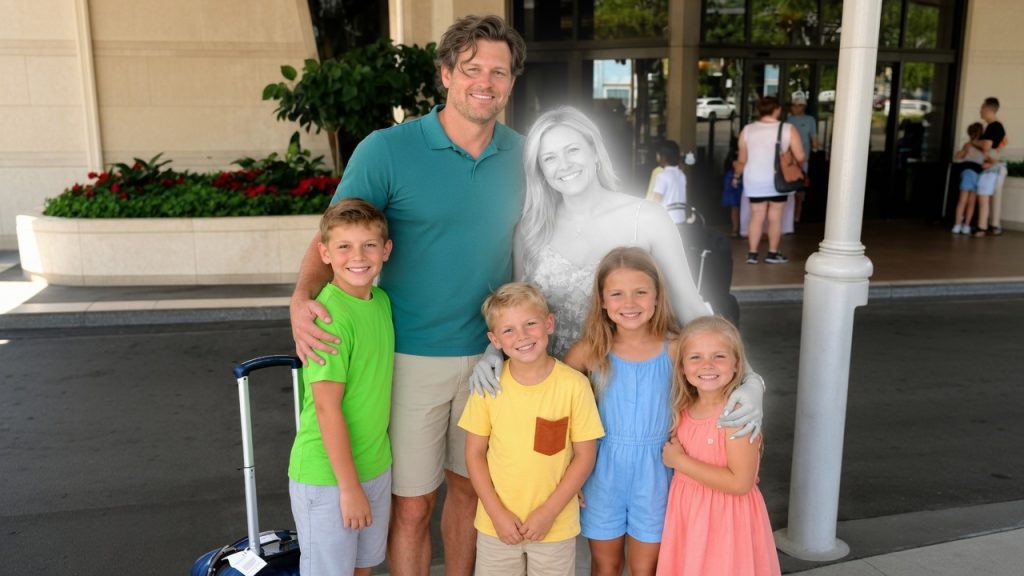
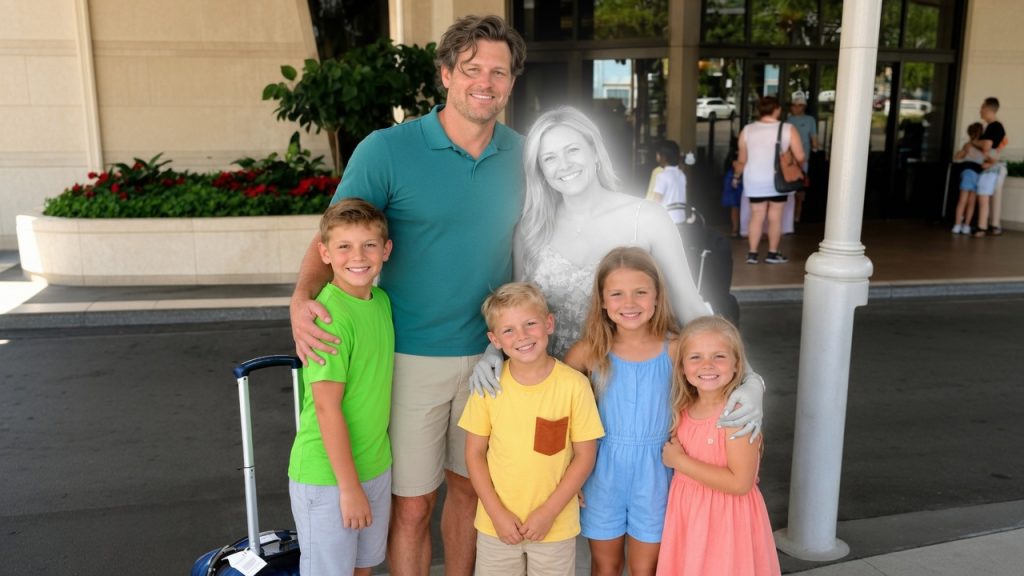
A picture of Sarah with all four children on the front porch, taken the summer before she died.
She is laughing in it.
Jeremy is on her hip.
Julie is rolling her eyes.
Joyce is making a silly face.
Joan is pretending not to smile.
And I am standing beside them, looking at Sarah instead of the camera.
Back then, I thought that photo showed my whole life.
I know better now.
It showed only the part I was lucky enough to see.
Sarah had shadows.
Secrets.
Regrets.
But she also had courage.
And in the end, the box she left behind did not destroy our family.
It saved it from becoming another generation built on silence.
I still wake up some mornings reaching for her.
I still turn sometimes to tell her something funny Jeremy said.
I still pause at the grocery store when I see her favorite tea.
Grief doesn’t leave.
It becomes part of the house.
Part of the morning routine.
Part of the way you breathe.
But so does love.
And every day, when I look at our children, I understand what Sarah was really asking of me in that first letter.
Not to solve every mystery.
Not to punish every wrong.
Not even to forgive before I was ready.
She was asking me to choose truth over comfort.
Love over fear.
The living over the secrets of the dead.
So that is what I do.
I raise our children.
I tell them stories about their mother.
I let them ask hard questions.
I answer as honestly as I can.
And whenever Jeremy looks at Matthew and notices the resemblance between them, I no longer feel afraid.
I feel grateful.
Because somewhere in all that pain, something lost was returned.
Not perfectly.
Not easily.
But truly.
And if Sarah can see us now, I hope she knows this:
I opened the box.
I found the truth.
And I am still here, loving the family she trusted me to protect.
THE END! THANK YOU FOR READING!