
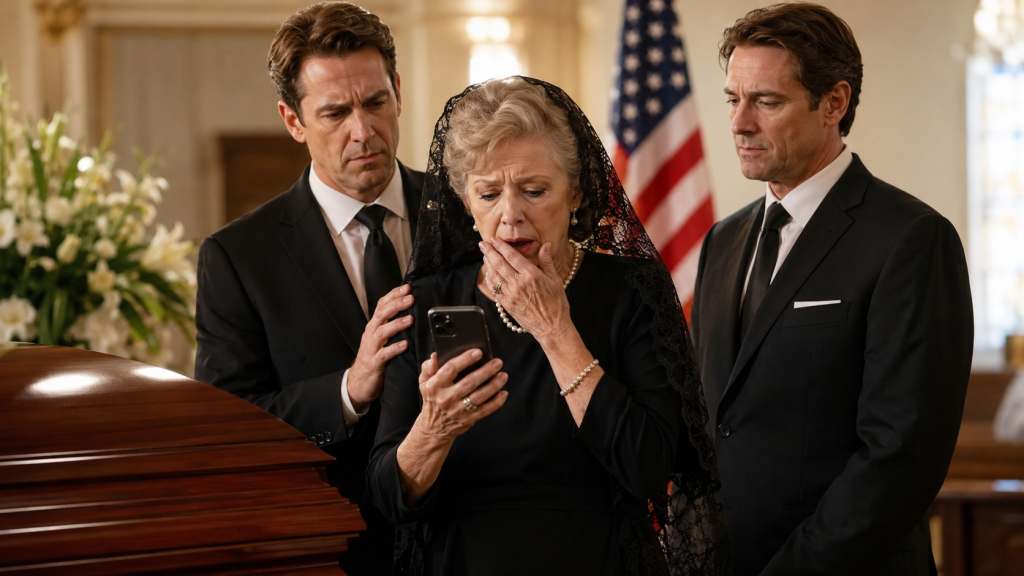
Right in the middle of my husband’s funeral, while my sons pretended to cry next to the casket, I received a text message: “I’m alive. Don’t trust them.” At first, I thought grief had finally broken something inside me.
I was standing in the front pew of St. Matthew’s Church, dressed in black from my veil to my shoes, with a closed mahogany casket less than ten feet away from me.
Inside it, everyone believed, was my husband. Robert Whitmore. The man I had loved for forty-three years. The father of my two sons. The owner of Whitmore Properties.
The man whose hand I had held through storms, surgeries, business failures, family betrayals, and every ordinary morning in between.
The pastor’s voice echoed gently through the church as he spoke about Robert’s generosity, his discipline, his devotion to family.
I almost laughed at that last word.
Family.
Because the two men standing beside the casket were my sons, Richard and Harrison, and something about them had felt wrong from the moment Robert died.
They stood with their heads bowed.
Richard held a folded white handkerchief in one hand.
Harrison kept his arm around his wife, though his eyes stayed dry.
Too dry.
Too steady.
Too watchful.
A mother knows her children’s grief.
She knows the shape of it, the sound of it, the way it changes their breathing.
And what I saw on my sons’ faces was not grief.
It was waiting.
My phone vibrated again in my gloved hand.
I should not have looked.
A widow should not check messages during her husband’s final prayer.
But something inside me had already started screaming.
I lowered my eyes.
The number was unknown.
The message was still open on the screen.
“I’m alive. Don’t trust them.”
My fingers turned numb.
For one terrible second, I thought someone was playing a cruel joke.
A business rival.
A scammer.
Some sick person who had seen the obituary and wanted to torture a grieving widow.
Then a second message arrived.
“Theresa, don’t cry over that body. I’m not in there.”
My knees nearly gave out.
Theresa.
No one called me Theresa except Robert when he was serious.
To everyone else, I was Terry.
To my friends, to my sisters, even to my sons.
But when Robert wanted my full attention, when he wanted me to know that every word mattered, he called me Theresa.
I gripped the back of the pew so hard my fingers ached.
My eyes lifted slowly to the casket.
Closed.
Polished.
Covered in white roses.
A portrait of Robert stood beside it, smiling with that calm, confident expression he had worn all his life.
The same gray eyes.
The same silver hair.
The same blue tie I had chosen for the funeral home.
Or thought I had chosen.
Suddenly, I could not remember seeing his face clearly after he died.
Richard had told me the body was badly affected by the sudden collapse and that I should remember his father as he was.
Harrison had said viewing him would only cause unnecessary pain.
The funeral director had looked uncomfortable, but he had not argued.
I had trusted my sons.
God help me.
I had trusted my sons.
With trembling fingers, I typed under the veil.
Who are you?
The reply came immediately.
“It’s Robert. Don’t trust our sons.”
The church blurred.
The pastor asked everyone to bow their heads.
People around me lowered their faces in prayer.
Richard glanced at me.
His expression softened instantly.
“Everything okay, Mom?” he whispered.
I clutched the phone to my chest.
“Yes,” I said, forcing my voice not to crack. “I just got a little dizzy.”
His hand touched my elbow.
Cold.
Controlled.
“You’ve been through too much,” he said. “After this, Harrison and I are taking you home.”
Taking me.
Not asking.
Harrison stepped closer on my other side.
“You shouldn’t be alone tonight, Mom.”
His voice was gentle enough for the people around us to hear.
But beneath it was something hard.
A warning wrapped in concern.
I nodded because I did not know what else to do.
The pastor finished the prayer.
The choir began a hymn.
And all I could hear was my husband’s impossible message repeating in my head.
“I’m alive.”
“Don’t trust them.”
The funeral ended in a haze.
People hugged me.
Women pressed tissues into my hand.
Men who had done business with Robert told me he had been a legend.
Neighbors said I was strong.
Old friends said my boys would take good care of me.
I nodded at all of them like a woman made of wax.
But every time someone said “your boys,” my stomach twisted.
Richard and Harrison never left my side.
Not for a second.
They guided me through the crowd, answered questions before I could, and kept touching my elbow as if I might collapse.
Or run.
At the wake, held in the reception hall behind the church, people ate small sandwiches and spoke in soft voices.
Robert’s portrait sat near the guest book.
The casket had already been taken away.
I watched Richard laughing quietly with our family attorney, Mr. Bellamy.
I watched Harrison whispering into his phone by the window.
I watched their wives sit together, expressionless, sipping white wine as if this were a business luncheon instead of a funeral.
My phone buzzed again.
I turned away from the room and pretended to adjust my veil.
The message contained a photo.
Robert’s desk.
The old mahogany one in his study.
The desk he had inherited from his father, with carved corners and secret-looking drawers I had always teased him about.
In the photo, a red circle had been drawn around the lower left molding.
The caption said:
“I hid the real will there. Press the left corner. Don’t open anything in front of them.”
My breath stopped.
The real will.
I looked across the room.
Richard was still speaking with Mr. Bellamy.
Harrison’s eyes suddenly lifted and found mine.
He smiled.
Not sadly.
Not lovingly.
He smiled like a man who had just seen a lock click shut.
I slipped the phone into my purse.
When the wake ended, Richard came to me with my coat.
“We’ll go home now,” he said.
“I can drive myself.”
“Nonsense,” Harrison said quickly. “You’re exhausted.”
“I said I can drive myself.”
For the first time that day, both of my sons went still.
Richard’s mouth tightened.
Only for a second.
Then he smiled again.
“Of course, Mom,” he said. “But we’ll follow you. Just to make sure you get there safely.”
There it was again.
Safety.
Concern.
Care.
All the soft words men use when they are building a cage.
The ride home to Greenwich felt longer than it should have.
The sky had turned the color of wet ash.
Rain began to streak down the windshield as I drove through familiar streets that suddenly looked foreign.
Robert and I had lived in that house for thirty-one years.
We had raised our sons there.
We had hosted Christmas dinners, charity events, graduation parties, business dinners, anniversary brunches, and one terrible Thanksgiving when Richard had announced he wanted nothing to do with the family business unless he controlled it.
Robert had laughed then, thinking it was youthful arrogance.
But I remembered the look in Richard’s eyes.
Hunger.
Harrison had always been quieter.
More careful.
He rarely demanded anything openly.
He simply stood behind Richard, watching, waiting, agreeing at exactly the right moments.
Robert used to say Richard was the hammer and Harrison was the blade.
I used to tell him not to speak that way about our children.
Now I wondered how long Robert had seen what I refused to see.
When I pulled into the driveway, Richard’s black Mercedes stopped behind me.
Harrison’s SUV followed.
They entered the house with me without asking.
The moment I stepped inside, grief hit me for real.
Robert’s reading glasses were on the side table.
His slippers were still beneath his chair.
The book he had been reading lay open on the armrest, one page folded down.
His coffee mug sat in the kitchen beside the sugar bowl.
The house still smelled faintly of him.
Pipe tobacco, cedar soap, old paper, and coffee.
I nearly broke then.
Not because of the funeral.
Not because of the casket.
Because his life was still everywhere.
Interrupted.
Not ended.
Richard removed his coat and draped it over a chair as if he owned the place already.
Harrison walked toward Robert’s study.
I followed immediately.
“What are you doing?”
He turned.
His face was all innocence.
“Looking for Dad’s insurance papers. Bellamy needs some documents.”
“Tonight?”
Richard came up behind me.
“Mom, there will be a lot to handle in the next few days. Dad left things complicated.”
“Robert never left anything complicated.”
Richard’s eyes narrowed.
“People change.”
I held his gaze.
“So do sons.”
Silence fell.
Harrison let out a small laugh.
“We’re all upset. Let’s not do this tonight.”
They stayed for almost two hours.
They opened drawers.
Made phone calls.
Whispered in the kitchen.
I sat in the living room pretending to be too tired to move, but I listened.
At one point, Harrison said, very low, “We need to do it before she starts asking questions.”
Richard replied, “I’m bringing the doctor tomorrow. With her grief and her age, it’ll be easy.”
My blood turned cold.
My age.
My grief.
Easy.
I was seventy-one years old, not helpless.
But I understood what they meant.
A grieving widow.
Confused.
Unstable.
Maybe incompetent.
Maybe unable to manage the estate.
Maybe in need of care.
Care chosen by her sons.
Care that would remove her from the house.
From the papers.
From the truth.
When they finally left, Richard kissed my forehead.
“You need to rest,” he said.
Harrison squeezed my shoulder.
“Don’t go through Dad’s things alone. It won’t be good for you.”
“I won’t,” I lied.
They left through the front door.
I watched their headlights disappear down the driveway.
Then I locked the door.
Then I locked the deadbolt.
Then I went to the back door and locked that too.
My hands shook so hard I could barely climb the stairs.
Robert’s study waited at the end of the hall.
The door was partly open.
Inside, everything was exactly as he had left it.
Green banker’s lamp.
Leather chair.
Wall of books.
Framed photo of us in Paris on our thirtieth anniversary.
And the mahogany desk.
I turned on the lamp.
Then I remembered the message.
“Don’t open anything in front of them.”
I turned the lamp off again.
Only the hall light remained, spilling weak gold across the carpet.
I knelt beside the desk.
My knees screamed in protest, but fear gave me strength.
I ran my fingers along the lower left molding.
At first, nothing happened.
I pressed harder.
Click.
A small hidden compartment popped open.
For a moment, I just stared.
Forty-three years married, and Robert had still managed to surprise me.
Inside was a folded letter, a USB drive, a small brass key, and a thick manila envelope with my name written across it in Robert’s handwriting.
Theresa.
My breath broke.
I picked up the letter first.
The paper trembled in my hands.
“My dearest Theresa,
If you are reading this, then I was right to be afraid.
I have discovered things about Richard and Harrison that I never wanted to believe. They have been moving money through shell accounts, pressuring employees, and trying to force changes to the company structure. Worse, I overheard them speaking with Dr. Lang about you. They asked how difficult it would be to have a grieving widow declared mentally unfit if she began resisting financial decisions.”
I pressed the letter against my mouth.
Dr. Lang.
Our family physician.
A man who had been invited to our dinner table.
A man who had sent flowers when Robert “died.”
The letter continued.
“They also asked about my life insurance and whether a closed-casket funeral would raise questions if death was certified quickly. I do not yet know how far they are willing to go, but I know enough to prepare.
Do not sign anything.
Do not take any medication they give you.
Do not eat or drink anything they bring.
The will Bellamy has been shown is not the final will. I suspected Bellamy might be under pressure or compromised, so I created a new document with another attorney and secured copies in three places. The first is inside this envelope. The second is with William. The third will appear when needed.
If I am truly gone, protect yourself.
If I am not, follow the messages.”
If I am not.
The words seemed to lift off the paper.
Before I could read more, I heard a sound downstairs.
A car door.
Then another.
I froze.
Through the study window, I saw headlights sweeping across the driveway.
Richard’s Mercedes.
Harrison’s SUV.
They were back.
Richard stepped out carrying a white pastry box.
Harrison held a cardboard tray of coffee.
Behind them walked a man in a white medical coat.
Dr. Lang.
I backed away from the window.
My phone buzzed again.
“Don’t open the door.”
The doorbell rang.
Once.
Twice.
Three times.
“Mom!” Richard called from below. “It’s us. We brought you dinner.”
I stood in the dark study, clutching Robert’s letter to my chest.
Harrison knocked harder.
“Mom, don’t make this difficult. The doctor just wants to check on you.”
The doctor.
At night.
After they had whispered about making it easy.
Richard’s voice changed.
“Theresa, open the door.”
Not Mom.
Not even Mother.
Theresa.
My own son had stopped pretending.
I rushed to the wall safe behind Robert’s painting.
My fingers shook as I entered the code.
Our wedding date.
The safe opened.
Inside was Robert’s small revolver, still in its case.
I did not know how to use it well.
Robert had taken me to a range twice, years ago, and I had hated every second of it.
But when I wrapped my fingers around it, I felt just enough courage return to move.
The pounding downstairs grew louder.
Then glass shattered.
A small window near the side entrance.
They were breaking in.
My phone buzzed again.
“Leave through the service door. William is waiting.”
William.
Our old driver.
He had worked for Robert for nearly twenty years.
Two months before Robert died, Richard had fired him, claiming William had been stealing fuel and company time.
Robert had been furious but strangely quiet afterward.
Now I understood why.
I grabbed the manila envelope, the USB drive, the brass key, and Robert’s letter.
I tucked them inside my coat.
Then I slipped down the back staircase.
My sons’ voices echoed through the front hall.
“Mom!”
“Theresa!”
“Where are you?”
Dr. Lang’s voice followed.
“She may be disoriented. Speak calmly.”
Disoriented.
I moved through the kitchen.
On the island sat Robert’s coffee mug.
The one he had used the morning before his supposed heart attack.
Beside it was the sugar bowl.
And behind the sugar bowl, half-hidden in shadow, was a tiny empty vial.
I had not noticed it earlier.
I picked it up.
It smelled bitter.
Chemical.
Wrong.
My phone vibrated.
“Did you see what they used?”
Tears filled my eyes so suddenly I could barely see.
I typed:
Where are you?
No answer.
Footsteps moved toward the kitchen.
I heard Harrison say, “Check the back.”
I ran.
The service door opened into a narrow stone path along the side of the house.
Rain soaked my veil immediately.
At the end of the path, near the dark alley behind the property, an old yellow taxi waited with its headlights off.
The driver’s window rolled down.
William’s face appeared, older than I remembered, but steady.
“Get in, Mrs. Theresa.”
I stumbled toward him.
“William, do you know where Robert is?”
He looked past me.
Richard had just stepped onto the back patio.
His face twisted when he saw me.
“Mom! Stop!”
Harrison came out behind him.
“Don’t let her leave!”
I climbed into the taxi.
William hit the gas before I had fully closed the door.
Richard’s shout vanished behind us.
The house disappeared into the rain.
I looked back once.
The mansion that had held my marriage, my children, my life, and my lies stood glowing in the dark like a beautiful trap.
My phone vibrated again.
“Go to St. Agnes Chapel. William knows the way.”
I lifted my eyes to the rearview mirror.
“William,” I whispered, “is my husband alive?”
His jaw tightened.
“Mr. Robert told me not to answer until you saw him yourself.”
I began to cry then.
Not loudly.
Not the kind of crying people expect from widows.
Just a silent collapse inside my chest.
Because hope is more terrifying than grief.
Grief at least has a shape.
Hope opens every door at once.
The taxi drove through back streets and narrow roads until the town lights thinned.
St. Agnes Chapel sat on a hill outside Greenwich, an old stone building Robert had once donated money to restore.
The main doors were locked.
But William drove around to the back, where a basement window glowed faintly.
He helped me out of the taxi.
My legs were numb.
Rain slid beneath my collar.
The envelope inside my coat pressed against my ribs like a second heartbeat.
William knocked three times on the basement door.
A pause.
Then two knocks answered from inside.
The door opened.
And there stood Robert.
Alive.
Pale.
Thinner.
With a bandage near his temple and bruising along one cheek.
But alive.
For several seconds, I could not move.
My mind refused to accept him.
The funeral.
The casket.
The portrait.
The messages.
The letter.
The body.
All of it crashed together until the world tilted.
Robert reached for me.
“Terry.”
That voice.
That one word broke me.
I fell into his arms.
He held me tightly, though I felt how weak he was.
His body trembled as badly as mine.
“You were in a casket,” I sobbed.
“No,” he whispered into my hair. “Someone was in a casket. Not me.”
I pulled back and hit his chest with both hands.
Not hard.
Not enough to hurt him.
Just enough to prove he was real.
“How could you do this to me?”
His eyes filled.
“I am sorry. I am so sorry. But I had no choice.”
“No choice?” I nearly shouted. “I buried you today.”
He closed his eyes.
“I know.”
The pain in his face silenced me.
William shut the door behind us and locked it.
Inside the chapel basement, a small room had been turned into a hiding place.
There was a cot, a table, a laptop, medical supplies, bottled water, and stacks of documents.
An elderly woman in a nurse’s uniform sat beside the table.
She rose when I entered.
“This is Margaret,” Robert said. “She worked for my father years ago. She has been caring for me.”
“Caring for you from what?” I asked.
Robert guided me to a chair.
Then he sat across from me as if the act cost him strength.
“I did have an attack that night,” he said. “But not a natural one.”
I touched the vial in my coat pocket.
“They poisoned you.”
He nodded slowly.
“I began suspecting something weeks before. Small things. Missing files. Strange calls. Richard pushing for power of attorney. Harrison asking questions about insurance policies. Then I overheard them speaking in the study.”
“With Dr. Lang?”
“Yes.”
My stomach turned.
“They discussed a medication that could mimic cardiac distress in someone my age if given in the right dose. I did not hear enough to accuse them, but I heard enough to prepare.”
“Why didn’t you come to me?”
His face twisted with guilt.
“Because I thought you would confront them.”
I opened my mouth.
Then closed it.
He knew me too well.
“I would have.”
“And they would have known I suspected. They might have moved faster. Or they might have harmed you first.”
The room went cold.
Robert reached across the table and took my hand.
“Terry, they weren’t only after me. They needed you controlled afterward.”
I thought of Richard’s hand on my elbow.
Harrison’s order disguised as concern.
Dr. Lang at my door.
The pastry box.
The coffee.
I pulled my hand back and pressed it to my mouth.
“My God.”
Robert continued.
“That night, I switched my coffee when I noticed the taste was off. I still must have swallowed enough to collapse. William was nearby because I had asked him to watch the house. He got to me before the ambulance took me away.”
William stepped forward.
“Mr. Robert was breathing, but barely. The men your sons called were not the usual emergency responders. One of them owed Dr. Lang.”
I stared at him.
“And the body?”
Robert’s voice lowered.
“A man from a private morgue. No family. No one to claim him. Dr. Lang arranged the paperwork. They were in too deep by then. They needed me declared dead quickly.”
I felt sick.
“My sons put a stranger in your casket?”
Robert nodded.
“They thought they did. They thought I was gone before William moved me. But William had friends at the funeral home. One of them helped us understand what had happened.”
The basement seemed to shrink around me.
I had spent hours beside that casket.
Crying for my husband over the body of a stranger whose name I did not know.
I whispered, “That poor man.”
Robert bowed his head.
“Yes. He deserves dignity too. We will make that right.”
For a moment, neither of us spoke.
Then I remembered the envelope.
I pulled it from my coat, along with the USB drive and the vial.
Robert’s eyes sharpened when he saw the vial.
“You found it.”
“In the kitchen.”
“That may be the piece we needed.”
William placed a small evidence bag on the table and carefully took it from me using a cloth.
Robert opened the laptop.
His hands moved slowly, but his mind was clear.
“This USB contains footage from the study and kitchen. I installed small cameras after I overheard them.”
The screen flickered.
Then Richard appeared in black-and-white security footage, standing in our kitchen.
He looked younger in the video.
Not by age.
By confidence.
He glanced toward the hall, opened a small vial, and poured clear liquid into Robert’s coffee mug.
My heart clenched.
A second clip showed Harrison in Robert’s study, speaking to Dr. Lang.
There was no sound at first.
Then Robert clicked a file.
Audio played.
Harrison’s voice filled the room.
“After Dad is gone, Mom will resist. She always does what he wanted.”
Dr. Lang replied, “Acute grief can create confusion. If she becomes paranoid or unstable, there are steps.”
Richard’s voice cut in.
“We just need her out of the house long enough to finalize everything.”
My body went numb.
Finalize everything.
I had changed their diapers.
Sat through their fevers.
Baked their birthday cakes.
Held them when girls broke their hearts.
And now they were discussing me as if I were an obstacle.
A chair in the wrong room.
A problem to be moved.
Robert stopped the audio.
“I didn’t want you to hear that yet.”
“I needed to.”
“Terry—”
“No,” I said, my voice steadier than I felt. “I needed to know exactly who they are.”
He looked at me with grief deeper than anything I had seen at the funeral.
“They are our sons,” he whispered.
I swallowed hard.
“They stopped being our sons when they decided we were worth more dead or silent.”
Robert looked down.
For the first time in forty-three years, I saw my husband truly defeated.
Not by business.
Not by age.
But by fatherhood.
By the unbearable truth that the children he had loved had become strangers.
I rose and went to him.
He leaned against me.
For a while, we simply held each other in that hidden chapel basement while the life we knew burned quietly behind us.
By dawn, Robert had made three calls.
One to the private attorney who had prepared the real will.
One to a retired judge who owed him a favor.
And one to a detective Robert trusted more than the police officers our sons might have already influenced.
At seven fifteen in the morning, Detective Mara Lewis arrived at St. Agnes Chapel with two officers and a medical examiner.
She was a tall woman with silver-threaded hair and the expression of someone who had heard every lie men could tell and believed none of them.
She listened to Robert.
She watched the footage.
She examined the vial.
Then she turned to me.
“Mrs. Whitmore, did your sons or Dr. Lang attempt to enter your house against your wishes last night?”
“Yes.”
“Did they bring food or drink?”
“Yes.”
“Did you consume any of it?”
“No.”
“Good.”
Robert handed her the documents.
“The real will, revised corporate structure, and evidence of financial transfers.”
Detective Lewis looked through them.
Then she said the words I did not know I had been waiting to hear.
“We move now.”
I rode with Robert in an unmarked car.
He wore a hat pulled low and a coat that hid most of his face.
William followed behind with Margaret.
The closer we got to the house, the more my hands shook.
Robert covered them with his own.
“You don’t have to go inside.”
“Yes,” I said. “I do.”
The house looked peaceful in morning light.
Too peaceful.
No one passing by would have guessed that evil had sat at its kitchen island and poured poison into a coffee mug.
Richard’s Mercedes was in the driveway.
Harrison’s SUV too.
Dr. Lang’s car was parked near the side entrance.
They were all inside.
Detective Lewis knocked once.
Then she entered with officers behind her.
I heard voices rise immediately.
Richard first.
“What is this?”
Harrison next.
“You can’t just come in here.”
Then Dr. Lang, nervous.
“Detective, there must be some misunderstanding.”
Robert stepped into the foyer.
Silence crashed through the house.
Richard saw him first.
His face emptied.
Completely.
As if someone had erased the man and left only fear behind.
Harrison backed into the wall.
Dr. Lang dropped the folder he had been holding.
Papers scattered across the marble floor.
Robert removed his hat.
“Good morning, sons.”
Richard opened his mouth.
No sound came out.
Harrison recovered first.
“Dad,” he whispered. “Thank God. We thought—”
“Don’t,” Robert said.
One word.
Quiet.
Deadly.
Harrison stopped.
Richard looked at me.
“Mom, you knew?”
I stepped beside Robert.
“I know everything now.”
His face changed instantly.
The fear became calculation.
“Mom, listen to me. Dad is confused. He’s been ill. We were trying to protect the family.”
Detective Lewis said, “Richard Whitmore, Harrison Whitmore, Dr. Samuel Lang, you are not required to answer any questions at this time.”
Richard’s face went red.
“You can’t be serious.”
Harrison pointed at me.
“She’s unstable. She ran from the house last night. She’s been receiving messages from an unknown number. Ask her. She’s grieving and confused.”
There it was.
The plan.
Still alive.
Still reaching for me.
I looked at him.
For a moment, I saw the little boy he used to be, standing in the kitchen with jam on his chin, asking me to tie his shoes.
Then he was gone.
Only this man remained.
This stranger wearing my son’s face.
“I am not confused,” I said. “I heard you. I saw the vial. I read your father’s letter. And I watched the footage.”
Richard’s eyes flicked toward Dr. Lang.
That tiny movement told the detective everything.
Officers moved forward.
Harrison shouted first.
Richard tried to pull away.
Dr. Lang insisted he had only followed medical procedure.
But none of it mattered.
Not anymore.
Their voices echoed through the foyer as handcuffs closed around their wrists.
My sons were taken out the front door of the house where I had once taught them to walk.
Reporters arrived by noon.
By evening, the story was everywhere.
Real estate heirs accused in plot against father.
Family doctor under investigation.
Widow nearly declared incompetent.
Funeral held for living millionaire.
The headlines were ugly.
The truth was uglier.
But the quiet afterward was worst of all.
Robert and I returned to the house two days later under police supervision.
The first night back, neither of us slept.
We sat in the kitchen until sunrise, staring at the coffee mug that was no longer there because the police had taken it.
“I keep thinking of them as babies,” I said.
Robert’s eyes were fixed on the window.
“So do I.”
“Did we fail them?”
He looked at me then.
The question had been living in him too.
Maybe for years.
“We loved them,” he said slowly. “We gave them everything we knew how to give.”
“Maybe too much.”
“Maybe.”
The honesty hurt.
But it also freed something.
Richard and Harrison had grown up surrounded by wealth, expectation, and Robert’s shadow.
They had wanted the kingdom without earning the burden of it.
They had mistaken inheritance for entitlement.
And somewhere along the way, love became less important than ownership.
The investigation widened.
Company accounts were frozen.
Employees came forward.
Old assistants admitted they had been pressured to alter documents.
A junior accountant revealed suspicious transfers Harrison had approved.
Dr. Lang’s nurse admitted she had seen medication samples disappear from a locked cabinet.
Mr. Bellamy, our longtime attorney, claimed he had been misled, but evidence later showed he had accepted money to present an outdated will.
One by one, the polished walls around my sons cracked.
And behind them was rot.
The real will was filed with the court.
In it, Robert had done something that shocked everyone.
He had not disinherited our sons completely.
Not at first.
Instead, he had placed their shares into a protected trust they could access only after an independent review, counseling, restitution, and a decade of monitored financial responsibility.
But after the attempted crimes became clear, the court froze those interests pending trial.
Most of Robert’s voting power and assets were transferred into a foundation we had once discussed creating together.
The Whitmore Foundation for Elder Protection and Financial Abuse Prevention.
The irony was not lost on me.
At the first court hearing, I saw Richard and Harrison again.
They wore suits.
Not mourning suits now.
Defense suits.
Richard looked angry.
Harrison looked smaller than I remembered.
When they brought them into the courtroom, Harrison searched for my eyes.
I almost looked away.
But I did not.
I had hidden from the truth long enough.
Richard leaned toward his attorney.
Harrison kept staring at me.
Then he mouthed:
Mom.
The word struck me like a stone.
Robert’s hand closed around mine.
I did not respond.
Not because I hated him.
That would have been easier.
I did not respond because some words should not be used as keys after you have burned down the house.
The trial took months.
There were delays, motions, sealed documents, expert witnesses, financial records, medical testimony, and enough family shame to fill every empty room in our mansion.
But the evidence was strong.
The footage.
The vial.
The forged documents.
The doctor’s notes.
William’s testimony.
Margaret’s medical records.
And Robert himself.
Alive.
Steady.
Unwilling to let power silence truth.
When Robert took the stand, the courtroom became so quiet I could hear the scratch of the clerk’s pen.
The prosecutor asked him how it felt to learn his sons had plotted against him.
Robert looked at Richard.
Then Harrison.
His voice did not shake.
“It felt like burying two children who were still breathing.”
Richard looked away.
Harrison cried.
I did not know if the tears were guilt, fear, or performance.
Maybe all three.
When it was my turn, I spoke about the funeral.
The messages.
The closed casket.
The way Richard held my arm.
The way Harrison ordered me to open the door.
The way Dr. Lang stood on my porch with coffee and pastries after my sons had discussed having me declared incompetent.
The defense attorney tried to make me look fragile.
He asked if grief could have affected my memory.
I smiled at him.
A small smile.
The kind Richard had once given me.
Only mine was sharper.
“Grief did not affect my memory,” I said. “It improved it. I remember every detail of the night my children stopped pretending to love me.”
No one spoke after that.
The verdict came in late autumn.
Guilty on multiple charges.
Conspiracy.
Financial fraud.
Attempted poisoning.
Forgery.
Elder exploitation.
Dr. Lang lost everything before sentencing even began.
Mr. Bellamy too.
Richard stood rigid as the verdict was read.
Harrison collapsed into his chair.
I felt no joy.
People expect justice to feel like victory.
It does not.
Not when the guilty are your children.
Justice felt like a door closing in a house already empty.
Afterward, Robert and I moved out of the Greenwich mansion.
People thought we would never leave.
That house had been a symbol for decades.
But symbols can become prisons.
We sold it and bought a smaller home near the water, with wide windows, a garden, and no rooms large enough for secrets to echo.
William came back to work for us, though we told him he was family now, not staff.
Margaret visited every Sunday.
Detective Lewis became, unexpectedly, a friend.
Robert recovered slowly.
His body healed faster than his heart.
Some mornings, I found him sitting with old photo albums open, touching pictures of Richard and Harrison as boys.
I never told him to stop.
A parent’s grief has no schedule.
Mine had none either.
I mourned them in strange ways.
I mourned Richard when I saw a boy in a school uniform carrying a briefcase too big for him.
I mourned Harrison when I heard piano music, because he had played beautifully as a child.
I mourned the sons I raised.
I feared the men they became.
And I learned that both truths could live inside me at once.
Months later, a letter arrived from Harrison.
Robert left it unopened on the kitchen table for three days.
Finally, he asked if I wanted to read it.
I did.
The handwriting was messier than I remembered.
Harrison wrote that he was sorry.
He wrote that Richard had pushed hardest.
He wrote that he had been afraid to lose everything.
He wrote that fear made him weak.
He wrote that he still loved us.
I read the letter twice.
Then I placed it back on the table.
Robert watched me.
“What do you think?”
“I think he is sorry now that the door locked behind him.”
Robert closed his eyes.
“Yes.”
“But maybe one day he will be sorry for the right reasons.”
“Will you write back?”
I looked out at the water.
“Not today.”
And I did not.
Forgiveness, I learned, is not a performance.
It is not owed because someone finally regrets the consequences.
It is not a switch a mother flips because her child cries.
Sometimes forgiveness is a road.
Sometimes it is a locked gate.
Sometimes it is simply choosing not to let bitterness eat what remains of your life.
Robert and I began working with the foundation.
At first, I only attended meetings.
Then I started speaking.
Quietly at first.
Then more firmly.
I spoke to widows.
Retired business owners.
Elderly couples whose children had begun circling their accounts like wolves.
Women whose sons called them confused whenever they asked about money.
Men whose daughters isolated them from friends in the name of care.
I told them what I had learned.
Concern can be love.
But control often wears the same coat.
Ask questions.
Keep copies.
Trust discomfort.
Do not surrender your voice because someone younger speaks louder.
One afternoon, after a foundation event, a woman came up to me.
She was about my age, with shaking hands and pearl earrings.
“My daughter says I can’t understand my own bank statements anymore,” she whispered. “But I think she’s been moving money.”
I took her hand.
“Then we’ll find someone who can help you look.”
She began to cry.
And in that moment, all the horror of what happened found a place to become something else.
Not healing exactly.
But purpose.
A year after the funeral that was not a funeral, Robert and I returned to St. Matthew’s Church.
Not for a service.
Not for grief.
For quiet.
We sat in the same front pew where I had received the first message.
Sunlight came through the stained-glass windows, painting the floor in red and gold.
Robert reached for my hand.
“I should have told you sooner,” he said.
I looked at him.
“Yes.”
He nodded.
“I was trying to protect you.”
“I know.”
“I hurt you.”
“Yes.”
His fingers tightened.
“I am sorry, Theresa.”
There was my name again.
Not a warning this time.
A confession.
I leaned my head on his shoulder.
“I forgive you for surviving badly.”
He laughed softly, though tears stood in his eyes.
“That may be the strangest forgiveness I’ve ever received.”
“It’s the only kind I have today.”
We sat there until the church grew dim.
When we stood to leave, I looked once toward the place where the casket had been.
For a moment, I saw myself there again.
Black veil.
Shaking hands.
A phone glowing like a secret in my palm.
I thought that message had pulled me out of grief.
But really, it pulled me out of blindness.
Robert had survived.
But something else had died that day.
The illusion that family could never become dangerous.
The belief that motherhood made me immune to betrayal.
The habit of trusting soft voices over sharp instincts.
I miss who I was before that funeral.
But I respect who I became after it.
I am no longer the woman who let her sons guide her by the elbow while they planned her silence.
I am no longer the widow people expected to fold neatly into grief.
I am Theresa Whitmore.
A wife.
A mother.
A survivor.
A woman who stood beside a casket and received a message from a dead man who was not dead.
A woman who learned that sometimes the people crying beside you are waiting for you to disappear.
And sometimes the person everyone buried is the only one still trying to save your life.
💬THE END! THANK YOU FOR READING!