
Last night, my son raised his hand and hit me across the face.I did not scream.I did not cry.I only stood there in the kitchen with my hand pressed to my mouth, tasting blood, listening to the refrigerator hum as if the whole world had not just changed……More article below👇
My son, Caleb, was sixteen years old.Six feet tall.Broad-shouldered.Starting linebacker.Honor roll when he cared enough to try.The kind of boy other parents called “a good kid” because he held doors open in public and said “yes, ma’am” to teachers.
But at home, something had been changing.
At first, it was small.
A slammed cabinet.
A cruel tone.
A curse muttered under his breath when I asked him to take out the trash.
Then it grew.
He punched a hole in his bedroom wall and told me it was an accident.
He threw his phone so hard it cracked the hallway mirror.He called me stupid when I said no to a late-night party.Each time, I found a reason.
Stress.
Hormones.
Football pressure.
Missing his father.
Growing pains.
I told myself teenage anger was normal.
I told myself he was hurting, not dangerous.
I told myself love meant patience.
But love without boundaries can become permission.
And last night, when I told him he could not take my car after lying about where he had been, he looked at me with eyes I barely recognized.
“You don’t get to control me,” he said.
“I’m your mother,” I replied. “And this conversation is over.”
He laughed.
It was not a teenage laugh.
It was cold.
“You think you’re powerful because Dad left and nobody checks you.”
My chest tightened.
His father had not just left.
He had walked out when Caleb was nine, remarried two years later, and became the kind of parent who sent expensive shoes but forgot birthdays.
I had worked two jobs to keep Caleb in the same school district.
I had sat in bleachers in the rain.
I had packed meals at midnight.
I had sold my wedding ring to pay for football camp.
But in that moment, none of it mattered to him.
Only the word no mattered.
I reached for the keys on the counter.
Caleb moved faster.
His hand struck my face with a sharp crack that bounced off the kitchen walls.
For one second, neither of us moved.
My lip split against my tooth.
Blood touched my tongue.
Caleb stared at his own hand, then at me.
I thought he might fall apart.
I thought he might say sorry.
Instead, his face hardened.
“If you ever tell me no again,” he said, “you’ll regret giving birth to me.”
Something inside me broke then.
Not my love.
Never that.
But the lie I had been telling myself.
That this was a phase.
That he would grow out of it.
That I could pray, excuse, soften, and absorb enough of his rage to protect him from consequences.
I looked at my son and understood with terrible clarity that if I kept protecting him from consequences, I might raise him into a man who thought fear was respect.
So I did not argue.
I did not threaten.
I picked up the keys, walked to my bedroom, locked the door, and sat on the floor until dawn.
I held a towel to my lip.
I took photos.
I wrote down exactly what happened while the memory was still fresh.
Then I called five people.
Not because I wanted to shame him.
Because secrecy had become the place where his violence grew.
The next morning, I got up early.
My face was swollen.
My lip hurt when I breathed.
I made his favorite breakfast anyway.
French toast.
Scrambled eggs.
Turkey bacon.
Fresh orange juice.
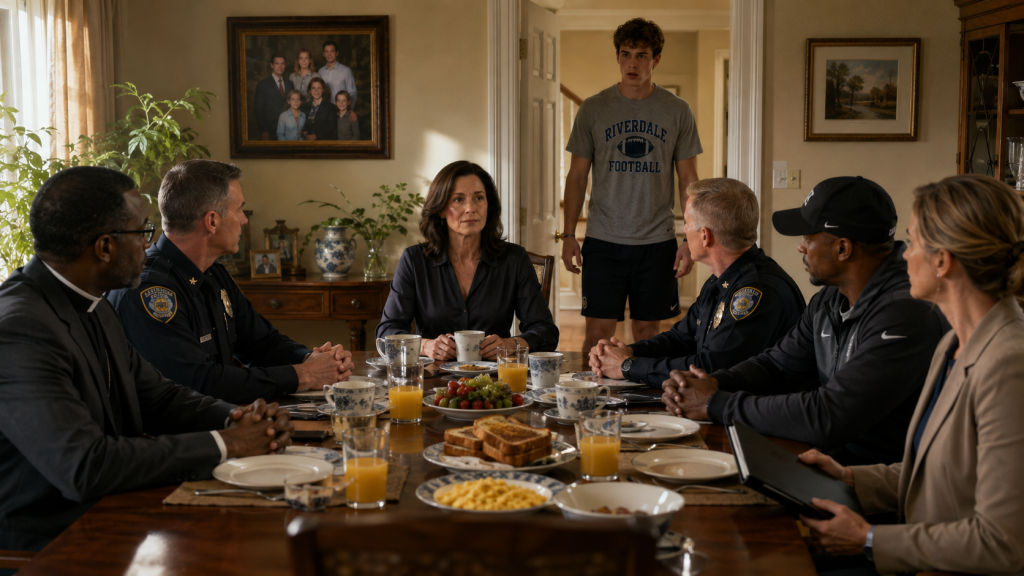
I set the dining room table with plates and napkins as if we were celebrating.
At 7:18, Caleb came downstairs.
His hair was wet from the shower.
His hoodie was wrinkled.
He walked into the kitchen like nothing had happened.
Then he saw breakfast and smirked.
“So you finally learned.”
I turned toward him.
He was still smiling when he looked past me into the dining room.
Then he froze.
Sitting quietly at the table were two police officers, our pastor, his football coach, and a family counselor.
The color drained from his face.
For the first time, he realized what happened the night before was no longer a secret between us.
I pulled out a chair.
“Sit down,” I said calmly. “Today is the day you learn that actions have consequences.”
He stared at me.
“What is this?”
His voice came out loud, but not strong.
Officer Daniels folded his hands on the table.
“This is a conversation you should have had before your mother had to call us.”
Caleb looked at the officers.
Then at Coach Reynolds.
Then at Pastor James.
His eyes landed on the counselor last, a woman named Dr. Harper, who had worked with families in crisis for twenty years.
“You called the police on me?” Caleb asked.
“I called the police because you hit me,” I said.
His jaw clenched.
“It wasn’t like that.”
I touched the split on my lip.
“Then explain what it was like.”
Silence.
Coach Reynolds leaned forward.
His disappointment seemed heavier than anger.
“You put hands on the woman who raised you,” he said. “That uniform you wear on Friday nights does not make you a man. How you treat people does.”
Caleb’s face reddened.
“You don’t know anything.”
“I know enough,” Coach said. “I know your mother has been driving you to practice after working double shifts. I know she sits alone in the stands because your father rarely shows up. I know you have been coming to practice angry for months, and I should have asked harder questions.”
Caleb looked down.
Pastor James spoke next.
“Accountability is not punishment, Caleb. It is a door back from becoming someone you cannot respect.”
Caleb snapped, “Everybody just wants to make me the bad guy.”
Dr. Harper’s voice was calm.
“No. We want to stop bad behavior before it becomes your identity.”
He looked at me then, searching for fear.
The fear he had seen before.
The fear I used to hide under patience.
I gave him none.
I pointed again to the chair.
“Sit.”
For once, he obeyed.
The room stayed quiet while he sat down.
Officer Daniels explained things plainly.
Because Caleb was a minor, because this was a first reported incident, and because I had requested intervention rather than immediate removal, there would be a safety plan.
But the officer made the boundaries clear.
If Caleb threatened me again, hit me again, destroyed property in anger, or refused the plan, the next step would be legal action.
No warning.
No family debate.
No “boys will be boys.”
Caleb’s hands curled into fists on the table.
The second officer noticed.
So did I.
Dr. Harper placed a folder in front of him.
“There will be anger management. Family therapy. Individual counseling. A written safety agreement. Your mother’s bedroom door gets a new lock. Your access to the car is suspended. Your phone stays downstairs at night. You will attend school, practice, therapy, and home. Nothing else until trust is rebuilt.”
Caleb’s eyes widened.
“That’s insane.”
“No,” I said. “What’s insane is a mother wondering if her own son will hit her again.”
His mouth opened.
No words came.
For the first time that morning, the anger cracked.
Underneath it was something younger.
Something scared.
“You’re ruining my life,” he whispered.
I felt that sentence in my chest.
A year ago, it would have made me back down.
That morning, it only made me sad.
“No,” I said. “I’m saving it before you ruin someone else’s.”
His shoulders dropped.
He stared at the table.
Then, in a voice so small I almost did not hear it, he said, “I didn’t mean to hit you.”
My throat tightened.
“But you did.”
His eyes filled.
“I was mad.”
“I know.”
“I don’t know why I get like that.”
“That is why we are here.”
Tears slipped down his face.
He wiped them angrily, embarrassed to cry in front of men he respected.
Coach Reynolds said, “Crying does not make you weak. Hitting your mother does.”
Caleb broke then.
Not dramatically.
No performance.
He just folded forward, elbows on the table, hands over his face.
“I’m sorry,” he said.
I wanted to run to him.
Every motherly instinct in me wanted to smooth his hair, hold him, tell him it was okay.
But it was not okay.
And if I made it okay too quickly, he would not understand.
So I stayed in my chair.
“I love you,” I said. “And I will not let you hurt me.”
He cried harder.
The weeks that followed were not easy.
People like to imagine accountability as one powerful morning and a clean ending.
It was not.
Caleb was angry after everyone left.
Ashamed.
Silent.
Then furious again.
He said I embarrassed him.
He said I made him look like a criminal.
He said Coach would never see him the same.
I told him the truth.
“Good. Maybe that will help you see yourself honestly.”
At first, therapy was a battle.
He sat with his arms crossed and answered with one word.
Fine.
No.
Maybe.
Whatever.
But Dr. Harper was patient in the way professionals can be patient when mothers are too exhausted.
She taught him words for what lived under his rage.
Abandonment.
Shame.
Fear.
Rejection.
Control.
He hated those words at first.
Then he began to use them.
One night, three weeks after the breakfast meeting, Caleb stood in the kitchen doorway while I washed dishes.
“Mom?”
I turned.
He looked smaller somehow.
“I think I get mad at you because Dad left and you stayed.”
I shut off the water.
He stared at the floor.
“It doesn’t make sense.”
“It does,” I said softly. “It isn’t fair, but it makes sense.”
His voice cracked.
“He gets to disappear and still be the hero when he shows up with money. You’re always here, so I take everything out on you.”
I leaned against the sink.
“That may explain it, Caleb. It does not excuse it.”
“I know.”
It was the first time he said those words without resentment.
Two months later, his father called.
Not to apologize.
To complain.
He had heard from Caleb that there were police officers at our house.
He accused me of being dramatic.
He said I was damaging his son’s future.
I put the phone on speaker so Caleb could hear.
Then I said, “Your son hit me. His future depends on him learning that is unacceptable.”
His father scoffed.
“He’s a boy. Boys get physical.”
Before I could answer, Caleb took the phone.
“No,” he said. “Men control themselves.”
The line went quiet.
Caleb handed the phone back to me and walked upstairs.
I ended the call.
Then I sat at the kitchen table and cried.
Not because everything was fixed.
Because something had shifted.
Slowly, our house changed.
The hole in Caleb’s wall was repaired, but he paid for the materials from his weekend job.
He wrote apology letters to me, his coach, and himself.
He lost driving privileges for three months.
He missed two parties he desperately wanted to attend.
He learned to stop mid-argument and say, “I need ten minutes.”
Sometimes he still slammed doors.
Sometimes I still flinched.
Healing does not erase the body’s memory overnight.
But he never raised his hand to me again.
The first football game after the incident, I almost stayed home.
I was embarrassed.
Not of him.
Of what people might know.
But Coach Reynolds called me himself.
“Your seat is in the stands,” he said. “Don’t let shame move you out of it.”
So I went.
Caleb found me before warmups.
He was in full uniform, helmet under one arm.
For a second, he looked like the little boy who used to run across the field after peewee games and leap into my arms.
He stopped at the fence.
“I’m glad you came,” he said.
“I will always come.”
He nodded.
Then he said, “I’m sorry I made you scared of me.”
My eyes filled.
“I’m sorry you were hurting and didn’t know how to say it.”
He looked at the ground.
“I still shouldn’t have hit you.”
“No. You shouldn’t have.”
He nodded again.
Then he ran back to his team.
That night, he played the best game of his season.
Not because he was angry.
Because he was focused.
Afterward, Coach told him, “That’s what strength looks like.”
A year has passed since that morning.
Caleb is not perfect.
Neither am I.
We still go to therapy twice a month.
There are still hard conversations.
His relationship with his father is complicated.
Sometimes he grieves the dad he wishes he had instead of the one who visits when convenient.
Sometimes I grieve the years I spent excusing disrespect because I was afraid of losing my son.
But now, our house has rules.
Real ones.
Spoken ones.
Written ones.
Love lives better with walls strong enough to keep harm out.
Last week, Caleb turned seventeen.
He asked for French toast for breakfast.
For a moment, I froze.
He noticed.
Then he said, “Not like that morning. I just want us to eat.”
So I made it.
We sat at the dining room table, just the two of us.
No officers.
No pastor.
No coach.
No counselor.
Only my son and me, sunlight on the plates between us.
After a while, Caleb put down his fork.
“Mom?”
“Yes?”
“Thank you for not giving up on me.”
I looked at him.
The boy who had frightened me.
The boy who had cried at my table.
The boy still becoming a man.
“I didn’t give up,” I said. “But I did stop covering for you.”
He nodded slowly.
“That’s what saved me, right?”
I reached across the table.
This time, when he took my hand, I did not flinch.
“Yes,” I said. “That’s what saved both of us.”
Last night, my son raised his hand and hit me across the face.
That was how the old story ended.
But the next morning, I filled my dining room with witnesses.
That was how the new story began.
Not with revenge.
Not with shame.
With accountability.
With help.
With the painful, necessary truth that love cannot protect a child by hiding the harm he causes.
Sometimes the bravest thing a mother can say is no.
And sometimes the most loving thing she can do is make sure the whole room hears it.
THE END! THANKS FOR READING!🙏