
I chose Red Lobster because I thought a public place would keep my wife from making a scene.Thirty years of marriage had taught me many things about Elaine.She could turn silence into punishment.She could make politeness feel sharper than shouting.She could sit through an entire dinner with a smile on her face while deciding, quietly, whether you deserved mercy.But she had never been the kind of woman to scream in a restaurant.
So on our thirtieth wedding anniversary, while families laughed over cheddar biscuits and the lobster tank bubbled near the entrance, I sat across from my wife and prepared to confess the one thing I had buried for eight years.Elaine ordered the Admiral’s Feast.
She always ordered it on special occasions.
I ordered grilled salmon because it was the first thing my finger landed on.
The check would come to ninety-two dollars before tip.
I remember that number clearly because my mind needed something small to hold while the rest of my life stood at the edge of the table.
Elaine looked beautiful that night.
Navy blouse.
Pearl earrings.
Hair pinned neatly at the back of her neck.She was sixty-one, but there was still something steady and sharp about her face, the kind of beauty that did not ask to be noticed.She stirred lemon into her water and looked around the restaurant with calm eyes.
“Busy tonight,” she said.
“Yeah.”
“That family over there is celebrating a birthday.”
I nodded.
My throat felt dry.
She looked at me then.
“Robert, you’ve been staring at your plate for ten minutes.”
I forced a laugh.
“Just thinking.”
“Dangerous habit.”
That was Elaine.
One sentence, soft voice, no smile.
The waitress brought our food.
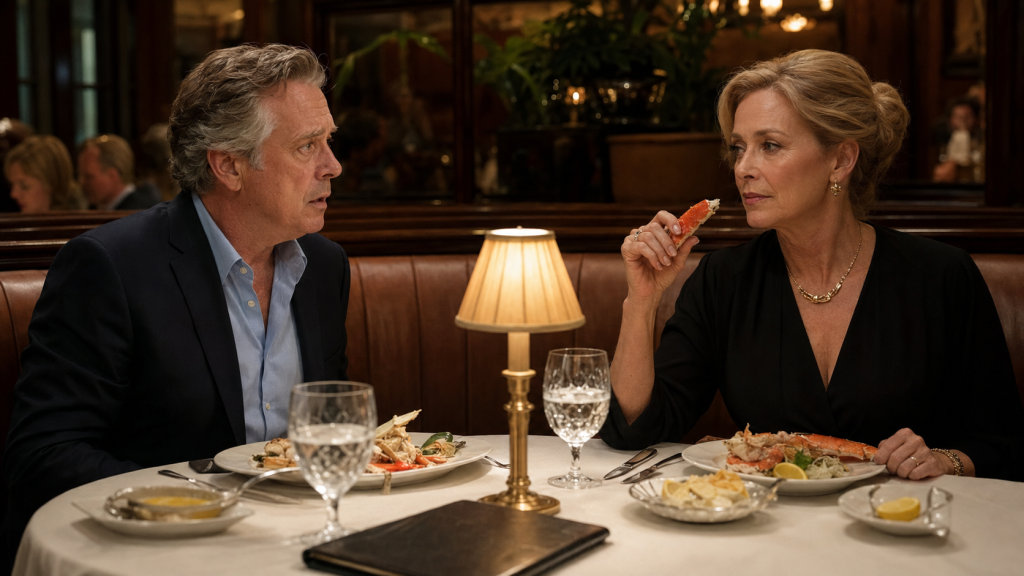
Elaine thanked her warmly, then picked up a crab leg and cracked it with practiced hands.
The sound made me flinch.
I do not know why I chose that exact moment.
Maybe guilt is a coward until it becomes impatient.
Maybe I wanted to confess before I lost courage.
Maybe I thought if I told her while she was eating, she would stay calm.
So while she dipped crab meat into melted butter, I said, “I had an affair.”
Her hand did not stop moving.
She lifted the crab to her mouth.
Ate it.
Chewed slowly.
Swallowed.
Then she picked up her napkin and touched the corner of her lips.
“I know.”
The restaurant seemed to fall away.
“What?”
“I know,” Elaine repeated.
She reached for another crab leg.
My chest tightened.
I had imagined crying.
Anger.
A stunned silence.
I had imagined myself explaining.
Apologizing.
Maybe even being forgiven because the affair had ended so long ago.
I had not imagined Elaine eating crab like I had told her the weather was bad.
“In 2016,” I said stupidly. “It lasted eight months.”
“I know that too.”
I stared at her.
The woman’s name was Marissa.
She worked in claims at the insurance office where I used to consult.
She laughed at my jokes.
She touched my arm when she spoke.
She made me feel younger and more interesting than I had felt in years.
At the time, I told myself Elaine had become distant.
I told myself we were more roommates than spouses.
I told myself a thousand small lies that made betrayal sound like loneliness.
Elaine cracked another crab leg.
“I followed you once,” she said. “Embassy Suites. Route 4. You parked by the side entrance because you thought the front lot had too many cameras.”
My mouth went dry.
“Elaine…”
“Don’t interrupt. I waited a long time to say this.”
Her voice was calm.
That frightened me more than anger would have.
“While you were upstairs in that room,” she continued, “I was in the lobby meeting a divorce lawyer.”
My heart seemed to stop.
“Eight years ago?”
“Eight years ago.”
The butter dish sat between us, golden and warm.
My salmon went cold.
Elaine looked down at her plate, selected a shrimp, and continued.
“He drew up papers that night. Home equity. Retirement accounts. Your consulting income. My inheritance. At the time, the split was roughly four hundred twenty thousand dollars.”
I could barely breathe.
“Why didn’t you file?”
She smiled.
It was small.
Not kind.
“Because filing would have given you an ending. Clean. Legal. Efficient. You would have cried, apologized, divided the money, and maybe run off with Marissa before she got tired of you. I wanted you to lose everything on my terms, not hers.”
A child laughed at the next table.
Somewhere near the bar, employees began singing Happy Birthday.
Life continued around us with cruel normalcy.
I leaned forward.
“Elaine, I ended it. Years ago.”
“Yes.”
“I was wrong.”
“Yes.”
“I wanted to tell you because I couldn’t carry it anymore.”
She looked at me then.
Really looked.
“Is that what this is? A confession?”
“What else would it be?”
“A request.”
“For what?”
“Relief.”
I had no answer.
She was right.
That was the problem with Elaine.
She was often right in a way that left no room to hide.
She reached into her purse and pulled out a small brass safety deposit box key.
She set it on the table between the butter dish and my untouched dinner.
“Last Tuesday,” she said, “I added something new to those papers.”
My fingers went numb.
“What did you add?”
“Proof.”
“Proof of the affair?”
“No, Robert. The affair was never the worst thing you did.”
Those words landed like a fist to the chest.
Because somewhere deep inside me, beneath all the excuses and careful forgetting, I knew she was right.
The affair had been betrayal.
But what followed had been something else.
Something colder.
Something I had spent years pretending was just financial confusion.
Temporary borrowing.
A mistake.
A fixable mess.
Elaine leaned back in the booth.
“I found the loan against my father’s lake cabin.”
My stomach dropped.
The cabin.
Her father had left it to her alone.
A small cedar place near Lake Hartwell with a crooked dock and green shutters.
Elaine loved that cabin.
She said it was the only place her father still felt close.
I had told myself I was protecting us when I opened that line of credit.
Marissa had been threatening to leave.
Her debts were worse than she had admitted.
I needed money quickly.
I convinced myself I would put it back before Elaine ever knew.
I did not.
Elaine watched my face change.
“Yes,” she said softly. “That one.”
I swallowed.
“I was going to repay it.”
“You used my forged authorization.”
“It was temporary.”
“That’s not a defense. That’s a timeline.”
I looked around quickly, afraid someone might hear.
Elaine noticed.
“Now you care about embarrassment?”
“Please lower your voice.”
“My voice is not the problem.”
She opened her purse again and pulled out a folded bank receipt.
“Last Tuesday, I went to the safety deposit box. I added the final bank statements. The credit line documents. The emails. Marissa’s messages. Copies of your hotel charges. And the consulting checks you hid from our joint tax filings.”
I stared at her.
“You kept all that?”
“You kept lying. I kept evidence.”
The waitress came by and asked if everything tasted okay.
Elaine smiled warmly.
“Very good, thank you.”
I could not even look up.
When the waitress left, I whispered, “What do you want?”
Elaine laughed once.
A short, dry sound.
“That question is eight years late.”
I looked at the key.
“Are you filing now?”
“Yes.”
“Because I confessed?”
“No. I decided before tonight.”
“Then why come here?”
“Because thirty years deserved a table. Not a text message. Not a note on the kitchen counter. A table.”
I hated how calm she was.
I hated that she still had manners while destroying me.
But most of all, I hated that I had given her the tools.
She picked up another piece of crab and dipped it in butter.
“Tomorrow morning, my lawyer files. At ten, the bank receives notice to freeze the cabin account. At eleven, your consulting partner receives formal notice that marital assets may have been used to cover personal fraud. By noon, Marissa will receive a subpoena.”
My heart hammered.
“Marissa has nothing to do with this anymore.”
Elaine’s eyes sharpened.
“There it is.”
“What?”
“You still protect her faster than you ever protected me.”
That silenced me.
Because it was true in the ugliest way.
Even after eight years, even after the affair had ended badly, even after Marissa had moved to another state and married someone else, my first instinct was still to keep her away from consequence.
Not Elaine.
Not the woman who had washed my father’s clothes when he was dying.
Not the woman who worked weekends when my consulting business failed.
Not the woman who stayed after my affair because I had lied well enough to make her feel crazy.
Elaine set down her fork.
“Do you remember the night I asked you if there was anything you needed to tell me?”
I closed my eyes.
I remembered.
She had stood in our bedroom doorway wearing a gray robe, her face pale, her hands clenched at her sides.
I had just come home from Marissa’s apartment.
Elaine said, “Robert, if there is something wrong in this marriage, say it now.”
I looked her in the eye and said, “You’re imagining things.”
Elaine nodded slowly now, as if hearing my memory.
“That was the night I stopped loving you the way a wife loves a husband.”
My throat tightened.
“But you stayed.”
“Yes.”
“Why?”
She looked down at her plate.
For the first time that night, her calm cracked slightly.
“Because leaving is easy in stories. In real life, there was your mother’s illness. Our sons’ college tuition. The mortgage. My father’s estate. The taxes. Your business problems. My own shame. And then, after a while, staying became a habit.”
I looked at her hands.
Her wedding ring was still there.
Gold.
Simple.
The same ring I had placed on her finger thirty years earlier in a small church with a leaking roof.
“I’m sorry,” I said.
Elaine looked at me.
“I know.”
“You know?”
“I know you are sorry right now. That is not the same as being changed back then.”
I had no defense.
Because change had been available to me many times.
The night I drove to Embassy Suites.
The first time I touched Marissa’s hand.
The day she asked me for money.
The day I opened the cabin credit line.
The night Elaine asked for the truth.
Each time, I chose myself.
Then called it confusion.
The waitress returned with the check.
“Celebrating something special?” she asked.
Elaine picked up the bill.
“Yes,” she said. “My freedom.”
The waitress smiled uncertainly, not understanding.
Elaine handed her a credit card.
When the waitress left, I leaned across the table.
“Please. Don’t do this tomorrow. Give me one week.”
“For what?”
“To make things right.”
She tilted her head.
“Can you give my father’s cabin back eight debt-free years?”
“No.”
“Can you give me back the years I spent checking bank statements at midnight?”
“No.”
“Can you give me back the version of myself who believed her husband would not look her in the eye and lie?”
I said nothing.
She nodded.
“That’s what I thought.”
The waitress returned with the receipt.
Elaine signed it and left a generous tip.
That was Elaine too.
Even in war, she tipped fairly.
She stood, picked up her purse, and slid the brass key back inside.
I stood too quickly and bumped the table.
My water glass wobbled.
A couple nearby glanced over.
Elaine did not look embarrassed.
I followed her outside into the parking lot.
Rain had started falling softly.
The red lobster sign glowed above us, reflected in shallow puddles.
“Elaine,” I said. “Thirty years has to mean something.”
She stopped beside her car.
For the first time that night, her eyes filled with tears.
“It did.”
Her voice was low now.
Not cold.
Tired.
“That’s why I stayed too long.”
Those words hurt more than rage.
I reached for her hand, but she stepped back.
“Don’t.”
“I still love you.”
“I believe you love what I made possible.”
“That’s not fair.”
“No, Robert. It is accurate.”
She opened her purse and took out a folded piece of paper.
A hotel reservation.
Her name only.
“You can go home,” she said. “I won’t be there.”
“Where will you be?”
“Somewhere my peace doesn’t have to ask permission.”
I looked at the paper.
Then at her.
And finally, too late, I understood.
She had not come to Red Lobster to hear my confession.
She had come to watch me realize I had confessed after the verdict.
By the time I drove home, the rain was heavier.
The house was dark except for the porch light.
Elaine’s car was gone.
I stepped inside and felt immediately that she had already left.
Not everything.
Not dramatically.
But the house had shifted.
Her coat was gone from the hook.
Her purse was gone from the chair.
The framed photo of her father had been removed from the hallway table.
The bedroom looked the same at first.
Then I saw the empty drawers.
The missing jewelry box.
The open closet.
She had taken enough.
Not all.
Enough.
On her pillow, there was an envelope with my name.
I opened it with trembling hands.
Inside was a copy of the divorce petition.
Not filed yet.
Stamped as prepared.
Attached to it was a note.
Robert, do not call our sons tonight. Let me tell them first. You controlled the story once. You will not control this one.
I sat on the edge of the bed until morning.
I did not sleep.
At 8:03 a.m., my phone rang.
Our oldest son, Michael.
I stared at his name until it stopped ringing.
Then our younger son, Aaron.
I did not answer him either.
Cowardice, after all these years, was still my easiest habit.
At 9:17, a courier arrived with a legal packet.
At 10:02, the bank called.
At 10:48, my business partner, Vince, called screaming.
“What the hell is going on, Robert?”
I closed my eyes.
“Elaine filed.”
“For divorce?”
“For more than that.”
Vince cursed.
His voice shook with panic.
“This says marital assets may have been misused through our consulting account. Did you route personal money through the business?”
I did not answer quickly enough.
“Oh my God,” Vince whispered. “You idiot.”
By noon, Marissa called.
I had not heard her voice in years.
She sounded older.
Frightened.
“What did you do?” she asked.
The same question everyone seemed to ask when truth finally arrived.
“Elaine subpoenaed you?”
“My husband answered the door,” she hissed. “Do you understand what you’ve done?”
Something bitter rose in my throat.
“Now you care about your marriage?”
She went quiet.
Then she said, “Don’t contact me again.”
She hung up.
I stood in my kitchen holding the phone while the old refrigerator hummed behind me.
For eight years, I had feared being exposed.
I had not understood that exposure was not one moment.
It was a sequence.
One door opening.
Then another.
Then another.
By Friday, my sons knew everything that mattered.
Not every ugly detail, but enough.
Michael came by first.
He was thirty-six, married, with two daughters.
He stood in the living room where he had once built Lego towers and looked at me like I was a stranger wearing his father’s face.
“Did you cheat on Mom?”
“Yes.”
“Did you steal from her cabin?”
I flinched at the word steal.
“Yes.”
“Did you forge her signature?”
My mouth opened.
Closed.
“Yes.”
Michael looked down.
When he spoke again, his voice had changed.
“Do you know what she did when I lost my job in 2020?”
I frowned, confused.
“She sent us money every month for five months. She told us it was from both of you.”
I did not know that.
Michael’s eyes filled.
“She was protecting how I saw you. Even then.”
He walked toward the door.
“Your granddaughters are asking why Grandma is sad. I don’t know what to tell them.”
“Tell them I made mistakes.”
He turned sharply.
“No. A mistake is forgetting to pay a bill. This was a life you built inside our family and hid in the walls.”
He left.
Aaron called instead of visiting.
His anger was colder.
“You made Mom think she was crazy.”
I sat at the kitchen table.
“I know.”
“You don’t get to say that like it helps.”
“I don’t know what else to say.”
“Try saying nothing. You were good at that for eight years.”
Then he hung up.
By Monday, Elaine sent one message to the family group chat.
I gave your father eight years to become honest. He waited until honesty could no longer save him. I love you both. Please do not carry what belongs to us.
Neither son replied in the chat.
But Michael sent a heart.
Aaron sent, Love you, Mom.
I stared at those messages until the screen dimmed.
The legal process was not dramatic in the way people imagine.
There was no screaming courtroom scene.
No shocking witness bursting through the doors.
Just documents.
Statements.
Bank records.
Copies.
Emails.
Dates.
Evidence.
Elaine’s lawyer was a woman named Patricia Voss.
She was small, silver-haired, and terrifyingly prepared.
My attorney, Gerald Pike, told me early that denial would be foolish.
“She has records,” he said. “The affair matters emotionally. The financial misconduct matters legally.”
Financial misconduct.
That was his polite phrase.
Elaine’s lawyer called it fraud.
The first mediation was held in a conference room with beige walls and bad coffee.
Elaine sat across from me wearing a gray suit.
No pearls this time.
Her hands were folded neatly.
She looked calm.
Not happy.
Calm.
Patricia opened with the cabin.
The credit line.
My forged authorization.
The transfers.
The consulting account.
The false business expenses.
Then the retirement withdrawal I had blamed on market losses.
I remembered that argument.
Elaine had asked why the account statement looked wrong.
I told her she did not understand investments.
I said it kindly.
Patiently.
As if she were simple.
Sitting in that conference room, hearing the statement read aloud, I felt something inside me collapse.
Not because I was caught.
Because I heard myself clearly for the first time.
I had not only betrayed Elaine.
I had trained her to distrust her own intelligence so I could keep my secrets safe.
At one point, Gerald leaned toward me.
“Do you want to contest the cabin issue?”
I looked at Elaine.
She did not look back.
“No,” I said.
He blinked.
“No?”
“No.”
The settlement cost me far more than the four hundred twenty thousand dollars I would have lost eight years earlier.
The lake cabin returned to Elaine’s name alone, debt obligation assigned to me.
My retirement was divided in her favor due to hidden withdrawals.
I paid restitution for misused marital funds.
My consulting license came under review.
Vince removed me from the partnership before the review was complete.
He said he could not risk the firm.
I wanted to hate him.
But he was doing what I had failed to do.
Protecting what was his.
The day we signed final papers, Elaine wore the pearl earrings from Red Lobster.
I noticed immediately.
Maybe she wore them intentionally.
Maybe not.
She signed with a steady hand.
Elaine Margaret Coleman.
Not Elaine Walsh.
She had taken back her maiden name.
I stared at the signature.
Thirty years of my name disappeared in three words.
After the hearing, I followed her into the courthouse hallway.
“Elaine.”
She stopped but did not turn.
“I’m sorry.”
“I know.”
“Do you believe me?”
She turned then.
Her face was softer than it had been in months, which somehow made it worse.
“Yes, Robert. I believe you are sorry.”
“Does that matter at all?”
“It matters to you. That is something.”
“And to you?”
She looked toward the courthouse doors.
“I spent years needing your remorse. By the time you gave it to me, I needed freedom more.”
I nodded because there was nothing else to do.
She walked out into sunlight.
For the first time in years, she looked lighter.
Not young.
Not untouched.
Lighter.
I stood in the hallway until Gerald touched my shoulder and told me we needed to go.
After the divorce, the house was sold.
Elaine did not want it.
I could not afford to keep it.
The buyers were a young couple with a toddler.
When they walked through during the showing, the little girl ran down the hallway laughing.
I wanted to tell them not to buy a house full of ghosts.
But that was unfair.
The ghosts belonged to me.
Not the walls.
Elaine moved to the lake cabin after the debt was cleared.
Michael told me because I asked once and promised not to go there.
She repaired the dock.
Painted the shutters blue instead of green.
Started volunteering at the library nearby.
Joined a walking group.
Took a pottery class.
I learned these things through my sons in careful fragments.
They loved me cautiously now.
That was the best way to describe it.
They called.
They visited sometimes.
But something had changed permanently.
Respect, once cracked in children, does not repair just because a father regrets the hammer.
Marissa testified by deposition.
I read the transcript once.
She admitted I had given her money.
Admitted I said Elaine would never know.
Admitted I told her my marriage was “already over.”
Then she said something I did not expect.
Robert was not trapped. He liked having two women believe different stories about him.
I hated her for that sentence.
Then I hated myself because it was true.
A year after the divorce, I drove past Red Lobster.
I had not meant to.
Traffic rerouted me.
The sign was still there.
The parking lot half full.
For a moment, I saw Elaine across from me again.
Cracking a crab leg.
Saying, “I know.”
I pulled into the lot and sat in my car.
I thought I might cry.
I did not.
Instead, I laughed.
A small, bitter laugh.
Thirty years had ended over a ninety-two-dollar dinner I thought I controlled.
That was the most ridiculous part.
I had chosen the place.
The timing.
The confession.
I thought I was finally steering the truth.
Elaine had been holding the map for eight years.
I began therapy because Aaron asked me to.
Not suggested.
Asked.
“If you want a relationship with me,” he said, “stop making guilt your whole personality and figure out why you were able to do this.”
So I went.
At first, I said the affair had happened because I felt unseen.
My therapist, Dr. Larkin, asked, “Did feeling unseen force you to forge your wife’s signature?”
I hated him immediately.
Then I kept going.
Week after week, I sat in his office and learned the difference between explanation and excuse.
I learned that guilt can become self-pity if you use it to avoid repair.
I learned that apologizing is not the same as accepting consequences.
I learned that I had spent most of my adult life wanting to be forgiven without becoming fully accountable.
That was not confession.
That was negotiation.
Two years after Red Lobster, Elaine and I were in the same room again for our granddaughter’s piano recital.
I arrived early and sat in the back.
Elaine sat near the front beside Michael’s wife.
She wore a pale blue dress.
No wedding ring.
No pearls.
The recital was held in a school auditorium that smelled like dust and floor polish.
Our granddaughter, Sophie, played badly and beautifully at the same time.
She missed three notes and smiled through all of them.
Afterward, families gathered in the lobby.
I stood near the vending machines, unsure whether to approach.
Elaine came to me first.
“Robert.”
“Elaine.”
For a moment, we were polite strangers with thirty years buried between us.
“You look well,” I said.
“I am.”
Good.
That word struck me.
Not because she said it cruelly.
Because she meant it.
“I’m glad,” I said.
She studied me.
“You look older.”
I laughed softly.
“I am.”
For the first time in a long time, she smiled without a blade in it.
Not warm.
Not forgiving.
But human.
“How is the cabin?” I asked.
Her smile faded slightly.
“Mine.”
One word.
A boundary and an answer.
I nodded.
“Good.”
She glanced toward Sophie, who was showing her certificate to Michael.
“She asked why we don’t sit together.”
“What did you tell her?”
“That some people love better with space.”
I swallowed.
“That’s a kind answer.”
“It’s a true one.”
Then she walked away.
I did not follow.
That was new for me.
There was a time I would have chased the conversation, asked for reassurance, tried to turn one gentle moment into a door.
This time, I let her go.
Respect sometimes looks like staying where you are.
Three years have passed now.
Elaine lives at the cabin.
I rent a small townhouse twenty minutes from Aaron.
My consulting license survived, but the partnership did not.
I do bookkeeping for small businesses now.
It is humbling work.
Quiet work.
Exact work.
Every number has to match.
There is justice in that.
I see my sons.
Not as often as I want.
More often than I deserve.
My granddaughters call me Grandpa Robert now, not just Grandpa.
Children sense adult fractures even when no one explains them.
Elaine and I exchange brief messages about family events.
No emotional essays.
No late-night apologies.
No attempts to dig up what has already been buried properly.
Just facts.
Sophie’s recital is at four.
Aaron’s surgery went well.
Michael is hosting Thanksgiving.
Polite.
Clean.
Bounded.
Sometimes I miss her so sharply it surprises me.
Not the version of her who cooked dinner or managed holidays or stood beside me in photographs.
I miss the woman who knew how to read a room.
The woman who remembered everyone’s birthdays.
The woman who loved storms at the lake.
The woman who sat across from me at Red Lobster and finally refused to carry my lies another inch.
I loved her too late.
Or maybe I loved her incorrectly for too long.
Those are not the same, but both are true.
People ask why Elaine waited eight years.
Some people call it cruel.
I used to think so too, in my weakest moments.
But now I think she waited because betrayal rarely gives the innocent person a clean exit.
She had to build one.
Document by document.
Dollar by dollar.
Breath by breath.
I had eight years to become honest.
I did not.
She had eight years to become free.
She did.
That is not cruelty.
That is patience sharpened into survival.
I still remember the key.
Small.
Brass.
Ordinary.
Set between butter and salmon like it belonged there.
A key to a box.
A key to evidence.
A key to the truth.
But for Elaine, it was more than that.
It was the key to the door she finally walked through.
On our thirtieth anniversary, I thought I was giving my wife a confession.
In truth, she gave me a mirror.
I did not like what I saw.
I still do not.
But at least now I look.
Elaine once told me, during one of our better years, that the worst lies are not the ones we tell others.
They are the ones we need them to believe so we can continue believing ourselves.
I forgot that lesson.
She did not.
At Red Lobster, over a ninety-two-dollar dinner, while families laughed and butter cooled on the table, my wife ended a marriage that had truly died eight years earlier.
She did not throw a drink.
She did not slap me.
She did not shout.
She cracked a crab leg, ate calmly, placed a key on the table, and reclaimed her life with the dignity I had mistaken for weakness.
When she left, she did not ruin me.
She simply stopped protecting me from what I had done.
And that was when I finally learned the cost of being forgiven too long.
THE END! THANKS FOR READING!