
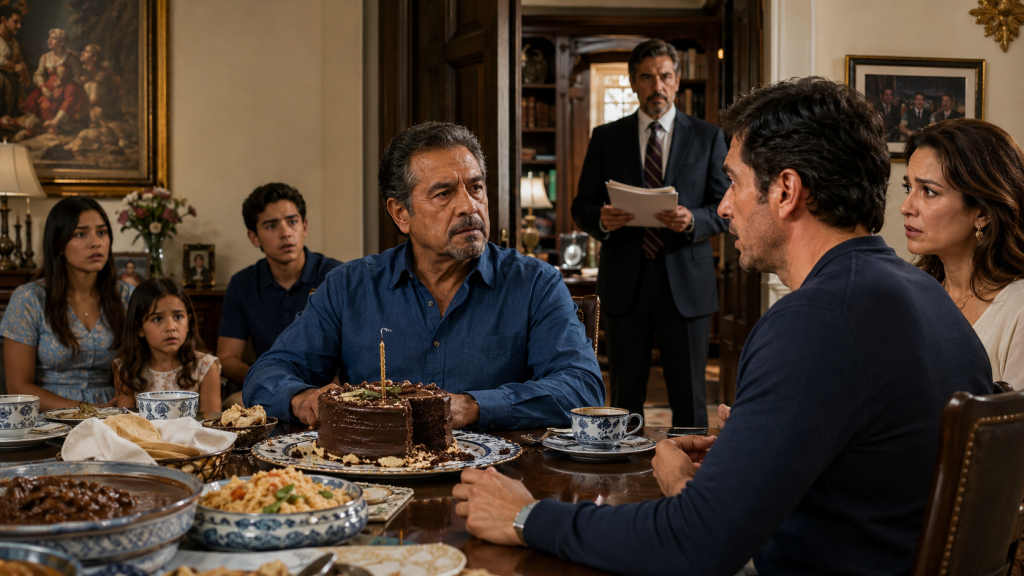
On my sixty-third birthday, my son leaned close to the cake and whispered, “I hope this is the last candle you ever blow out.”I heard him clearly.So did God, if He was listening.Everyone else kept clapping, smiling, filming, and pretending the moment was beautiful.I looked at the small gold candle burning in front of me.Then I looked at my son, Daniel.His smile was soft.Almost loving.That made it worse.
Because cruelty shouted in anger can be dismissed as heat.Cruelty whispered calmly is a decision.I blew out the flame.The room applauded.Daniel smiled for the camera.His wife, Lucia, tilted her head and clapped with perfect red nails.My grandchildren cheered because they did not understand what their father had just said.
I leaned back in my chair, looked Daniel straight in the eye, and replied, “My wish has already come true. Tomorrow you will understand.”
His jaw tightened.
Lucia’s smile flickered.
Nobody else noticed.
They were too busy eating my cake.
My name is Ernest Salazar.
I am sixty-three years old.
And the house where everyone sat laughing that night was built with thirty years of shop work, grease under my fingernails, sore knees, and sacrifices no one at that table seemed to remember.
My wife, Teresa, died eight years ago.
Cancer took her slowly, room by room, breath by breath.
After she passed, everything in the house became too big.
The kitchen table.
The bed.
The quiet.
The evenings.
But the biggest thing was the silence my children left behind when they began visiting only to ask for something.
Daniel was my oldest son.
When he was little, he used to fall asleep on my chest while cartoons played too loudly on the television.
He would press one hand against my shirt and murmur, “Don’t move, Dad.”
So I didn’t.
For hours sometimes.
I let my arm go numb because my boy was sleeping.
That was the version of Daniel I kept loving long after the real one had changed.
The adult Daniel had learned to say “Dad” with the same tone a debt collector uses at a door.
“Dad, we need to review the insurance.”
“Dad, it’s time to put the shop in the family’s name.”
“Dad, you’re getting older. Paperwork is stressful.”
Paperwork.
That was what they called my life.
The house where Teresa painted the flowerpots red.
The auto shop where I opened the doors before sunrise for three decades.
The bank accounts I built slowly so I would never have to beg my children for medicine, food, or dignity.
Lucia was worse because she smiled through everything.
She kissed my cheek while her eyes traveled over the furniture.
She complimented Teresa’s dishes while asking whether they were antique.
She called me “Papá Ernest” in front of guests, but when Daniel thought I could not hear, she called me “the old man.”
My birthday dinner had been her idea.
That should have warned me.
They all showed up.
Daniel and Lucia.
My grandchildren.
Two nephews who almost never called.
A cousin who appeared only when there was free food.
Even my neighbor Marta came for ten minutes with a casserole and hugged me like she meant it.
She was the only guest I believed.
Lucia brought an expensive cake from a bakery downtown.
Gold candles.
White frosting.
Little sugar flowers.
She placed it on the table like an offering.
Or a stage prop.
The living room camera was set up on a tripod to record “the family moment.”
I wore my blue shirt, the one Teresa used to say made me look less grumpy.
The table was full.
Mole.
Rice.
Warm tortillas.
Sodas.
Dirty glasses.
Too much laughter.
Not the kind of laughter that fills a home.
The kind people use when they are performing happiness.
Lucia talked about how the kitchen needed “a new life someday.”
Daniel mentioned that the auto shop needed “modern administration.”
My nephews discussed property values.
My cousin asked whether I still had Teresa’s jewelry.
Only my youngest grandson, Mateo, gave me a real hug.
He wrapped both arms around my waist and whispered, “Happy birthday, Grandpa.”
He smelled like soap and chocolate.
For that one second, the night felt bearable.
Then they placed the cake in front of me.
Everyone began singing.
The candles flickered.
I looked at Teresa’s empty chair.
I imagined her there, rolling her eyes at all the noise, then smiling because birthdays made her sentimental.
Then Daniel leaned close.
Glass in hand.
Smile still fixed for the camera.
“I hope this is the last candle you ever blow out.”
The words entered me quietly.
No drama.
No explosion.
Just a final closing of a door I had been holding open for too long.
My son did not want to wait anymore.
He wanted the house.
The shop.
The accounts.
The insurance.
He wanted the old man removed from the paperwork.
I blew out the candle.
The room clapped.
I told him my wish had already come true.
Because in that moment, it had.
I had finally stopped pretending.
After they left, the house smelled like extinguished wax, cold coffee, and family lies.
I cleaned the dishes slowly.
Not because I needed to.
Because my hands needed something to do while my heart learned how to let go.
On the tablecloth, beneath Lucia’s plate, I found a folded napkin.
At first, I thought it was trash.
Then I saw her handwriting.
House.
Shop.
Insurance.
Investment account.
Pending signature.
Pending signature.
I laughed to myself.
A dry, tired laugh.
The kind of laugh a man gives when sadness has nowhere else to go.
My phone buzzed.
A text from Daniel.
Thanks for dinner, old man. Don’t forget to pay the house insurance.
Old man.
Not Dad.
Old man.
I stood in the kitchen for a long time, staring at the message.
Then I walked upstairs.
My bedroom still looked like Teresa had just stepped out for laundry.
Her photo sat on the dresser.
Her hairbrush remained in the drawer.
Her side of the closet still held two dresses I could never bring myself to donate.
I opened the safe we had bought when the auto shop started doing well.
Inside were deeds, bank statements, contracts, insurance papers, the old will, medical authorizations, and one folder with Daniel’s name on the tab.
For years, I had avoided that folder.
Because part of me still saw the boy.
The child asleep on my chest.
The teenager who cried when his mother got sick.
The young man who once promised, beside Teresa’s hospital bed, “I’ll take care of Dad.”
But that night, the boy was gone.
Maybe he had been gone for years.
I simply refused to bury him.
I took everything out.
I sat on the bed.
I read every page.
Every authorization.
Every beneficiary listing.
Every signature I had given Daniel “just in case something happened.”
A bank access form.
A power of attorney draft I had never finalized but had foolishly allowed him to keep.
Insurance documents.
The old will naming him executor.
A shop management agreement he had pushed me to sign but which Robert Ibanez, my attorney, had told me to wait on.
Then I found something that made my hands go cold.
A copy of a document I did not remember signing.
It transferred “temporary operational control” of Salazar Auto Repair to Daniel under certain conditions.
At the bottom was my signature.
Or something trying to be my signature.
I stared at it.
The E in Ernest was wrong.
Teresa used to tease me that my E looked like a broken ladder.
This one did not.
I placed it beside Lucia’s napkin.
Then I checked the insurance papers.
Daniel had been trying to change the beneficiary.
He had not succeeded yet.
But he had tried.
My chest did not tighten this time.
My hands did not shake.
I felt relief.
That may sound strange.
But sometimes truth does not destroy you.
Sometimes it explains why you have been hurting.
At five in the morning, before the sky changed color, I called Robert Ibanez.
Robert had been Teresa’s friend before he became my lawyer.
He was one of the few men left who spoke to me as Ernest, not as an old man with assets to divide.
He answered on the fourth ring, voice rough with sleep.
“Ernest? Are you all right?”
“The time has come,” I said.
He did not ask what time.
He only said, “I’m on my way.”
By seven, Robert was sitting in my dining room in a dark suit, drinking black coffee from Teresa’s yellow mug, with his black briefcase open on the table.
I showed him the napkin.
The text.
The insurance request.
The forged shop document.
The old authorizations.
He read everything silently.
When he finished, he took off his glasses and rubbed the bridge of his nose.
“Ernest,” he said, “if you signed what Daniel wanted, in six months you would not have a house or a shop left.”
I nodded.
“I know.”
“He has been setting up control points. Insurance, business management, medical authority, property transfer. Separately, each request looks like planning. Together, it looks like a net.”
I looked toward Teresa’s empty chair.
“She would have seen it sooner.”
Robert’s face softened.
“Teresa saw many things sooner than the rest of us.”
That made my throat tighten.
I looked down at my hands.
Hands that fixed engines.
Hands that held my children.
Hands that held my wife’s hand while she died.
Hands that had signed too many things because loneliness made me want to believe my son cared.
“What do we do?” I asked.
Robert opened his briefcase.
“We protect you.”
For the next four hours, we worked.
We revoked every old authorization.
We notified the bank in writing.
We changed account access.
We removed Daniel as emergency contact.
We withdrew the old will.
We created a new trust.
The house would go into protected ownership, with clear instructions that I could live there for the rest of my life and no one could force a sale.
The auto shop would transfer, after my passing, not to Daniel, but to the employees who had kept it alive.
Men like Hector, who had worked beside me for twenty-two years and still called every Saturday to ask if I needed groceries.
Women like Nina, our bookkeeper, who had caught Daniel twice trying to get copies of tax forms he had no right to see.
The life insurance would no longer go to Daniel.
It would fund the Teresa Salazar Children’s Cancer Foundation, a small local charity Robert helped me establish years ago in her memory but which I had never fully funded.
The investment account would be divided into education trusts for my grandchildren.
Not controlled by their parents.
Not accessible for remodeling, vacations, or “family management.”
Only education.
Only them.
When Robert placed the final paper in front of me, I thought my hand might tremble.
It did not.
I signed carefully.
Ernest Salazar.
Broken ladder E and all.
Robert witnessed.
The notary stamped.
Something invisible lifted from my shoulders.
“Are you sure?” Robert asked gently.
I looked at Teresa’s photo on the sideboard.
“When someone pushes you to the edge,” I said, repeating her favorite words, “you don’t ask permission to step aside.”
Robert smiled sadly.
“She would approve.”
At noon, I called Daniel.
“Come over for lunch,” I said. “There is something I want to discuss.”
His voice changed immediately.
Interested.
Almost cheerful.
“About the paperwork?”
“About that and other things.”
“We’ll be there.”
Of course they would.
They arrived at one.
Daniel wore a new shirt.
Lucia wore expensive perfume and carried a bottle of wine she knew I would not drink.
The children came too.
Mateo ran in first.
I hugged him longer than usual.
Daniel looked around the house as if measuring walls.
Lucia kissed my cheek.
“You look better today, Ernest.”
“That’s because I slept well.”
She looked surprised.
Daniel sat in his usual chair.
The chair closest to the cabinet where I kept important household papers.
“Are we finally going to talk about the insurance?” he asked.
“About that and other things.”
Lucia smiled sweetly.
“That’s wonderful. The important thing is that everything stays in the family.”
Robert was in the study behind the half-open door.
They did not know.
I let them eat.
I served chicken soup because Teresa always said soup tells you who is grateful.
Mateo thanked me twice.
Daniel complained it needed more salt.
Lucia barely touched hers.
She was too busy watching me.
I let Daniel talk about investments.
I let Lucia mention the kitchen “deserved a new life.”
I let them talk about how stressful property management could be for men my age.
I let them toast to “the future.”
Then Daniel raised his glass and said, “To the future, Dad. May it come sooner than we think.”
Lucia laughed too quickly.
I set down my spoon.
Robert stepped out of the study.
Daniel’s smile vanished.
“What’s he doing here?”
“Protecting what your mother and I built,” I said.
Daniel stood halfway.
“Dad, this is a family lunch.”
“Yes,” I replied. “That is why my attorney is here.”
Lucia’s face tightened.
Robert placed three documents on the table.
The new trust.
The revised will.
The termination notices revoking Daniel’s access to my accounts, shop matters, medical decisions, and insurance policies.
Daniel grabbed the first page.
His eyes moved quickly.
Then faster.
Lucia leaned over his shoulder.
Her face drained of color before his did.
“What is this?” Daniel demanded.
“My decision.”
“You can’t do this.”
“I already did.”
His hand slapped the paper.
“The shop goes to employees?”
“The workers who kept it alive.”
“I’m your son.”
“You wished me dead in front of my birthday cake.”
The room went silent.
Even the children stopped moving.
Daniel’s mouth opened.
No words came out.
Lucia tried to recover.
“Ernest, I think there has been a misunderstanding. Daniel was joking.”
Robert reached into his briefcase and placed a small recorder on the table.
“My client’s living room security system captured the birthday dinner,” he said. “Including your husband’s whisper.”
Daniel went pale.
Lucia whispered, “Daniel…”
Robert pressed play.
The recording filled the dining room.
The family singing.
The clapping.
My candle.
Then Daniel’s voice, low and clear:
“I hope this is the last candle you ever blow out.”
Mateo began crying.
Not loudly.
Just a small broken sound that cut through me worse than Daniel’s words had.
Daniel looked toward his son.
“Mateo, it was a joke.”
Mateo pulled away from him.
“No, it wasn’t.”
The boy was only nine.
But children know when something is ugly.
Lucia stood.
“This is cruel. You’re humiliating us in front of the children.”
I looked at her.
“You brought them to watch me sign away their future.”
She froze.
Daniel pointed at me.
“After everything I’ve done for you?”
I almost laughed.
“What have you done for me, Daniel?”
“I check on you.”
“You check the mail.”
“I help with bills.”
“You look for account numbers.”
“I care about this family.”
“You care about inheritance.”
His face twisted.
“You’re old, Dad. You don’t understand how things work now. The shop needs new management. The house needs updates. Money sitting in accounts is wasted.”
“It is not wasted because it is not yours.”
That sentence landed harder than I expected.
Maybe because no one had ever said it to him plainly.
Lucia’s voice became sharp.
“You’re letting strangers poison you against your own son.”
Robert spoke calmly.
“No one poisoned Mr. Salazar. Your handwritten list did help clarify matters.”
He placed the napkin on the table.
House.
Shop.
Insurance.
Investment account.
Pending signature.
Lucia stared at it.
Her lips parted.
Then she said, foolishly, “That’s not mine.”
I looked at her manicured red nails.
“Lucia, your name is written on the back.”
She looked.
It was.
She had written “call flooring contractor” and signed her initials beneath it.
Daniel slowly sat back down.
His anger turned to panic.
“Dad,” he said, softer now. “Let’s talk alone.”
“No.”
“Please.”
“You whispered alone at my cake. You planned alone with your wife. Now we speak with witnesses.”
His face flushed.
“You’re really going to give my inheritance to mechanics?”
“To workers. To children with cancer. To my grandchildren’s education. Yes.”
“What about me?”
I looked at him for a long time.
And in that moment, I saw both versions.
The boy asleep on my chest.
The man who wished me gone.
I loved one.
I no longer trusted the other.
“You already received more than you earned,” I said.
Daniel’s chair scraped back as he stood.
“You’ll regret this when you need me.”
I picked up Teresa’s photograph from the sideboard.
“I needed you for eight years after your mother died. You came when paperwork was involved.”
His face changed.
Not guilt.
Exposure.
There is a difference.
Lucia grabbed her purse.
“Come on, Daniel. We are leaving.”
Mateo ran to me and hugged my waist.
His mother snapped, “Mateo.”
He did not move.
Daniel looked furious.
“Get over here.”
The boy shook his head.
“I don’t want Grandpa to die.”
The dining room became very still.
Lucia’s face crumpled—not with remorse, but with embarrassment.
Daniel tried to reach for him, but I placed a hand on Mateo’s shoulder.
“Don’t scare the child.”
“He’s my son.”
“And I am your father. That did not stop you.”
Daniel’s hand dropped.
My other grandchildren sat frozen at the table.
Too young to understand contracts.
Old enough to understand cruelty.
Robert cleared his throat.
“Mr. Daniel Salazar, further attempts to pressure, coerce, or obtain signatures from my client will be documented. Any contact regarding assets will come through my office.”
Daniel stared at him.
“You think you can keep me from my own father?”
Robert answered before I could.
“No. Only from his property.”
That was the cleanest sentence spoken all day.
Daniel left shouting.
Lucia followed him.
My older grandchildren trailed behind in confusion.
Mateo stayed until I knelt in front of him.
“You should go with your parents, mijo.”
He wiped his face.
“Are you mad at me?”
I hugged him.
“Never.”
“Are you sick?”
“No.”
“Are you going to die?”
I closed my eyes.
“Not today.”
He hugged me again.
“Good.”
Then he left.
The house became quiet after they were gone.
Robert began gathering papers.
I stayed seated with Teresa’s photo in my hands.
For a while, neither of us spoke.
Then I said, “That was the last lunch Daniel will eat in this house.”
Robert nodded.
“I think you know that.”
I did.
Knowing did not make it painless.
Freedom does not always feel like joy at first.
Sometimes it feels like grief with open windows.
Daniel called forty-three times that week.
Then he texted.
At first, anger.
You embarrassed me.
You made me look like a monster.
You are destroying this family.
Then threats.
I’ll contest everything.
You’re not mentally fit.
Robert is manipulating you.
Then pleading.
Dad, I was joking.
Please call me.
The kids miss you.
That last one almost worked.
Almost.
But Robert had warned me.
“He will use what still loves him.”
So I did not answer directly.
All communication went through Robert.
Daniel did try to challenge the documents.
He claimed I was confused.
He claimed Robert pressured me.
He claimed grief had made me unstable.
But Robert had prepared for that too.
The notary had recorded my capacity statement.
My doctor confirmed I was mentally sound.
The bank had notes from previous suspicious requests Daniel made.
Nina, my bookkeeper, provided emails where Daniel asked for business documents “so Dad can relax.”
Hector admitted Daniel had once told him, “The old man won’t be running this place much longer.”
Daniel denied it.
Then Hector produced the text.
The court did not remove Daniel from my life.
It simply removed him from my control points.
That was enough.
For the first time in years, I slept without wondering what paper I had forgotten to hide.
I visited the shop the next Monday.
The smell of oil, rubber, and coffee hit me like memory.
Hector looked up from under a hood.
“Boss?”
“I am still alive,” I said.
He grinned.
“Good. This transmission is not going to insult itself.”
I laughed.
A real laugh.
Nina made me coffee.
The young mechanic, Luis, asked if the rumors were true.
“What rumors?”
“That you’re leaving the shop to us.”
I looked around.
At the lifts.
The tool benches.
The old radio.
The grease-stained calendar Teresa used to replace every January.
“I am leaving it to the people who know what work means.”
Hector turned away quickly, pretending to check a wrench.
His shoulders shook once.
That was more thanks than a speech.
Weeks passed.
Daniel did not come to the house.
Lucia posted vague things online about betrayal and elderly manipulation.
My cousin liked them.
Then unliked them when Marta commented, “Maybe don’t wish people dead for cake.”
God bless Marta.
Mateo wrote me a letter in pencil.
Grandpa, I am sorry Dad was mean. I still want to come fix cars with you. Love, Mateo.
I folded it carefully and placed it in the safe.
Not all family had to be thrown away.
Only the parts that cut your hands every time you reached for them.
After three months, Daniel asked through Robert if he could meet.
Public place.
No Lucia.
No paperwork.
I agreed.
We met at a diner Teresa used to love.
Daniel looked tired.
For the first time in years, he looked more like my son than my opponent.
He sat across from me.
His hands were clasped together.
“I said something terrible,” he began.
“Yes.”
“I was angry.”
“No,” I said. “You were impatient.”
His eyes lowered.
“That too.”
I waited.
He swallowed.
“I thought everything would come to me eventually, and I started acting like waiting was unfair.”
That was the first honest thing he had said.
I drank my coffee.
“What did you want from me today?”
He flinched slightly.
“I wanted to apologize.”
“And?”
His jaw tightened, then loosened.
“And ask if I can still bring the kids to see you.”
“Without Lucia?”
He looked toward the window.
“She says you’re trying to turn them against us.”
“No. You did that when you made them hear the recording.”
He closed his eyes.
“I know.”
For a second, I saw pain.
Real pain.
But pain is not the same as change.
“I will see my grandchildren,” I said. “But not in my house yet. Not with papers. Not with conversations about property. And not if you use them to reach me.”
He nodded.
“I understand.”
I was not sure he did.
But it was a beginning.
The visits started in the park.
Mateo brought toy cars.
The younger ones brought drawings.
Daniel sat on a bench nearby, quiet.
Sometimes he looked ashamed.
Sometimes irritated.
Sometimes both.
Healing, I learned, is not the same as returning to how things were.
How things were had nearly cost me everything.
A year after my sixty-third birthday, I held another small dinner.
No camera tripod.
No gold candles.
No cousins hunting for food.
Just Marta, Robert, Hector, Nina, my grandchildren, and Daniel sitting quietly at the far end of the table.
Lucia did not come.
Nobody asked why.
The cake was homemade.
Marta baked it.
It leaned slightly to one side.
Teresa would have loved it.
When the candle was placed in front of me, the room grew quiet.
Not uncomfortable.
Respectful.
Mateo stood beside me.
“Make a wish, Grandpa.”
I looked at Teresa’s chair.
Still empty.
Still hers.
Then I looked at Daniel.
His eyes filled, but he said nothing.
That was wise.
I blew out the candle.
Everyone clapped softly.
No whispers.
No hidden knives.
No performance.
Just breath.
After dinner, Daniel helped wash dishes.
Awkwardly.
Badly.
He handed me a plate still greasy, and I handed it back.
“Try again.”
He looked surprised.
Then laughed once.
A small laugh.
Almost like the boy he used to be.
Almost.
I do not know if Daniel will ever fully become a man I trust.
I know better now than to build my peace on someone else’s possible improvement.
The trust remains.
The shop remains protected.
The foundation receives its funding.
My grandchildren’s education is secured beyond their parents’ reach.
My house is mine until my last day.
That is not revenge.
It is order.
The day after my sixty-third birthday, Daniel understood what I meant.
My wish had come true.
Not because I wanted to hurt him.
Not because I stopped loving him.
But because I finally stopped confusing blood with loyalty.
I still love my son.
That is the complicated truth.
Love does not vanish because someone becomes greedy.
But love no longer gets my signature.
Love no longer holds my bank access.
Love no longer gets to call me old man while reaching for my keys.
Teresa used to say a man must know the difference between a home and a house.
A house has walls.
A home has respect.
For years, I let disrespect sit at my table because it came wearing my son’s face.
Not anymore.
Now, when I open the safe, everything is in order.
The deeds.
The trust.
The letters.
Mateo’s pencil note.
Teresa’s photograph.
The rewritten will.
The papers no one can twist without my consent.
Sometimes I stand in the doorway of my shop before sunrise, coffee in hand, listening to the old building settle.
I think of all the mornings I nearly quit.
All the nights Teresa waited up.
All the birthdays I thought I wanted a crowded table more than a peaceful one.
Then I remember Daniel’s whisper.
“I hope this is the last candle you ever blow out.”
He was wrong.
That was not my last candle.
It was the last candle I blew out as a man begging to be loved by people counting his assets.
The next flame belonged to me.
THE END! THANKS FOR READING!