
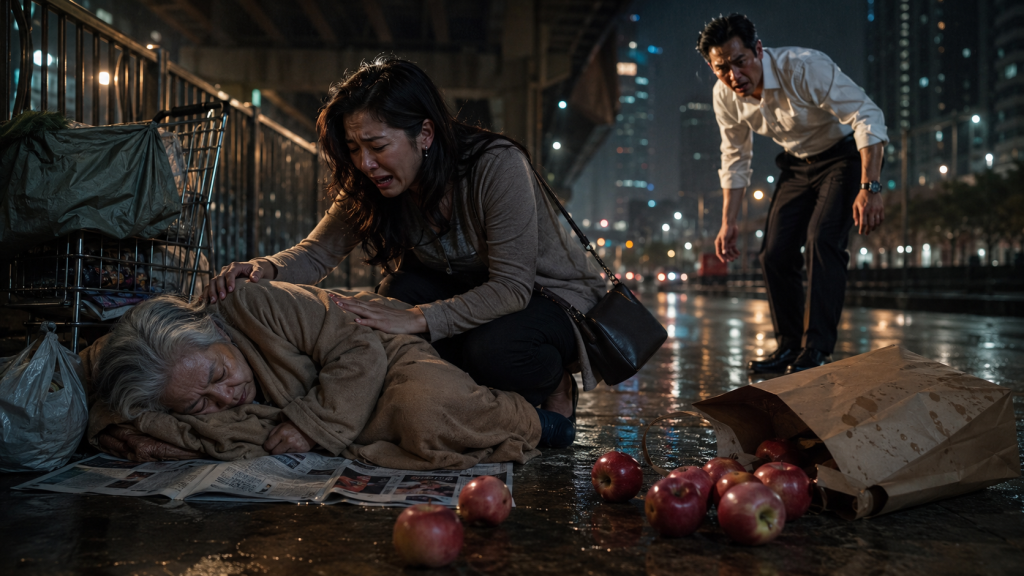
The rain had turned the city silver when we saw my mother curled beneath the highway overpass, sleeping on newspapers like someone the world had forgotten.For three full seconds, none of us moved.Cars hissed past above us.Water dripped from the concrete beams.A shopping cart leaned beside her, holding two plastic bags, a folded blanket, and a pair of shoes tied together by the laces.
My husband, Daniel, was the first to breathe.The grocery bag slipped from his hand.Apples rolled across the wet concrete.“Claire,” he whispered.But I was already walking forward.Then running.“Mom?”Her eyes opened slowly.At first, she looked afraid.
Then ashamed.
Then she recognized me.
“Claire,” she whispered, as if saying my name hurt.
I dropped to my knees beside her, not caring that rainwater soaked through my jeans.
Her coat was too thin.
Her hands were shaking.
Her hair, once always carefully pinned, hung loose and gray around her face.
“What are you doing here?” I asked, my voice breaking. “Mom, where is your house?”She lowered her eyes.That was when fear became something colder.Three months earlier, my mother, Ruth Bennett, still lived in the small blue house my father bought for her before he died.It was worth four hundred fifty thousand dollars.
Maybe more, after the market rose.
But to Mom, it was never an investment.
It was the rose garden.
The yellow kitchen.
The porch swing Dad built with his own hands.
The hallway where our heights were marked in pencil until my brother Kyle said it made the place look childish.
That house was the last place where my father’s voice still seemed to linger.
“What happened to your four-hundred-fifty-thousand-dollar house?” I asked, fighting tears.
Mom’s lips trembled.
“Your brother and Vanessa sold it while I was in the hospital.”
The words struck harder than the rain.
Daniel’s face changed.
The warmth disappeared from his eyes, replaced by a stillness I knew too well.
I had seen that expression only once before, when he testified in a federal corruption case and calmly explained how a man had stolen public funds for seven years.
Daniel did not rage when something was serious.
He became precise.
“What do you mean they sold it?” I asked.
Mom looked down at the newspaper beneath her.
“I signed papers.”
“What papers?”
“I don’t know. They said insurance forms. Hospital forms. Something about protecting the house until I recovered.”
My stomach twisted.
Three months earlier, Mom had undergone heart surgery.
I lived two states away then, buried under work and school schedules, calling every night, believing my brother’s updates.
Kyle said everything was fine.
Vanessa said Mom was improving.
They told me not to travel because the doctors wanted Mom resting.
They told me hospital visits were limited.
They told me the rehab center was strict.
“She needs peace, Claire,” Kyle said.
“You’re too emotional,” Vanessa added. “You’ll stress her out.”
I hated that I believed them.
Or maybe I believed what I needed to believe.
That my brother, selfish as he was, would never endanger our mother.
That Vanessa, polished and cold as she could be, would not steal from a woman recovering from heart surgery.
Mom reached under the blanket beside her.
“I kept these.”
She pulled out a plastic grocery bag and handed it to Daniel with shaking fingers.
Inside were hospital discharge papers, motel receipts, a photocopy of the deed, an old utility bill, bank notices, and a crumpled business card from a notary.
Daniel crouched beside her.
“Ruth, did Kyle bring these papers to the rehab center?”
She nodded.
“Vanessa did most of the talking. Kyle stood by the door. She said I needed to sign so the insurance company would keep paying. My hands were weak. I couldn’t see well because they had changed my medication.”
“Did anyone read the papers to you?”
Mom shook her head.
“I asked. Vanessa got angry. She said, ‘Do you want to lose everything because you can’t trust your own son?’”
I closed my eyes.
I could hear Vanessa saying it.
Soft voice.
Sharp meaning.
Mom continued.
“Two weeks later, Kyle said the house needed emergency repairs and moved me to a motel. He said it was temporary. Then the motel stopped being paid. I called him. He said I was ungrateful.”
Her voice broke.
“Then he blocked me.”
Something inside me cracked so cleanly it almost sounded like calm.
Daniel removed his jacket and wrapped it around Mom’s shoulders.
Then he took out his phone and began photographing every document.
Every receipt.
Every signature page.
Every name.
“Claire,” he said quietly, “call an ambulance. Tell them she’s post-cardiac surgery, exposed to cold, possibly dehydrated.”
I nodded, fingers shaking so badly I had to unlock my phone twice.
While I called, Daniel stepped a few feet away and made another call.
His voice was low.
Controlled.
“I need an emergency preservation request tonight. Possible deed fraud, vulnerable adult exploitation, forged medical capacity documentation, and proceeds moving across state lines.”
He listened.
Rain ran down his face, but he did not wipe it away.
“Yes,” he said. “County recorder. Title company. Closing attorney. Bank wires. Do not alert the subjects.”
Subjects.
Not Kyle.
Not Vanessa.
Subjects.
That single word told me my husband had stopped seeing them as family.
Maybe I had too.
The ambulance arrived within twelve minutes.
Mom kept apologizing as they lifted her onto the stretcher.
“I didn’t want you to see me like this.”
I held her hand.
“Mom, I should have come sooner.”
She shook her head weakly.
“They said you were angry with me.”
I looked at her.
“What?”
“Kyle said you didn’t call because you were tired of taking care of everyone. He said I had become a burden.”
My throat closed.
Daniel heard it.
He looked away toward the dark road, and I knew he was collecting every word.
By midnight, Mom was in a private hospital room under a protected patient notice.
A nurse tucked warm blankets around her.
A doctor ordered fluids, bloodwork, and a full cardiac evaluation.
The skin on Mom’s hands was raw from cold.
Her blood pressure was unstable.
But she was alive.
That was all I could hold onto at first.
Daniel spent the night in the hospital hallway with his laptop open.
He was not acting officially as a federal agent; he was careful about that.
But he knew exactly who to call.
Exactly what language triggered preservation.
Exactly which records disappeared first when people knew they were being watched.
He contacted an elder abuse prosecutor he had worked with years earlier.
Then a county fraud investigator.
Then a title company compliance officer.
Then someone at the bank where the sale proceeds had been wired.
At 3:12 a.m., the first emergency hold went through.
At 3:47, the second.
By 5:30, the county recorder had flagged the deed transfer as suspected fraud.
At sunrise, Kyle called me screaming.
I was sitting beside Mom’s bed, watching her sleep under clean white blankets.
My phone buzzed again and again.
Kyle.
Vanessa.
Kyle.
Unknown number.
Kyle.
Finally, I answered.
“What did you do?” he shouted.
Not hello.
Not where is Mom.
Not is she safe.
What did you do?
I looked at my mother’s sleeping face.
“What you should have feared.”
“You froze my accounts!”
“No,” I said. “A court froze accounts tied to suspected fraud.”
“Don’t talk to me like I’m stupid.”
“I’m trying not to lie.”
He cursed.
“You have no idea what you’re messing with.”
Daniel, standing by the window, slowly turned his head.
I put the call on speaker.
Kyle kept going.
“That house was mine. Mom gave it to me. She signed everything.”
“She thought she was signing hospital forms.”
“That’s not my problem.”
Daniel’s eyes sharpened.
Kyle had no idea he had just stepped directly into evidence.
“You left Mom under an overpass,” I said.
Silence.
Then he said, colder, “She chose to leave the motel.”
“She left because you stopped paying.”
“She was becoming difficult.”
Difficult.
Our mother had become difficult because she needed a bed, medication, and the home she had owned for twenty-eight years.
Before I could answer, there was pounding on Kyle’s end of the line.
A dog barked.
Vanessa screamed, “Who is it?”
Kyle said, “Claire, what did you do?”
Then a voice in the background said, “Police. Open the door.”
Daniel reached over and ended the call.
“Let them speak without us,” he said.
I stared at him.
“Are they being arrested?”
“Questioned,” he said. “For now.”
His calm scared me.
But for the first time that night, it also comforted me.
By eight that morning, we learned what investigators had already found.
The sale proceeds had been split into three accounts.
One under Kyle’s name.
One under Vanessa’s maiden name.
One business account tied to a shell LLC created six weeks before Mom’s surgery.
A portion had paid off Kyle’s credit cards.
Another portion purchased a new SUV.
Another had gone toward a vacation rental in Florida.
They had not even waited for Mom to disappear properly before spending her life.
Vanessa opened the door to police wearing silk pajamas and my mother’s wedding ring.
That detail came from the investigator.
I did not hear it from Kyle.
He never would have told me.
Mom had thought the ring was lost at the hospital.
Vanessa had been wearing it like a prize.
The notary confessed first.
People like that always did when the paper trail turned toward them.
His name was Carl Medina.
He admitted Vanessa had brought documents to the rehabilitation center and insisted Mom was willing but “medically tired.”
He had notarized signatures without properly verifying capacity.
He had accepted a cash payment.
He had not logged the visit correctly.
He said Vanessa told him Mom was “too confused to understand the details but cooperative.”
Daniel looked at me when that phrase came through.
Too confused.
Cooperative.
Those words were poison.
They made theft sound polite.
They made exploitation sound administrative.
The next day, Mom woke enough to understand she was in the hospital.
When I told her the house sale was being challenged, she turned her face toward the window.
“They sold my roses?”
“No,” I said quickly. “Not anymore. The sale is frozen.”
“But someone bought it.”
“We’re going to undo that.”
“Can they undo it?”
I looked toward Daniel.
He answered instead.
“Yes, Ruth. They can. And they will.”
Mom studied him.
“You sound like Frank.”
My father.
Daniel’s face softened for the first time since the overpass.
“I’ll take that as an honor.”
For three days, investigators gathered records.
Hospital medication logs showed Mom had been on pain medication when the documents were signed.
Rehab notes showed confusion and fatigue during the exact week Vanessa brought the papers.
Security footage showed Kyle and Vanessa entering with a folder.
Then leaving with Mom crying in her wheelchair.
The title company had missed red flags.
The buyer’s attorney had accepted documents too quickly.
The buyer claimed he did not know anything was wrong.
Maybe he did not.
Maybe he only saw a bargain.
That did not matter.
A bargain built on fraud is not a bargain.
It is evidence.
The emergency court hearing took place six days after we found Mom.
She was still too weak to attend in person, so she appeared by video from the hospital.
I sat beside her.
Daniel sat behind us.
Kyle and Vanessa appeared in court with an attorney who looked like he already regretted taking the case.
Kyle wore a navy suit and the expression of a man who believed confidence could become innocence if he performed it hard enough.
Vanessa wore soft beige and pearls.
She cried when the judge looked at her.
I had seen that performance before.
At family dinners.
At Christmas.
At Dad’s funeral.
Vanessa cried whenever accountability entered the room.
Their attorney argued that Mom had gifted Kyle the house.
He claimed family arrangements were informal.
He said Mom wanted to simplify her estate.
He said I was angry because I had been left out.
I almost laughed.
Left out.
They had left Mom under concrete in the rain.
My attorney, a woman named Angela Frost, did not raise her voice.
She simply opened the file.
Hospital records.
Medication schedule.
Rehab security footage.
Bank transfers.
Motel receipts.
Blocked call logs.
And then the video.
Daniel’s investigator had obtained it from the rehabilitation center hallway.
The screen showed Mom in a wheelchair, pale and weak, holding a pen.
Vanessa leaned over her shoulder.
Kyle stood by the door, arms crossed.
The audio was faint but clear enough.
Mom said, “I can’t read it.”
Vanessa replied, “Just sign where I marked.”
Mom said, “Should Claire see this?”
Kyle stepped forward.
“Claire will put you in a nursing home if you make this harder.”
Mom’s hand shook.
“I don’t want that.”
“Then sign,” Kyle said. “We’re trying to help you.”
The courtroom went silent.
Mom, watching from the hospital screen, covered her mouth.
I took her free hand.
The judge asked to see the next clip.
In that one, Vanessa guided Mom’s hand to the page.
My brother stood there and watched.
My brother, who had borrowed money from Mom for years.
My brother, whose children she babysat for free.
My brother, who cried at Dad’s funeral and promised to “look after the old girl.”
He looked after her home.
Her accounts.
Her signature.
Everything except her.
The judge reversed the sale pending final adjudication and ordered the deed transfer voided under suspected fraud.
The accounts remained frozen.
The house was placed under court protection.
Kyle exploded.
“This is insane. She signed! She signed everything!”
The judge looked at him over his glasses.
“Mr. Bennett, your mother was medicated, medically vulnerable, and recorded stating she could not read the documents. I would advise you to stop speaking before you improve the prosecution’s case.”
Kyle sat down.
Vanessa’s tears stopped.
That was how I knew she was truly frightened.
Police arrested them two weeks later after the financial investigation confirmed stolen proceeds, forged disclosures, and false notary documentation.
Vanessa tried to claim Kyle made her do it.
Kyle tried to claim Vanessa handled the paperwork.
The notary tried to claim he misunderstood.
Everyone misunderstood everything once consequences arrived.
Mom was discharged into our care after eleven days.
Not to a motel.
Not to a shelter.
To our home.
We set up the guest room with her favorite quilt.
Daniel installed a rail in the bathroom.
I bought the rose-scented lotion she liked.
For the first week, she kept apologizing.
For needing help.
For signing.
For being fooled.
For sleeping under the overpass.
One night, I found her sitting at the kitchen table in the dark.
“Mom?”
She looked up.
“I raised him.”
I knew who she meant.
Kyle.
“My little boy,” she whispered. “How does a mother raise someone who can leave her in the rain?”
I sat beside her.
“I don’t know.”
She began to cry.
Not loudly.
Not dramatically.
Just exhausted tears.
“He used to bring me dandelions. He used to crawl into my bed during storms.”
“I know.”
“When did he stop loving me?”
I took her hand.
“Maybe he didn’t stop. Maybe what he called love was never strong enough to stand between him and money.”
She looked at me then.
Her eyes were full of grief, but also something clearer.
“That is worse.”
“Yes,” I said. “It is.”
I did not lie to comfort her.
She deserved truth.
The house took months to fully recover in court.
The buyer fought at first.
Then the evidence became public record, and he backed down.
The title company settled.
The notary lost his commission and faced charges.
Kyle and Vanessa eventually pleaded guilty to multiple counts related to fraud and elder exploitation.
Vanessa returned Mom’s wedding ring through her attorney.
It arrived in a padded envelope with no apology.
Mom held it for a long time.
Then she set it on the table.
“I don’t want to wear it yet,” she said.
“That’s okay.”
“It feels like they touched your father.”
I understood.
Some theft reaches beyond property.
Some theft puts dirty hands on memory.
When the house was finally returned, I drove Mom there myself.
Daniel followed in his car with boxes of groceries, cleaning supplies, and new locks.
The blue house looked tired.
The grass was overgrown.
The porch swing hung crooked.
The rose bushes had been neglected but not dead.
Mom stood on the sidewalk with one hand pressed to her chest.
“I thought I would never see it again.”
I wrapped an arm around her.
“You’re home.”
She stepped inside slowly.
Every room held evidence of Kyle and Vanessa.
Empty spots where furniture had been removed.
Cabinets searched.
Drawers left open.
Dad’s tools gone from the garage.
Mom’s jewelry box missing.
But the house itself remained.
The yellow kitchen.
The hallway marks.
The window over the sink.
The porch where Dad used to drink coffee.
Mom walked into her bedroom and touched the wall.
Then she turned to me.
“I want new locks.”
“Already happening.”
“I want cameras.”
“Daniel brought them.”
“I want my own attorney.”
I smiled.
“That’s my mother.”
She smiled back, weak but real.
For the first time since we found her, I saw the woman who raised me.
Not broken.
Bruised by betrayal, yes.
But not gone.
The police pounded on Kyle’s door at sunrise, but justice did not happen in one morning.
That was something I learned.
People like quick endings.
Frozen accounts.
Reversed sale.
Arrests.
They sound clean.
But the real work comes after.
Helping Mom trust the phone again.
Helping her understand bank alerts.
Driving her to court.
Sitting with her when a memory ambushed her in the cereal aisle because Kyle used to like that brand as a child.
Changing beneficiaries.
Canceling cards.
Replacing documents.
Calling agencies.
Explaining to neighbors why Mom had vanished.
Explaining again.
And again.
And again.
Some neighbors cried.
Some said they suspected something.
I tried not to hate them for saying it too late.
One woman, Mrs. Palmer, brought a casserole and whispered, “I should have checked sooner.”
Mom touched her hand.
“So should many people.”
That was the closest Mom came to anger for a while.
Then one afternoon, she found out Kyle’s SUV had been repossessed because the frozen funds were clawed back.
She sat quietly with the letter in her hand.
Then she said, “Good.”
I looked up, surprised.
She folded the paper.
“He drove that while I slept under a bridge.”
There she was again.
My mother.
Soft, but not weak.
Wounded, but not foolish.
The first holiday after everything happened, Mom insisted on hosting Thanksgiving.
I worried it would be too much.
She insisted harder.
Daniel and I came early.
We helped cook.
We fixed the porch swing.
We brought folding chairs because the dining set Kyle sold had not yet been replaced.
Mom set the table with mismatched plates.
At the center, she placed Dad’s old candle holders.
Then she did something that made me cry.
She brought out the wedding ring.
She did not put it on.
She placed it beside Dad’s photograph.
“I’m keeping it there for now,” she said. “Until it feels like mine again.”
Only four of us ate that day.
Mom.
Daniel.
Me.
My teenage daughter, Sophie, who had been quiet about the whole thing but watched everything with serious eyes.
Before dinner, Mom stood at the head of the table.
Her hands trembled slightly.
“I want to say something.”
Daniel reached for my hand under the table.
Mom looked at each of us.
“I was ashamed when Claire found me. More ashamed than I have ever been in my life. I thought being homeless meant I had failed. I thought being tricked meant I was stupid.”
Her voice shook.
“But I know now the shame belongs to the people who lied. Not the person who trusted.”
I covered my mouth.
Mom looked at Sophie.
“Remember that. Trusting family is not stupidity. Betraying family is the sin.”
Sophie nodded, eyes wet.
Mom sat down.
Then she passed the mashed potatoes as if she had not just rebuilt the world with three sentences.
Kyle wrote letters from jail.
I did not read them at first.
Mom did.
Or tried to.
The first one blamed Vanessa.
The second blamed stress.
The third said he loved her and hoped she remembered “the good years.”
Mom placed them all in a shoebox.
She did not answer.
One afternoon, she asked me, “Do you think I’m cruel for not writing back?”
“No.”
“Do you think he’s still my son?”
“Yes.”
Her eyes filled.
“Then why can’t I miss him without wanting him near me?”
I sat beside her on the porch swing Dad built.
“Because love and safety are not the same thing.”
She leaned into my shoulder.
“I wish I had learned that younger.”
“So do I.”
We sat together while evening settled over the roses.
Months turned into a year.
Mom’s health improved.
She gained weight.
Her cheeks filled out.
She started volunteering at the library.
Daniel helped her set up automatic alerts on every account.
Angela Frost became her personal attorney.
The house was placed into a trust with protections so no one could transfer or sell it without multiple independent verifications.
Mom learned to say, “I’ll have my lawyer review that.”
She enjoyed saying it more than I expected.
One day, she called me laughing.
A contractor had tried to pressure her into signing a same-day repair agreement.
Mom told him her attorney would review it.
He left.
She was delighted.
“I sounded rich,” she said.
“You sounded protected,” I told her.
The rose garden came back that spring.
Not all at once.
Some bushes had to be cut back nearly to the ground.
Some never recovered.
But others bloomed fiercely, red and pink and white against the blue house.
Mom stood in the yard with pruning shears and mud on her shoes.
“Your father planted these the year you were born,” she said.
“I remember.”
“Kyle used to pull the petals off.”
I said nothing.
She clipped a dead stem.
“I should have corrected more things when they were small.”
That sentence stayed with me.
Because fraud did not begin with forged deeds.
It began with entitlement.
With Kyle taking without gratitude.
With Mom forgiving because he was her son.
With me avoiding conflict because family peace felt sacred.
With Vanessa learning that polished lies could pass for competence.
Every big betrayal grows from smaller permissions.
We all saw signs.
We just did not know they were directions.
A year and a half after we found Mom, the final restitution order came through.
Some money was gone forever.
Spent.
Hidden.
Wasted.
But enough came back to repair the house, replace what mattered, and secure Mom’s care.
The court permanently voided the fraudulent sale.
Kyle and Vanessa were ordered to pay restitution.
The title company paid a settlement.
The notary was barred from practice and sentenced separately.
Daniel came home that evening with flowers for Mom.
Not roses.
Tulips.
“She has enough roses,” he said.
Mom laughed and hugged him.
Then she looked at me.
“You married a good man.”
“I know.”
Daniel smiled.
“She married a suspicious man.”
Mom patted his arm.
“Suspicious saved me.”
That night, after dinner, I walked alone to the hallway where our childhood heights were marked.
Mine was still there.
Claire, age eight.
Claire, age twelve.
Kyle, age six.
Kyle, age ten.
Mom had not painted over his marks.
I asked why.
She stood beside me for a long time before answering.
“Because I need to remember he was not always only what he became.”
I understood.
That was the hardest part of betrayal.
The villain still had a baby picture.
Still had a favorite cereal.
Still once gave dandelions during storms.
But memory is not permission.
And love is not access.
Mom kept the marks.
She changed the locks.
That became the shape of her healing.
The house is safe now.
There are cameras at the front and back.
A new porch swing.
Fresh paint.
A legal trust.
A neighbor check-in system.
A bank alert that texts both Mom and me for anything unusual.
But more than that, Mom has her voice back.
She asks questions.
She says no.
She no longer apologizes for needing help.
Sometimes we drive past the overpass.
Not often.
Only when traffic forces us that way.
The first time it happened, Mom’s hand tightened around her purse.
I reached for her.
She shook her head.
“I’m all right.”
“You sure?”
She looked at the concrete where we found her.
Then she looked forward.
“I’m not there anymore.”
No, she was not.
She was in the passenger seat wearing a warm coat, holding a library book, going home to the blue house with roses.
The place Kyle and Vanessa tried to steal.
The place Daniel helped save.
The place my father’s memory still waited.
People like to say the sale was reversed by sunrise.
In one way, that is true.
By sunrise, the accounts were frozen.
The deed was flagged.
The police were knocking.
But the real reversal took longer.
It was not just a house returning to the right name.
It was my mother returning to herself.
The woman beneath the overpass had whispered like someone asking permission to exist.
The woman in the blue house now stands on her porch and tells pushy salesmen, “No, thank you,” with the authority of a queen.
Kyle and Vanessa thought they sold a house.
They thought they could turn a mother into paperwork.
They thought illness made her signature available.
They thought distance made me weak.
They thought Daniel was just a quiet government accountant.
They were wrong about every single thing.
My mother was not a document.
Her house was not their payday.
Her trust was not stupidity.
And her daughter was not too late.
The night we found her beneath that overpass, I thought I had lost something that could never be restored.
Maybe part of that is true.
We lost innocence.
We lost Kyle.
We lost the belief that family would always stop at certain lines.
But we did not lose Mom.
We did not lose the house.
We did not lose the truth.
And sometimes, that is how justice begins.
Not in a courtroom.
Not with sirens.
Not with a dramatic confession.
Sometimes it begins under a highway overpass in the rain, when a daughter kneels beside her mother and asks what happened.
And the answer finally names the thieves.
THE END! THANKS FOR READING!