
My mother-in-law gave me one hundred thousand dollars in cash and begged me to go to Europe alone.She said I needed rest.She said I looked exhausted.She said distance would help me think clearly.But when I pretended to go to the airport and secretly came back, I found my husband celebrating something that could only happen if I disappeared.“Take this, Valerie,” Eleanor Whitmore said, sliding a thick cream envelope across the marble breakfast table. “Go away for a few weeks. You need to get away.”……More article below👇
I stared at the envelope.It was heavy.Too heavy to be travel money.Eleanor watched me with that calm, polished expression she always wore, the one that made her look gentle from far away and dangerous up close.She had never been cruel to me in the obvious ways.
She did not shout.
She did not insult my clothes.
She did not make scenes at dinner.
Eleanor was quieter than that.
She corrected people with silence.
She punished with smiles.
She could make a compliment feel like a warning.
So when she put her hand over mine and said, “You deserve to breathe,” every instinct in my body told me to pull away.I opened the envelope.Cash.Stacks of it.Hundreds.At first, my mind refused to count.Then it did.One hundred thousand dollars.
I looked up at her.
“Why so much money?”
Eleanor patted my hand.
“Because this marriage is draining the life out of you.”
Her voice softened.
“Because a woman deserves to breathe too.”
It sounded kind.
Too kind.
I had been married to Andrew for five years.
Five years in a massive house outside Dallas with iron gates, polished floors, and windows so tall they made me feel exposed even indoors.
From the outside, we were the kind of couple people envied.
Andrew was handsome, successful, charming when charm benefited him.
I managed part of his real estate investment company, hosted charity dinners, smiled beside him in photographs, and wore dresses chosen by his mother because Eleanor said public presentation mattered.
But inside the house, the marriage had grown cold.
Andrew barely looked at me anymore.
He went to sleep late.
He deleted text messages.
He took business calls in the garage.
When I asked who kept calling after midnight, he told me I was paranoid.
When I asked why he had stopped wearing his wedding ring on work trips, he said it was being resized.
When I asked whether there was someone else, he laughed and said, “Don’t humiliate yourself, Val.”
That was his favorite way to end a conversation.
Make me feel small enough to stop asking.
So when Eleanor suddenly appeared with an envelope full of cash and a suggestion that I disappear for three weeks, I did not feel relief.
I felt the floor tilt beneath me.
“Andrew knows about this?” I asked.
“Of course.”
She smiled.
“He thinks it will be good for you.”
That evening, I told Andrew in the bedroom while he stood at the mirror adjusting his watch.
“Your mother wants me to go to Europe.”
He did not turn around.
“Good.”
Just that.
Good.
No surprise.
No questions.
No concern about me traveling alone.
“Just good?” I asked.
He finally looked at me through the mirror.
“You’ve been tense. Maybe a trip will stop you from looking at me like I’m on trial.”
My hand tightened around the edge of the dresser.
“She gave me cash.”
“She likes gestures.”
“One hundred thousand dollars is not a gesture.”
His expression did not change.
“Take it, Valerie. Stay somewhere beautiful. Paris. Florence. Anywhere that makes you feel less miserable.”
Less miserable.
Not loved.
Not missed.
Not safe.
Then he added, “Mom will keep an eye on the house.”
That sentence froze me.
The house.
Not me.
Not us.
The house.
That night, I packed my suitcase.
Clothes.
Shoes.
Passport.
Perfume.
Chargers.
And a suspicion so heavy it felt like another body in the room.
I barely slept.
Andrew did.
He slept easily, turned away from me, phone tucked beneath his pillow.
The next morning, Eleanor insisted on driving me to Dallas/Fort Worth Airport herself.
She arrived wearing beige silk and pearl earrings, with sunglasses perched perfectly on her hair.
During the drive, she talked nonstop.
Paris was beautiful this time of year.
I should stay near the river.
I should turn off my phone.
I should avoid work calls.
I should not check the house cameras.
I should allow myself complete freedom.
I should not come back early.
She repeated that last part three times.
At Terminal D, she hugged me tightly.
Too tightly.
“Promise me you won’t come back until three weeks have passed,” she whispered.
I looked into her eyes.
“I promise.”
I lied.
I watched her car pull away from the curb.
Then I walked inside the airport.
I stood near the departures board for seven minutes, long enough for any camera or curious eye to believe I was continuing forward.
Then I walked out through another exit, canceled my flight on my phone, and took an Uber back toward home.
I did not call anyone.
Not Andrew.
Not my mother.
Not my assistant.
No one.
I wanted to know what happened in my house when everyone thought I was already in the air over the Atlantic.
I got out of the Uber two blocks away at 8:04 p.m.
The neighborhood was quiet.
Sprinklers hissed over dark lawns.
The Texas heat still clung to the pavement even though the sun was gone.
I walked with my suitcase under the shadows of oak trees, my heart beating so loudly I thought someone might hear it from the street.
Then I turned the corner and saw our house.
The front door was open.
Music floated out.
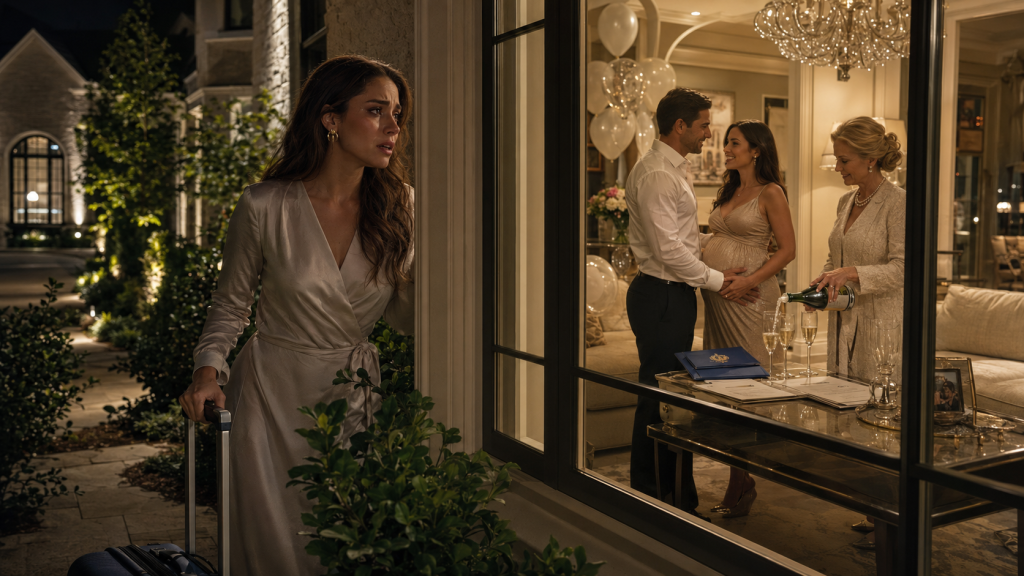
There were white balloons tied around the entrance.
White balloons.
At my house.
My stomach dropped.
I left the suitcase behind a hedge and moved through the side garden, past the broken security camera Andrew had promised to repair months ago.
I reached the living room window and looked inside.
The air left my lungs.
Andrew stood near the fireplace wearing a crisp white shirt and the smile he had not given me in months.
He was holding a pregnant woman.
Not casually.
Not politely.
Intimately.
His hand rested on her belly like it belonged there.
The woman was younger than me.
Dark hair.
Gold dress.
One hand curved possessively over her stomach.
Eleanor stood in front of them, pouring champagne.
Champagne.
For the pregnant woman, she poured sparkling water into a crystal flute and laughed as though this was a family celebration.
“She’s finally gone,” Eleanor said. “Now we can do things properly.”
The pregnant woman smiled.
“What if Valerie comes back early?”
Andrew laughed.
“She’s not coming back. We gave her enough money to disappear happily.”
My legs nearly gave out.
But the worst was not the woman.
Not even the baby.
It was the blue folder Eleanor pulled from a side table and placed in front of Andrew.
“Tomorrow,” she said, “the lawyer files these. With this, we prove abandonment of the marital home, emotional instability, and voluntary forfeiture of assets.”
Forfeiture.
I pressed a hand over my mouth.
I had signed nothing.
I owned half the company.
The house had been bought during our marriage, partly with money from my father’s inheritance.
My name was on accounts, insurance policies, investment agreements.
They could not simply erase me.
Unless they had created a version of me who had erased herself.
Andrew opened the folder.
I saw my signature.
My signature.
Not perfect, but close enough to fool someone who did not know how carefully I wrote the V in Valerie.
A document stating I voluntarily left the marital home.
Another stating I surrendered any claim to joint property.
Another authorizing Andrew to act on my behalf in company matters during my “extended absence.”
The pregnant woman leaned closer.
“And if someone asks where she is?”
Eleanor raised her glass.
“We’ll say she ran off to Europe with a lover. Nobody looks for a woman who chose to leave.”
Andrew kissed the woman’s forehead.
“In three weeks, this house belongs to our son.”
Our son.
My body went cold in a way that had nothing to do with fear anymore.
That child had not stolen anything from me.
But everyone in that room had built a future over my disappearance.
I backed away from the window, needing air.
That was when I heard the crunch of leaves behind me.
I turned quickly.
Rosa, our housekeeper, stood in the garden holding a black trash bag.
She was pale.
Shaking.
“Mrs. Valerie,” she whispered. “Don’t go in.”
My throat closed.
“Rosa?”
She glanced toward the living room window.
“Please. Not here.”
We moved behind the garden wall near the pool equipment.
Her hands trembled as she opened the bag.
Inside were shredded papers.
Not all shredded well.
Some had been torn in halves.
Others crumpled.
She had saved them.
At the top was a copy of a death certificate.
My name.
Valerie Whitmore.
Date of death: tomorrow.
My vision blurred.
Underneath it was a handwritten note from Andrew.
After the accident, no one must find the original file. Burn all drafts. Tell Marcus to confirm the report.
My mouth went dry.
“What accident?”
Rosa’s eyes filled with tears.
“The lake house,” she whispered. “I heard them talking two days ago. They said you would return from Europe early because you were unstable. They said there would be a boating accident. But tonight they said maybe they don’t need the lake if the papers go through.”
My knees weakened.
Rosa grabbed my arm.
“They were going to make you disappear one way or another.”
The world around me became sharp.
The smell of jasmine.
The music inside the house.
The reflection of white balloons in the pool.
My husband’s laughter.
My mother-in-law’s champagne.
The fake signature.
The fake death certificate.
The cash.
One hundred thousand dollars.
Not a gift.
Bait.
They wanted proof that I had accepted money and left.
Proof that I was unstable.
Proof that I had abandoned everything.
I took out my phone.
My hand shook only once.
Then I called the only person I still trusted.
Malcolm Reed.
My late father’s attorney.
He answered after two rings.
“Valerie?”
“Are you alone?” I whispered.
His voice changed immediately.
“Yes. Are you safe?”
“Not if I go inside.”
I told him everything in broken pieces.
The cash.
The airport.
The party.
The forged signatures.
The pregnant woman.
The death certificate.
Rosa’s warning.
Malcolm did not interrupt.
When I finished, he said, “Stay hidden. Do not confront them. I’m already moving.”
“Already?”
A pause.
“Your father asked me to watch carefully if Andrew ever became too interested in your assets.”
My breath caught.
“My father?”
“Your father did not trust easily,” Malcolm said. “And he never fully trusted your husband.”
For one second, grief hit me so hard I almost bent over.
My father had died three years earlier.
I had thought losing him meant losing the last person who knew how to protect me without making me feel weak.
But somehow, even gone, he had left a door unlocked for me.
“Malcolm,” I whispered, “they gave me cash.”
“Good,” he said. “Bring it. Every bill matters.”
“What does that mean?”
“It means the money is not theirs anymore.”
Twenty minutes later, the street filled with quiet headlights.
Not sirens.
Not flashing lights.
Quiet.
Precise.
Two police cars stopped at the curb.
A black SUV pulled behind them.
Malcolm stepped out in a dark suit, carrying a leather briefcase.
Beside him was a private investigator named Celeste Grant, whom I had met only once after my father’s funeral.
Rosa began crying when she saw them.
Malcolm walked straight to me.
He did not hug me.
He did something better.
He looked at my face and said, “We believe you.”
Those three words steadied the ground under my feet.
Celeste photographed the death certificate.
The note.
The cash envelope.
The shredded papers.
My phone recording from the window.
Rosa’s statement was taken in the garden.
Then Malcolm opened his briefcase and removed copies of real company documents.
Andrew had never known the full structure of my ownership.
He thought my shares were simple marital property.
They were not.
My father had placed a portion of my inheritance into a protected trust before Andrew and I married.
The house’s down payment had been traceable.
My company interest required biometric verification and a board witness for any transfer.
My signature alone was not enough.
Especially not on forged documents.
“Why didn’t I know all this?” I whispered.
“You were told,” Malcolm said gently. “Years ago. But grief and marriage make people trust the wrong hands sometimes.”
That was true.
Painful.
But true.
Then he said something that made my spine straighten.
“The cash Eleanor gave you was drawn from an account we’ve monitored for two months.”
I stared at him.
“Monitored?”
“You reported missing funds from the company in March. You thought it was a bookkeeping error.”
I remembered.
Andrew had told me I was overreacting.
Malcolm’s face hardened.
“It was not an error. The bills in that envelope are traceable.”
I looked toward the glowing living room.
“So she paid me with stolen money?”
“She tried to send you away with evidence.”
For the first time that night, I almost laughed.
Not because any of it was funny.
Because arrogance had made them careless.
When the officers entered the house, the music stopped first.
Then came voices.
Sharp.
Confused.
A glass breaking.
I stood behind Malcolm in the front hall as Andrew turned and saw me.
The color drained from his face.
“Valerie.”
The pregnant woman stepped back.
Eleanor did not.
She lifted her chin.
“What is this?”
I held up the copy of my death certificate.
“No, Eleanor. What is this?”
The room went silent.
The pregnant woman looked from me to Andrew.
“Death certificate?”
Andrew moved toward me.
“Val, listen. You don’t understand.”
An officer blocked him.
“Stay where you are.”
I looked at the woman.
“What’s your name?”
She swallowed.
“Camille.”
“How far along are you?”
“Seven months.”
Seven months.
So Andrew had been building this life while still sleeping beside me.
Camille’s hand moved protectively over her stomach.
“I didn’t know about a death certificate,” she whispered.
Eleanor snapped, “Don’t say another word.”
Camille flinched.
That told me everything.
She had known about me.
Known about the marriage.
Known enough to celebrate my disappearance.
But maybe not enough to understand the danger she had stepped into.
I turned back to Andrew.
“You forged my signature.”
“No.”
Malcolm handed a file to the detective.
“The originals are here. We also have security footage from the home office printer, timestamps, and the notary stamp used fraudulently.”
Eleanor’s face twitched.
Only once.
“You stole documents from my home,” she said.
I looked around the living room.
The white balloons.
The champagne.
The folder on my table.
“My home,” I replied.
Her smile disappeared.
Rosa stepped forward then.
Her voice shook, but she spoke.
“I saw Mrs. Eleanor put papers in the trash. I heard them talk about the lake house. I saved what I could.”
Andrew looked at her with hatred.
“You ungrateful—”
“Careful,” Malcolm said quietly. “Threatening a witness in front of police would be unwise.”
Andrew shut his mouth.
The officers collected the blue folder.
The forged documents.
The champagne glasses.
The trash bag.
The cash envelope.
Andrew kept insisting it was a misunderstanding.
Eleanor claimed the death certificate was “estate planning.”
That was the phrase she used.
Estate planning.
Even the detective looked disgusted.
Camille sat on the sofa, crying silently, while an officer took her statement.
At one point, she looked at Andrew and asked, “Were you really going to say she ran away?”
Andrew did not answer.
That silence did more to break her than any confession could have.
By midnight, Andrew and Eleanor were taken for questioning.
Not handcuffed in front of the neighbors.
Not yet.
They walked out stiff-backed, clinging to dignity like it could save them.
But the performance was over.
The pregnant woman left with her sister, who arrived shaking with anger and refused to look at Andrew.
Rosa stayed with me.
When the house emptied, the silence was enormous.
I stood in the living room beneath the white balloons meant to celebrate my erasure.
Then I began popping them one by one.
Not dramatically.
Not in rage.
Just methodically.
Each burst sounded like a small correction.
Rosa watched me, then picked up a pin and joined me.
By the time Malcolm returned from speaking with detectives, the floor was covered in white rubber scraps.
He looked around.
“I see you started cleanup.”
“I started breathing.”
He nodded.
“Good.”
The investigation moved fast.
Faster than I expected.
Andrew had been moving company money through shell vendor accounts.
Eleanor had coordinated with a notary she knew socially.
The forged documents had been prepared weeks before the Europe trip.
The death certificate draft led investigators to a man named Marcus Ellery, a former county clerk who had been paid to create fraudulent templates.
The “accident” note tied them to the lake house, where police found staged maintenance requests and messages about a boat I had never planned to use.
It was not one crime.
It was a ladder.
Fraud.
Conspiracy.
Forgery.
Financial theft.
And something darker hanging over all of it.
Andrew tried to speak to me through attorneys.
Then through friends.
Then through his pregnant mistress.
Camille wrote me a letter two weeks later.
I expected excuses.
Instead, she wrote:
I knew he was married. I believed him when he said you had abandoned him emotionally and only cared about money. I did not know they planned to hurt you. I am ashamed that I attended a celebration built on your disappearance. I will testify.
I read it twice.
Then I gave it to Malcolm.
“Do you believe her?” he asked.
“I believe she knows survival now.”
That was enough.
Eleanor never apologized.
She blamed Andrew.
Then Camille.
Then me.
She said I had always been cold.
She said I had driven her son into desperation.
She said the cash was generosity twisted by an ungrateful daughter-in-law.
But evidence does not care about tone.
And recordings do not care about pearls.
At the preliminary hearing, prosecutors played the audio from that night.
Eleanor’s voice filled the courtroom.
We’ll say she ran off to Europe with a lover. Nobody is going to look for a woman who chose to leave.
I watched her face as she heard herself.
She did not look ashamed.
She looked annoyed that the room had heard what was meant to stay private.
Andrew looked worse.
Paler.
Thinner.
When the recording reached his line—
In three weeks, this house will belong to our son—
Camille started crying in the back row.
I did not turn around.
I had no tears left for his other life.
Andrew took a plea after Marcus agreed to cooperate.
Eleanor fought longer.
She always believed the world would bend for composure.
It did not.
The house became mine fully after the financial investigation proved Andrew had used marital funds and company money to support the scheme.
I did not keep it.
Too many walls had listened to too many lies.
I sold it six months later.
Not because I was running.
Because I refused to live inside the stage they built for my disappearance.
Before the sale, I walked through every room alone.
The dining room where Eleanor gave me the envelope.
The bedroom where Andrew slept so peacefully the night before he tried to erase me.
The living room where white balloons floated over forged documents.
The garden where Rosa saved my life with a trash bag full of torn paper.
I stopped by the fireplace and cried for the woman I had been.
The woman who thought suspicion made her weak.
The woman who thought asking questions made her difficult.
The woman who almost got on that plane.
Then I locked the door behind me.
The money from the sale went into three places.
First, my protected accounts.
Second, a new apartment downtown with floor-to-ceiling windows and locks only I controlled.
Third, a legal fund for domestic financial abuse survivors, named after my father.
Rosa came with me.
Not as a housekeeper.
As the first employee of the foundation.
She became our intake coordinator because she knew better than anyone how danger hides in ordinary rooms.
“Sometimes,” she told me, “the person cleaning the house sees what the family hides.”
She was right.
The first woman we helped arrived with a grocery bag full of bank statements and a shaking voice.
Her husband had not hit her.
He had emptied her accounts, isolated her, and told everyone she was unstable.
She kept saying, “Maybe I’m overreacting.”
I took her hand and said, “No. You are noticing.”
Her eyes filled with tears.
I recognized that feeling.
The shock of being believed before you have to bleed.
A year after Eleanor handed me the envelope, I returned to Dallas/Fort Worth Airport.
Not because I was running.
Because I was finally taking the trip.
Paris.
Florence.
Madrid.
Places Eleanor had named like bait.
This time, I bought my own ticket.
Used my own card.
Told people where I was going.
Kept my phone on.
At Terminal D, I stood near the same doors where I had lied to Eleanor and promised not to come back early.
I looked out at the curb where her car had pulled away.
Then I smiled.
She had thought she was sending me out of my life.
Instead, she sent me back into it.
The flight took off at sunset.
For the first time in years, I looked down at the shrinking city and felt no fear of what waited below.
Andrew was no longer in my house.
Eleanor no longer had power over my silence.
The company was secure.
The foundation was open.
Rosa was safe.
And I was alive.
In Paris, I walked beside the Seine alone.
Not lonely.
Alone.
There is a difference.
I drank coffee without checking whether someone approved.
I bought a blue scarf because I liked it.
I slept in a hotel room with the door locked and no one expecting me to disappear.
On the last night, I opened the notes app on my phone and wrote one sentence:
The money was bait, but I became the trap.
Then I deleted it.
It sounded too much like revenge.
And what I had built was better than revenge.
Revenge looks backward.
Freedom walks forward.
When I came home, Malcolm picked me up from the airport.
He handed me a folder in the car.
“The final restitution order,” he said.
I opened it.
Andrew’s signature sat at the bottom.
Real this time.
Eleanor’s too.
For a moment, I stared at the names.
Then I closed the folder.
“Do you want to keep it?” Malcolm asked.
“Yes,” I said. “But not where I can see it.”
He smiled faintly.
“Your father would be proud.”
I looked out the window at the Dallas skyline.
“I wish he were here.”
“He left you well protected.”
I thought of the trust.
The company documents.
The monitoring.
The lawyer who answered on the second ring.
Then I thought of Rosa standing in the garden with shaking hands and a trash bag.
“He wasn’t the only one.”
Years have passed now.
The foundation has helped dozens of women recover money, documents, identification, property access, and, most importantly, belief in their own instincts.
I speak sometimes at private events.
People ask how I knew something was wrong.
I tell them the truth.
I did not know.
Not fully.
I only noticed that kindness felt like a locked door.
I noticed that my husband was too calm.
I noticed that Eleanor repeated “don’t come back early” one too many times.
I noticed that one hundred thousand dollars in cash was not generosity.
It was a signal.
A warning wrapped in an envelope.
Women are often taught to dismiss what they notice.
To be polite.
To accept explanations.
To feel guilty for suspicion.
But suspicion saved my life.
So did silence.
So did patience.
So did Rosa.
So did my father’s careful love.
I still have the envelope Eleanor gave me.
Empty now.
Evidence tag removed.
It sits in a locked file at the foundation office.
Sometimes, when a woman tells me she feels foolish for not seeing danger sooner, I show it to her.
“This was handed to me like a gift,” I say. “It was meant to make my disappearance look voluntary.”
Then I tell her the part that matters.
“You are not foolish because someone lied beautifully. You are wise because you started listening to the part of you that knew.”
My mother-in-law gave me one hundred thousand dollars and begged me to go to Europe alone.
My husband kissed another woman beneath white balloons and planned a future that required my absence.
They forged my name.
Drafted my death.
Bought champagne for my erasure.
But they made one mistake.
They assumed leaving meant disappearing.
They forgot that a woman can walk out one door and come back through another with the truth in her hand.
I did not vanish.
I returned.
And when I did, the celebration ended.
THE END! THANKS FOR READING!