
I left my family fourteen years ago.Three children.The youngest was two.I was twenty-three years old, broke, exhausted, and drinking every night just to make the noise in my head go quiet.People like to imagine that mothers leave in dramatic ways.Suitcases.Screaming.A slammed door.A final cruel sentence.But I left at 4:17 in the morning with one backpack, forty-two dollars, and a pair of shoes that still had baby cereal dried on the laces.….More article below👇
I did not kiss my children goodbye.That is the part I still cannot forgive myself for.My oldest, Lily, was five then. She slept curled around a stuffed rabbit with one missing eye.Ava was three, wrapped in a pink blanket, her thumb pressed against her mouth.Jonah was two, breathing softly in his crib, one little hand open like he was waiting for mine.
I stood in their bedroom doorway for almost fifteen minutes.
Then my mother’s voice came from behind me.
“Leave now,” she whispered, “or ruin them.”
I believed her.
At that age, I believed anyone who spoke with enough certainty.
I had already broken plates.
I had already forgotten school pickup once.
I had already passed out on the kitchen floor while Jonah cried beside me.
I had already seen the way my husband, Daniel, looked at me—not with hatred, but with fear.
Fear of what I was becoming.
Fear of what the children were learning to survive.
So I left.
I told myself it was sacrifice.
It was not.
It was cowardice wearing a nicer name.
For years, I moved from one cheap apartment to another.
I washed dishes.
I cleaned motel rooms.
I stocked shelves after midnight.
Sometimes I got better.
Sometimes I got worse.
When I could, I sent $150 a month to Daniel.
No notes.
No birthday cards.
No phone calls.
Just money orders with my name written small in the corner, as if making the letters smaller could make my absence smaller too.
I knew it was not enough.
Money cannot braid a daughter’s hair.
Money cannot teach a child to ride a bike.
Money cannot sit beside a feverish boy and whisper that monsters are not real.
But money was the only way I knew how to say, “I am alive, and I am ashamed.”
Daniel never sent it back.
That almost hurt more.
Fourteen years passed.
I got sober for real when I was thirty-one.
Not the kind of sober where you say the words and secretly keep a bottle behind the bathroom towels.
Real sober.
Meetings.
Apologies.
Shaking hands.
Nights spent staring at the ceiling while every memory I had buried climbed into bed beside me.
I made amends to old coworkers, landlords, a woman whose car I dented and never paid for.
But I never called my children.
Every time I tried, my fingers froze over the phone.
What could I say?
Hello, this is your mother, the one who disappeared?
Sorry I missed your childhood?
Sorry I chose silence because facing your pain scared me more than living with my own?
So I stayed away.
I told myself they were better without me.
Maybe that was true.
Maybe it was just another excuse.
Last week, someone knocked on my apartment door at 8:06 in the evening.
I remember the time because I had just made tea.
I do that now.
Tea instead of whiskey.
Chamomile instead of poison.
The knock came again, firm and controlled.
When I opened the door, my past was standing in the hallway.
She was nineteen.
Tall.
Dark-haired.
Her eyes were mine.
Not similar.
Mine.
The same stormy gray, the same tired shadows underneath.
For a second, I forgot how to breathe.
“Lily?” I whispered.
She did not hug me.
She did not cry.
She stood there with her arms at her sides, wearing a denim jacket and holding an envelope like it weighed more than paper.
“I drove six hours,” she said.
Her voice was calm.
Too calm.
That kind of calm only comes after years of being forced to grow up before your time.
“Can I come in?”
I stepped aside.
My apartment suddenly looked humiliating.
The thrift-store couch.
The chipped mug.
The single framed picture on the wall of a beach I had never visited.
Lily looked around once, then sat on the edge of the chair like she did not want to leave any part of herself behind.
I sat across from her.
Neither of us spoke for a while.
Finally, I said, “You look beautiful.”
Her mouth twitched, but not into a smile.
“Dad said you always started with something soft when you were scared.”
My eyes burned.
“How is he?”
That was when something changed in her face.
A crack.
Small, but real.
“He died two months ago.”
The room went silent.
Not quiet.
Silent.
As if every object in it had stopped existing.
Daniel was thirty-eight when I left.
Strong shoulders.
Gentle hands.
A laugh that filled the kitchen.
In my mind, he had stayed frozen there forever.
Young.
Alive.
Waiting somewhere I was too afraid to return to.
I gripped the edge of the coffee table.
“How?”
“Heart attack,” Lily said. “At work. His second job.”
Second job.
The words slid into me like a blade.
“He worked three jobs sometimes,” she continued. “During the bad years. He never said you were a monster. I wanted him to. Ava wanted him to. Jonah used to cry and ask when you were coming back, and Dad would just say, ‘Your mother is sick, but sickness is not the same as not loving.’”
I covered my mouth.
Lily watched me.
No comfort.
No cruelty.
Just watching.
“Ava learned to read without a mother,” she said. “She used to sit in the hallway outside my room and sound out words because Dad was always tired. Jonah still sets a plate for you at dinner. He’s sixteen now. He pretends it’s a joke, but it’s not.”
I bent forward like someone had punched me.
“I’m sorry,” I said.
The words were so small.
So useless.
Lily’s eyes flashed.
“Don’t say it like that.”
I looked up.
“Like what?”
“Like sorry is a blanket you can throw over fourteen years.”
I deserved that.
I nodded.
“You’re right.”
She reached into her jacket and pulled out the envelope.
It was old.
Yellowed at the edges.
My name was written across the front in Daniel’s handwriting.
My whole body recognized it before my mind did.
“Dad wrote this the night you left,” Lily said. “He told me to give it to you when I was ready.”
“When you were ready?”
She nodded.
“Not when you were ready. When I was.”
That broke something in me.
Because Daniel, even after everything, had still protected her choice.
I took the envelope with shaking hands.
For a moment, I could not open it.
I just held it.
Fourteen years of silence pressed between my fingers.
Finally, I tore the flap.
Inside was one folded page.
At the top, Daniel had written:
For the children, when they are old enough to ask the real question.
My breath caught.
The first line said:
“She didn’t leave because she stopped loving you. She left because I told her to.”
I closed my eyes.
“No,” I whispered.
Lily leaned forward.
“What does that mean?”
I shook my head, but the memories were already opening.
Daniel in the kitchen that last night.
Me crying against the sink.
My hands trembling.
The smell of whiskey on my breath.
His face pale with exhaustion.
“You need help,” he had said.
“I know.”
“No, you don’t. You keep saying you know, but tomorrow you’ll drink again.”
“I’m trying.”
“I can’t let the kids watch this anymore.”
I remembered him turning away.
I remembered my mother standing behind him, arms crossed, whispering that I was poison.
I remembered Daniel saying the words that had followed me into every lonely room since.
“Maybe the best thing you can do is go.”
At the time, I heard it as a sentence.
A final judgment.
But now I read his letter.
I kept going.
“I was angry when I said it,” Daniel had written. “I was tired, afraid, and too proud to admit I needed help too. I told her to leave because I wanted the drinking gone, and in that moment, I could not separate the sickness from the woman I loved. I thought she would go for a few days. I thought she would come back sober and sorry, and I could forgive her on my terms. But when she left, I let my pride become a wall. I did not chase her. I did not call. I told myself the children needed stability, but part of me wanted her to feel the emptiness she had left in us.”
My tears fell onto the paper.
The ink did not run.
Fourteen years old, and still stronger than I was.
“I failed her too,” he wrote. “That does not erase what she did. It does not excuse the birthdays missed, the empty chair, the questions I could not answer. But children, please know this: your mother loved you. She was sick. She was ashamed. And I was too hurt to build a bridge when I should have.”
I pressed the letter to my chest.
Lily’s voice was quieter when she asked, “Is it true?”
I looked at her.
Every lie I had ever told myself lined up behind my teeth.
I could have said I had no choice.
I could have blamed my mother.
I could have blamed Daniel.
I could have blamed poverty, youth, addiction, fear.
But Lily had driven six hours for the truth.
So I gave it to her.
“Yes,” I said. “He told me to go. But I chose not to come back.”
Her face tightened.
“I waited for you.”
“I know.”
“No, you don’t.” Her voice broke for the first time. “I waited by the window for two years. Every car that slowed down, I thought it was you. Every woman at school pickup with dark hair, I looked twice. Ava stopped asking first. Jonah never stopped. I hated you for that.”
“I hated me too.”
“That doesn’t help us.”
“No,” I said. “It doesn’t.”
She wiped her cheek angrily, as if the tear had betrayed her.
“Dad made excuses for you until the day he died.”
“He shouldn’t have.”
“He loved you.”
I looked down at the letter.
“I loved him too.”
“Then why didn’t you call?”
That was the question.
The real one.
The one I had dodged for fourteen years.
“Because I was a coward,” I said. “Because the first year I was drunk. The second year I was ashamed. After that, every day I waited made the next day harder. I told myself you hated me, and I used that as permission to stay gone.”
Lily stared at me.
I forced myself to keep speaking.
“I missed your birthdays. Your first dances. Your scraped knees. Your bad dreams. I missed Ava learning to read. I missed Jonah growing tall enough to look me in the eyes. There is no apology big enough for that. I won’t ask you to forgive me.”
Her shoulders lowered slightly.
“What are you asking for?”
I swallowed.
“One chance to stop running.”
She looked toward the window.
Outside, the city lights flickered against the glass.
For a long moment, I thought she would stand up and leave.
Maybe she had only come to deliver the letter.
Maybe that was all I deserved.
Then she reached into her pocket and placed a folded paper on the table.
An address.
“Our house,” she said. “Dad left it to all three of us. Ava is angry. Jonah is excited and pretending he isn’t. I told them I’d come here first.”
My hand hovered over the paper.
“Do they know?”
“They know I found you.”
“And?”
“Ava said not to bring you back unless you looked sorry.”
I let out a broken laugh through tears.
Lily did not smile, but her eyes softened.
“Do I?”
I nodded.
“Every second of every day.”
She stood.
I stood too, too fast, almost knocking over my tea.
At the door, she turned back.
“I’m not calling you Mom yet.”
“I understand.”
“And I’m not hugging you.”
“I understand that too.”
Her fingers closed around the doorknob.
“But Jonah is making spaghetti tomorrow night,” she said. “He said if you come, he’ll set the plate on purpose this time.”
My knees almost gave out.
“I’ll come.”
Lily studied me.
“Don’t say it unless you mean it.”
I thought of Daniel.
Of the letter.
Of three children growing up around an empty chair.
Of a little boy setting a plate for a ghost.
“I mean it,” I said.
The next evening, I drove six hours with Daniel’s letter on the passenger seat.
My hands shook the whole way.
I stopped twice because I thought I might turn around.
But each time, I heard Lily’s voice.
Don’t say it unless you mean it.
So I kept driving.
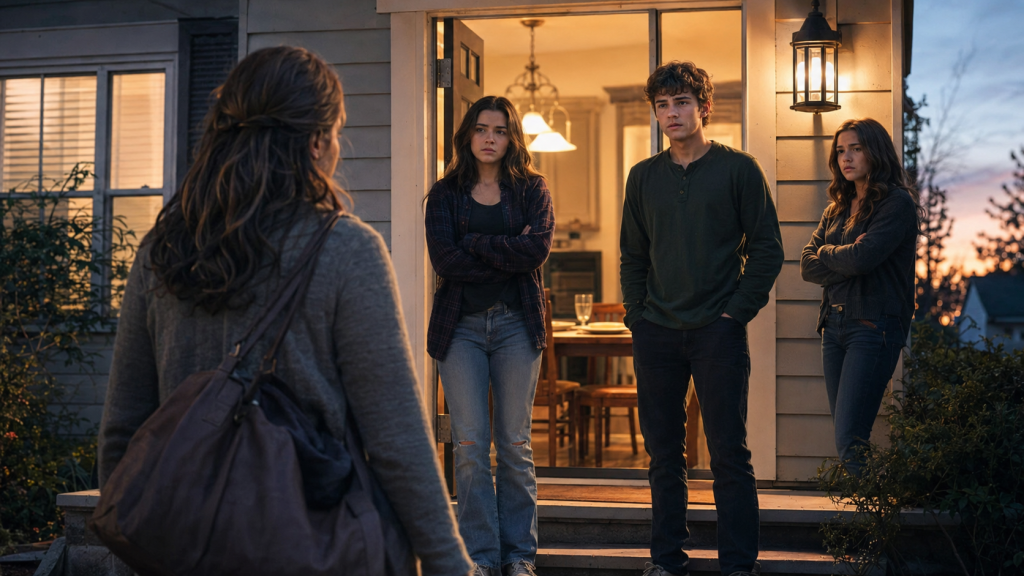
The house looked smaller than I remembered.
White siding.
Blue shutters.
A crack in the front step Daniel always promised to fix.
For a full minute, I sat in the car, unable to move.
Then the front door opened.
A boy stood there.
Tall.
Thin.
Sixteen.
Jonah.
He looked at me like he had seen a photograph come to life.
Behind him stood Ava, arms crossed, face hard, eyes red.
And beside her was Lily.
No one spoke.
Then Jonah stepped aside.
On the dining table, four plates were set.
And one extra.
At the empty chair.
I walked toward the porch with my heart breaking open.
I did not know whether I was coming home.
I did not know whether forgiveness would ever find me there.
But for the first time in fourteen years, I did not run.
I climbed the steps.
I looked at my children.
And with my voice shaking, I said the only true thing I had left.
“I’m here.”
Jonah’s face crumpled.
Ava turned away, crying silently.
Lily held the door open.
And somewhere inside that house, in the space Daniel had protected until his last breath, the empty chair waited for me.
Not as forgiveness.
Not yet.
But as a beginning.
THE END! THANKS FOR READING!🙏