
My son removed me from the family group chat, and when I asked him why, he said, “Mom, it was for working adults. You don’t understand what we talk about.”A week later, all twelve of them showed up at my farm with suitcases, meat, coolers, and that careless confidence people have when they believe an old woman will always forgive them.They thought I would once again leave the key under the flowerpot.
But that night, by the locked gate, a sign and a notebook were waiting for them.A notebook they never should have looked down on.It was not the moment my son removed me from the family chat that hurt me the most. It was the sentence that came after, said with that cold calm only children use when they stop seeing you as their mother and start seeing you as a burden.
“Mom, it was for working adults. You don’t understand what we talk about.”
I am seventy-six years old. I have been a widow for eleven years. And that sentence stayed stuck inside me like a thorn under my ribs, because they were not just leaving me out of a conversation.
They were slowly erasing me from my own family.
My name is Benita Álvarez.
For thirty-nine years, my husband José and I built our farm with hands that cracked in winter and burned in summer. We started with nothing but two stubborn hearts, three skinny chickens, and a piece of land everybody said was too dry to feed anyone.
But José always believed land listens to those who respect it.
So we respected it.
We planted lemon trees first, then orange trees, then rows of vegetables. We saved every coin from the market. We patched the roof ourselves. We carried stones. We dug the well. We painted the walls in the evenings with our children asleep inside, their little shoes lined up by the door.
That farm was not just land.
It was every sacrifice I had ever made.
But after José died, my children began treating the house differently.
At first, I told myself it was love. They came on weekends with their families. They brought meat for grilling, coolers full of drinks, loud music, and children who ran through the yard chasing the chickens.
I cooked.
I washed towels.
I made beds.
I packed leftovers for them when they left.
And because I missed being needed, I accepted everything.
Then the visits changed. They stopped asking if they could come. They simply announced it.
“Mom, we’ll be there Friday.”
“Mom, leave the key.”
“Mom, make sure there are clean sheets.”
“Mom, can you cook your rice pudding? The kids like it.”
No one asked if I was tired. No one asked if I had plans. No one asked if my knees hurt after standing at the stove all day.
Still, I smiled.
Because a mother can mistake being used for being loved when she is lonely enough.
The family group chat had started years earlier. José was still alive then, and we used it to share photos, birthdays, prayers, recipes, and little jokes. After he died, it became one of the few places where I still felt connected to everyone.
Then one Monday morning, I opened my phone and noticed the chat was gone.
At first, I thought I had pressed something wrong.
I asked my grandson to help me, but he avoided my eyes. Later that day, I called my eldest son, Carlos.
“Carlos,” I said carefully, “I think something happened to the family chat. I cannot see it anymore.”
There was a pause.
Then he sighed.
“Mom, I removed you.”
I sat very still.
“Why?”
“It was for working adults,” he said. “You don’t understand what we talk about.”
Working adults.
As if I had not worked since I was twelve years old.
As if I had not raised three children, buried a husband, managed a farm, dealt with buyers, paid taxes, hired workers, fixed water pumps, and kept every receipt José and I ever signed.
I did not argue.
I only said, “I see.”
But after I hung up, I sat at my kitchen table for a long time, staring at the empty space where my husband used to sit.
A week later, my daughter-in-law Laura sent me a private message.
“Benita, leave the keys where they always are. We’re coming Friday with the kids.”
No please.
No thank you.
No how are you.
That was how I found out they had planned an entire weekend at my farm without telling me.
Twelve people.
My two sons, my daughter, their spouses, and the grandchildren.
They had removed me from the family conversation, but they still expected access to my home.
That was the moment something inside me shifted.
Not loudly.
Not angrily.
Just enough.
I went to the farm a day early.
Juan, the caretaker, was repairing a fence near the lower field when I arrived. He had worked with José for twenty-two years, and after José died, he stayed because he said the farm still felt like home.
The moment he saw my face, he wiped his hands on his pants and came toward me.
“Doña Benita,” he said gently, “what happened?”
I wanted to say nothing.
Instead, my mouth trembled.
“They think I am furniture, Juan.”
He did not ask more. He simply made tea and left me alone in the living room.
That was when I saw it.
The brown leather notebook.
José had made it himself from scraps of old leather and thick paper. For years, we wrote everything in it. The cost of the well. The number of lemon trees planted. How much we earned at the market. Which year we repaired the roof. Which bank account held emergency savings.
There were also things my children had never cared enough to read.
Promises.
Plans.
Instructions.
Memories.
It was almost a will without being called one.
That afternoon, Carlos arrived first.
He came in without knocking.
He did not kiss my cheek. He did not ask how I felt. He looked around the kitchen and frowned.
“Mom, why are you here already?”
I looked at him quietly.
“This is my house, Carlos.”
He gave a tired smile, the kind a man gives when he thinks an old woman is being difficult.
“I know, Mom. I mean, we were going to come tomorrow. Laura told you, right?”
“No,” I said. “Laura ordered me.”
His face tightened.
“Don’t make everything dramatic.”
I stood beside the table, my hand resting on José’s notebook.
“You removed me from the family chat.”
Carlos rolled his eyes.
“It was so we wouldn’t bother you with adult things.”
Adult things.
There it was again.
My son, who had once cried into my apron because a rooster chased him across the yard, now stood in my kitchen explaining adulthood to me.
Then he noticed the notebook.
“What is that old thing?”
“Your father’s records.”
He picked it up, flipped through a few pages, and laughed without warmth.
“These things only collect dust, Mom.”
Then, as if it meant nothing, he tossed José’s notebook into the trash.
“You should clean up a little before everyone else gets here.”
For a moment, I heard nothing.
Not the wind.
Not the clock.
Not my own breathing.
I looked at the trash can.
I looked at my son.
And something inside me finally stopped begging to be loved properly.
I did not yell.
I did not slap him.
I did not cry in front of him.
I simply said, “You should go back to town tonight.”
He frowned.
“What?”
“The others can come tomorrow. But you should go.”
He laughed once.
“Mom, don’t be ridiculous.”
I walked to the door and opened it.
“Go, Carlos.”
Maybe it was my voice. Maybe it was the look on my face. Whatever he saw, it made him quiet. He muttered something under his breath, grabbed his keys, and left.
That night, I took the notebook from the trash.
I cleaned the cover with a damp cloth.
Then I went to my bedroom, moved the old rug, and lifted the loose floorboard José had installed decades ago.
Under it was a metal box.
Inside were the real documents.
The updated deed.
The savings records.
The agreement José and I had signed years ago after watching a neighbor lose her farm to greedy relatives.
The farm was in my name alone.
Every inch.
Every tree.
Every wall.
José had insisted on it before he got sick.
“Benita,” he had told me, “our children are good, but comfort can make good people forgetful. Protect yourself.”
At the time, I thought he was being too cautious.
Now I kissed the edge of the paper and whispered, “You knew.”
Then I called my lawyer.
By morning, the gate was locked with a new chain.
The key was no longer under the flowerpot.
The spare key in the shed was gone.
The side door was bolted.
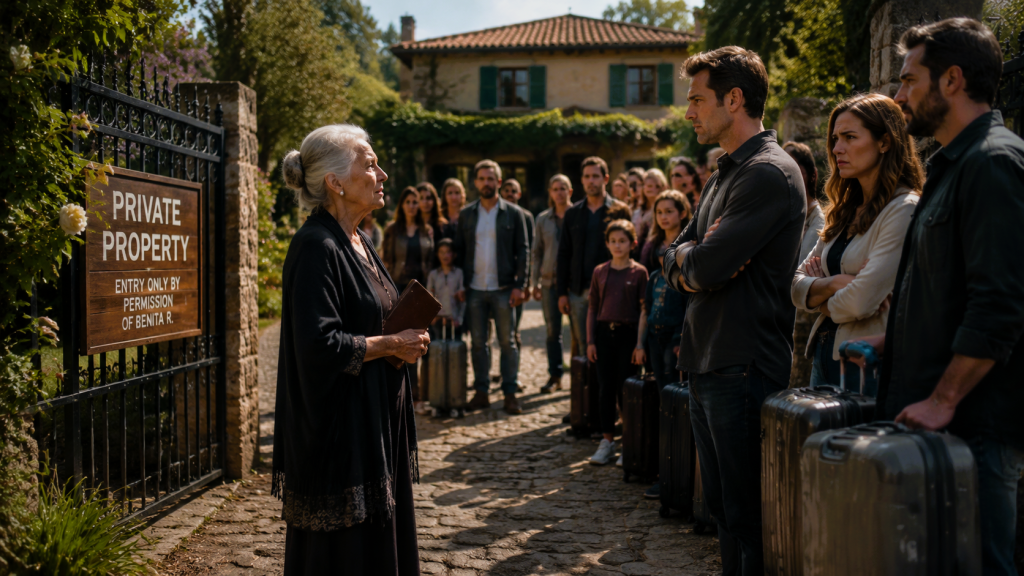
And beside the gate, Juan helped me hang a white sign.
It read:
“This farm is not a free hotel. This house belongs to the woman you removed from the family.”
Under the sign, on a small wooden stool, I placed José’s notebook wrapped in plastic.
Inside the front cover, I had written one sentence.
“Read before entering.”
They arrived around eleven.
I watched from behind Juan’s truck as the first car pulled up, then the second, then the third.
The children jumped out first, complaining about the heat. Laura got out wearing sunglasses and carrying a bag as if she were arriving at a resort. Diego, my younger son, opened the trunk and pulled out coolers. My daughter Mariana was laughing at something on her phone.
Then Carlos saw the locked gate.
He shook it.
“What is this?”
Laura walked to the flowerpot and lifted it.
Nothing.
She looked confused, then annoyed.
“Benita!” she shouted.
No one answered.
Carlos called my phone.
I let it ring.
Then Mariana noticed the sign.
At first, she read it quickly.
Then she read it again.
The smile left her face.
“What does it say?” Diego asked.
She did not answer.
Carlos marched over and ripped the plastic from the notebook.
“Oh, for heaven’s sake,” he muttered. “She’s being dramatic.”
He opened the notebook carelessly.
But slowly, his expression changed.
Because the first pages were not just numbers. They were proof.
José’s handwriting filled the paper.
“Benita sold her wedding bracelet today so we could buy seed.”
“Carlos had fever. Benita stayed awake two nights, then still went to market.”
“Paid second loan installment. No help from anyone.”
“Mariana’s school uniform bought with lemon money.”
“Diego cried because he wanted boots. Benita patched José’s old ones smaller.”
Page after page carried the history they had forgotten.
The farm did not rise from luck.
It rose from my body.
My hunger.
My savings.
My youth.
Then Carlos reached the final page.
I had placed a copy of the deed there.
Behind it was a letter José had written years before he died.
Carlos read it silently, but I knew the words by heart.
“My children, if you are reading this, remember this farm belongs to your mother. Not because I loved you less, but because she carried more than any of you saw. If you ever treat her like a servant in her own home, you do not deserve the shade of the trees she planted.”
Laura’s face went pale.
Diego took off his cap.
Mariana covered her mouth.
That was when I stepped out.
For the first time all morning, no one spoke.
I walked slowly to the gate, Juan beside me.
Carlos swallowed.
“Mom…”
I raised one hand.
“No.”
His mouth closed.
I looked at all of them, one by one.
“You removed me from the family because I did not understand adult things,” I said. “So today, I will explain one adult thing very clearly.”
I pointed to the gate.
“This is private property.”
Laura opened her mouth, but I turned to her.
“You planned to come here without asking me. You told me to leave keys as if I were hired help. You brought coolers and suitcases before you brought respect.”
Her cheeks reddened.
“I didn’t mean—”
“Yes,” I said softly. “You did.”
Then I looked at Carlos.
“And you threw your father’s notebook in the trash.”
His eyes dropped.
“I was upset.”
“No,” I said. “You were comfortable.”
That hurt him more. I could see it.
I continued.
“You may visit me as family. You may sit at my table if you knock first. You may eat in my kitchen if you help cook and help clean. Your children may run in my yard if they are taught not to break what others built. But you will never again enter this house as owners.”
The silence was heavy.
One of my granddaughters began to cry quietly. Not because she understood the deed, but because children feel shame before adults admit it.
Mariana stepped forward.
“Mamá, I didn’t know Carlos removed you from the chat.”
I looked at her.
“You did not ask where I was.”
Her face crumpled.
That was the truth none of them could escape.
They had all enjoyed the convenience of my absence.
Carlos gripped the notebook with both hands.
“What do you want us to do?”
I almost laughed.
Not because it was funny, but because for once, my son was asking instead of assuming.
“I want you to go home today.”
Laura gasped.
“But we drove two hours.”
“And I lived seventy-six years before learning to lock my own gate,” I said. “We all survive disappointment.”
Diego lowered his head, trying to hide a smile. Maybe he deserved scolding too, but at least he understood the sentence.
Carlos looked toward the children.
“Mom, please. The kids were excited.”
“So was I,” I said. “Every time I thought my family was coming to see me.”
That finished him.
His shoulders dropped.
For the first time in years, my son looked like the boy who used to run barefoot through the lemon trees.
“I’m sorry,” he whispered.
The words were small.
But they were real.
Still, apologies are not keys.
I nodded.
“I hear you.”
He waited.
I did not open the gate.
One by one, they returned the coolers to the cars. The children climbed back inside. Laura avoided my eyes. Mariana cried openly. Diego came to the gate and touched the metal bars.
“I’m sorry, Mamá,” he said.
“You can call me tomorrow,” I answered.
Carlos was the last to leave.
Before getting into his car, he looked back at the notebook in his hands.
“Can I keep this?”
“No,” I said.
He walked back and handed it through the gate.
“This stays with me.”
He nodded, ashamed.
They drove away slowly, dust rising behind them on the road.
When the last car disappeared, Juan unlocked the gate.
I walked back to the house carrying José’s notebook against my chest.
That evening, I cooked only for myself and Juan. We ate beans, rice, and fried plantains on the porch while the sun went down behind the lemon trees.
For the first time in years, the farm was quiet.
Not lonely.
Quiet.
There is a difference.
Two days later, my phone rang.
It was Carlos.
“Mom,” he said, voice rough, “I added you back to the family chat.”
I looked out at the trees José and I had planted.
“No,” I said.
He went silent.
“No?”
“No,” I repeated. “I do not want to be added back to a place where my presence depends on your permission.”
He breathed shakily.
“What do we do then?”
I smiled a little.
“You start a new chat. And this time, you ask me if I want to join.”
An hour later, my phone buzzed.
A new invitation appeared.
The group name was: “Family — With Mom.”
I stared at it for a long time.
Then I accepted.
The first message was from Carlos.
“Mom, would you allow us to visit next Sunday? We will bring food, cook together, clean before we leave, and come only if you want us there.”
Then Mariana wrote, “I’m sorry, Mamá. I forgot how much this place cost you.”
Diego wrote, “I’ll fix the back fence when I come.”
Laura wrote nothing for a while.
Then finally, she sent, “I was disrespectful. I am sorry, Benita.”
I did not answer immediately.
I let them wait.
Not to punish them.
To teach them that my silence was no longer empty.
It had value.
Finally, I typed, “Sunday is fine. Lunch at one. Knock when you arrive.”
The next Sunday, they came with flowers instead of suitcases.
They knocked.
Carlos repaired the shed door. Diego fixed the fence. Mariana washed dishes beside me without being asked. Laura set the table and looked embarrassed every time I reached for something heavy.
At lunch, my youngest grandson asked, “Grandma, why is the key not under the flowerpot anymore?”
Everyone froze.
I smiled and touched his cheek.
“Because some doors only open when people remember to ask.”
Carlos looked down at his plate.
Then he reached across the table and held my hand.
“Mom,” he said, “we forgot who built this family.”
I looked at my children, my grandchildren, the trees outside, and José’s notebook resting safely on the shelf.
“No,” I said gently. “You forgot who was still holding it together.”
And this time, no one argued.
Because at last, they understood.
Not because I shouted.
Not because I begged.
But because I locked the gate.
And finally made them stand outside long enough to see the woman they had left behind.
THE END! THANKS FOR READING!🙏🔥