
At 85 years old, my bicycle was stolen, and two days later, I saw it advertised online like it was just some piece of junk.I arranged a meeting under the pretense of being a buyer.The thief had no idea I had taught Taekwondo for forty years.He arrived at Lincoln Park smiling.He had my bike. My bike. The same one I used to ride to the bakery, the grocery store, the pharmacy, and the little coffee shop on Clark Street where the young waitress always saved me a corner table by the window…More article below👇
And he still had the nerve to say, “Morning, granny. Are you the one who wants to take a look at it?”Granny.It almost made me feel tender.Almost.I was sitting on a bench with oversized glasses, a gray shawl, and a cane I did not even need. I only brought it to look more harmless.More fragile.
More like the kind of old woman boys like him believed they could fool without consequences.But age only wrinkled my face.It did not weaken my character.
Two days earlier, my bicycle had been stolen right outside the farmers market. I had left it locked to the rack while I bought tomatoes, onions, bread, and a block of sharp cheddar cheese.
When I came out, it was gone.
Only the broken lock remained on the pavement.
For a long moment, I simply stood there, staring at the empty space.
People passed around me. Cars honked. Someone laughed nearby.
But all I could see was the spot where my husband’s last gift used to be.
It was not an expensive bicycle.
It was not new.
The front basket was loose, the seat was patched with black duct tape, and the little bell sounded slightly crooked, like it had a cold.
But it was mine.
My husband, Harold, gave it to me six months before he passed away.
He had been thin by then, his hands colder than they used to be, but his smile was still the same.
“So you never have to depend on anyone, Betty,” he told me, resting one hand on the handlebars.
I laughed at him then.
“I am eighty-one, Harold. Where exactly do you think I’m going?”
“Wherever you please,” he said.
That was Harold.
He believed love meant giving someone freedom, not holding them still.
After he died, I rode that bicycle almost every morning.
Sometimes I only went three blocks.
Sometimes I rode all the way down by the lake and let the wind hit my face until I could pretend I was young again.
So when I saw the online advertisement, I felt something hot and ugly rise inside my chest.
My granddaughter, Lily, was the one who found it.
She came into my kitchen with her phone in her hand and a strange look on her face.
“Grandma,” she said carefully, “isn’t this your bike?”
I wiped my hands on a dish towel and took the phone.
There it was.
Photographed against a graffiti-covered wall.
My basket.
My crooked bell.
My duct-taped seat.
And the tiny sticker of the Virgin Mary on the frame.
A ridiculous price sat above it.
“Used bike. Good condition. Must sell ASAP.”
ASAP.
Of course he needed to sell it quickly.
Thieves do not enjoy keeping evidence in their hands for long.
Lily wanted to call the police immediately, but I told her to wait.
“Grandma, no,” she said. “I know that look.”
“What look?”
“The look you get before someone regrets meeting you.”
I smiled.
“That is an old look, sweetheart.”
I messaged the seller from her account.
“Hello, young man. I’m interested in the bike. Can you show it to me tomorrow?”
He replied in under a minute.
“Yeah, boss. Cash only.”
Boss.
If he only knew.
That night, I barely slept.
Not because I was afraid.
At 85, fear becomes a smaller animal. You have already buried your parents, your husband, some friends, and parts of yourself you thought would never die. You learn that the world can take many things from you.
But it should never take your dignity.
By morning, I had made my plan.
I dressed like a defenseless old lady.
Beige cardigan.
Long skirt.
Comfortable shoes.
Oversized glasses.
Gray shawl.
And the cane.
Lily stood in the hallway watching me like I had lost my mind.
“Grandma, please just let the police handle it.”
“The police can handle him after I confirm it is mine.”
“You are eighty-five.”
“And he is stupid. We all have our burdens.”
She groaned. “This is not funny.”
“No,” I said, checking myself in the mirror. “It is not.”
Then my voice softened.
“That bicycle was your grandfather’s last gift to me.”
Lily stopped arguing.
She knew.
Before I left, she hugged me so tightly I had to pat her back twice.
“Do not get hurt,” she whispered.
I kissed her forehead.
“I taught Taekwondo for forty years, sweetheart. I taught girls how to scream from their stomachs. I taught boys how to respect the word no. I taught frightened mothers how to stand tall again.”
“That was years ago.”
“My knees are older,” I said. “My timing is not.”
The meeting place was Lincoln Park.
I arrived early and sat on a bench under a tree, looking harmless enough to be ignored.
That was always the mistake people made.
They saw white hair and thought empty hands.
They saw wrinkles and thought weakness.
They saw a cane and thought helpless.
The boy arrived ten minutes late.
He was pushing my bicycle beside him like he owned it.
He wore a black baseball cap, a fake gold chain, white sneakers, and the lazy smile of someone who had never been properly corrected.
“Morning, granny,” he said. “You the one asking about the bike?”
I looked up slowly.
“Oh yes, young man. That’s me.”
“It’s a good ride,” he said. “Just has a few cosmetic details.”
Cosmetic details.
The basket Harold had tightened with his own hands.
The bell Lily had bought me for Christmas.
The duct tape I had wrapped around the seat myself during the summer rain.
I stood up slowly and leaned heavily on the cane.
“Oh, my knees are not what they used to be,” I said. “Let me take a good look.”
He laughed.
“Sure. Check it out.”
I stepped closer.
My fingers touched the handlebar.
Memory can live in metal.
I knew the worn place where my palm always rested.
I knew the tiny scratch near the brake.
I flicked the bell.
It gave its sad, crooked ring.
Mine.
I swallowed the knot in my throat.
“And where did you get it?” I asked.
He shrugged.
“Belonged to my uncle.”
“Your uncle?”
“Yeah. He doesn’t use it anymore.”
“How interesting.”
My eyes lowered to the Virgin Mary sticker.
There was a tiny scratch through the blue robe. I had made that scratch myself while cleaning the frame with rubbing alcohol.
“How strange,” I said.
“What?”
“I said, how strange. Because I am the one who put that sticker there.”
His smile disappeared.
For the first time, he looked at me properly.
“What are you talking about?”
I straightened.
The old lady voice left me.
“I am saying that bicycle is mine.”
He reached for the handlebar and tried to pull it away.
I placed one hand on it.
Just one.
He pulled harder.
The bicycle did not move an inch.
His face changed.
Mine did not.
“Let go, lady.”
“No.”
“I’m telling you to let go.”
“And I am telling you that you were raised wrong, kid.”
People nearby began to look over.
A woman holding grocery bags stopped.
A man feeding pigeons paused with his hand in the air.
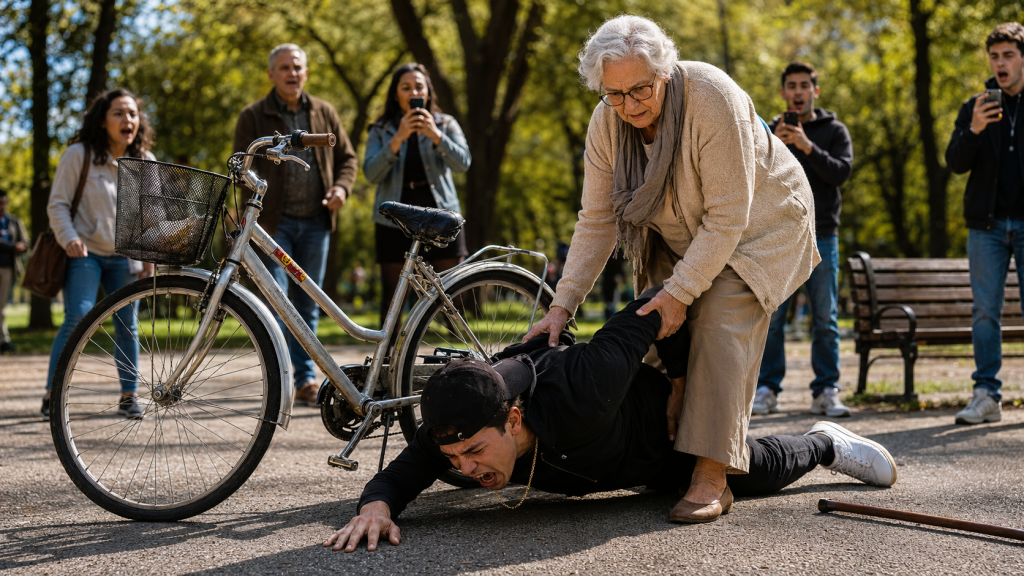
Two teenagers turned their phones toward us.
The boy lowered his voice.
“You don’t want trouble.”
I almost laughed.
At my age, people think trouble is something that arrives suddenly.
They do not understand that trouble has been sitting beside you for decades, drinking coffee, wearing different faces.
“I do not want trouble,” I said calmly. “I want my bicycle.”
He shoved me.
That was his mistake.
Not because he was strong.
Because he was careless.
My cane hit the ground with a dull thud.
Before he could react, I stepped forward.
Just one step.
The same step I had repeated thousands of times in front of students.
My left hand caught his wrist.
My right palm pressed against his shoulder.
I turned my hips, not with anger, but with memory.
His own strength betrayed him.
The boy stumbled forward, lost his balance, and landed flat on the grass beside my cane.
The crowd gasped.
One of the teenagers shouted, “Yo!”
I stood over him, breathing evenly.
“Taekwondo,” I said. “Fourth-degree black belt. Forty years teaching.”
His eyes went wide.
“You crazy old lady!”
I picked up my cane.
“No, sweetheart. Crazy is stealing from an old woman and calling her granny.”
He scrambled backward, his hands muddy.
“I found it!”
“You found it locked outside a farmers market?”
“I didn’t steal nothing!”
“Then you are also bad at lying.”
The man who had been feeding pigeons stepped closer and said, “Ma’am, I already called the police.”
“Thank you,” I said.
The boy tried to run.
He made it three steps before one of the teenagers blocked the path, and the woman with grocery bags shouted, “Don’t you dare touch her again!”
I did not touch him again either.
I did not need to.
He stood there trapped by eyes, phones, and his own foolishness.
When the officers arrived, he began talking fast.
He said a friend gave him the bike.
Then he said he found it.
Then he said he was only selling it for someone else.
Liars often carry too many stories and drop them all at once.
I showed the officers the online ad.
I showed them the broken lock Lily had photographed.
Then I showed them a picture of Harold and me beside that same bicycle, taken the day he gave it to me.
In the photo, Harold was smiling with one hand on the seat.
I was laughing, pretending I was too old for such a thing.
The younger officer looked at the photo, then at the bicycle, then at me.
“This is definitely yours, ma’am.”
“Yes,” I said quietly. “It is.”
The thief’s face turned pale when they put him in handcuffs.
Before they led him away, he looked back at me.
This time, he did not call me granny.
He said, “Ma’am, I’m sorry.”
I looked at him for a long second.
He was young.
Too young to already believe the world owed him things.
Too young to think stealing from the weak made him strong.
“Do not be sorry because you were caught,” I said. “Be sorry because one day you may grow old, and you will pray the world treats you better than you treated me.”
He lowered his head.
For the first time that morning, he looked like a child.
After the police left, the park became quiet again.
The woman with grocery bags touched my arm and said, “You were amazing.”
The teenagers asked if I really knew martial arts.
I smiled and said, “Enough.”
Then I placed my cane in the basket, swung one leg carefully over the bicycle, and sat down.
My knees complained.
My back complained.
But my heart did not.
I rang the crooked little bell once.
Its sad, off-pitch sound floated through the park.
And suddenly, I remembered Harold standing in our driveway, watching me ride in circles like a girl.
“Wherever you please, Betty,” he had said.
So I rode home slowly.
Past the trees.
Past the bakery.
Past the farmers market where the empty rack no longer felt like a wound.
When I reached my house, Lily burst through the front door.
“Grandma!”
She ran down the steps and stopped when she saw the bicycle.
Then she saw the cane in the basket.
Then she saw my face.
“You got it back.”
I nodded.
“I got it back.”
She hugged me, laughing and crying at the same time.
“You are unbelievable.”
“No,” I said, patting her cheek. “I am simply not finished yet.”
That evening, Lily posted the video online.
By morning, half the neighborhood had seen it.
People brought flowers.
The coffee shop gave me free muffins for a week.
Someone at the farmers market bought me a stronger lock.
And three mothers asked whether I still taught self-defense.
I told them I had retired.
Then I thought about Harold.
I thought about all the women who had once walked into my dojang afraid to lift their eyes.
I thought about Lily, and every girl who would someday be told she was too old, too small, too weak, too late.
So the next Saturday, I opened the old community room behind the church.
I put up a sign.
“Self-defense for women and seniors. First class free.”
Twenty-three people came.
Some were teenagers.
Some were mothers.
Some were grandmothers with soft hands and tired eyes.
I stood in front of them with my white hair pinned back, my old uniform tied around my waist, and my husband’s bicycle parked near the door.
I looked at every face in the room.
Then I said the first thing I had said to every student for forty years.
“Your body belongs to you. Your voice belongs to you. Your life belongs to you. And nobody gets to take what is yours without learning who you are.”
They stood straighter.
So did I.
At 85 years old, my bicycle was stolen.
But that thief gave me something back too.
He reminded me that I was not just an old woman sitting on a bench.
I was Betty.
Harold’s wife.
Lily’s grandmother.
A teacher.
A fighter.
And still, very much, a woman who could take back what belonged to her.
THE END! THANKS FOR READING!🥰