
My son came home from his mother’s house walking strangely, clenching his teeth, and unable to sit down.I didn’t call a lawyer.I didn’t argue with my ex.I called 911 before anyone could erase the evidence.Tommy was eight years old, and he arrived with his backpack hanging from one shoulder, his face pale, and his eyes swollen from crying in silence for far too long.His mother, Lauren, dropped him at the curb like she did every Sunday evening and didn’t even get out of the car.
She only rolled down the window and shouted, “He’s being dramatic. Just ignore him.”Then she drove away.I knew something was wrong before my son said a single word.Tommy didn’t run to me.He didn’t hug me tight like he always did.He just stood in the entryway, his legs trembling, his little hands gripping the straps of his backpack as if that was the only thing keeping him upright.
“Dad,” he whispered, “can I sleep standing up?”
The sentence hit me harder than any punch ever could.
I knelt in front of him.
“What happened, champ?”
Tommy looked down.
“Nothing.”
That word scared me more than a scream.
Because children say “nothing” when someone has taught them to be afraid.
Lauren and I had been divorced for two years. She had custody during the week, and I had Tommy on weekends. At first, I told myself he was just adjusting. Divorce was hard on kids. New routines were hard. Two homes were hard.
But every time Tommy came back from Lauren’s house, he seemed smaller.
First, he stopped singing in the car.
Then he started biting his nails until they bled.
Then he started asking me on Sunday nights, “Do I have to go back?”
I reported it.
I talked to his teacher.
I talked to the school counselor.
I talked to Lauren.
She always had an answer.
“You’re filling his head with fear.”
“He’s just sensitive.”
“You’re trying to turn him against me.”
And somehow, everyone believed her more.
Because Lauren dressed well.
Because Lauren smiled in court.
Because Lauren posted birthday cakes, school pictures, and perfect captions online.
Because Lauren knew how to look like a good mother in front of people who never saw what happened after the door closed.
But that evening, no smile could hide what I was seeing.
Tommy tried to sit on the sofa and let out a sound I will never forget.
“No, Dad,” he gasped. “Not there.”
His face went white.
His hands shook.
Sweat broke across his forehead.
I stood up slowly, grabbed my phone, and dialed 911.
The operator answered.
“What is your emergency?”
“My son just arrived from his mother’s house,” I said, my voice flat because if I let it shake, I knew I would break. “He can’t sit down. He is in severe pain. I need an ambulance and a police officer.”
Tommy’s eyes widened.
“No, Dad,” he cried. “Don’t call. Mom said if the police come, you’ll go to jail.”
That was when I understood.
The damage wasn’t only physical.
Someone had planted fear inside my son and watered it every day.
I dropped back to my knees and took his hands.
“Listen to me, Tommy. You did nothing wrong.”
His lips trembled.
“But Mom said—”
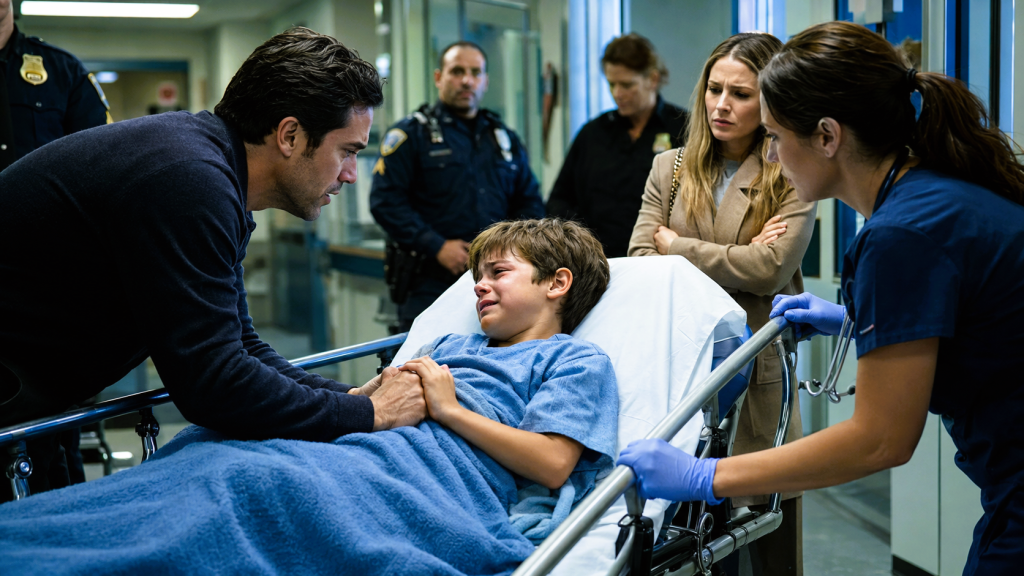
“I don’t care what Mom said. You are safe with me.”
For the first time, he cried out loud.
The ambulance arrived first. Then a police cruiser pulled up behind it.
Neighbors peeked through windows. A woman across the street stepped onto her porch. I didn’t care who watched. Let the whole world watch. My son needed help.
The EMT came inside, looked at Tommy, and her expression changed instantly.
“Who brought him here in this condition?”
“His mother dropped him off fifteen minutes ago.”
“She left?”
“Yes.”
The EMT exchanged a look with her partner.
“We’re taking him to the hospital now.”
Tommy clung to my neck when they tried to put him on the stretcher.
“Dad, don’t leave me.”
“I’m not leaving you,” I said. “Not now. Not ever.”
At the hospital, everything moved fast.
A nurse took Tommy back. A doctor came in. A social worker introduced herself. A police officer asked me when he had arrived, what Lauren had said, what I had noticed.
I answered every question.
But when they asked to examine Tommy, the social worker stopped me at the door.
“I need to go with him,” I said.
“I understand,” she replied gently. “But we have to follow protocol.”
“I’m his father.”
“That’s exactly why we need to protect him properly.”
Protect him properly.
The words landed in my chest like a stone.
What had I been doing all those months?
Waiting for court dates?
Saving messages?
Trying to be calm?
Trying not to look bitter?
My son had been asking for help in every way a child could ask without using the exact words.
And I had been hoping the system would catch up before something worse happened.
Twenty minutes later, Lauren stormed into the ER.
Her hair was perfect. Her handbag was expensive. Her jacket was one I had bought her years ago, back when I still believed love could fix everything.
“What did you do, Andrew?” she snapped. “Did you call the police over a tantrum?”
I didn’t answer.
She tried to push past the nurse.
“I’m his mother. I want to see my son.”
The nurse stepped in front of her.
“You cannot go in right now.”
Lauren’s face hardened.
“Excuse me?”
“For that very reason, ma’am. Please wait here.”
It was the first time I had ever seen Lauren lose control in public.
“My son fell in the bathroom,” she said quickly. “I was going to explain it.”
The police officer looked up.
“You said he fell?”
“Yes. He slipped. Children slip.”
Before anyone could respond, the doctor came out.
His face was calm, but his eyes were not.
“Mr. Carter, we need to speak with you privately.”
Lauren stepped forward.
“No. You speak to me. I’m his mother.”
The doctor looked at the officer.
“Not right now.”
That was when Lauren started talking too fast.
She said Tommy was dramatic.
She said he lied.
She said I had coached him.
She said I had always wanted full custody and this was my trick.
Then the social worker appeared holding a sealed plastic bag with Tommy’s clothes inside.
Evidence.
Lauren saw it and went silent.
From behind the curtain, Tommy’s tiny voice called, “Dad?”
I rushed in.
He was lying on his side, gripping the blanket with both hands.
His face was wet with tears.
“It wasn’t the bathroom,” he whispered.
My knees nearly gave out.
“What happened, son?”
He looked at the door first, like he expected someone to burst in and punish him for speaking.
“Mom said I had to learn not to tell.”
The room went still.
“Who hurt you?” the officer asked gently.
Tommy closed his eyes.
“Her boyfriend.”
Lauren screamed from the hallway.
“He’s lying!”
But this time, no one moved toward her.
Everyone moved toward Tommy.
The next hours blurred together.
Doctors.
Questions.
Photos.
Forms.
Statements.
A child advocate came in with a soft voice and a stuffed bear.
Tommy held that bear like it was a lifeline.
Lauren’s boyfriend, Darren, was picked up that night.
Lauren was questioned.
I was told not to confront anyone, not to post anything, not to call her family, not to give them any warning.
So I sat beside my son’s hospital bed and held his hand while the truth finally came out piece by piece.
Darren had been living at Lauren’s house for months, though she had never told the court.
He drank.
He yelled.
He punished Tommy for “talking back.”
Lauren saw more than she admitted.
Maybe she didn’t do the worst of it herself.
But she allowed it.
She covered it.
She sent my son back to me in pain and told him I would be arrested if he spoke.
The next morning, an emergency custody hearing was scheduled.
I showed up in the same clothes I had worn the night before.
Lauren showed up with her lawyer, crying perfectly.
She told the judge I was unstable.
She said I had always been jealous.
She said Tommy was confused.
Then the prosecutor submitted the hospital report.
The courtroom changed.
Lauren stopped crying.
Her lawyer stopped interrupting.
The judge read silently for a long time.
Then he looked up.
“Pending investigation, the mother’s visitation is suspended immediately. Full temporary custody is granted to the father.”
I closed my eyes.
Not because I was relieved.
Because I was furious it had taken this much pain for people to listen.
Tommy came home with me two days later.
He moved slowly.
He slept with the hallway light on.
For weeks, he woke up crying.
Sometimes he asked if police were going to take me away.
Sometimes he apologized for making trouble.
Every time, I told him the same thing.
“You did not make trouble. You told the truth.”
Healing was not quick.
Movies make justice look like one courtroom scene and one hug.
Real healing is different.
It is a child refusing to sit at the dinner table unless his back is against the wall.
It is a little boy flinching when someone raises their voice on TV.
It is finding small socks hidden under the bed because he packed them “in case he had to run.”
It is therapy twice a week.
It is patience.
It is learning not to ask too many questions at once.
It is celebrating the first time he laughs without looking guilty.
Three months later, Lauren tried to call me from an unknown number.
I didn’t answer.
She left a voicemail.
“Andrew, please. I didn’t know it was that bad.”
I listened once.
Then I saved it for my lawyer.
Because “I didn’t know it was that bad” is not innocence.
It is a confession that she knew something.
Darren eventually took a plea.
Lauren lost custody.
Her family tried to blame me at first. They said I had destroyed her life.
I told them the truth.
“No. She destroyed Tommy’s safety. I just stopped pretending.”
After that, most of them disappeared.
Good.
Tommy didn’t need people around him who cared more about family image than a child’s pain.
A year passed.
Slowly, my son came back to himself.
He started singing in the car again.
Quietly at first.
Then louder.
One Friday afternoon, I picked him up from school and found him running toward me with his backpack bouncing behind him.
For a second, I couldn’t breathe.
Because it was the old Tommy.
My Tommy.
He jumped into my arms and nearly knocked me backward.
“Dad! Guess what? I got picked for the science fair!”
I held him so tight he laughed.
“Dad, I can’t breathe.”
I let go, smiling through tears.
That night, he sat on the sofa beside me.
Not standing.
Not shaking.
Sitting.
He leaned his head against my shoulder and whispered, “I like our house.”
I kissed the top of his head.
“Our house likes you too.”
He was quiet for a while.
Then he said, “Dad?”
“Yeah, champ?”
“Thank you for calling 911.”
I looked down at him.
His eyes were steady now.
Still carrying shadows, yes.
But not trapped in them.
I swallowed hard.
“I should have done more sooner.”
He shook his head.
“You came when I needed you.”
That broke me.
Not loudly.
Not dramatically.
Just quietly, in the dark living room, with my son safe beside me.
People ask me sometimes how I knew.
The answer is simple.
I paid attention.
Not to Lauren’s smile.
Not to her excuses.
Not to the perfect pictures she posted online.
I paid attention to my child.
To the way he walked.
To the way he stopped singing.
To the way he said “nothing” like it was a locked door.
And when the truth finally stood in my entryway, pale and trembling, I stopped trying to be polite.
I stopped trying to look reasonable.
I stopped trying to win an argument.
I called for help.
Because sometimes the bravest thing a parent can do is refuse to handle something quietly.
Sometimes saving your child means making noise loud enough that no one can ignore it anymore.
And if I had to do it again, I would make that call even faster.
Because evidence can disappear.
Stories can be twisted.
Adults can lie.
But a child’s pain tells the truth.
And that night, I finally listened.
THE END! THANKS FOR READING!