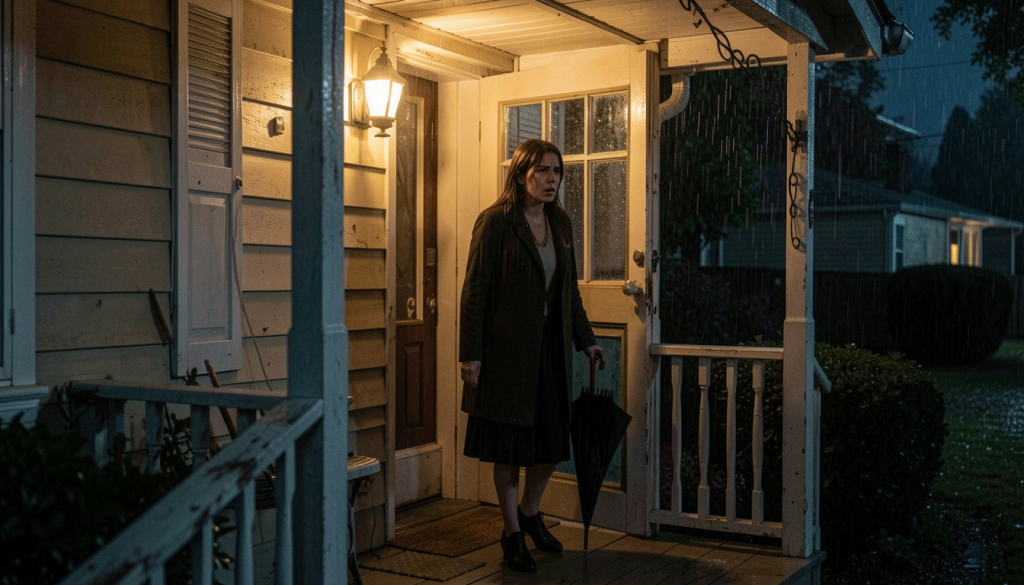
That is the detail I keep returning to -Not the photos on my phone. Not the gardenia perfume clinging to his collar. Not even the way his face turned the color of cold ash when he looked at the screen.I keep returning to the pot roast.
I had peeled the carrots by hand. I had browned the meat in the good pan, the heavy one we bought together at a Saturday market in Lyon on our honeymoon, back when we still believed love was something solid enough to hold.
Before Mia was born. Before Karen’s kitchen sink mysteriously needed fixing every Friday for three years.
I set the table that night.I folded the napkins.I lit the candle in the center, not because we needed light, but because candles used to mean something in our house. Once, they meant romance. Effort. Hope. I suppose some foolish part of me wanted to remember what that felt like before everything collapsed.
Marcus walked in at ten past ten.
I heard his key turn in the lock the way you hear something you have been bracing for all evening — a sound that releases the breath you did not know you were holding.
He stepped into the kitchen still wearing his jacket. His hair was slightly messed up. And Karen was in the room with him as surely as if she had walked in beside him.
That scent.
Gardenia and white musk.
Karen had worn it since college. I used to steal sprays of it from her dresser when we were teenagers, back when I still believed borrowing from your sister was harmless. Back before I understood some things, once taken, could never truly be returned.
Marcus saw me sitting at the table.
I did not shout. I did not cry. I did not ask where he had been.
I simply picked up my phone, unlocked it, and slid it across the wood toward him like a card in a game I already knew I had won.
He looked down.
His hand froze on the edge of the table.
He stared at the first photo. Then the second. Then the third.
With each image, his jaw tightened.
But it was not guilt I saw. I knew guilt. I had worn it myself. This was something more complicated. Something heavier. Something that looked almost like grief.
At last, he set the phone down.
Then he said, “Before you leave me, you need to know something.”
I stared at him.
“Karen came to me,” he said. “Three years ago. She found out something about you. Something she said you could never—”
“Stop.”
The word came out quieter than I expected.
“Claire—”
“Whatever she told you,” I said, my voice shaking now, “whatever she has been holding over your head, whatever arrangement the two of you have been conducting in her kitchen for the past three years — I want you to understand something. Nothing justifies what I saw through that window. Nothing.”
He pulled out the chair across from me and sat down like a man suddenly much older than forty-four.
He did not look at the food.
He placed both hands flat on the table, and for one unbearable second, I noticed how familiar those hands were to me. Hands that had fixed leaky faucets, tied Mia’s shoelaces, carried grocery bags, touched my face in the dark.
It was a terrible thing, realizing you still recognized the hands that had betrayed you.
“She didn’t tell me to sleep with her,” he said quietly. “That wasn’t what she wanted.”
I stared at him.
“She came to me in November,” he continued. “Three years ago November.”
My stomach tightened.
“You remember that month,” he said. “You remember what happened.”
Of course I remembered.
November three years ago was a month I had buried so deep under routines and school pickups and grocery lists that I had almost convinced myself it belonged to another woman.
The miscarriage.
Our second.
The one we told no one about. Not even Karen. Especially not Karen.
I had not been ready to be comforted by anyone who knew me too well.
“She found out,” Marcus said. “Not from me. She said she spoke to Dr. Heller’s receptionist. I don’t know how. I don’t know what was said. But she came to me and told me she knew about the pregnancy.”
The candle flickered between us.
“And about the other thing,” he added.
The room changed.
“What other thing?” I asked carefully.
Marcus looked at me for a long time.
“The DNA test,” he said. “The one you did in October. The one where you found out Mia—”
“Don’t.”
The word broke out of me like glass.
“Marcus, don’t.”
“She knew, Claire.”
I gripped the edge of the table.
“I don’t know how,” he said. “But she knew. She told me she would tell Mia herself if I didn’t do what she wanted.”
I stood up too fast. The chair scraped against the floor.
I walked to the window over the sink and stared out at the dark backyard, at the oak tree we had planted when Mia turned five.
Mia.
Our Mia.
The girl who had Marcus’s laugh.
Or at least I had always thought she did.
Three years ago, a DNA test had told me otherwise. For three years, I had lived with that secret lodged inside me like a stone. I had told myself the test was wrong. That labs made mistakes. That some truths were kinder when left untouched.
“She was going to tell her,” I whispered.
It was not a question.
Marcus nodded.
“She said if I stopped coming, she would tell Mia everything.”
I turned around slowly.
My husband sat at our table in the low candlelight, surrounded by the wreckage of three years, and for the first time I understood the shape of what Karen had done.
It had not been seduction.
It had been a hostage situation.
A slow, careful extraction of payment for a crime she had appointed herself to punish.
“She knew about Thomas,” I said.
Marcus nodded again.
Thomas.
A name I had not spoken in nine years.
A three-day mistake at the end of a lonely winter. A weekend I had folded away in shame before Mia was born. Before Marcus became the man who raised her, the man who walked the floor with her at two in the morning, the man who taught her to ride a bike, then drive a car, then believe she was loved.
“Why didn’t you tell me?” I asked. “Why didn’t you come to me and say Karen knew? Why didn’t you tell me she was threatening us?”
He looked down.
“Because I thought you would think I was lying to excuse myself,” he said. “I thought you would look at me exactly the way you are looking at me now, and I wouldn’t be able to explain it before I lost you.”
“So instead,” I said, “you let it continue for three years.”
His silence answered before he did.
“I didn’t know how to stop it without—”
“Without me finding out what you were doing?” I asked. “Or without Mia finding out the truth?”
The silence that followed was louder than any shouting could have been.
I sat down again.
The pot roast sat between us, cold now. The wine had been opened and abandoned. The folded napkins waited beside untouched plates. All the ordinary props of a marriage were still there, but the marriage itself had shifted into something I no longer recognized.
That is the part no one tells you about betrayal.
Not the discovery.
The inventory.
The sitting afterward and counting what is still real.
Mia was real.
Whatever a test said, whatever Karen thought she knew, Mia was ours in every way that mattered. She was the child Marcus had raised from her first breath. The child whose nightmares he had chased away. The child whose homework he had helped with for hundreds of evenings.
Biology was one kind of fact.
Sixteen years of fatherhood was another.
And that one was harder to argue with.
Karen was my sister.
Had been my sister.
I thought of her face, so much like mine that strangers used to ask if we were twins. I searched my memory for some wound I had given her without realizing. Some resentment I had ignored. Some moment when envy had taken root while I was too busy surviving my own life to notice.
The worst part was that I could almost understand it.
Loneliness makes people into versions of themselves they would not recognize in daylight.
I had been lonely too once.
Lonely enough to make a choice that had echoed nine years into this kitchen, this table, this ruined Friday night.
“Does Mia know?” I asked.
“No.”
“Are you sure?”
“I’m sure.”
I looked at Marcus’s hands again.
A marriage, I realized, was not truly an act of knowing someone completely. No one ever knows another person completely. A marriage was an act of choosing. Again and again. Daily. Hourly. Sometimes in the tiny invisible decisions no one applauds.
“You should have told me,” I said.
“I know.”
“What Karen did to you was wrong,” I said. “What she made you do was cruel. But I will not pretend it erases what I saw today.”
“I know.”
“It changes the shape of it,” I said. “But it does not make it disappear.”
The candle had burned low. Outside, a car passed slowly down the street, and its headlights moved across the ceiling like something searching for a way in.
“I’m going to call Karen tomorrow,” I said.
Marcus looked up.
“Not to forgive her,” I continued. “Maybe not ever. But I need to look her in the face. I need to hear her say out loud what she thought she was doing.”
He swallowed.
“And us?” he asked.
His voice was small.
I picked up my phone and looked at the photos again. Six images taken through a kitchen window. Six pieces of proof I wished I had never needed.
Then I deleted them.
One by one.
Not because they had not happened.
Because I already knew what I had seen.
I did not need to keep seeing it.
Grief is not the same as evidence. You do not have to preserve the wound to prove it was real.
“I don’t know yet,” I said honestly. “I need time.”
Marcus nodded.
He did not beg. He did not argue. He did not reach for me.
He simply nodded, and maybe that was the most honest thing he had done all night. He understood there were thresholds a person could not charm their way back across. Some doors did not open for explanations. Some doors required patience, silence, and the possibility that they might never open again.
I went upstairs.
I stopped outside Mia’s bedroom and listened to her breathing in the dark.
Slow.
Even.
Peaceful.
The sound of a girl who did not yet know the truth everyone around her had been bleeding to protect.
Not tonight, I thought.
Maybe not ever.
Not if we were careful enough.
Not if, for once, we were honest enough with each other.
I went into our bedroom.
I did not lock the door.
I lay down on my side of the bed and stared at the ceiling.
I thought about Lyon.
About the good pan.
About the Saturday market and the man beside me when I bought it. I thought about how young we had been, how certain, how convinced we were that choosing something durable meant it would never break.
Then I thought about Karen, alone in her house, wearing our mother’s perfume, building a trap out of loneliness and my secrets.
I thought about all the things people do to the ones they love because they cannot bear to look at themselves.
And then I closed my eyes.
Not because I was ready to forgive.
Not because I knew what came next.
But because the night had finally taken everything it could from me.
And all that remained was morning.